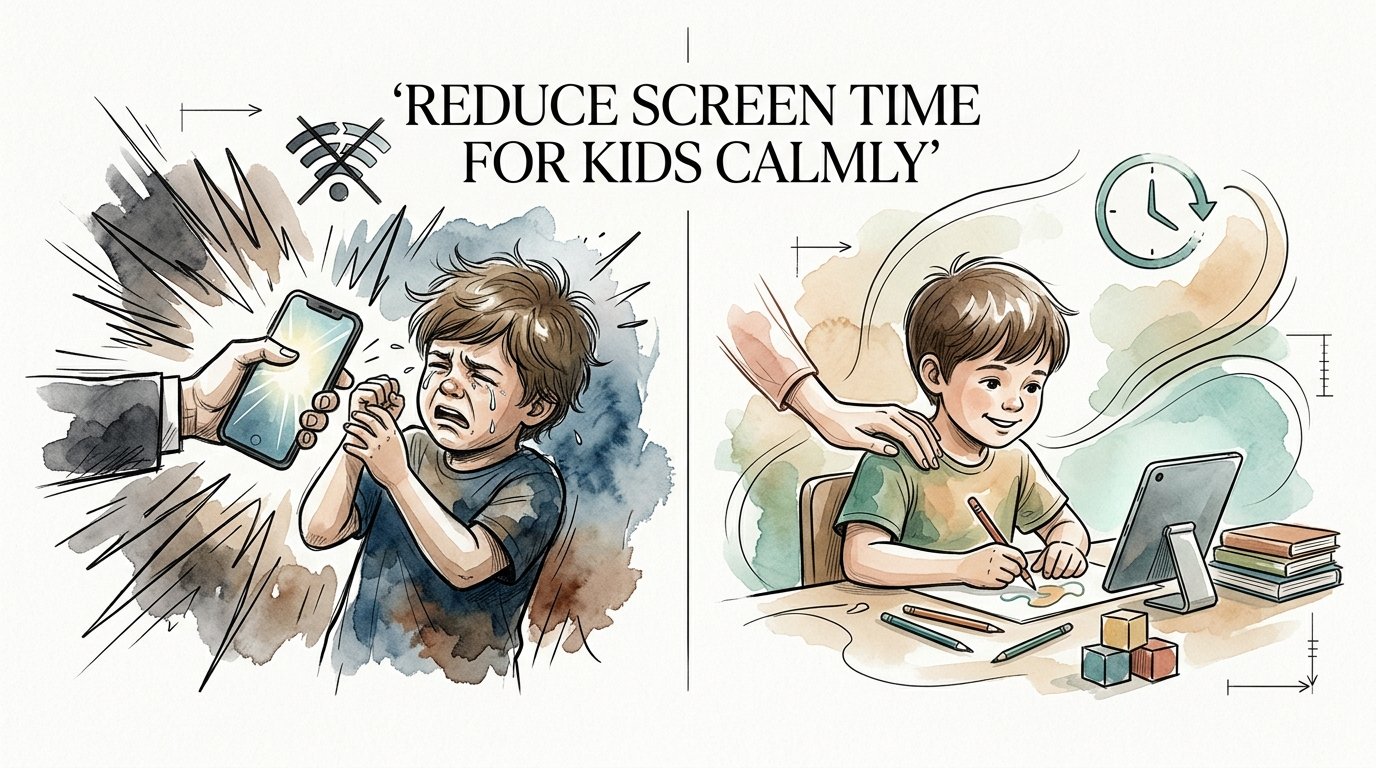
reduce screen time for kids calmly
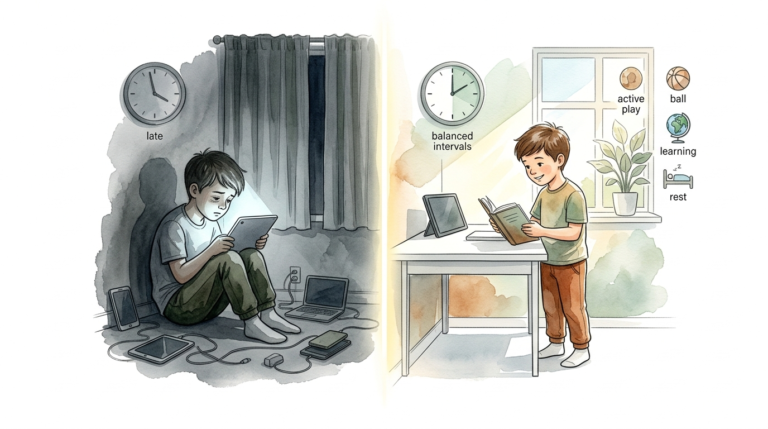
The secret to no tantrums isn’t ‘less tech’—it’s better transitions. Abruptly ending a dopamine loop causes a neurological ‘crash.’ Use these precision transition techniques to lower screen time while keeping the peace.
Most parents believe the battle is about the device itself. They think if they could just find the right “limit,” the screaming would stop. But the reality is that your child’s brain is locked in a chemical cycle that doesn’t care about your rules.
When a child is gaming or scrolling, their brain is flooded with dopamine, the neurotransmitter responsible for reward and motivation. Ending that session abruptly is like pulling a rug out from under their emotional stability. You aren’t just taking away a tablet; you are forcing a physiological withdrawal.
To reduce screen time for kids calmly, you have to stop thinking like a warden and start thinking like a navigator. This guide will show you how to build “dopamine bridges” that allow their nervous system to downshift without the typical explosion.
reduce screen time for kids calmly
Reducing screen time calmly is the process of managing a child’s neurological state during the transition from high-stimulation digital environments to lower-stimulation real-world activities. It focuses on the “how” of ending a session rather than just the “how much” of the time spent.
In the real world, this is used to prevent “tech tantrums”—those intense outbursts of anger or despair that happen when a device is turned off. These meltdowns are often a result of a sharp drop in dopamine levels, leaving the brain in a state of temporary withdrawal. Unlike serotonin, which supports long-term well-being, dopamine provides short-term reward spikes that are highly addictive for developing brains.
Think of it like an airplane landing. A pilot doesn’t just stop the engine mid-flight; they gradually decrease altitude and speed until the wheels touch the tarmac. Precision transitions provide that runway, allowing the prefrontal cortex—the part of the brain responsible for impulse control—to catch up with the emotional surge of the amygdala.
The Precision Transition Protocol: How to Do It
Success depends on moving from a reactive “stop now” approach to a proactive “bridge” system. Follow these steps to implement a precision transition in your home.
Step 1: The Predictive Warning
Give your child a “heads-up” that is based on their activity, not just the clock. For a gamer, say “one more match” or “ten more minutes.” For a toddler watching a show, say “after this episode.” This allows them to find a logical stopping point in their digital narrative.
Step 2: The Co-Viewing Connection
Sit down with your child for the final two minutes of their screen time. Ask them what they are doing or watch the video with them. This “enters their world” and builds a bridge of connection, making the transition feel less like an attack and more like a shared move to the next activity.
Step 3: The Dopamine Bridge
Offer a “bridge activity” that provides a physical or sensory transition. This could be a high-energy movement like ten jumping jacks or a sensory task like helping stir a pot of soup. These activities help the brain recalibrate from the high-intensity screen stimulus to the slower pace of real life.
Step 4: The Physical Handoff
Instead of snatching the device, ask your child to hand it to you or place it in a designated “charging home.” This gives them a sense of autonomy and agency over the ending of the session, reducing the feeling of being controlled.
Benefits of the Precision Transition Approach
Switching to precision transitions offers measurable improvements in both child behavior and parent-child relationships. The primary benefit is the significant reduction in emotional volatility during daily routines.
- Improved Self-Regulation: Children learn to recognize the “drop” in their own energy and develop the skills to handle it without external intervention.
- Increased Trust: When transitions are predictable and respectful, children feel less defensive and more willing to cooperate with family boundaries.
- Better Executive Function: By practicing these structured shifts, children strengthen their prefrontal cortex, which aids in long-term focus and impulse control.
- Reduced Parental Stress: Eliminating the “yelling match” at the end of every tablet session preserves your energy for more positive interactions.
Over time, this approach creates a household culture where technology is a tool for enjoyment rather than a source of constant friction. You are teaching digital literacy—the ability to move in and out of digital spaces with control.
Challenges and Common Mistakes
The most frequent error is the “Standard Confiscation” trap. This happens when a parent, frustrated by a child’s lack of response, simply grabs the device. This almost always triggers an immediate “neurological crash” and an aggressive emotional response.
Another pitfall is inconsistency. If you give a 5-minute warning but don’t follow up for 20 minutes, the child learns that your words don’t mean the session is ending. This causes them to “hyper-focus” on the screen even more, as they never know when the end will actually come.
Avoid lecturing while the child is in the middle of a meltdown. When their dopamine has crashed, their “thinking brain” is essentially offline. Save the discussions about screen limits for a time when they are calm and regulated, usually at least 30 minutes after the screen has been put away.
Limitations: When This May Not Work
While precision transitions are powerful, they are not a magic bullet for every situation. Environmental factors and neurodiversity can play a significant role in how effective these techniques are on any given day.
For children with ADHD or Autism, the “pull” of the dopamine loop is significantly stronger. Their brains may require much longer “bridge” periods or more intensive sensory input to successfully transition. In these cases, visual timers or vibrating alarms may be more effective than verbal warnings.
Additionally, the content matters. If a child is consuming “infinite scroll” content like TikTok or high-stakes competitive games like Roblox, the neurological grip is much tighter. In these scenarios, even a perfect transition may still result in some irritability, as the brain struggles to disengage from the high-arousal state.
Standard Confiscation vs. Precision Transition
The following table compares the traditional approach to screen time management with the neuroscience-informed precision method.
| Feature | Standard Confiscation | Precision Transition |
|---|---|---|
| Core Philosophy | Control and Authority | Connection and Regulation |
| Ending Trigger | Sudden/Arbitrary | Predictive/Contextual |
| Neurological Impact | Dopamine Crash | Controlled Downshift |
| Child’s Response | Defensive/Aggressive | Cooperative/Autonomous |
| Long-term Skill | Compliance | Self-Regulation |
Practical Tips for Immediate Application
You can start using these techniques today. Here are a few “pro-tips” to make the process smoother right away.
- Use a “Visual Countdown”: Children often have a poor sense of time. Use a sand timer or a visual clock app so they can see the “time” disappearing physically.
- The “Save Game” Ritual: Before ending, explicitly ask, “Have you saved your progress?” or “Is there one thing you want to finish before we stop?” This respects their effort.
- The 5-Minute Recovery Rule: If a child is grumpy after the screen stops, remind yourself it’s a “dopamine crash” and give them five minutes of quiet space before asking them to do a chore.
- Post-Screen Palette Cleanser: Keep a basket of “low-tech” fun (Legos, coloring books, or a ball) near the screen area to provide an immediate, tangible alternative.
Advanced Considerations for Serious Practitioners
For those looking to deeply optimize their home environment, consider the “Dopamine Fast” concept. This involves designating one day a week where the entire family avoids high-stimulation digital media. This helps reset the brain’s reward baseline, making daily transitions much easier for the rest of the week.
Advanced practitioners also focus on “Digital Diet” optimization. Not all screen time is equal. High-arousal content (fast-cutting videos, competitive multiplayer games) requires more “landing runway” than low-arousal content (educational slow-paced shows, digital drawing). Adjust your transition time based on the intensity of the content your child was just consuming.
Finally, explain the science to your kids. When they understand that their brain is “missing its fun chemical,” they can often participate in the transition more effectively. “My brain is feeling the crash right now” is a much more productive statement than a scream of “I hate you!”
Example Scenario: The YouTube Shutdown
Imagine your 8-year-old is deep into a YouTube rabbit hole. Instead of shouting from the kitchen that time is up, you walk over and sit on the couch next to them. You watch thirty seconds of the video together and ask, “What’s the funniest thing that happened in this one?”
After they answer, you say, “This is a great video. You have two minutes left, then we are going to head to the kitchen to help me mash the potatoes.” You set a visual timer on the table. When the timer goes off, you don’t reach for the device. You simply stand up and say, “Timer is up. Potato mashing time! Can you put your tablet in its home and meet me in the kitchen?”
By including the co-viewing connection and the specific “bridge” activity (mashing potatoes provides heavy sensory input), you’ve allowed their brain to shift gears without the friction of a direct power struggle.
Final Thoughts
Reducing screen time for kids calmly is not about being a “soft” parent; it is about being a smart one. By understanding the neurological drivers of behavior, you can move away from constant conflict and toward a home environment built on cooperation and mutual respect.
Remember that the “meltdown” is often a transition problem, not a character problem. Your child isn’t necessarily being defiant; their brain is struggling to handle a massive chemical shift. When you provide the bridge, you give them the tools they need to navigate the digital world safely and sanely.
Start small by implementing one bridge activity this evening. Observe how the energy in the room changes when you offer a connection before a correction. With consistency, these precision techniques will become a natural part of your daily routine, keeping the peace and protecting your child’s developing mind.
Sources
1 thejacobsladdergroup.org | 2 peaceathomeparenting.com | 3 peaceathomeparenting.com | 4 childtherapycenterla.com | 5 childtherapycenterla.com | 6 childcareed.com | 7 childcareed.com | 8 medium.com | 9 sf-stemful.com | 10 daar.com.au | 11 wellspringprevention.org | 12 theguardian.com | 13 nih.gov | 14 nih.gov | 15 sueatkinsparentingcoach.com | 16 sf-stemful.com | 17 mayoclinichealthsystem.org | 18 medlineplus.gov | 19 nationwidechildrens.org | 20 uconn.edu | 21 therapiesoftherockies.com | 22 nih.gov | 23 sparkandstitchinstitute.com | 24 choc.org | 25 healthykidshealthyfuture.org | 26 riseedumag.com