screen time for kids poster
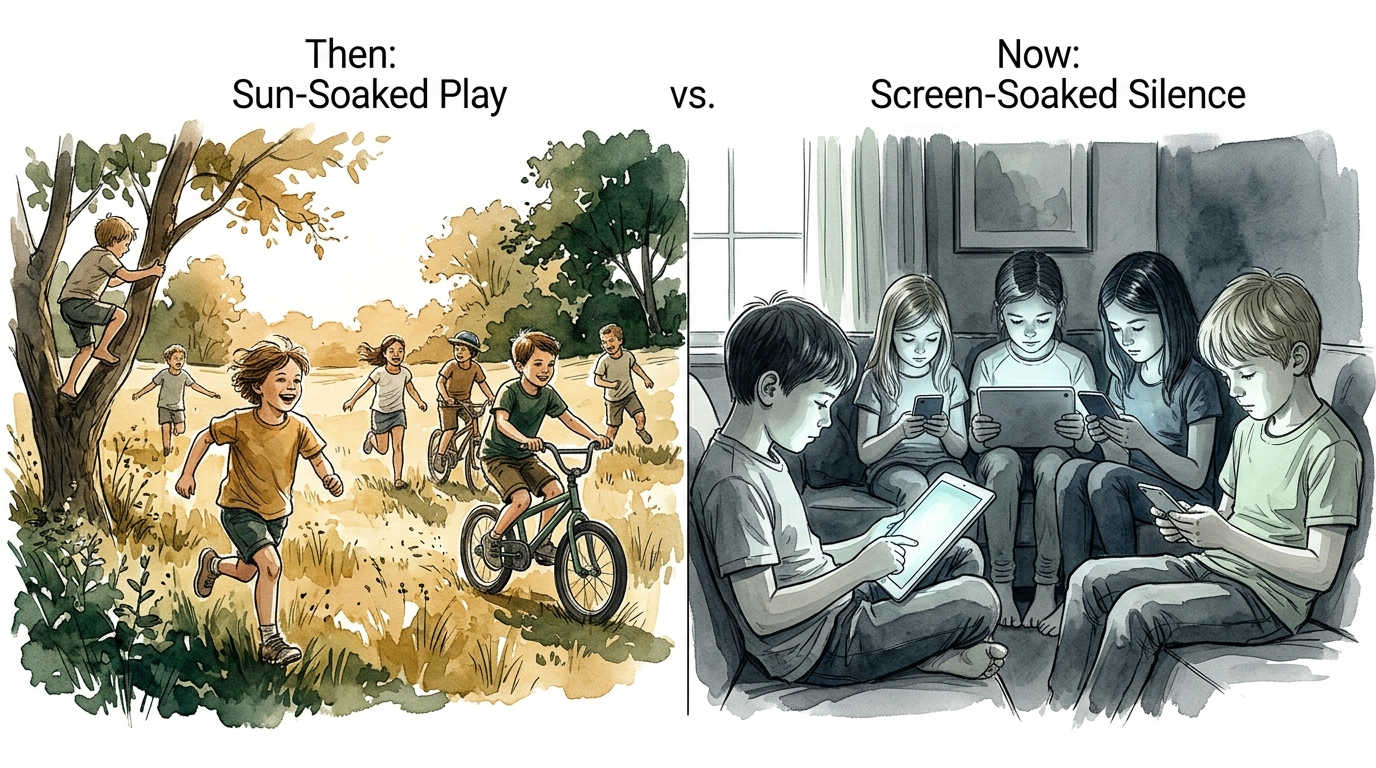
We traded the great outdoors for a five-inch glow. Is it time to go back? Childhood used to be defined by dirty knees and sunset curfews. Now it’s defined by battery life. We can’t change the era, but we can change the environment.
Every parent knows the feeling. You see your child slumped over a tablet, eyes glazed, oblivious to the world. You want to intervene, but the mere suggestion of “turning it off” feels like pulling a pin on a grenade. It is a modern struggle that wasn’t in the parenting manual thirty years ago.
The digital age has brought incredible tools, but it has also brought a silent crisis of over-consumption. Recent data shows that children aged 5 to 8 are now averaging three hours and 38 minutes of screen media use per day. For toddlers as young as two, that number is already over two hours. These aren’t just numbers; they represent hours of missed physical play and real-world connection.
How do we bridge the gap between the screen-soaked silence of today and the sun-soaked play of yesterday? The answer isn’t in more nagging or complicated apps. It is in a simple, physical tool that changes the conversation from a power struggle to a shared family goal.
screen time for kids poster
A screen time for kids poster is more than just a piece of paper on the wall. It is a visual contract. It serves as a physical boundary in a world of infinite digital scrolls. While an iPad has no “end,” a poster provides a clear, unmoving reference point for what is expected in the home.
These posters come in many forms, ranging from simple rule lists to complex “earning” charts. The goal is to make the abstract concept of “time” tangible. Since young children often struggle with time management and auditory processing, a visual aid provides the constant support they need to navigate their day.
In practice, a screen time poster acts as the “silent authority.” Instead of the parent constantly repeating directions, the environment takes over. This shifts the role of correction away from you and onto the house rules. It reduces the “nagging factor” and gives children a sense of autonomy over their digital choices.
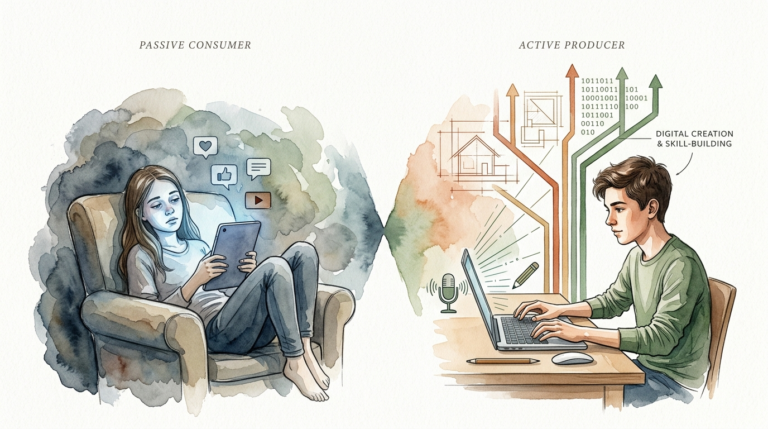
You might find posters that categorize activities into “Active” vs. “Passive” use. Active use includes learning, creating, or video chatting with family. Passive use is the endless scrolling or auto-play videos that often lead to meltdowns. By visualizing these differences, kids learn to identify healthy habits early on.
How It Works: The Psychology of Visual Cues
Why does a poster work when your voice doesn’t? It comes down to how a child’s brain processes information. Research shows that elementary and middle school children can typically only comprehend between 130 and 140 words per minute. When you give a long, complex lecture about screen limits, they often “tune out” after the first ten words.
A visual support provides a concrete reminder that stays in place. While spoken words vanish the moment they are said, a poster is always there. This supports executive functioning—the mental processes that help with organization, planning, and task management. It helps kids see the “big picture” of their day.
To implement this effectively, you should follow a four-step process. First, conduct a family audit. Look at when screens are being used out of necessity versus habit. Second, design the poster with child-friendly language and icons. Non-readers need pictures to understand the “When” and “How” of screen time.
Third, place the poster at eye-level in a high-traffic area. The kitchen or the charging station is usually best. Finally, maintain consistency. The poster only works if the rules it displays are enforced every single time. This creates predictability, which is the foundation of emotional regulation in children.
Benefits of a Visual Screen Strategy
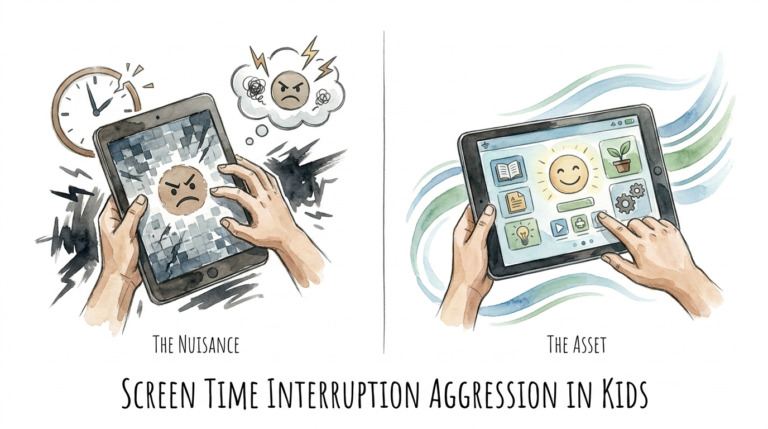
The primary benefit of a screen time poster is the reduction of power struggles. When a child knows exactly what is expected, the “surprise” of turning off the TV disappears. This prevents the dopamine crash that often leads to tantrums. Predictability equals peace.
Another major advantage is the promotion of independence. Instead of asking “Can I play my game?” every ten minutes, a child can check the poster. They can see if they have completed their “Must-Dos”—like homework, chores, or outdoor play—before reaching for a device. This builds self-reliance and internal motivation.
Visual aids also help with transitions. Many posters incorporate visual timers or “check-off” lists for morning and bedtime routines. By making the transition steps visible, you reduce the anxiety that children feel when moving from a high-stimulation activity (gaming) to a low-stimulation activity (brushing teeth).
Finally, it fosters a “Screen-Smart” culture. It teaches children that screens are a tool for specific purposes, not a default state of being. Like a food treat, screen time can be seen as “dessert”—something enjoyed in moderation after the “nutritious” parts of the day are finished.
Challenges and Common Mistakes
The most common mistake is the “Set It and Forget It” trap. Parents often print a beautiful poster, hang it up, and then stop referencing it after three days. For a visual tool to remain effective, it must be a living part of the daily conversation. If you ignore the poster, your child will too.
Another pitfall is making the rules too complex. If a poster has twenty different conditions and earning requirements, it becomes a source of frustration rather than a guide. Keep it simple. Focus on three to five core “house rules” that are easy to remember and even easier to follow.
Parental hypocrisy is a massive hurdle. If the poster says “No screens at the table” but you are checking emails during dinner, the system collapses. Children are masters of observation. They will always follow your actions over your posted rules. Modeling healthy digital habits is a non-negotiable part of the process.
Lastly, some parents use the poster as a “punishment board.” If the visual aid is only associated with losing privileges, it will be met with resentment. Use the poster to celebrate successes and offer “sparks” for alternative activities like reading, building, or outdoor exploration.
Limitations and Realistic Boundaries
A poster is a tool, not a cure for digital addiction. If a child is already exhibiting signs of severe screen dependency—such as aggression when devices are removed or loss of interest in all other hobbies—a piece of paper won’t be enough. In those cases, a more comprehensive “digital detox” or professional guidance may be necessary.
Age is also a major limitation. While a colorful poster works wonders for a seven-year-old, a fifteen-year-old will likely roll their eyes at it. For teenagers, the “poster” should evolve into a digital contract or a collaborative “Family Media Plan” stored on their own devices. The principle of visual clarity remains, but the delivery must change.
Environmental factors can also get in the way. If your home is designed with the TV as the central focal point of every room, a poster will have a hard time competing. You may need to rearrange your physical space to make non-screen activities (like a reading nook or an art station) more inviting than the “five-inch glow.”
Then vs. Now: A Practical Comparison
Comparing the childhood of thirty years ago to today helps us see what is missing. It isn’t about being “anti-tech,” but about being “pro-balance.” Use this table to evaluate the current environment in your home.
| Factor | Sun-Soaked Play (Then) | Screen-Soaked Silence (Now) |
|---|---|---|
| Activity Level | High (Physical, Outdoor) | Low (Sedentary, Indoor) |
| Social Style | Face-to-Face, Unstructured | Mediated, Algorithmic |
| Boredom Response | Creativity, Exploration | Immediate Digital Gratification |
| Parental Role | Passive Supervision | Active “Gatekeeper” |
Practical Tips for Your Screen Time Poster
When creating your poster, use high-contrast colors and bold fonts. The information should be readable from across the room. If your child is under the age of six, use 80% pictures and 20% words. Icons for “Bed,” “Book,” and “Outside” are far more effective than written lists.
Laminate the poster. This allows you to use dry-erase markers to change “Bonus Goals” or “Weekly Challenges.” It also makes the poster feel like a permanent, important fixture in the house rather than a temporary flyer. Durability matters when it comes to long-term habit formation.
Incorporate a “Creation vs. Consumption” section. Encourage your child to use their screen time for “Production”—like filming a movie, coding a simple game, or digital drawing. Draw a line on the poster to show that creative tech time earns more “credit” than passive watching. This shifts their mindset from being a consumer to a creator.
Place the poster right next to the device charging station. This creates a “decision point.” The moment they go to reach for a phone or tablet, they are forced to look at the poster and ask: “Have I met my requirements today?” This brief pause is often enough to break the habitual reach for a screen.
Advanced Considerations: The Digital Ecosystem
For serious practitioners, the poster is just the visible tip of the iceberg. You should also consider the “Socio-ecological system” of your home. This means looking at how your neighborhood, school, and social circles influence screen use. A poster works best when it’s supported by a wider community of families with similar values.
Think about child-centered design. Many apps are designed with “dark patterns”—features like infinite scroll and auto-play intended to keep kids hooked. Use your poster to educate your child about these tricks. When a child understands they are being “tricked” into staying on an app, they are more likely to want to reclaim their autonomy.
Consider the “Three-C” approach: Content, Context, and Child. Content matters—educational shows are better than mindless unboxing videos. Context matters—screens during a long car ride are different than screens during a family dinner. And the Child matters—every kid has a different level of sensitivity to digital stimulation. Your poster should reflect these nuances.
Scenario: The Saturday Morning Pivot
Imagine it is Saturday morning. Usually, the kids wake up and immediately head for the TV, staying there until noon. You feel the guilt creeping in, but you need that time for chores or a moment of peace. Here is how the poster changes that scenario.
The poster on the fridge has a “Saturday Morning Checklist.” It says: 1. Eat breakfast, 2. Get dressed, 3. Read for 20 minutes, 4. One hour of “Open Play” (Legos, Art, Backyard). Only after these are checked off can the “Screen Time” token be used.
Because the expectation was set on Friday evening and is visible on the wall, the kids don’t argue. They move through their list because it is the “law of the house.” You get your quiet morning, and they get their screen time later, having already moved their bodies and engaged their brains. Everyone wins.
Final Thoughts
We cannot delete the digital world, nor should we want to. Technology offers unparalleled access to knowledge and connection. However, we must ensure that the “great outdoors” and real-world relationships remain the primary focus of childhood. A screen time for kids poster is a simple, powerful way to draw that line in the sand.
By making rules visible, you remove the emotional weight of enforcement. You empower your children to manage their own time and help them develop a healthy relationship with technology that will serve them for the rest of their lives. It starts with one piece of paper and a commitment to consistency.
Don’t wait for the next meltdown to make a change. Start today by discussing these boundaries with your family. Let your kids help design the poster. When they feel like they have a say in the “environment,” they are far more likely to respect the rules within it. Trade that five-inch glow for some dirty knees and a sunset curfew—your kids will thank you later.
Sources
1 aap.org | 2 blankspaces.app | 3 screensdownfamilyup.com | 4 monstermath.app | 5 socialworkerstoolbox.com | 6 biermanautism.com | 7 mastermindbehavior.com | 8 nwckidsimpact.org | 9 luriechildrens.org | 10 screensdownfamilyup.com | 11 aap.org | 12 frontiersin.org | 13 aacap.org | 14 apa.org | 15 aap.org | 16 cpa.ca | 17 choc.org