screen time contract
Vague rules create arguments; precise agreements create peace. A standard contract is too easy to ignore. A precision agreement tailored to your child’s maturity and your family values eliminates the ‘gray area’ where tantrums live.
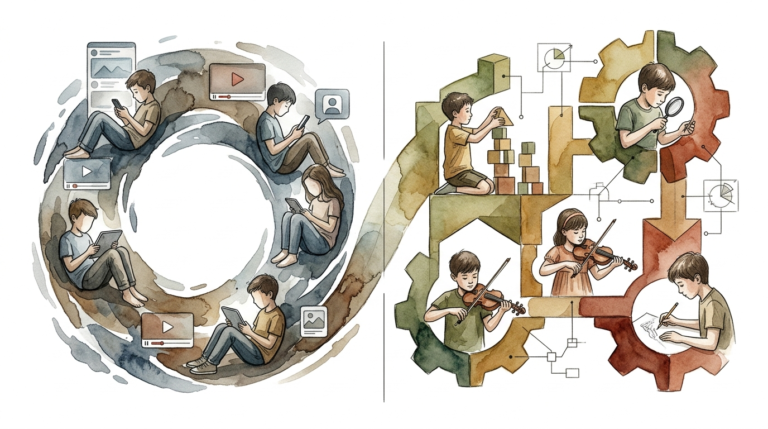
Most parents feel like they are losing a war they never signed up for. You hand over a tablet to get twenty minutes of peace, and you pay for it with two hours of emotional fallout when the timer dings. It feels like a constant negotiation where the goalposts are always moving.
You need a better system. A verbal “don’t stay on too long” is a recipe for disaster. Your child’s definition of “too long” and yours are light-years apart. To bridge that gap, you need a document that acts as a constitution for your digital home.
This isn’t about being a dictator. It is about being a mentor. It is about creating a roadmap that allows your child to enjoy the benefits of technology while protecting their sleep, their focus, and their mental health. Let’s dive into how you can build a screen time contract that actually works.
screen time contract
A screen time contract is a written, collaborative agreement between a parent and a child. It clearly outlines the rules, responsibilities, and consequences regarding device usage. Think of it as a formal “Terms of Service” for your household, but one where the user actually understands what they are signing.
In the real world, these agreements are used to transform technology from a source of conflict into a tool for growth. Rather than reacting to every new app or late-night gaming session with a fresh argument, you point back to the document you both signed in a moment of calm. It moves the conflict away from the parent-child relationship and places it onto the agreement itself.
Research shows that children thrive with structure and consistency. Experts at Bark Technologies suggest that clear rules before a conflict occurs are far more effective than trying to negotiate in the heat of a “tech tantrum”. By defining the “when, where, and how” of screen use, you provide a safety net for a developing brain that is not yet equipped for perfect self-regulation.
A precision agreement covers more than just a daily minute count. It addresses content types, social media behavior, privacy settings, and the physical location of devices. It is a living document that evolves as your child matures, moving from high-restriction for young kids to higher-autonomy for teens.
How to Build Your Agreement Step-by-Step
Creating an agreement is a process, not a surprise. If you slide a printed sheet across the table and demand a signature, you will meet resistance. To get “buy-in,” you must make the process collaborative. Here is how you do it effectively.
1. The Family Meeting
Schedule a time to talk when everyone is well-rested and fed. Do not do this right after an argument about video games. Start by explaining the “why.” Use phrases like, “I want you to enjoy your games, but I also want to make sure your brain gets enough sleep to grow.” This positions you as an ally, not an obstacle.
2. Define the ‘Where’ and ‘When’
Establish tech-free zones and times. Common examples include no devices at the dinner table or in the bathroom. Most experts, including the American Academy of Pediatrics (AAP), recommend that devices stay out of bedrooms overnight to prevent sleep disruption. Decide on a “sunset time” when all devices go to a central charging station.
3. Discuss Content and Safety
Be specific about what is allowed. For a younger child, this might mean only approved YouTube Kids channels. For a teen, it might involve rules about not sharing passwords or what to do if they see something “weird” or uncomfortable online. Explain that your role is to protect them, not to spy on them.
4. Set Clear Consequences
Vague threats like “I’ll take your phone away” are hard to enforce. Instead, use logical consequences. If they don’t get off when the timer goes off, they lose their screen time for the next day. Make the punishment fit the crime, and make it predictable. Predictability reduces the emotional intensity of the enforcement.
5. The Mutual Clause
This is the secret sauce. Include a section for parents. If you want your child to stay off their phone at dinner, you must agree to do the same. This builds immense trust and shows that the family values “presence” over “pings.” Children are much more likely to follow a rule they see their heroes following.
Benefits of a Precision Agreement
The most immediate benefit is the elimination of the ‘Gray Area.’ When the rules are written down, there is no room for “I didn’t know” or “but you said yesterday.” This clarity reduces daily friction and preserves the parent-child bond. You are no longer the “bad guy”; you are simply the person reminding them of the agreement they helped create.
Beyond peace in the home, these contracts teach digital literacy and responsibility. Technology is designed to be addictive. Apps use “variable rewards” and “infinite scrolls” to keep users engaged. By having a contract, you are teaching your child how to recognize these loops and set their own boundaries. You are training them for the day they leave your house and have to manage their own digital life.
Another major advantage is the protection of developmental milestones. High-quality sleep, physical activity, and face-to-face social interaction are non-negotiable for healthy development. A well-crafted contract ensures these activities are prioritized, preventing screen time from “crowding out” the essential experiences of childhood. According to recent 2025 research from the American Psychological Association, families with structured agreements reported 73% fewer screen-related conflicts.
Challenges and Common Mistakes
The biggest pitfall is inconsistency. If you enforce the rule on Monday but let it slide on Tuesday because you’re tired, the contract loses its power. Children are expert “negotiators” and will look for any crack in the foundation. If they learn that a loud enough tantrum can “break” the contract, they will continue to escalate until you fold.
Another common error is over-complexity. Do not try to regulate every single minute of the day. A contract with fifty rules is impossible to follow and even harder to manage. Focus on the big wins: sleep, meal times, and online safety. Keep the language simple and the expectations reachable. If a child feels like they can never win, they will stop trying.
Parental hypocrisy is a frequent deal-breaker. If you are scrolling through TikTok while telling your teen to go for a walk, the contract is dead on arrival. Modeling the behavior you want to see is the most powerful tool in your kit. If you find yourself struggling to stay off your device, be honest about it. Say, “I’m having a hard time putting my phone down too. Let’s both put ours in the kitchen for an hour.”
Limitations of Screen Time Contracts
A contract is a tool, not a cure-all. It cannot solve underlying emotional issues or clinical addiction. If a child is using screens as a primary coping mechanism for anxiety, depression, or social isolation, a piece of paper won’t stop the behavior. In these cases, professional help and a more nuanced “digital wellness” approach are necessary.
Environmental factors also play a role. If your child’s school requires four hours of laptop work daily, your “one-hour limit” at home may need to be adjusted. The context of screen use matters just as much as the quantity. Educational use is vastly different from passive scrolling or competitive gaming. A contract that treats all screen time as “bad” will quickly become unrealistic in the modern world.
Finally, contracts have a shelf life. A contract written for a 10-year-old is useless for a 13-year-old. The landscape of technology moves faster than parental guidelines. You must commit to regular reviews—perhaps every three to six months—to ensure the rules still match your child’s maturity and the current digital reality.
Generic Rules vs. Precision Expectations
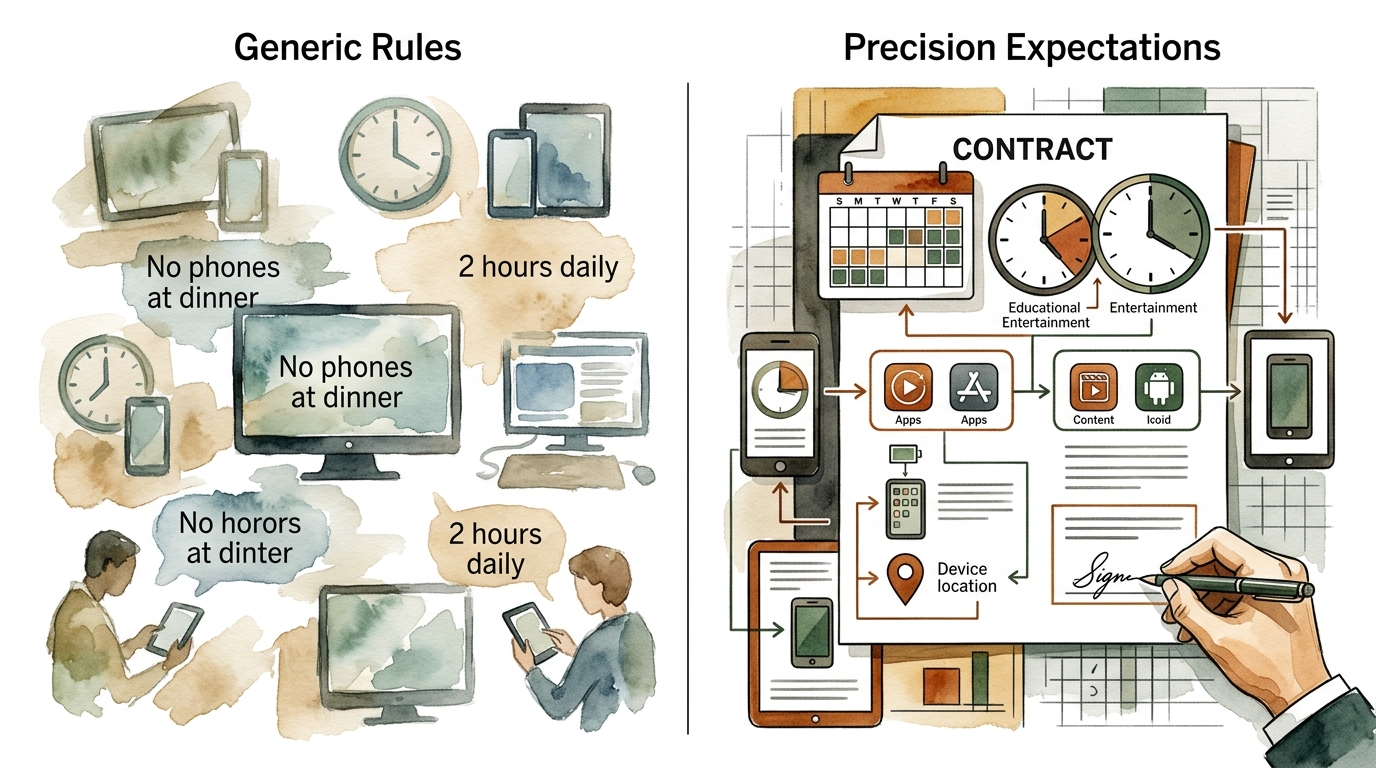
Many families operate on “Generic Rules.” These are the unwritten, fluctuating expectations that lead to most arguments. A “Precision Expectation” is the backbone of a successful screen time contract. It replaces emotion with data.
The table below highlights the differences between these two approaches:
| Feature | Generic Rule (The Vague Way) | Precision Expectation (The Contract Way) |
|---|---|---|
| Time Limits | “Don’t stay on too long today.” | “60 minutes of gaming after homework is finished.” |
| Transitions | “Get off the iPad right now!” | “At the 5-minute warning, find a saving point.” |
| Physical Space | “No phones at the table sometimes.” | “All phones go in the ‘Tech Basket’ during meals.” |
| Consequences | “I’m taking that away if you’re not careful.” | “Missing the 8:30 PM cutoff = No screens tomorrow.” |
| Review Process | Never discussed until a fight happens. | Scheduled check-in every first Sunday of the month. |
Practical Tips for Immediate Success
Use a “Sunset Clause.” Set a hard stop for all screens at least 60 minutes before bedtime. This allows the brain’s natural melatonin production to begin without interference from blue light. It is one of the most effective ways to improve a child’s mood and school performance.
Implement “Work Before Play.” The contract should stipulate that “High Dopamine” activities (gaming, social media) only happen after “Low Dopamine” responsibilities (chores, homework, outdoor play) are complete. This trains the brain’s reward system to value effort and delayed gratification.
Establish a “Parking Lot.” Designate a specific spot in the house—like a kitchen counter or a decorative basket—where all devices live when not in use. When a device is in the parking lot, it is invisible. This removes the “visual cue” of the phone, which reduces the urge to check notifications constantly.
- The 5-Minute Warning: Always give a verbal or haptic warning before time is up to help with transitions.
- Open Door Policy: Screens should generally be used in common areas where “casual supervision” is possible.
- App Approval: No new apps should be downloaded without a “review session” where you look at the privacy settings together.
Advanced Considerations for Parents
For parents of older children, the contract should move into Digital Citizenship. This includes discussing the “THINK” rule before posting: Is it True, Helpful, Inspiring, Necessary, and Kind? As teens gain more autonomy, the focus shifts from “how many minutes” to “what is the quality of your digital footprint?”
You should also address AI and Algorithms. Teach your children that social media apps are designed by some of the smartest people in the world specifically to keep them scrolling. Help them understand that they are the “product,” and their attention is what is being sold. This awareness can create a healthy skepticism that protects them better than any restriction could.
Scaling the agreement is also vital. Consider a “Milestone-Based” approach. For example, “When you show you can follow the 9:00 PM cutoff for three months straight, we will discuss adding 15 minutes to your weekend gaming time.” This ties privileges to demonstrated maturity, which is a powerful motivator for adolescents.
Examples and Real-World Scenarios
Scenario A: The 8-Year-Old Gamer
In this scenario, the contract focuses on Physical Boundaries and Content. The agreement states: “Leo can play Minecraft for 45 minutes on school days after his homework is in his backpack. All play must happen in the living room. If Leo screams or gets angry when the timer goes off, Minecraft is paused for 48 hours.” This creates a direct link between behavior and privilege.
Scenario B: The 14-Year-Old Social Media User
Here, the focus shifts to Privacy and Mental Wellness. The agreement states: “Sarah may use Instagram, but her profile must remain private. She agrees not to share her location or personal details. Every Saturday, we will look at her ‘Screen Time’ report together. If her ‘App Pickups’ are over 100 per day, we will work together to find ways to reduce phone checks.” This emphasizes self-monitoring over top-down control.
Final Thoughts
A screen time contract is not a magic wand, but it is a powerful anchor. It replaces the chaos of “tech battles” with the calm of a negotiated peace. By being precise, you eliminate the confusion that leads to arguments. You give your child the structure they crave and the safety they need in an increasingly digital world.
The goal is to eventually “work yourself out of a job.” You want your child to internalize these boundaries so they can regulate themselves when you aren’t looking. A well-written agreement is the first step toward that independence. It builds a foundation of trust, responsibility, and mutual respect.
Start small. Sit down this weekend, have the conversation, and write it out. You might be surprised at how much peace a single piece of paper can bring to your home. Experiment with the clauses, revisit them often, and remember that the relationship is always more important than the rules.
Sources
1 care.com | 2 timily.app | 3 care.com | 4 care.com | 5 bark.us | 6 childmind.org | 7 cpcmg.net | 8 screenagersmovie.com | 9 screenagersmovie.com | 10 texaschildrens.org | 11 kidshubms.com | 12 happilyfamily.com | 13 todaysparent.com | 14 digitalchild.org.au | 15 psychologytoday.com | 16 sbesyes.org