screen time agreement
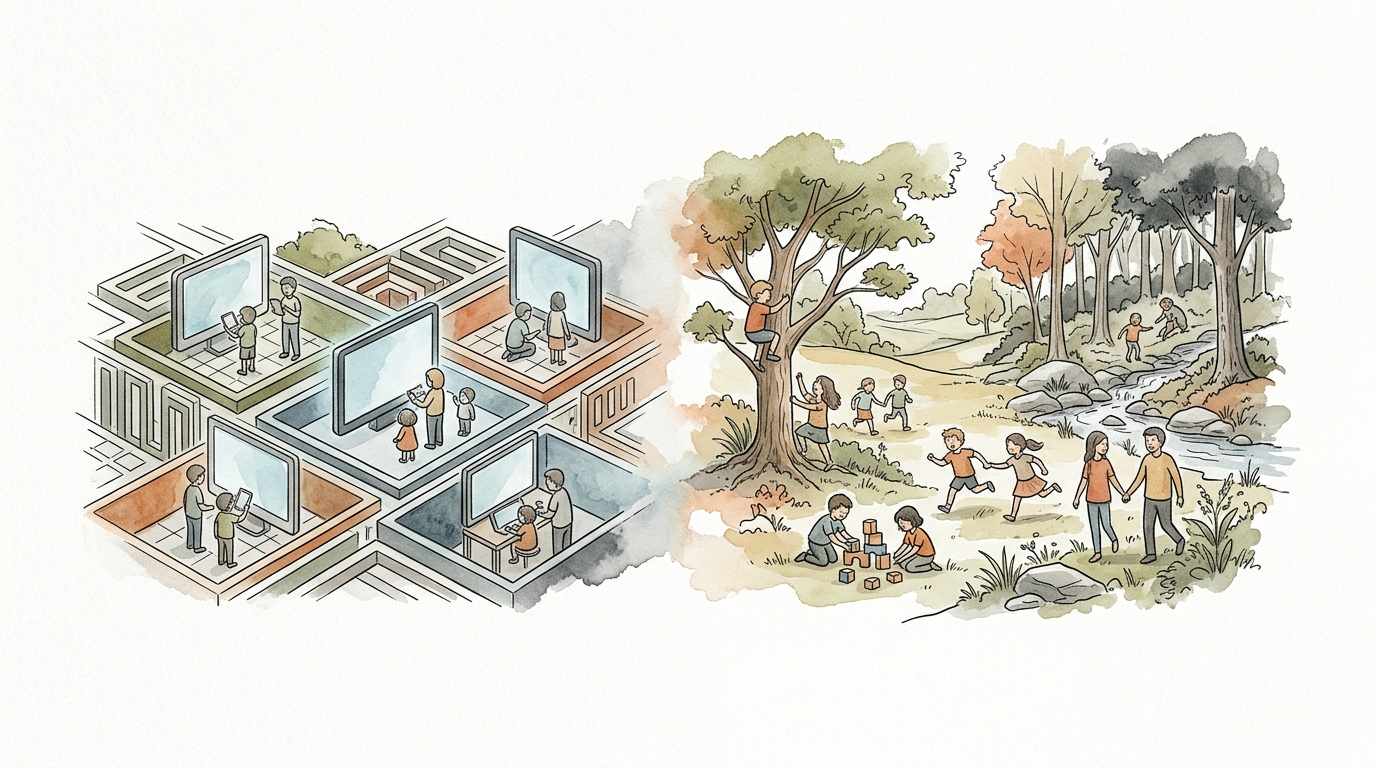
The goal of an agreement isn’t more rules—it’s more freedom for the real world. Screens offer a curated, ‘urban’ digital experience. An agreement ensures your child still gets the ‘wild,’ unstructured play they need for brain development. Here is how to balance the two.
Modern parenting often feels like a constant negotiation between the convenience of technology and the instinctual need for a “free-range” childhood. We live in a world where digital devices are ubiquitous, woven into the fabric of education, social life, and entertainment. This creates a paradox: while screens offer incredible opportunities for learning and connection, they also risk crowding out the essential “wild” experiences that define healthy human development.
Creating a balance isn’t about being anti-tech. It is about being pro-development. When we establish clear boundaries, we aren’t just limiting minutes; we are protecting the space for boredom, curiosity, and physical exploration. This guide will show you how to move from a reactive “put that phone away” stance to a proactive, collaborative partnership with your children.
screen time agreement
A screen time agreement is a collaborative, written framework that outlines how, when, and where digital devices are used within a family. Think of it as a roadmap for digital citizenship rather than a rigid list of prohibitions. It is a living document that evolves as children grow, shifting from strict parental oversight to a model based on earned trust and increasing responsibility.
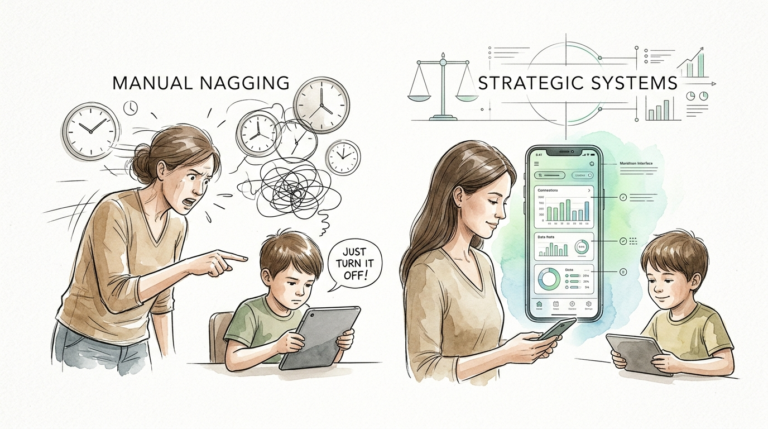
In real-world situations, these agreements act as a “third party” in the room. When a child knows exactly when their gaming session ends, the transition away from the screen becomes less about a parent’s whim and more about a pre-established commitment. This significantly reduces the daily “tech-tantrums” and the constant friction that often surrounds device usage. It transforms the conversation from “why are you being mean?” to “what did we agree on?”
Analogy-wise, think of a screen time agreement like a park fence. Without the fence, a toddler might wander into a busy street, requiring constant, stressful monitoring. With the fence, the toddler is free to run, jump, and explore safely within a defined boundary. The agreement provides the digital “fence” that allows children the freedom to explore the curated digital world without losing themselves in it. It ensures that the ‘urban’ digital experience doesn’t pave over the ‘wild’ neurological terrain they need to navigate to grow.
How to Build Your Family Agreement
Building an effective agreement is a process of collaboration. If a rule is imposed unilaterally, children often spend their energy finding ways to bypass it. If they help build it, they are more likely to respect it. Follow these steps to create a system that actually sticks.
Step 1: The Family Kickoff Meeting
Schedule a specific time to talk, ideally when everyone is calm and well-fed. Avoid starting this conversation in the middle of a conflict about screens. Frame the discussion around health and well-being. Explain that the goal is to make sure everyone—parents included—is getting enough sleep, movement, and face-to-face connection. This sets a tone of teamwork rather than policing.
Step 2: Define Content and Context
Not all screen time is created equal. Distinguish between “active” use (creating music, coding, video-calling family) and “passive” use (endless scrolling on short-form video platforms). Recent 2025 guidelines from pediatric experts suggest prioritizing quality and context over simple clock-watching. Discuss which apps are “green light” (educational or creative), “yellow light” (social media with supervision), and “red light” (age-inappropriate or high-risk platforms).
Step 3: Establish Device-Free Zones and Times
Physical boundaries are often more effective than time limits. Common successful “zones” include the dining table, bedrooms, and bathrooms. Crucial “times” include the hour before sleep and the first hour after waking up. Research shows that keeping screens out of the bedroom is one of the single most effective ways to protect a child’s deep REM sleep, which is essential for processing the day’s learning and memory.
Step 4: Incorporate “The Boredom Clause”
Explicitly value “unstructured freedom” in your agreement. Boredom is not a problem to be solved; it is the laboratory where creativity, self-direction, and internal motivation are built. When a child is bored, their brain is forced to look inward or outward for entertainment rather than relying on a dopamine-dispensing algorithm. Make it clear that a certain portion of the day must be “analog and unstructured.”
Step 5: Set Clear Consequences
An agreement without consequences is just a list of suggestions. Decide together what happens when a rule is broken. Perhaps a day of “digital fasting” or losing a specific app for a week. When these consequences are agreed upon in advance, they feel like a natural result of a choice made by the child, rather than an arbitrary punishment from a parent.
Benefits of a Balanced Approach
The practical benefits of a screen time agreement extend far beyond just having “quieter” evenings. By balancing curated digital time with unstructured play, you are essentially “cross-training” your child’s brain for the future.
Neurological Resilience: High amounts of passive screen time in early childhood have been linked to differences in brain areas responsible for visual processing, empathy, and attention. Conversely, unstructured play—the kind involving mud, sticks, and make-believe—strengthens neural pathways related to executive function and complex problem-solving. A balanced agreement protects this critical developmental window.
Emotional Regulation: Constant access to high-dopamine digital rewards can make the “real world” feel boring or frustrating. A screen time agreement helps children practice the skill of delayed gratification. They learn to self-regulate, moving from the high-intensity stimulation of a video game back to the lower-intensity, slower pace of physical reality without a complete emotional collapse.
Digital Trust and Literacy: When you talk about why certain apps are restricted or why time limits exist, you are building your child’s digital literacy. They start to understand “attention hacking” and the business models of social media. This builds a foundation of trust; they see you as a mentor helping them navigate a complex world, rather than a gatekeeper trying to take away their fun.
Challenges and Common Mistakes
Even the best-laid plans encounter resistance. Recognizing these common pitfalls will help you maintain the integrity of your agreement over the long haul.
Inconsistency Between Parents: This is the most frequent point of failure. If one parent enforces the agreement while the other allows “Minecraft marathons” to get some peace and quiet, the child receives mixed messages. They will quickly learn to manipulate the gap. Co-parents, even those in separate households, must present a united front to ensure the child feels the boundary is stable and non-negotiable.
Bending Under Pressure: Children are natural negotiators. They will escalate, argue, and wait for a moment when you are exhausted to push the boundary. If the only way for a child to influence a rule is to fight about it, they will fight. Experts warn that “a rule that folds when a child escalates teaches escalation.” Stick to the agreement, but schedule regular “review dates” where rules can be discussed and adjusted in a calm environment.
Modeling “Do as I Say, Not as I Do”: If you tell your child to stay off their phone while you are constantly scrolling through emails or social media during dinner, the agreement loses its moral authority. Children are keen observers of hypocrisy. An effective agreement often includes a section for parents, committing to device-free presence during family times.
Limitations and Realistic Constraints
While a screen time agreement is a powerful tool, it isn’t a magic wand. There are realistic boundaries to what it can achieve in a hyper-connected society.
Academic requirements are a major hurdle. In 2025, many school systems require students to be online for homework, research, and collaborative projects. Distinguishing between “mandatory school screen time” and “recreational screen time” can be difficult. It requires a nuanced approach where “work mode” is respected, but physical breaks are still encouraged to prevent digital fatigue.
Social isolation is another legitimate concern, particularly for older teens. For many adolescents, the digital world is the “town square” where their social lives happen. Cutting them off completely can lead to genuine social exclusion. The agreement must be flexible enough to allow for meaningful social connection while still preventing the addictive “doom-scrolling” that leads to anxiety and depression.
Finally, children with neurodivergent needs, such as ADHD or autism, may interact with screens differently. For some, digital tools are essential for communication or sensory regulation. In these cases, a “one-size-fits-all” agreement may not work. The focus should shift toward “functional use” and ensuring that screens are aiding development rather than hindering it.
Digital Enclosure vs. Unstructured Freedom
Understanding the difference between the “curated” digital world and the “wild” real world helps in framing the value of your agreement. We can compare these two environments across several key developmental factors.
| Feature | Digital Enclosure (The Curated Screen) | Unstructured Freedom (The Wild Backyard) |
|---|---|---|
| Rule System | Predetermined by programmers. Hard limits. | Created and negotiated by the child. Fluid. |
| Sensory Input | Highly stimulating, but “impoverished” (visual/audio only). | Full-spectrum (touch, smell, temperature, balance). |
| Risk Level | Low physical risk; high psychological/algorithmic risk. | Managed physical risk; essential for building resilience. |
| Attention Model | Captive attention (passive consumption). | Sustained focus and “flow” (active creation). |
The goal is not to eliminate the “Digital Enclosure” but to ensure it doesn’t become the only environment the child knows. The agreement acts as the gate between these two worlds, ensuring the child can transition freely between the curated and the wild.
Practical Tips and Best Practices
To make your agreement more effective, implement these actionable strategies immediately.
- Create a “Boredom Menu”: Brainstorm a list of 20 non-screen activities (Lego, drawing, biking, baking) and post it on the fridge. When the screens go off and the “I’m bored” complaints start, refer them to the menu. This removes the mental friction of having to “think of something to do” when their dopamine levels are low.
- Use Technical Backups: Don’t rely solely on willpower. Use tools like Apple Screen Time, Google Family Link, or hardware solutions like Circle to automate the “shut-off” times. This removes you from the role of the “bad guy” and makes the technology itself responsible for the boundary.
- The “One Screen” Rule: Ban the habit of “second screening” (using a phone while watching a movie). This practice fragments the attention span and prevents the brain from fully engaging with a single narrative or task.
- The “20-20-20” Rule: For every 20 minutes of screen time, look at something 20 feet away for 20 seconds. This is a simple, actionable health tip that protects eye health and encourages a momentary “reset” of the child’s focus.
Advanced Considerations for Digital Mentorship
As children enter adolescence, the screen time agreement should shift from “limitation” to “literacy.” It is no longer just about how much they watch, but what they understand about what they are watching.
Discuss the concept of “Engagement-Based Design.” Teach your children how algorithms work—how “auto-play” and “infinite scroll” are specifically engineered to keep them on the platform longer than they intended. When a child understands that they are being “hacked,” they often develop a sense of healthy rebellion against the platform, which is a far more powerful motivator than a parent’s rule.
Consider the role of Artificial Intelligence. In 2026, kids are interacting with AI-generated content daily. Part of your agreement should involve “The Human Check.” Ask: Is this content real? Who created it? Why does it want my attention? This builds the critical thinking skills necessary to survive and thrive in a world of deepfakes and algorithmic bias.
Example Scenario: The Balanced Saturday
How does this look in practice? Let’s look at a typical Saturday for a family with a 10-year-old child using a functional agreement.
08:00 – 09:00: The “Wild Hour.” No screens. The child handles their own breakfast and finds something to do (reading, playing outside, or just lying on the floor). This allows the brain to wake up without a dopamine spike.
09:00 – 10:30: “Curated Tech.” The child has 90 minutes of screen time. They choose to play a creative building game. Because it is a weekend, the limit is slightly higher than on a school day.
10:30 – 16:00: “Unstructured Freedom.” The screens go into the charging station. The family goes for a hike or the child plays with neighborhood friends. There is no set “schedule,” just the freedom to be outside and “wild.”
16:00 – 17:00: “Social Tech.” The child uses a tablet to video-chat with a cousin. This is categorized as “connection” time rather than “recreation” time.
18:00 – 19:30: “Family Connection.” Dinner with zero devices at the table. A shared family board game or movie night (the “One Screen” rule applies).
19:30 – Bedtime: “The Digital Sunset.” All devices are turned off and placed in the central charging station 60 minutes before lights out. The brain begins producing melatonin naturally for deep sleep.
Final Thoughts
A screen time agreement isn’t a tool for restriction; it is a tool for liberation. By defining the “urban” digital boundaries, you create the necessary “wild” space for your child’s brain to develop the focus, creativity, and resilience they will need for the rest of their lives. It acknowledges that screens are a permanent part of our ecosystem while insisting that they should be our tools, not our masters.
The transition may be rocky at first, especially if your family is currently in a “tech-heavy” phase. However, the long-term rewards—better sleep, deeper connections, and a child who knows how to entertain themselves without a battery-powered device—are worth the effort. Start small, be consistent, and keep the focus on the “why”: more freedom for the real world.
Experiment with your agreement. Revise it as your children age. As you do, you’ll find that the friction of the digital age begins to smooth out, replaced by a family culture that values both the convenience of the future and the essential, unstructured “wildness” of the past.
Sources
1 reason.com | 2 verizon.com | 3 verizon.com | 4 healthychildren.org | 5 galvingrowthgroup.com | 6 nih.gov | 7 krauslawfirm.com | 8 harvard.edu | 9 kidshubms.com | 10 kidshubms.com | 11 care.com | 12 screenagersmovie.com | 13 screenagersmovie.com | 14 bunnyhopkinstoys.com | 15 childproofparenting.com | 16 centerforonlinesafety.com | 17 choc.org | 18 manhattanpsychologygroup.com | 19 cincinnatichildrens.org | 20 aap.org | 21 care.com | 22 heard-law.com | 23 alithisfamilylaw.com | 24 aacap.org | 25 aap.org | 26 healthychildren.org | 27 compasschildcare.com | 28 childrenandscreens.org | 29 greatcaringdocs.com