Teaching Optics To Kids
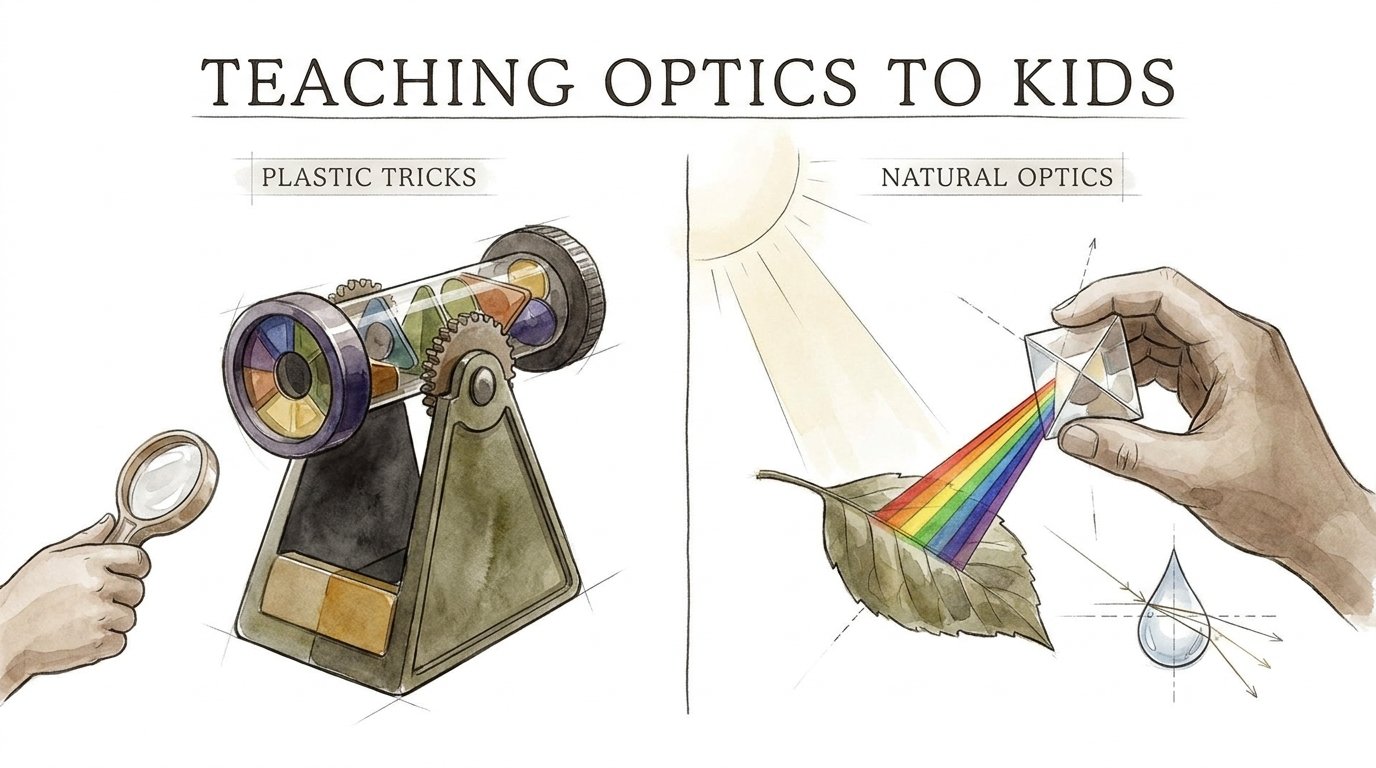
A plastic toy ‘performs’ for your child, but a glass prism lets your child perform with the laws of the universe. Most ‘magic kits’ are just plastic junk that teaches kids to follow a script. A single glass prism teaches them the fundamental physics of light, refraction, and the visible spectrum. Stop entertaining them and start enlightening them.
Your child doesn’t need more flashing lights or pre-recorded sounds. They need to understand the source of light itself. A glass prism is the ultimate bridge between play and physics. It turns a boring afternoon into a high-stakes investigation of the cosmos.
Every rainbow on the wall is a lesson in momentum and geometry. Every beam of light is a data point waiting to be analyzed. We are moving past the era of cheap distractions. It is time to give them the tools that the great scientists used to unlock the secrets of our world.
Teaching Optics To Kids
Teaching optics is about showing children that the invisible is actually measurable. Optics is the branch of physics that studies the behavior and properties of light. It isn’t just about glasses or telescopes. It is about how we perceive every single thing around us.
Light is energy moving at incredible speeds. When it travels through empty space, it moves in a straight line. But our world is full of different materials. Air, water, and glass all change the way light moves. This change is where the magic—and the science—happens.
Think about a straw in a glass of water. The straw looks broken at the surface. That is refraction in action. This is the same principle that allows cameras to focus and fiber optic cables to carry the internet across the ocean.
By teaching optics early, you help children build a mental model of the physical world. They stop seeing “magic” and start seeing systems. They begin to ask why the sky is blue and why a puddle looks like it has oil on top. Optics provides the answers to the most common questions of childhood.
The Physics of Refraction: How It Works
Refraction is the bending of light as it passes from one medium to another. Imagine a car driving from a paved road onto a sandy beach at an angle. One wheel hits the sand first and slows down. This cause the whole car to pivot. Light behaves the same way.
When light moves from the air into the dense glass of a prism, it slows down. This change in speed causes the light to bend. But not all light bends at the same angle. This is the secret to the rainbow.
White light is actually a mixture of many different colors. Each color has a different wavelength. Red light has long wavelengths and bends the least. Violet light has short wavelengths and bends the most. This separation of colors is called dispersion.
When you hold a prism in the sun, you are acting as a “traffic controller” for light. You are forcing the chaotic white light to organize itself. The result is a perfect, repeating spectrum: Red, Orange, Yellow, Green, Blue, Indigo, and Violet. This isn’t a trick of the eye. It is the physical reality of the universe.
The Role of the Angle
The shape of the prism is critical. Most prisms are triangular because they provide two surfaces for the light to bend. The light bends once when it enters the glass and again when it leaves. This double-bend amplifies the separation of colors.
If the glass were a flat window, the light would bend in and then bend back out at the same angle. It would stay white. The triangle shape ensures the colors stay separated. This geometry is why your child can project a rainbow across an entire room.
Benefits of Choosing Real Optics Over Plastic Toys
Real glass prisms offer a level of clarity that plastic toys cannot match. Plastic “prisms” are often molded with imperfections. These flaws scatter the light and create a blurry, muddy spectrum. A high-quality glass prism provides a crisp, sharp rainbow with distinct bands of color.
Using real scientific tools builds a sense of responsibility. When a child handles a piece of optical glass, they know it is different from their plastic blocks. They learn to treat tools with respect. This shifts their mindset from “consumer” to “researcher.”
Developing Critical Thinking
Optics experiments require patience and precision. Your child has to find the exact angle to catch the sun. They have to adjust the distance to the wall. This is the scientific method in its purest form.
They are forming hypotheses. “If I turn the prism this way, will the rainbow get bigger?” They are collecting data. They are observing results. This builds the neurological pathways for problem-solving that will serve them in every subject, from math to history.
Hands-On Physics
Physics can feel abstract and intimidating in a textbook. But holding a rainbow in your hand makes it tangible. It transforms an equation into an experience. This hands-on approach is far more effective for long-term retention than reading a diagram.
Challenges and Common Mistakes
The biggest challenge is the light source. Prisms require a “point source” of light to work effectively. A standard household light bulb often produces “diffuse” light that won’t create a strong rainbow. This can lead to frustration if you don’t know what to look for.
Another common mistake is trying to use the prism in a room that is too bright. If the ambient light is high, the rainbow will look faded or invisible. You need contrast to see the spectrum clearly.
The Alignment Struggle
Finding the right angle can be tricky for younger kids. They might hold the prism in the light and see nothing. It takes fine motor control and spatial awareness to align the sun, the prism, and the wall.
Common Pitfalls to Avoid:
- Dirty Glass: Fingerprints on the prism will scatter the light. Keep a microfiber cloth handy.
- Wrong Time of Day: High noon is actually harder for indoor rainbows. Use the low morning or afternoon sun for long, dramatic projections.
- Using Multiple Lights: If you have two different lamps on, the spectra might overlap and wash each other out.
Limitations of Prism Learning
Prisms are weather-dependent. If it is a cloudy day, your main experiment is on hold. This can be a hard lesson for a child who is excited to start. You can use a high-powered flashlight, but it rarely matches the brilliance of the sun.
Safety is also a factor. Glass prisms can have sharp edges if they chip. They are also fragile. A single drop on a hardwood floor can end the experiment. This means constant adult supervision is required for younger children.
Physical Constraints
A prism can only show dispersion and refraction. It doesn’t explain things like diffraction or interference as easily. It is a specialized tool. While it is the “gold standard” for light separation, it is only one piece of the optical puzzle.
Glass vs. Plastic: Which is Better?
Choosing between a glass prism and an acrylic (plastic) one depends on your goals. For a preschooler, plastic is a safer bet. For a serious learner, glass is the only real choice.
| Feature | Glass Prism | Plastic (Acrylic) Prism |
|---|---|---|
| Clarity | Exceptional. Sharp color bands. | Moderate. Some blurring at edges. |
| Durability | Fragile. Can shatter if dropped. | High. Virtually unbreakable. |
| Refractive Index | Higher. Better light bending. | Lower. Requires steeper angles. |
| Price | Slightly more expensive. | Very budget-friendly. |
If you want your child to see the “Fraunhofer lines” (the dark lines in the solar spectrum), you need glass. Plastic is a toy; glass is an instrument.
Practical Tips for a Better Rainbow
To get the most out of your prism, you need to control the environment. Start by darkening the room. Use heavy curtains or cardboard to block out most of the window. Leave only a small “slit” for the sunlight to come through.
This concentrated beam is called a “collimated” beam. When this thin slice of light hits the prism, the resulting rainbow will be incredibly sharp. You can even use a second piece of cardboard with a hole in it to “aim” the light.
The Rotation Technique
Don’t just hold the prism still. Teach your child to rotate it slowly. As the angle changes, the rainbow will move across the room. It will grow longer and then shorter. This shows how the “angle of incidence” directly affects the “angle of refraction.”
Best Practices:
- Project onto white: Use a clean white sheet of paper or a white wall. Colored walls will “eat” some of the spectrum colors.
- Increase the distance: The further the rainbow is from the prism, the more the colors will spread out.
- Trace the colors: Have your child use colored pencils to trace the rainbow on the paper. This helps them identify where one color ends and another begins.
Advanced Considerations: Snell’s Law and More
For older kids or serious practitioners, the prism is a gateway to mathematical physics. You can actually calculate exactly where the light will land. This is done using Snell’s Law.
The formula is: n1 * sin(?1) = n2 * sin(?2). In this equation, “n” is the refractive index of the material. Air has an index of about 1.0, and glass is usually around 1.5. By measuring the angles, your child can “predict” the path of the light before it even hits the glass.
Total Internal Reflection
Sometimes, light hits the inside of a prism at such a steep angle that it can’t get out. Instead, it reflects perfectly off the inner surface like a mirror. This is called Total Internal Reflection.
This is the principle behind high-end binoculars and periscopes. It is also how “fiber optic” internet works. The light stays trapped inside the glass cable, bouncing along the walls until it reaches its destination. A prism is the best way to visualize this “trapping” of light.
Example Scenario: Replicating Newton’s “Crucial Experiment”
In 1665, Isaac Newton performed an experiment that changed history. People at the time thought prisms “colored” the light—that the glass itself was adding the rainbow. Newton proved them wrong.
You can replicate this at home. You need two prisms. First, use one prism to create a spectrum. Then, use a piece of cardboard with a small hole to let only the “red” part of the rainbow through.
Place the second prism in the path of that red light. What happens? The red light bends, but it stays red. It doesn’t turn into a new rainbow. This proves that the colors were already inside the light. The prism is just a tool for separation, not a source of color.
Finally, try turning the second prism upside down. If you align it perfectly, it will catch all the colors from the first prism and “squish” them back together into a single beam of white light. This is the ultimate “Aha!” moment for a young scientist.
Final Thoughts
A glass prism is more than a science project. It is a fundamental shift in how your child interacts with reality. It teaches them that the world is governed by laws that are consistent, beautiful, and discoverable.
By moving away from “magic” and toward optics, you are giving them a head start in a world that is increasingly driven by technology and data. They aren’t just watching a show; they are directing the laws of physics.
Encourage them to experiment. Let them get the angles wrong. Let them try different light sources. Every “failure” is just another observation in the grand experiment of childhood. Start with a prism, and you might end with a physicist.
Sources
1 arxiv.org | 2 wikipedia.org | 3 littlebinsforlittlehands.com | 4 ox.ac.uk | 5 medium.com | 6 britannica.com | 7 bu.edu | 8 scienceready.com.au | 9 creative-science.org.uk | 10 science-sparks.com | 11 imthecheftoo.com | 12 unsw.edu.au | 13 lawrencehallofscience.org | 14 researchgate.net | 15 spie.org | 16 hpl.ca | 17 buggyandbuddy.com | 18 fsu.edu | 19 optics4kids.org | 20 webexhibits.org