no phone summer tutorial
Stop throwing your summer in the digital trash and start fueling your creative fire. Every hour spent scrolling is an hour of potential lost. This tutorial shows you how to convert that wasted digital energy into tangible skills you can keep forever. Ready to build something real?
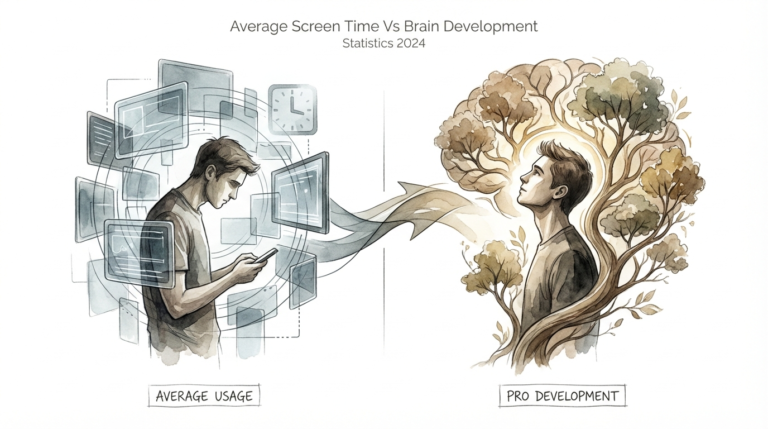
Most of us are currently trapped in a cycle of “continuous partial attention.” This is a state where you are never fully present because your brain is constantly scanning for the next notification or dopamine hit. Research shows that adults now spend an average of 11 hours a day engaging with digital media. That is nearly half of your life spent staring at a glowing rectangle. But summer offers a unique window to break this loop.
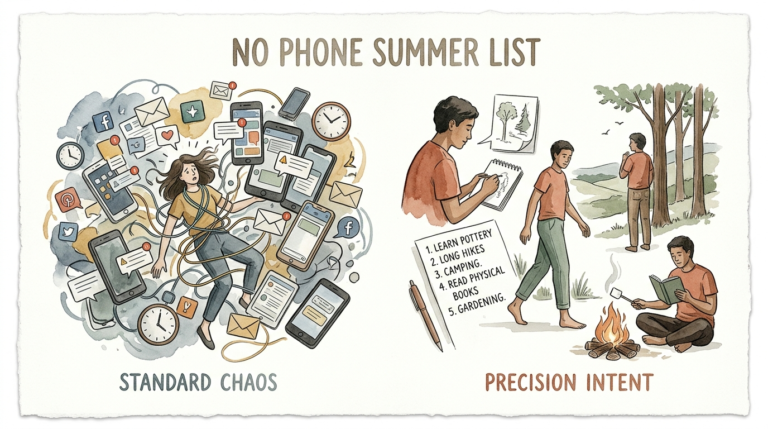
By stepping away from the screen, you aren’t just “unplugging.” You are reclaiming your cognitive bandwidth. You are trading Wasted Screen Hours for Fuel for Real Skills. This guide isn’t about becoming a hermit; it is about becoming a builder. Whether you want to master a craft, learn a language, or build physical strength, the process starts by reclaiming your time.
no phone summer tutorial
A “No Phone Summer” is a deliberate commitment to prioritize tactile, real-world experiences over digital consumption during the warmest months of the year. It is often referred to in 2026 as the Analog Summer movement. Instead of seeing the world through a lens or a feed, you engage with it directly using your hands and your focus.
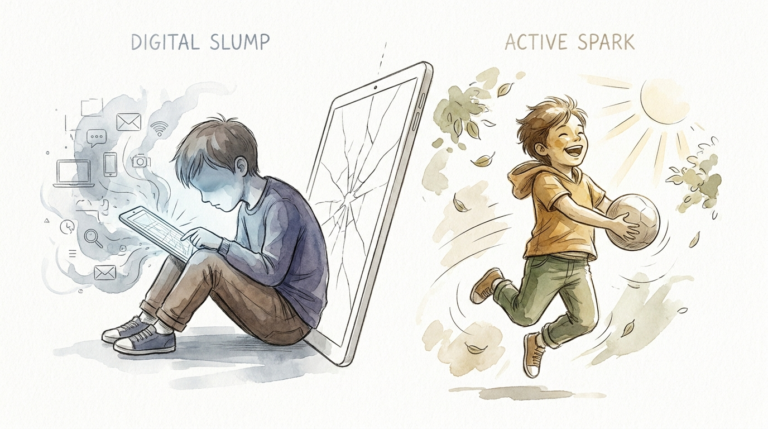
The concept exists because our brains are currently over-indexed on “fast dopamine.” Apps are designed like slot machines to keep you hooked with unpredictable rewards. A phone-free summer acts as a neurological hard reset. It forces you to find “slow dopamine” through activities that require effort before the reward. Think of it as a metabolic shift for your mind.
In real-world terms, this is used by high-performers, artists, and students to spark “deep work” phases. For example, a writer might ditch their smartphone to finish a novel, or a student might go analog to master a complex subject like carpentry or botany. It is a tool for those who realize that the most valuable things they own are the ones they had a hand in creating.
Imagine the difference between watching a 30-second clip of someone making a sourdough loaf and actually feeling the dough between your fingers. One is a fleeting image; the other is a permanent skill. This tutorial provides the framework to make that transition permanent.
How to Turn Scroll Time into Skill Time
Transforming your habits requires more than just willpower. You need a system. Follow these steps to build your analog engine and start producing tangible results.
Step 1: Conduct a Digital Audit
You cannot change what you do not measure. Open your phone’s “Screen Time” or “Digital Wellbeing” settings. Look at the raw numbers. If you spend three hours a day on social media, that is 21 hours a week. Over a three-month summer, that is over 250 hours. That is enough time to learn the basics of a new language or build a piece of furniture from scratch.
Step 2: Choose Your Tangible Skill
Pick one skill that has a physical output. Avoid “passive” hobbies like just reading (though reading is great). Aim for something that requires “friction”—the resistance of physical materials. Good examples include:
- Woodworking: Build a birdhouse or a simple stool.
- Gardening: Cultivate a vegetable patch from seeds.
- Analog Photography: Use a film camera where every shot matters.
- Cooking: Master five complex recipes using only a physical cookbook.
Step 3: Redesign Your Environment
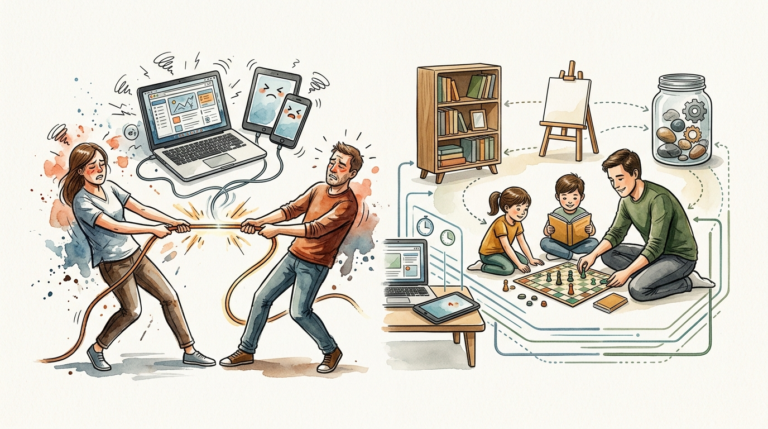
Your phone wins because it is the “path of least resistance.” To win back your time, you must add friction to your phone and remove it from your hobby. Buy a physical alarm clock so your phone stays in another room at night. Purchase an iPod shuffle or a dedicated MP3 player for music. When your phone isn’t the only tool for every task, it loses its power over you.
Step 4: The Grayscale Hack
Go into your phone’s accessibility settings and turn on “Grayscale.” Our brains are wired to respond to bright, saturated colors. By stripping away the color, you make the apps look boring. Instagram and TikTok become far less addictive when they look like a 1950s newspaper. This simple change reduces the “eye candy” effect and makes it easier to put the device down.
The Tangible Benefits of Unplugging
The advantages of an analog summer go far beyond just “having more time.” You are physically and chemically altering your brain for the better.
Reduced Cortisol Levels: Research shows that just 20 minutes in nature without a device can reduce cortisol (the stress hormone) by 21 percent. Constant notifications keep your body in a state of low-level “fight or flight.” Removing the trigger allows your nervous system to finally settle.
Improved Focus and Deep Work: When you stop multitasking between apps, you rebuild your attention span. This is the “monk mode” effect. You will find that after two weeks of no scrolling, you can read for an hour without feeling the “itch” to check your pocket. This is a superpower in the modern economy.
Better Sleep Quality: Blue light from screens suppresses melatonin. By removing the phone from your bedroom and stopping screen use two hours before bed, you allow your body’s natural circadian rhythm to take over. You will fall asleep faster and reach deeper REM cycles, meaning you wake up with actual energy.
Genuine Social Connection: When you are not looking at a screen, you see the people in front of you. Analog summer practitioners report deeper conversations and a stronger sense of “belonging” because they are fully present for the micro-expressions and nuances of human interaction.
Challenges and Common Mistakes
The first 72 hours are the hardest. You will experience “Withdrawal Symptoms” that feel like a physical craving. This is normal, but here is where most people fail.
The “One Quick Check” Trap: You tell yourself you just need to check the weather or a single message. Ten minutes later, you are deep in a comment section. This happens because the “habit loop” is still strong. Avoid this by using “Single-Purpose Devices.” Use a physical watch for the time, a paper map for directions, and a weather radio or newspaper for the forecast.
Phantom Vibration Syndrome: You will feel your leg tingle as if your phone is vibrating, even if it is in another room. This is a sign of how deeply the device has rewired your sensory processing. Don’t panic. Simply acknowledge the sensation and return to your physical task. It will fade within a week.
Lack of Replacement Activities: If you take away the phone but don’t have a project ready, you will succumb to boredom. Boredom is the “danger zone.” You must have your tools—your yarn, your wood, your seeds—ready and visible on your kitchen table. Make the healthy choice the easiest choice.
Limitations: When This May Not Be Ideal
We live in a digital world, and a total blackout isn’t always practical or safe. Understanding the boundaries of this method strengthens your success.
Safety is the primary constraint. If you are hiking in a remote area, having a GPS-enabled device is a necessity, not an indulgence. Similarly, if your job requires you to be “on-call” for emergencies, you cannot simply disappear. In these cases, the “Analog Summer” becomes about Intentional Utility.
The goal is to eliminate Infinite Feeds, not Essential Tools. You can use your phone as a tool (calculator, map, emergency phone) without using it as an entertainment hub. If you find yourself unable to separate the two, you might need a “Dumb Phone” or a secondary device that lacks an app store for the duration of the summer.
Scrolling vs. Building: The Reality Check
To understand the trade-off, look at the measurable factors involved in how we spend our time.
| Factor | Digital Scrolling | Tangible Skill Building |
|---|---|---|
| Dopamine Type | Fast (Instant/Cheap) | Slow (Earned/Satisfying) |
| Attention Span | Fragmented/Shortened | Expanded/Deepened |
| Long-term Value | Zero (Forgotten by tomorrow) | High (Asset you keep forever) |
| Mental State | Anxious/Comparison-driven | Calm/Flow-state |
Practical Tips for Immediate Results
Apply these Best Practices today to start your transition without feeling overwhelmed.
- The “Out of Sight” Rule: If you aren’t using your phone as a tool, it should be in a drawer or another room. Human willpower is weak; physical barriers are strong.
- Notification Decimation: Turn off ALL notifications except for phone calls and direct texts from a “VIP” list. If it’s not a real person calling for a real reason, you don’t need to know about it.
- Use a “Boredom Board”: Hang a physical list of 10 things you can do when you feel the itch to scroll. Write things like “do 10 pushups,” “water the plants,” or “read 5 pages.”
- Batch Your Digital Tasks: If you must check email or social media, do it once a day on a laptop. Laptops are “work stations”; phones are “dopamine delivery systems.”
Advanced Considerations: The Dopamine Reset
For those looking to go beyond the basics, you should understand the Neural Pathway Pruning that happens during a digital detox. When you stop the constant bombardment of stimuli, your brain begins to prune away the connections that crave quick hits. This makes you more resilient to boredom and more capable of complex problem-solving.
Serious practitioners often use Environment Design to scale their progress. This might involve creating a “Tech-Free Zone” in the house, like a workshop or a reading nook, where no devices are allowed under any circumstances. This creates a psychological trigger: when you enter that space, your brain automatically switches into “Build Mode.”
Consider the concept of “Optimal Friction.” You want to make your phone hard to use (long passwords, grayscale, kept in a box) and your tools easy to use (wood shop set up, books open on the desk). This alignment of your environment with your goals is what separates the temporary detoxers from those who actually master a new craft.
Scenario: A Day in Your Analog Summer
Let’s look at how theory translates into a real-world day. This is a “Day 14” scenario after the initial withdrawal has faded.
07:00 AM: You wake up to a physical bell alarm. No blue light hits your eyes. Instead of checking news, you head outside for 10 minutes of sunlight. Your cortisol levels drop, and your body readies itself for the day.
09:00 AM – 12:00 PM: Deep Work session. You are building a garden bed. Because your phone is in the house, you don’t stop to take “progress photos” every five minutes. You enter a flow state. The friction of the wood and the weight of the hammer keep you grounded in reality.
01:00 PM: Lunch with a friend. Both phones are in your pockets. You notice the way they laugh, the stories they tell, and you find yourself actually listening. You feel more connected than you have in months.
04:00 PM: The “Afternoon Slump.” Usually, you would scroll for an hour. Instead, you check your Boredom Board. You pick up your guitar (or your sketchbook) and practice for 30 minutes. You make a small breakthrough in a song you’ve been trying to learn.
08:00 PM: Wind down. You read a physical book by a lamp. By 10:00 PM, you feel naturally tired because your brain has been producing melatonin for hours. You fall into a deep, restorative sleep.
Final Thoughts
Stop throwing your summer in the digital trash. The apps will still be there in September, but the version of you that knows how to build, create, or grow something with your own hands is far more valuable than a version of you with a “perfectly curated” feed. Reclaiming your time is the ultimate act of rebellion in an attention-starved world.
This tutorial isn’t just about a season; it is about a lifestyle shift. Every hour you pull back from the screen is an hour you invest in your own human potential. Start small today—turn your phone to grayscale, move it to another room, and pick up a tool. Your future self will thank you for the skills you built while everyone else was busy scrolling.
Experiment with this framework. Allow yourself to be bored. Within that boredom, you will find the spark of creativity that has been buried under a mountain of notifications. Build something real this summer. You have the time; you just have to take it back.
Sources
1 wmchealth.org | 2 ch-dc.org | 3 sallymatheny.com | 4 wileyphone.com | 5 sisyaclass.com | 6 sisyaclass.com | 7 prairie-care.com | 8 notsomoderngirl.com | 9 summacare.com | 10 kansascity.com | 11 reddit.com | 12 wikihow.com | 13 finura.co.uk | 14 donawellnessclinic.com | 15 womansworld.com | 16 thecoachspace.com | 17 mudita.com | 18 medium.com | 19 thecommon.place | 20 raleighinternational.org | 21 bulletproof.com | 22 ch-dc.org | 23 medium.com | 24 acon24.com | 25 acon24.com