Imaginative Play With Bed Sheets
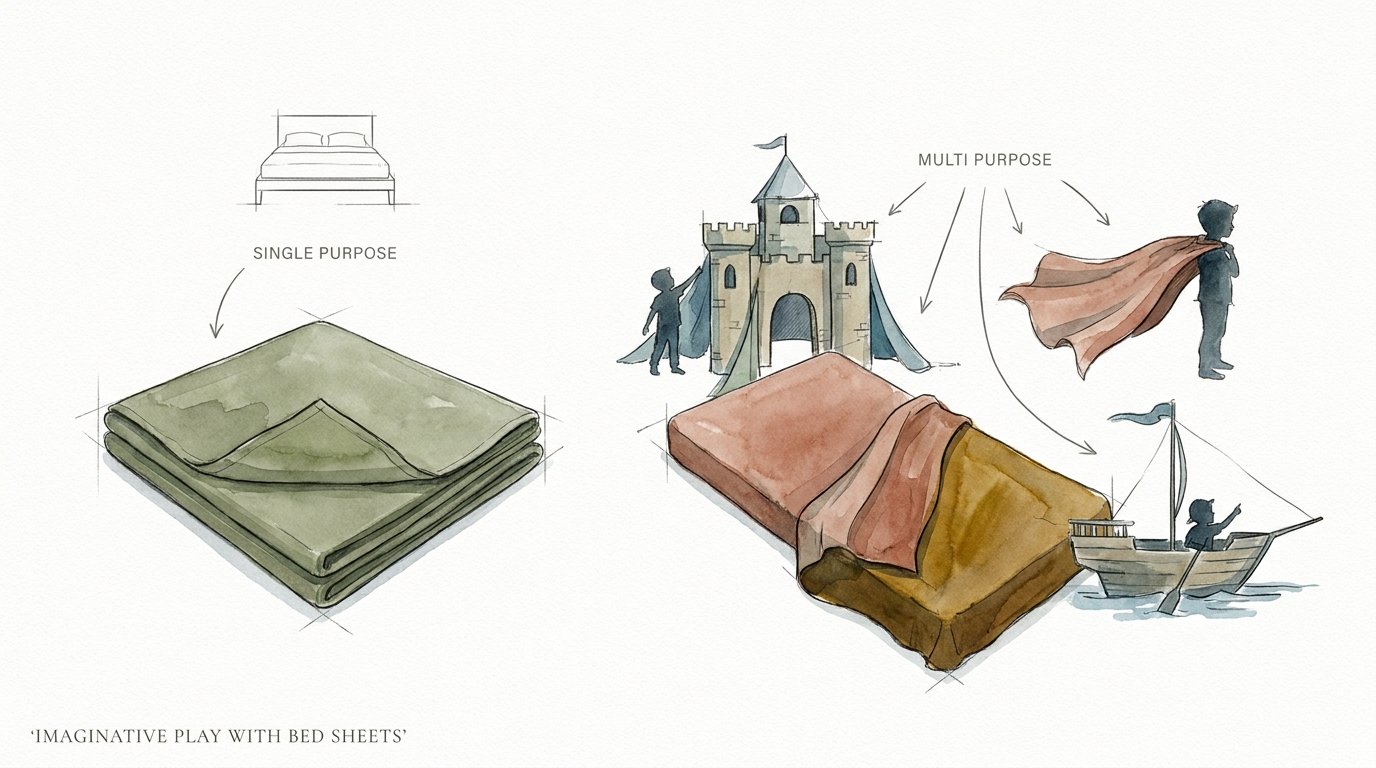
When a toy does only one thing, the imagination stops. When a tool does everything, the play never ends. The most powerful object in your linen closet isn’t for sleeping—it’s for world-building. A sheet requires a child to provide the ‘graphics’ with their own mind, turning a piece of fabric into a universe.
You might see a simple cotton rectangle, but your child sees a portal. This isn’t just about keeping kids busy on a rainy afternoon. It’s about fundamental brain development, engineering, and the “Theory of Loose Parts.”
Welcome to the world of sheet-based play. We are going to dive deep into why this humble fabric is the ultimate developmental tool.
Imaginative Play With Bed Sheets
Imaginative play with bed sheets is the gold standard of “open-ended play.” This concept focuses on materials that have no pre-defined purpose. Unlike a plastic toy kitchen that can only ever be a kitchen, a bed sheet is fluid. It changes its identity based entirely on the user’s intent.
This type of activity falls under what architect Simon Nicholson called “Loose Parts Theory” in 1971. He argued that the richness of an environment is directly proportional to the number of variables in it. A bed sheet is a massive variable. It can be a cape, a ghost, a roof, a sea, or a bandage.
In real-world terms, sheet play exists everywhere from high-end Montessori classrooms to the smallest city apartments. It matters because it forces the brain to engage in “divergent thinking.” This is the ability to generate creative ideas by exploring many possible solutions. When a child looks at a flat sheet and decides it is a roaring waterfall, they are practicing high-level cognitive mapping.
How It Works: The Mechanics of Sheet Construction
Building with sheets is an accidental lesson in structural engineering. To make a structure stay up, children must intuitively understand forces like gravity and tension. Gravity is the constant enemy, trying to pull the fabric toward the center of the earth. Tension is the solution, achieved by pulling the fabric tight and securing it.
Success in sheet play depends on anchor points. These are the sturdy objects in your home that serve as the “foundation” for the structure. Sofa cushions, dining chair backs, and heavy tables are the most common anchors. Children learn that the higher the anchor point, the more interior volume the fort will have.
Connectors are the next piece of the puzzle. While parents often reach for heavy books to hold sheets down, these can be unstable. Professional “fort builders” prefer binder clips, clothespins, or rubber bands. These tools allow children to attach fabric to furniture without damaging the finish.
Benefits of Sheet-Based Play
The practical benefits of playing with sheets go far beyond mere entertainment. This activity engages the child’s entire body and mind simultaneously. It is a full-sensory experience that builds resilience and physical capability.
Cognitive Development: Building a fort requires planning and executive function. A child must visualize the end result and work backward to achieve it. If the roof collapses, they have to troubleshoot the “why.” This is the scientific method in its purest, most playful form.
Gross and Fine Motor Skills: Dragging heavy blankets and stretching sheets across a room provides “heavy work.” This is excellent for proprioceptive input, helping kids understand where their bodies are in space. Manipulating small clips or tying knots in corners sharpens fine motor control and hand-eye coordination.
Social and Emotional Growth: When two or more children build together, they are negotiating. They must agree on the design and the “rules” of the imaginary world. This builds communication skills and the ability to compromise. It also provides a “safe space” or “enveloped space” where children feel secure and in control of their environment.
Challenges and Common Mistakes
The most frequent pitfall in sheet play is structural failure. A child spends twenty minutes building a “castle,” only for the roof to slide off the moment they crawl inside. This happens because of a lack of friction or poor weight distribution. It can lead to intense frustration if not handled correctly.
Another common mistake is using materials that are too heavy for the supports. Using a thick, king-size duvet on top of flimsy dining chairs is a recipe for collapse. The weight of the fabric creates too much downward force for the chair legs to handle safely.
Safety is the biggest concern that parents often overlook. Using heavy objects like glass vases or tall, unstable lamps as anchors is dangerous. If the sheet is pulled suddenly, these objects can fall on the child. Always ensure that anchor points are low-profile and cannot be easily toppled.
Limitations of Sheet Play
While sheets are versatile, they have realistic constraints. Space is the primary limitation. A full-scale “tented village” might not fit in a studio apartment without blocking essential pathways. This requires a trade-off between the complexity of the play and the functionality of the home.
Material type also matters. A silky satin sheet will slip off almost any surface, making it terrible for fort-building. Cotton or flannel sheets have more “tooth” and stay in place better. If you only have slippery fabrics, the play will likely be limited to “dress-up” rather than “construction.”
Age appropriateness is another boundary. Very young toddlers may struggle with the frustration of a falling structure. They might also face a suffocation risk if they become tangled in large amounts of heavy fabric unsupervised. Older children may find simple sheet play “boring” unless you introduce advanced engineering challenges.
Comparison: Sheets vs. Commercial Play Tents
Many parents wonder if they should just buy a pre-made pop-up tent. While commercial tents have their place, they offer a very different experience than sheet play.
| Feature | Bed Sheets (Loose Parts) | Commercial Pop-Up Tents |
|---|---|---|
| Cost | Virtually free ($0 – $10) | $30 – $150+ |
| Creativity | Infinite configurations | Static, one-shape design |
| Storage | Folds flat in a drawer | Bulky, even when folded |
| Skill Building | Engineering and problem solving | Minimal (just “unfolding”) |
| Longevity | Adapts as the child grows | Often outgrown quickly |
Commercial tents are “closed-ended.” They are 90% the toy and 10% the child. A sheet is 10% the tool and 90% the child. Choosing the sheet encourages the child to do the mental work, which is where the development happens.
Practical Tips for the Ultimate Sheet Kit
If you want to optimize your child’s play, create a dedicated “Fort Kit.” This keeps the play organized and prevents your good linen from being ruined. Include a mix of different fabric weights and sizes to allow for variety.
Fabric Selection: Include old flat sheets in Twin, Queen, and King sizes. Avoid fitted sheets for roofs, as the elastic corners make them difficult to stretch flat. However, fitted sheets make excellent “floors” for the fort because they stay tucked around sofa cushions.
The Accessory Bag: Add a dozen sturdy binder clips from the office supply store. Include some lengths of soft rope or thick yarn for “guy lines.” A few rubber bands can help secure fabric to smooth surfaces like bedposts or door handles.
Lighting: Nothing transforms a sheet structure like light. Battery-operated LED string lights are safe because they don’t get hot. They turn a dark cave into a magical bioluminescent forest or a high-tech spaceship dashboard.
Advanced Engineering Considerations
For older children, sheet play can become a lesson in advanced physics. Introduce the concept of “trusses” and triangles. Explain that a square frame is easy to collapse, but a triangle is the strongest shape in architecture. Show them how to use a single broomstick as a “center pole” to create a teepee shape.
Teach them about load-bearing. If they want to hang a “lantern” (a flashlight) from the roof, they need to reinforce that part of the sheet. They can do this by gathering a small “ball” of fabric and tying a string around it to create a hard point for attachment.
Consider the “friction coefficient.” Placing a rubber jar opener between the sheet and a wooden chair can prevent the fabric from sliding. This is a practical application of physics that helps them build taller, more stable structures. It moves the activity from “messing around” to “intentional design.”
Examples and Scenarios
To help children get started, you can suggest specific scenarios that utilize the unique properties of sheets. Each scenario requires a different building technique and narrative style.
Scenario A: The Deep-Sea Submersible. Use blue or green sheets draped over a low table. The “enveloped space” feels like a pressurized cabin. Use a flashlight to search for “giant squids” (stuffed animals) outside the fabric walls. The physical constraint of the low table mimics the cramped quarters of a real submarine.
Scenario B: The Arctic Expedition. Use white sheets spread across the floor to represent snow and ice. Build “ice caves” using chairs. The child must stay on the “ice” (the sheets) to avoid falling into the “freezing water” (the bare floor). This encourages gross motor control and balance.
Scenario C: The Hospital Ward. Hang sheets vertically from a tension rod or a clothesline to create “curtains” between beds. This scenario focuses on social roles and empathy. The sheets provide privacy for the “patients,” mimicking a real-world medical setting.
Final Thoughts
Imaginative play with bed sheets is more than just a way to pass the time. It is a profound developmental exercise that respects the child’s ability to create their own world. By providing simple, open-ended tools, you are giving them the keys to unlock their own creativity and problem-solving potential.
Do not be afraid of the mess. A living room full of draped fabric is a sign of a brain that is working, growing, and learning. These structures are temporary, but the neural pathways they build are permanent.
Encourage your children to experiment with tension, gravity, and narrative. Let them fail, let the roof fall down, and let them figure out how to fix it. The most important thing they are building isn’t a fort—it’s a capable, imaginative mind.
Sources
1 mayrivermontessori.com | 2 childcareed.com | 3 maisonruekid.com | 4 lillio.com | 5 oac.edu.au | 6 kathybrodie.com | 7 invent.org | 8 makeafort.ca | 9 earlysciencematters.org | 10 miriambeloglovsky.com | 11 youtube.com | 12 thelittlelearnerstoys.com | 13 myteachingcupboard.com | 14 3boysandadog.com | 15 thelearningworldvenetian.com | 16 radchildrensfurniture.com | 17 biloban.com | 18 healthychildren.org