how to reduce screen time for kids
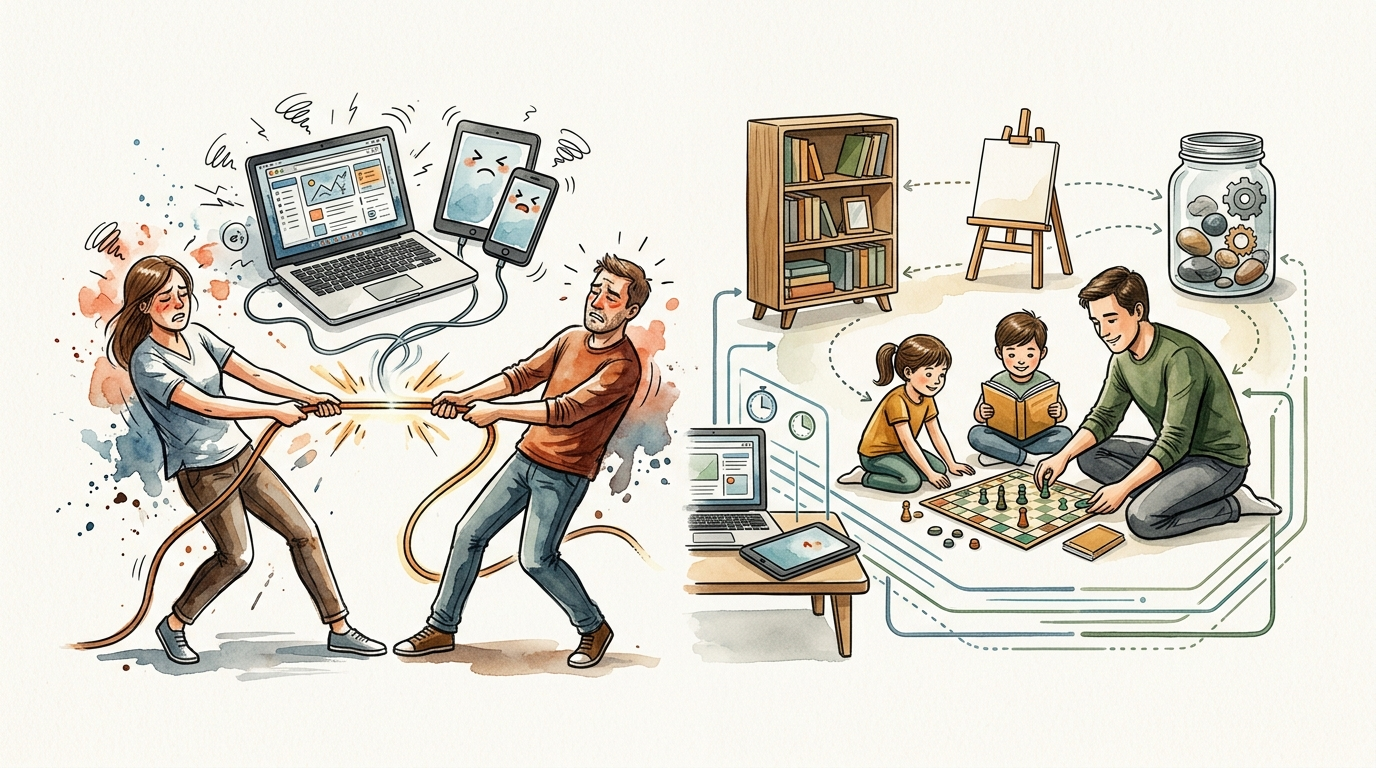
Stop fighting the child; start managing the environment. Strategy beats willpower every time. Don’t spend your energy on daily battles. Use strategic friction to make screens less accessible and real play more inviting.
You have likely felt the exhaustion of the “five-minute” warning that turns into a thirty-minute meltdown. Every parent knows the heavy feeling of watching a child scroll through endless videos while the sun shines outside. You want to reclaim your family time, but the devices feel like they have a stronger pull than you do.
This guide shifts the focus away from your child’s behavior and toward the architecture of your home. Managing screen time is not about being a drill sergeant; it is about being a designer. When you change the environment, the behavior changes on its own.
how to reduce screen time for kids
Reducing screen time for kids is the process of intentionally designing a home environment that prioritizes real-world interaction over digital consumption. It involves moving away from constant verbal reminders and moving toward structural changes that make screens harder to use and physical activities easier to start.
Recent research from the American Academy of Pediatrics (AAP) and other major health organizations has shifted the conversation from “how many minutes” to “what is the context.” In 2026, experts increasingly emphasize quality and conversation over strict timers for older children, while maintaining firm boundaries for the very young.
Excessive screen use exists because digital platforms are engineered to be high-reward and low-effort. Features like autoplay and endless scrolling tap into the brain’s dopamine system, making it nearly impossible for a child’s developing prefrontal cortex to say “enough.”
In real-world terms, reducing screen time means creating a “digital sunset” where devices go to sleep before people do. It means ensuring that bedrooms remain sacred spaces for rest rather than glowing hubs of entertainment. It is about restoring the “boredom threshold” so children can develop the internal drive to create, play, and explore.
The Mechanics of Strategic Friction
Strategic friction is the practice of placing obstacles between a user and an undesirable habit. Willpower is a finite resource that drains throughout the day. Strategic friction preserves your energy by making the “wrong” choice harder to execute.
Start by auditing the physical path to a device. If a tablet is sitting on the coffee table, the friction is zero. The child sees it, wants it, and takes it. If that same tablet is kept in a high kitchen cabinet inside a zippered case, the friction increases significantly.
Digital friction is equally powerful. You can remove “one-click” access by deleting apps that cause the most conflict. Forcing a child to log in through a web browser rather than an app creates just enough of a hurdle to break the automatic habit loop.
Environmental cues act as the opposite of friction. Setting out a basket of new library books or a half-finished puzzle in the center of the room provides an immediate “on-ramp” to non-digital play. You are not just taking away a screen; you are filling the vacuum with something tangible.
Benefits of Environmental Management
Shifting to an environment-first approach offers measurable improvements in family dynamics. You stop being the “bad guy” who constantly says no. The environment does the heavy lifting for you.
Children experience better sleep quality when screens are removed from the evening routine. Removing blue light and high-intensity stimulation allows the pineal gland to release melatonin naturally. This leads to faster sleep onset and deeper rest.
Social and emotional development thrives in the absence of constant digital noise. Without a screen to turn to during moments of boredom or slight social awkwardness, children learn to navigate their feelings. They develop grit and creative problem-solving skills that are often bypassed by the instant gratification of an app.
Long-term brain health is perhaps the most significant advantage. Studies, including a major 13-year longitudinal scan study out of Singapore, suggest that early and excessive screen exposure can alter brain development in areas responsible for focus and emotional regulation. Reducing screen time helps protect these critical neurological pathways.
Challenges and Common Mistakes
The biggest mistake parents make is being inconsistent. A rule that only applies when you are energetic will never be respected when you are tired. Children are experts at finding the cracks in a system, and inconsistency teaches them that if they push hard enough, the boundary will move.
Parental modeling is another frequent pitfall. You cannot expect a child to ignore a tablet while you are scrolling through social media at the dinner table. Children mimic what they see more than what they hear. Your own digital habits set the ceiling for their progress.
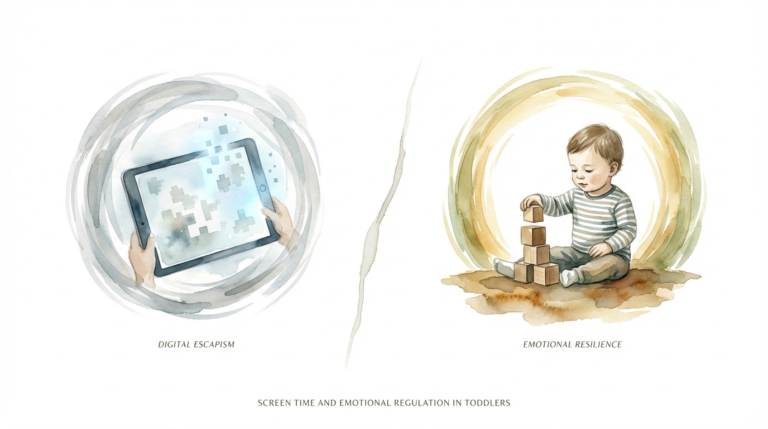
Using screens as a primary emotional regulator is a dangerous cycle. When a child is upset and you hand them a phone to “calm them down,” you are teaching them to outsource their emotional processing to an algorithm. This often leads to a “vicious circle” where the child needs more screen time to cope with the irritability caused by too much screen time.
Underestimating the power of the “amygdala hijack” during transitions is also common. Moving from a high-dopamine activity like gaming to a low-dopamine activity like homework is physically painful for a child’s brain. Expecting them to do this instantly without a transition ritual is a recipe for conflict.
Limitations of This Approach
Environmental management has its boundaries, especially as children age. Teenagers need to develop internal self-regulation rather than just following external locks. Relying solely on friction for a 16-year-old can lead to resentment and secretive behavior.
School requirements can also complicate your strategy. Many modern educational systems require several hours of laptop use for homework. You cannot simply hide the devices when they are necessary tools for academic success. This requires a shift from “avoidance” to “differentiation” between work screens and play screens.
Social inclusion is a real factor for older kids. If every friend is communicating through a specific gaming platform, total restriction can lead to social isolation. In these cases, the goal is not zero screen time, but rather intentional and moderated use that does not displace physical activity or sleep.
Physical space limitations might make “tech-free zones” difficult. In smaller homes, the living room might be the only place to do homework and relax. This requires more creative solutions, like using physical covers for TVs or designated “docking stations” for mobile devices.
Manual Willpower vs. Strategic Friction
| Factor | Manual Willpower | Strategic Friction |
|---|---|---|
| Parental Effort | High (Constant monitoring/yelling) | Low (Set it and forget it) |
| Conflict Level | High (Daily battles) | Low (The “system” says no) |
| Consistency | Difficult to maintain | Built into the environment |
| Child’s Reaction | Resentment toward parent | Acceptance of household “flow” |
| Sustainability | Ends in burnout | Becomes a lifestyle habit |
Practical Tips and Best Practices
Establish a “central charging station” in a common area. No devices should ever be charged in a bedroom overnight. This simple physical rule eliminates the temptation of late-night scrolling and ensures that sleep remains the priority.
Implement a “Digital Sunset” rule. Pick a time, such as 7:00 PM, when all recreational devices are docked. Use this time for reading, board games, or evening walks. Creating a predictable rhythm helps the child’s nervous system wind down.
Use “App Timers” as a backup, not the main solution. Software like Apple Screen Time or Google Family Link can provide a hard stop to an activity. This shifts the role of the “rule-enforcer” from you to the device itself.
Create “Yes Spaces” where physical play is encouraged. If you want them to stop gaming, make sure the craft supplies are accessible and the sports equipment is ready to go. You want the path to “real play” to be the path of least resistance.
Practice “Co-Viewing” with younger children. Instead of using the TV as a babysitter, watch a high-quality program together and talk about it. This turns a passive activity into an active, social, and educational experience.
Advanced Considerations for Digital Architecture
Serious practitioners look at the “Choice Architecture” of the entire home. This involves analyzing the first thing a child sees when they walk into a room. If the TV is the focal point of the living room, it will be the first choice for entertainment. Rotating the furniture so that a bookshelf or a window becomes the focal point can subtly shift behavior.
Understand the “Dopamine Baseline.” When a child is exposed to constant high-intensity digital stimulation, their baseline for what feels “fun” rises. Normal activities like playing with blocks or drawing start to feel boring. Recalibrating this baseline requires a “digital fast” or a period of significantly reduced stimulation to allow the brain to reset.
Leverage your home network at the router level. Many modern routers allow you to create “profiles” for each family member. You can schedule the internet to shut off for specific devices at specific times. This provides a clean, non-negotiable boundary that does not require you to physically take a device away.
Teach “Digital Literacy” alongside limits. As children grow, explain *why* the apps are designed to be addictive. Discuss the “economy of attention.” Children who understand they are being manipulated by an algorithm are more likely to develop a sense of autonomy and resistance to endless scrolling.
Real-World Scenarios
Consider the “After-School Rush.” Usually, children come home exhausted and want to collapse into a screen. In a manual willpower household, the parent yells to put the phone away, and a fight ensues. In a strategic friction household, the devices are already in a timed lockbox that doesn’t open until 5:00 PM. The child, finding the screen inaccessible, automatically moves to the snack table and then to their legos.
Think about the “Saturday Morning Trap.” Instead of the kids waking up and immediately turning on the TV while you sleep, you set out a “Saturday Morning Tray” the night before. This tray contains new coloring pages, a specific toy they haven’t seen in a while, or a simple breakfast they can assemble. The environment provides the “on-ramp” to play before the screen even becomes an option.
In the case of a long car ride, the common move is to hand over tablets immediately. A more strategic approach involves “staged access.” The first hour is for audiobooks or “eye-spy.” The second hour might be for a physical travel game. The tablet only appears for the final stretch of the journey. This manages the child’s expectations and prevents the “screen-fog” that often occurs during long periods of consumption.
Final Thoughts
Managing screen time is not about winning a war against technology. It is about creating a habitat where your children can thrive. Devices are powerful tools, but they are also designed to bypass our natural stopping points. Your job as a parent is to provide the structural support that a child’s brain cannot yet provide for itself.
Focus on the architecture of your home first. When you move the charger, lock the app, and set out the books, you are making the healthy choice the easy choice. You will find that when the environment is managed, the “daily battles” begin to disappear on their own.
Start small by choosing one tech-free zone or one new piece of strategic friction today. Observe how the energy in your home shifts when the screens go dark and the real world comes back into focus. You are not just reducing screen time; you are expanding your child’s life.
Sources
1 actionforhealthykids.org | 2 nexus-education.com | 3 manhattanpsychologygroup.com | 4 hollyburn.ca | 5 choc.org | 6 nsw.gov.au | 7 mayoclinic.org | 8 cacfp.org | 9 myhspediatrics.com | 10 sbm.org | 11 ckfamilyservices.org