healthy screen time for kids
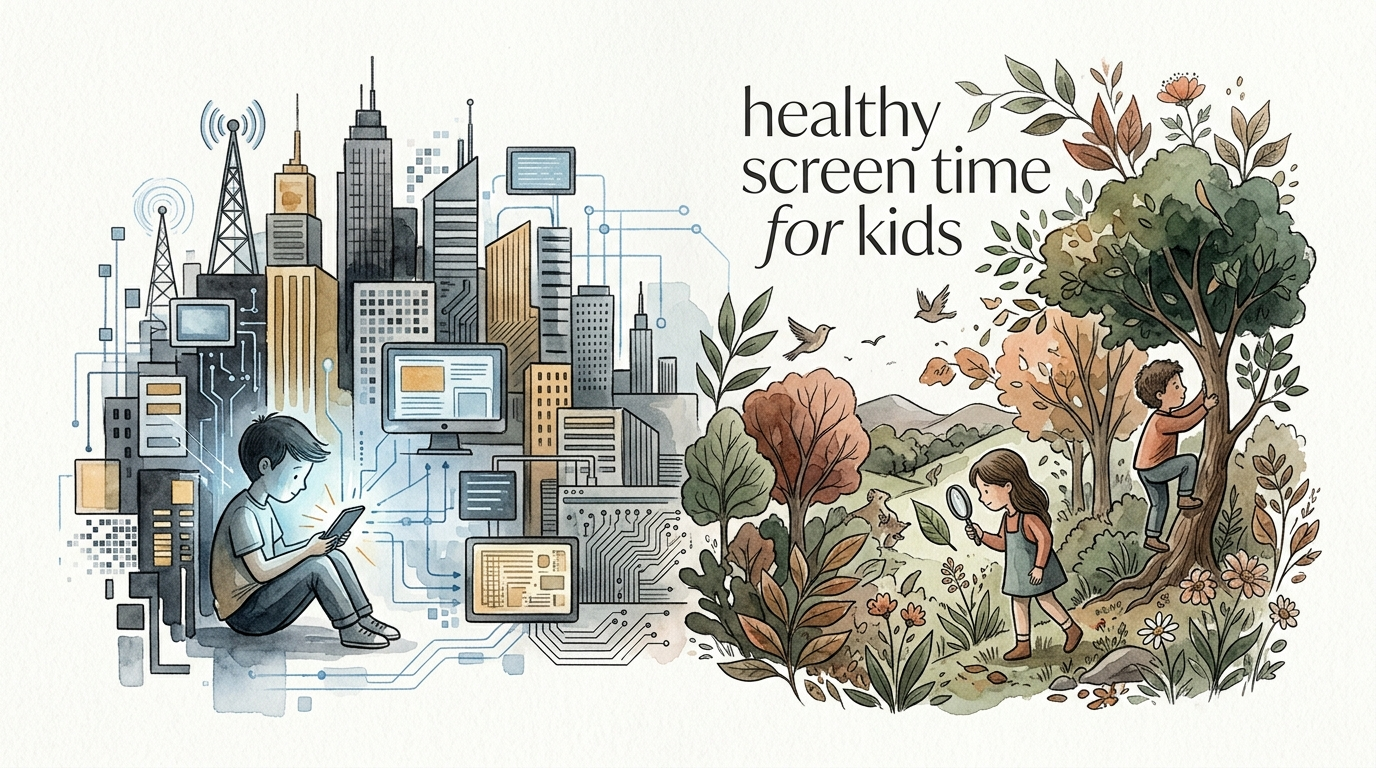
The digital world is a high-traffic city for a child’s brain. They need the ‘wild’ to recover. For every hour spent in the high-stimulus ‘Digital Urban’ environment, kids need an hour in the ‘Analog Wild.’ This balance prevents sensory overload and fosters genuine curiosity.
When children navigate apps, they are effectively walking through a neon-lit metropolis of notifications and rewards. This intense input requires a counterweight—a place where the pace is set by the rustle of leaves rather than the chime of a push notification. Achieving this equilibrium is the key to long-term cognitive health.
healthy screen time for kids
Healthy screen time for kids is no longer just about counting minutes on a clock. In 2025, experts have shifted the focus toward a “balanced digital diet” that prioritizes quality, context, and the type of interaction. It is the practice of using technology as a tool for growth rather than a passive void for consumption.
The concept exists because the human brain, especially one that is still developing, was not designed for the constant, high-octane stimulus found in modern digital ecosystems. Think of a tablet like a sports car; it is powerful and exciting, but if a child spends all day in the driver’s seat, they miss out on the vital developmental work of walking, climbing, and exploring the physical world.
Real-world healthy screen use involves active participation. This means a toddler video-chatting with a grandparent or a teenager using a digital workstation to edit a short film. It is purposeful and bounded. When screens are used this way, they complement a child’s life rather than dominating it.
Current guidelines from the American Academy of Pediatrics emphasize that for children ages 2 to 5, screen time should be limited to about one hour per day of high-quality, educational content. For older children, the focus is on ensuring that digital use does not displace sleep, physical activity, or face-to-face social connections.
How to Implement the 1:1 Balance
The ‘Analog Wild’ refers to environments that provide “soft fascination”—low-intensity stimuli like watching clouds move or water flow. To implement the 1:1 balance, start by auditing your child’s current digital habits. If they spend two hours on a gaming console on a Saturday morning, they should ideally spend two hours in an unstructured, outdoor environment that afternoon.
Step one is to define your “Digital Urban” zones. These are the high-energy, high-dopamine activities like fast-paced video games or short-form video feeds. These activities require “directed attention,” which is a finite mental resource that leads to fatigue when overused.
Step two is to schedule “Analog Wild” recovery. This does not always mean a trip to a national park. It can be as simple as playing in a backyard, visiting a local garden, or even “messy play” with dirt and water. The goal is to allow the child’s brain to switch to “involuntary attention,” where the mind can wander and rest.
Consistency is more important than perfection. If a rainy day leads to extra screen time, use the following clear day to double down on the outdoor hours. This teaches children the principle of self-regulation and helps them recognize the physical feeling of being “over-stimulated.”
Benefits of the Analog Wild Balance
The primary benefit of this approach is the restoration of the “directed attention” system. Research in Attention Restoration Theory suggests that nature exposure allows the prefrontal cortex to recover from the heavy lifting required by digital interfaces. This leads to improved focus when the child returns to schoolwork or complex tasks.
Physical health improvements are immediate and measurable. Outdoor play involves “heavy work”—climbing, jumping, and lifting—which develops motor skills and sensory processing in ways a flat screen cannot. It also helps regulate the circadian rhythm, as exposure to natural light improves sleep quality and duration.
- Emotional Regulation: Nature provides a “low-stakes” environment where children can manage boredom and frustration without the instant gratification of an app.
- Cognitive Flexibility: Unstructured play in the “wild” requires children to invent their own rules and solve physical problems, building creative muscles.
- Reduced Anxiety: The lack of social comparison and algorithmic pressure in the analog world significantly lowers cortisol levels in school-age children.
Challenges and Common Mistakes
One common pitfall is using screen time as a reward for outdoor time. This inadvertently frames the “Analog Wild” as a chore and the “Digital Urban” as the ultimate prize. Instead, present both as essential parts of a healthy day, much like eating a variety of foods.
Another mistake is “Technological Nature.” This happens when parents try to replace real nature with high-definition nature documentaries or VR forest walks. While these are visually impressive, they still require directed attention and do not provide the sensory-rich, multi-dimensional feedback of the physical world.
Parents often struggle with “The Transition Tantrum.” This is the friction that occurs when moving a child from a high-dopamine screen to a low-dopamine reality. It happens because the child’s brain is literally coming down from a chemical high. Understanding this as a physiological response rather than mere “bad behavior” can help parents manage the transition with more empathy.
Limitations of the Method
Environmental constraints are a major factor. For families living in dense urban areas with limited access to green space, the “Analog Wild” can feel out of reach. In these cases, the “wild” must be redefined as any low-stimulus, non-digital environment, such as a quiet library corner or a living room “fort” built with blankets.
Academic requirements also pose a challenge. As schools increasingly rely on digital platforms for homework and research, the “Digital Urban” hours can stack up quickly. It is important to distinguish between “Required Digital Labor” (schoolwork) and “Recreational Digital Urbanism” (social media or gaming) when calculating the balance.
Age-specific needs vary significantly. A teenager may find the 1:1 ratio difficult to maintain due to social expectations and extracurricular loads. In these instances, the focus should shift from strict hourly ratios to “Quality of Life” markers, such as ensuring they have at least one hour of device-free movement every day.
Comparing Digital Urban vs. Analog Wild
Understanding the fundamental differences between these two environments helps parents make better decisions about their child’s daily schedule. The following table highlights how each environment impacts the developing brain.
| Feature | Digital Urban (Screens) | Analog Wild (Nature/Play) |
|---|---|---|
| Attention Type | Directed (High Effort) | Involuntary (Effortless) |
| Feedback Loop | Instant & Algorithmic | Natural & Delayed |
| Sensory Input | 2D (Sight/Sound) | 3D (Multi-sensory) |
| Dopamine Level | High / Artificial | Low / Sustained |
| Physicality | Sedentary | Active / Dynamic |
Practical Tips for Digital Wellness
Start by creating “Tech-Free Transit.” This means no phones or tablets in the car. This small window of time allows a child to stare out the window, observe the world passing by, and practice the art of “being bored,” which is a precursor to creative thinking.
Implement the “Blue Light Sunset.” Ensure all high-stimulus screens are powered down at least 60 to 90 minutes before bedtime. This allows the brain to begin the natural production of melatonin, which is suppressed by the blue light emitted from tablets and smartphones.
- Co-viewing: Whenever possible, watch or play with your child. This turns a passive activity into a social one, allowing for “on-the-fly” media literacy lessons.
- Curated Feeds: Use tools to block “endless scroll” features on platforms. If a video ends, the screen should go dark rather than auto-playing the next suggestion.
- Nature Buckets: Keep a kit of outdoor gear (magnifying glasses, balls, chalk) near the door to make the transition to the “Analog Wild” friction-free.
Advanced Considerations for Practitioners
Serious practitioners of digital wellness should look into the concept of “Neural Pruning.” The brain builds connections based on what it does most often. If a child’s brain is primarily “wired” for the fast-twitch responses required by gaming, it may prune away the pathways needed for long-term contemplation and deep reading.
Consider the “5 C’s” framework: Child, Content, Calm, Crowding out, and Communication. This advanced strategy moves beyond time limits to analyze if media is “crowding out” essential behaviors like sleep or family meals. It also looks at the “Calm” factor—does the child use the screen to numb emotions rather than learning to self-soothe?
Performance optimization for students involves using the “Analog Wild” as a pre-study ritual. A 20-minute walk in a park has been shown to improve test scores and memory retention more effectively than a 20-minute nap or a digital break. This is because nature clears the “attentional smog” accumulated during a day of classroom learning.
Example Scenario: A Balanced Saturday
Consider a 10-year-old child named Leo. On Saturday morning, Leo spends 90 minutes playing an online building game with his friends. This is his “Digital Urban” time. He is focused, his heart rate is slightly elevated, and his brain is managing complex social and spatial data.
After lunch, the family applies the 1:1 rule. Leo spends the next 90 minutes at a local park. He isn’t given a task; he simply wanders, climbs a tree, and watches a group of dogs playing. His brain shifts from the “hard fascination” of the game to the “soft fascination” of the park.
By evening, Leo’s “directed attention” has been replenished. He is less irritable, more willing to engage in conversation at dinner, and falls asleep easily because his sensory system has been regulated by the balance of high-intensity digital input and low-intensity analog recovery.
Final Thoughts
The goal of balancing the Digital Urban with the Analog Wild is not to demonize technology. In fact, understanding the “wild” makes the “digital” more productive. When a child’s brain is rested and regulated, they bring more creativity and better decision-making to their time online.
We are the first generation of parents and educators navigating this specific neuro-landscape. There is no perfect roadmap, but the principle of biological balance is a reliable compass. By protecting the ‘wild’ spaces in a child’s life, we ensure their ‘digital’ future is built on a foundation of mental clarity and emotional strength.
Encourage your children to experiment with these boundaries. Let them feel the difference between the buzz of an app and the calm of the woods. Over time, they will learn to seek out the Analog Wild on their own, developing a lifelong skill for maintaining their own mental wellness in an increasingly crowded digital city.
Sources
1 biglifejournal.com | 2 mayoclinichealthsystem.org | 3 myhspediatrics.com | 4 choc.org | 5 cacfp.org | 6 ccrcca.org | 7 ecehh.org | 8 compasschildcare.com | 9 inhf.org | 10 asla.org | 11 childrenandnature.org | 12 harvard.edu | 13 aap.org | 14 substack.com | 15 frontiersin.org | 16 greatcaringdocs.com | 17 healthychildren.org | 18 wikipedia.org