screen free evening routine
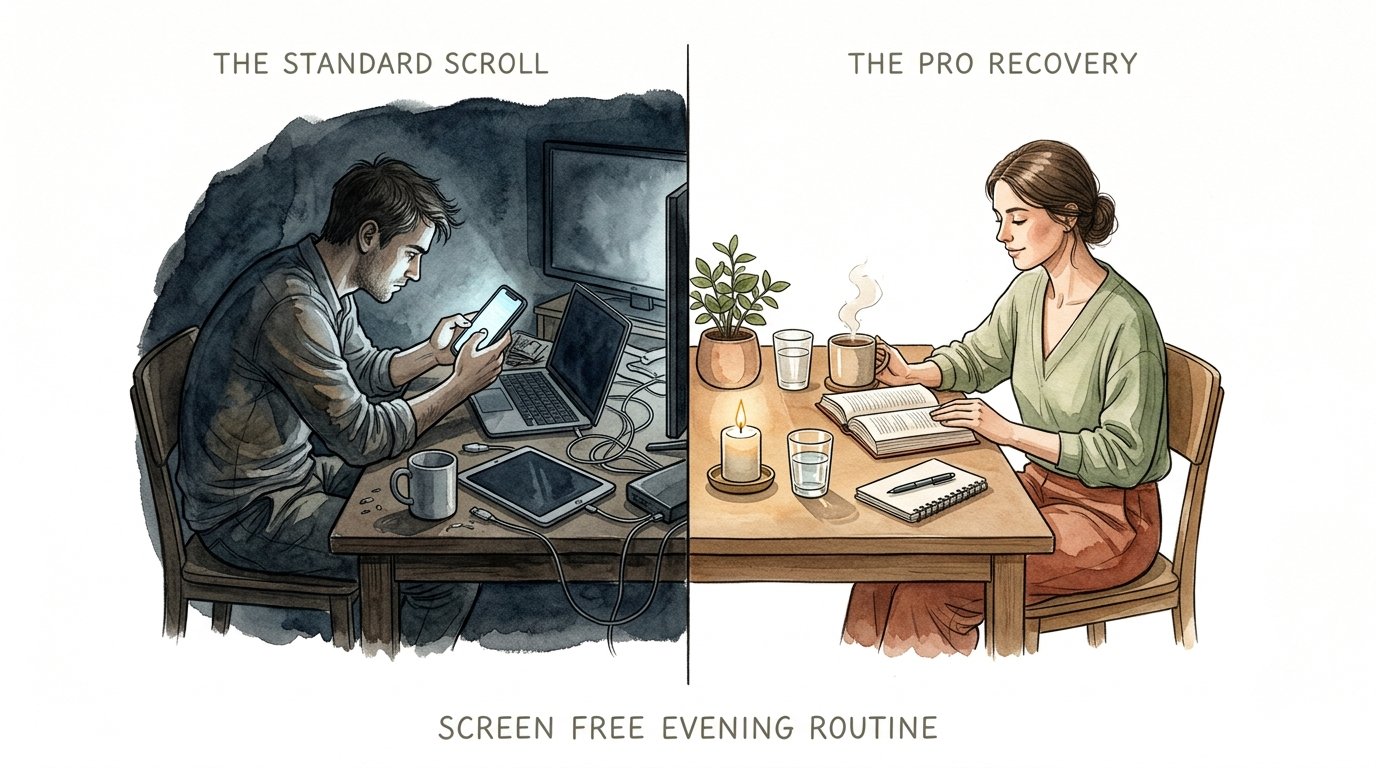
Upgrade your sleep from ‘standard’ to ‘pro.’ The world’s highest achievers don’t end their day on TikTok. They use a pro-level recovery routine to reset their brains. Join the elite.
You are likely reading this because your current night routine isn’t working. Maybe you feel wired but tired. Perhaps you wake up groggy despite getting eight hours of sleep. Most people treat their evenings like a “leftover” part of the day. They scroll until they pass out.
High performers view the evening differently. It is not just time away from work. It is a critical window for physiological and cognitive restoration. Transitioning into a pro-level routine means reclaiming your biology from the algorithms designed to keep you awake.
This guide will walk you through the mechanics of a screen free evening routine. You will learn why blue light is a performance killer. You will discover how to manage your hormones for deep, restorative rest. Let’s dive in.
screen free evening routine
A screen free evening routine is a deliberate period before bed where you eliminate all digital devices. This includes smartphones, tablets, laptops, and televisions. It is often called a “Digital Sunset.”
This practice exists to align your body with its natural circadian rhythm. Modern technology emits artificial light that tricks your brain into thinking it is noon. By removing screens, you allow your brain to recognize the transition into night. Real-world implementation usually starts 60 to 90 minutes before your head hits the pillow.
Think of it like a plane landing. A pilot doesn’t just cut the engines at 30,000 feet. They follow a gradual descent protocol. Your brain needs that same descent to move from high-beta work waves into alpha and theta states. It is used by CEOs, elite athletes, and top researchers to ensure they hit the ground running the next morning.
The Physiology of Performance: How It Works
The core principle behind this routine involves two major players: melatonin and cortisol. Melatonin is your “sleep hormone.” It begins to rise as the sun goes down. Cortisol is your “alertness hormone.” It should be high in the morning and low at night.
Blue light specifically targets the melanopsin-containing cells in your eyes. Research shows that blue light suppresses melatonin production twice as effectively as other wavelengths. This shift can delay your internal clock by hours. When you look at a screen at 10 PM, your brain thinks it is actually 7 PM.
Beyond light, the content itself matters. Social media is designed to trigger dopamine loops. Every notification or “outrage” tweet causes a micro-spike in cortisol. Your body enters a “fight or flight” mode because your amygdala cannot tell the difference between a work email and a predator. Lowering these levels is essential for entering REM and deep sleep cycles.
Elite Benefits: Why the Pros Unplug
The most immediate benefit is reduced sleep latency. This is the technical term for how long it takes you to fall asleep. People who ditch screens often fall asleep 20 to 30 minutes faster than those who scroll. Every minute saved here is extra time for deep tissue repair.
Cognitive clarity is the second major advantage. During sleep, your brain’s glymphatic system flushes out metabolic waste. This “brain washing” process is most effective during deep, uninterrupted sleep. A screen-free start ensures your brain cycles into these deep phases sooner, leading to better memory and focus the next day.
Emotional regulation also sees a massive boost. Scrolling late at night often exposes us to “doomscrolling” or social comparison. This leads to increased anxiety and a restless mind. By unplugging, you create a psychological buffer. You start the next day with a “clean slate” rather than reacting to yesterday’s digital noise.
Challenges and Common Mistakes
Digital addiction is the biggest hurdle. Most people have a physiological craving for the dopamine hit provided by a phone. You might feel “phantom vibrations” or a sense of FOMO (Fear Of Missing Out). This is a normal withdrawal symptom that usually fades after seven to ten days of consistency.
Another common mistake is “the replacement trap.” People put down the phone but turn on a high-definition TV. While the screen is further away, it still emits significant blue light and provides high-arousal content. A pro-level routine requires a complete break from all backlit displays.
Failing to plan for the “void” is a third pitfall. If you don’t have a screen-free activity ready, you will gravitate back to your phone out of boredom. You need to have physical books, a journal, or a hobby prepared. Boredom is often the precursor to a relapse into scrolling.
Limitations and Realistic Constraints
This method has practical boundaries. For example, shift workers or medical professionals on-call may not have the luxury of a 90-minute digital sunset. In these cases, the focus shifts to mitigation. Using high-quality blue-light blocking glasses (the orange-tinted ones) can help protect the circadian rhythm even when screens are necessary.
Parents with young children also face unique challenges. The “witching hour” often requires high alert levels. If a screen-free block is impossible, practitioners should aim for “micro-detoxes.” Even 15 minutes of device-free time before bed is better than zero.
Environmental trade-offs are another factor. Living in a small studio apartment where your “office” is also your “bedroom” makes the psychological separation difficult. In these settings, physical barriers like putting the phone in a timed kitchen safe or a different room become essential tools for success.
The Comparison: Standard Scroll vs. Pro Recovery
| Feature | The Standard Scroll | The Pro Recovery |
|---|---|---|
| Hormone State | High Cortisol, Low Melatonin | Low Cortisol, High Melatonin |
| Mental Activity | Reactive / Stimulated | Proactive / Reflective |
| Sleep Quality | Fragmented / Light | Deep / Restorative |
| Next Day Focus | Brain Fog / Low Energy | High Clarity / Sustained Drive |
Practical Tips: The 10-3-2-1-0 Protocol
Serious practitioners often use the 10-3-2-1-0 formula to automate their success. This system removes the guesswork and creates a predictable path to high performance. It starts long before you enter the bedroom.
- 10 Hours Before Bed: Stop all caffeine consumption. Caffeine has a half-life of about 5-6 hours. It can stay in your system long enough to block adenosine receptors, preventing the “sleep pressure” you need.
- 3 Hours Before Bed: Stop eating large meals and consuming alcohol. Digestion requires energy and raises core body temperature. Alcohol may help you fall asleep, but it destroys REM quality.
- 2 Hours Before Bed: Stop working. Close the laptop. No more Slacks or emails. This tells your brain the “hunting and gathering” phase of the day is over.
- 1 Hour Before Bed: No more screens. This is the “Digital Sunset.” Turn off the TV and put the phone in another room.
- 0 Times: The number of times you hit the snooze button in the morning. A pro-level routine ends with a decisive start to the day.
Focus on low-arousal activities during your screen-free hour. Reading a physical book (fiction is often better than business) helps transport your mind. Light stretching or yoga can lower physical tension. Journaling—specifically a “brain dump” of tomorrow’s to-do list—clears cognitive loops that cause middle-of-the-night wake-ups.
Advanced Considerations for High Performers
Once you have mastered the basics, you can optimize your environment. Temperature is a major lever. Your core body temperature needs to drop by about 2 degrees Fahrenheit to initiate sleep. Keeping your bedroom at 65-68 degrees Fahrenheit (18 degrees Celsius) is the gold standard.
Consider the “Red Light” transition. Red wavelengths do not suppress melatonin like blue or green light. Swapping your bedside lamps with red or warm amber bulbs can further signal to your brain that it is time to wind down. This creates a “cave-like” environment that our ancestors’ brains are hard-wired to recognize.
Supplementation can play a role, but only as a secondary support. Magnesium glycinate is frequently used by high performers to support muscle relaxation and nervous system calm. However, a pill cannot outrun a bad screen habit. Fix the routine first, then optimize with supplements if needed.
Example Scenario: The Sunday Reset
Imagine it is 8:30 PM on a Sunday. You plan to be in bed by 10:00 PM to wake up at 6:00 AM for a big project. Instead of scrolling through news, your routine looks like this:
8:30 PM: You set a “Digital Sunset” alarm. You put your phone on a charger in the kitchen. You close the laptop and put it in your bag. The house lights are dimmed to 20%.
8:45 PM: You take a warm shower. The transition from the warm water to the cooler air of the bedroom helps trigger the core temperature drop needed for sleep. You change into comfortable, breathable sleepwear.
9:15 PM: You sit in a comfortable chair—not the bed—and read 20 pages of a physical book. Your brain begins to produce alpha waves. You feel a natural heaviness in your eyelids as melatonin flows freely.
9:45 PM: You spend five minutes journaling. You write down three things you are grateful for and the “Top 3” tasks you must accomplish tomorrow. This “closes the loops” in your mind. You move to the bed, which is now a dedicated zone for sleep only.
Final Thoughts
Implementing a screen free evening routine is the single most effective way to upgrade your cognitive performance. It is a biological hack that requires zero expensive equipment. By respecting your circadian rhythm, you allow your brain to perform the deep maintenance it needs to lead, create, and solve problems.
Start small. Do not try to overhaul your entire life tonight. Try a 15-minute digital sunset for three days. Once that feels natural, expand to 30 minutes. The results—the clarity, the energy, and the focus—will speak for themselves. You aren’t just sleeping; you are recovering like a professional.
The elite don’t leave their recovery to chance. They design it. Put the phone down. Pick up a book. Reset your brain. Your future self will thank you for the extra edge.
Sources
1 medium.com | 2 earlytorise.com | 3 goodhousekeeping.com | 4 jaimedicalsystems.com | 5 lifegoalsmag.com | 6 trinityhealth.com | 7 msu.edu | 8 hcahoustonhealthcare.com | 9 thensf.org | 10 sbm.org | 11 verizon.com | 12 thepcosdietitian.co.uk | 13 foundmyfitness.com | 14 harvard.edu | 15 freedom.to | 16 drkristinedwards.com | 17 cdc.gov