screen time healthy
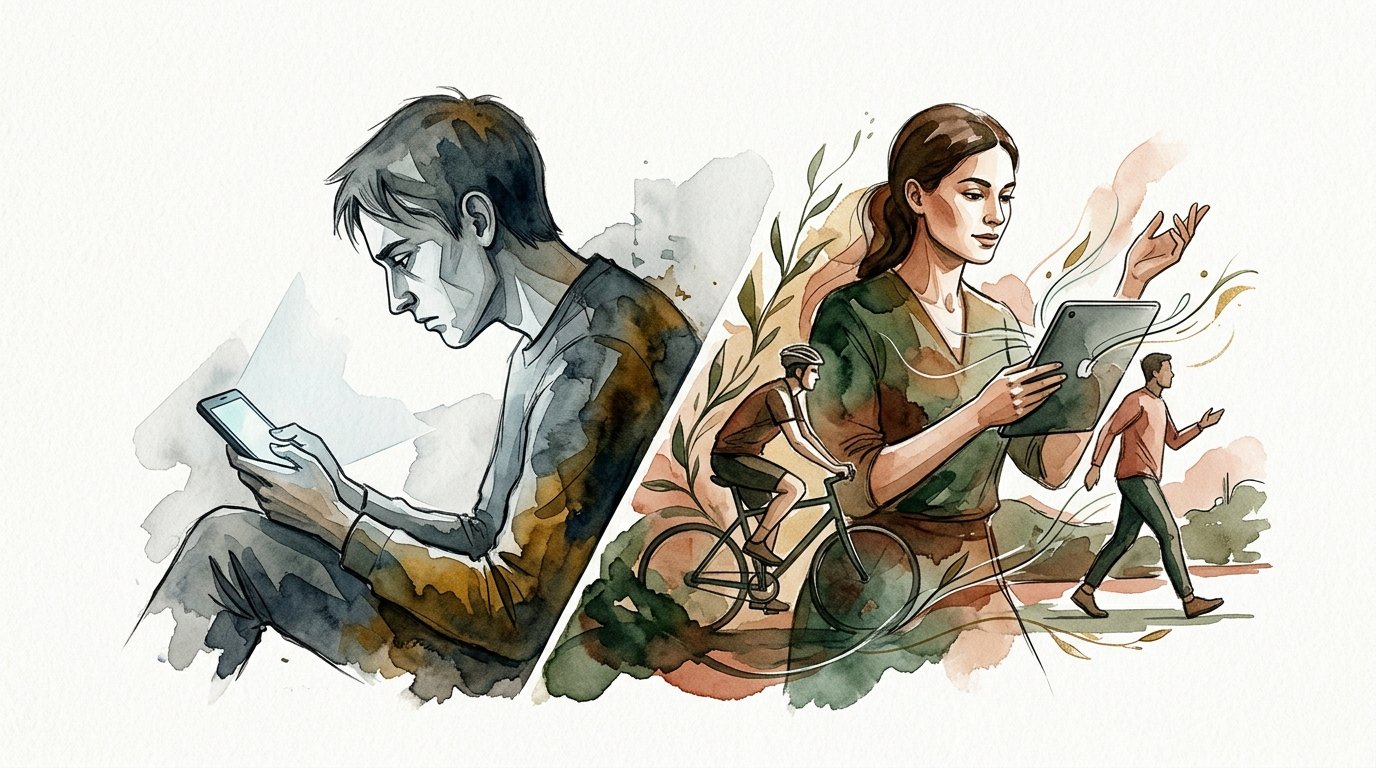
Is your screen time keeping you frozen in place? Screens turn us into statues. True health is found in movement and the real world. Here is how to transition from static scrolling to dynamic living.
The modern world is designed to keep you seated. We wake up to an alarm on a glowing rectangle. We spend hours leaning into monitors for work. We “relax” by staring at a slightly larger screen until our eyes burn. This lifestyle has created a silent epidemic of physical and mental stagnation.
The Static Stare has replaced the natural human rhythm of exploration and effort. Our bodies are marvels of engineering, built for range, speed, and endurance. Yet, we use them primarily as holders for our mobile devices. Breaking this cycle is not just about “using less phone.” It is about reclaiming your biological heritage of movement.
This guide will show you how to melt the digital ice. You will learn to recognize when your tech is a tool and when it is a cage. We will explore the science of why screens keep us paralyzed and, more importantly, how to start moving again.
screen time healthy
The concept of being screen time healthy is not about total elimination. It is about intentionality and balance. In its simplest form, healthy screen use is active rather than passive. It is using a device to achieve a specific goal—like learning a skill, navigating a new city, or connecting with a loved one—rather than falling into a bottomless pit of algorithmic consumption [1.2.3, 1.2.5].
Current health guidelines suggest that for adults, recreational screen time should ideally be limited to less than two hours per day outside of work [1.2.7, 1.6.2]. For children, the limits are even stricter, with experts recommending no screen time for those under two and very limited, high-quality exposure for toddlers [1.2.1, 1.2.4].
Why does this matter? Because screens are inherently sedentary. When you are staring at a screen, your energy expenditure is at its lowest possible level [1.2.1]. Your heart rate remains flat. Your muscles go slack. Your metabolism slows to a crawl. Over time, this “statue state” leads to metabolic disorders, vision degradation (myopia), and a decline in cardiovascular fitness [1.1.2, 1.1.8].
Real-world healthy screen time looks like this:
- Using a fitness app to guide a 20-minute workout.
- Looking up a recipe and then putting the phone away to cook.
- Video-calling a distant relative for twenty minutes of focused conversation [1.1.7].
- Participating in an online course that requires you to step away and practice.
Healthy screen use serves the user. Unhealthy screen use serves the platform. When your screen time is healthy, it acts as a bridge to the real world, not a substitute for it.
How to Transition from Static to Dynamic Living
Moving from a screen-centric life to a movement-centric one requires a systematic approach. You cannot simply willpower your way out of a dopamine-driven habit loop. You need to redesign your environment to make movement the path of least resistance.
Step 1: Audit Your Stagnation. Before you can change, you must see the problem. Most modern smartphones have built-in trackers that show exactly how many hours you spend in the “static stare.” Look at these numbers. Do not judge them, just observe them. Americans now average over five hours of phone use daily, a 14% increase in just one year [1.1.6].
Step 2: Implement “Movement Snacks.” You do not need to spend two hours at the gym to be dynamic. Instead, break the static cycle every 30 minutes. Stand up. Stretch. Walk to the window. These micro-movements keep your metabolism active and prevent the “brain fry” associated with long-term screen use [1.3.3, 1.5.4].
Step 3: Create Friction for Digital Consumption. Make it harder to be static. Move social media apps off your home screen. Turn off all non-human notifications. If you have to dig through three folders to find an app, you are less likely to open it out of boredom [1.5.1, 1.5.5].
Step 4: Establish Digital Sunsets. Your body needs time to downshift. Blue light from screens tricks your brain into thinking it is midday, suppressing melatonin and ruining sleep quality [1.6.5, 1.6.7]. Turn off all screens at least 60 minutes before bed. Replace the screen with a physical book or a stretching routine [1.2.7, 1.6.5].
Step 5: Practice “2007 Mode.” This is an advanced technique popularized by digital minimalists. Try to use your phone like it’s 2007—only for calls, texts, and essential utilities like maps or music. Treat the “smart” features as tools you only pick up when you have a specific task to perform [1.5.4].
The Benefits of a Life in Motion
When you trade the static stare for the dynamic flow, the changes are both immediate and cumulative. Your body and mind were designed for the real world, and they reward you when you return to it.
Physiological Restoration. Regular movement improves cardiovascular health, strengthens bone density, and maintains muscle mass [1.3.1, 1.3.7]. More importantly, it reverses the damage of “tech neck” and sedentary stiffness. Standing and moving more helps regulate blood sugar and reduces the risk of type 2 diabetes and heart disease [1.3.1, 1.3.7].
Cognitive Clarity. Screens provide “impoverished stimulation” compared to reality [1.6.3]. Moving through physical space forces your brain to process complex, 3D information. This boosts neuroplasticity and executive function. Studies show that people who balance screen time with physical activity have better focus and lower rates of anxiety and depression [1.1.1, 1.6.4].
Neurological Balance. Constant scrolling creates a dopamine-loop that leaves you feeling “wired but tired.” Physical movement releases a more balanced cocktail of neurotransmitters, including endorphins and serotonin. This provides a sense of genuine accomplishment rather than the hollow “high” of a social media notification [1.6.4].
Vision Protection. Our eyes are suffering from a global epidemic of myopia because we spend too much time looking at things inches from our faces [1.1.2, 1.1.8]. Spending time outdoors and looking at the horizon allows the eye muscles to relax and reset. This is essential for long-term ocular health [1.6.2].
Challenges and Common Mistakes
The road to dynamic living is paved with digital traps. Understanding these pitfalls is the first step toward avoiding them.
The “Everything or Nothing” Fallacy. Many people try to delete every app and throw away their TV in a single day. This usually leads to a “relapse” within 48 hours. Human behavior changes best in increments. Start by replacing just 1% of your screen time with a walk [1.5.2].
Mistaking Work for Vitality. Just because you are “busy” on a screen doesn’t mean you are active. We often use the excuse of “work” to justify 12 hours of sitting. High-intensity mental work requires high-intensity physical breaks to maintain performance.
Ignoring the Dopamine Withdrawal. When you stop scrolling, you will feel bored. This is a good thing. Boredom is the space where creativity and imagination happen [1.6.3]. If you immediately reach for your phone the second you feel a “twitch” of boredom, you never allow your brain to reset [1.5.5].
The Social Media Comparison Trap. It is common to use screens to “look” for inspiration on how to be active. You might spend an hour watching people do yoga on Instagram instead of actually doing three minutes of yoga. This is a classic “Static Stare” trap. Knowledge without action is just more stagnation.
Limitations and Realistic Constraints
While a dynamic life is the goal, we must acknowledge the realities of the 21st century. Technology is woven into the fabric of our survival.
Professional Necessity. For many, the “Static Stare” is a job requirement. Software developers, writers, and analysts cannot simply “stop using screens.” In these cases, the focus must be on ergonomic optimization and compensatory movement. If you must sit for eight hours, you must move with intention for the other sixteen.
Environmental Boundaries. Not everyone has access to safe parks or hiking trails. Urban environments can make dynamic living more challenging. In these situations, “home-based” movement, like bodyweight exercises or stretching, becomes the primary tool for breaking the static cycle.
Physical Limitations. Not everyone can go for a five-mile run. However, dynamic living is relative. For some, it may mean chair-based yoga or walking to the mailbox. The goal is to move *more* than you do now, regardless of your starting point [1.3.7, 1.4.3].
The Static Stare vs. The Dynamic Flow
To help visualize the difference, consider how these two states impact your daily experience.
| Feature | The Static Stare (Screen-Bound) | The Dynamic Flow (Real-World) |
|---|---|---|
| Body Posture | Curbed spine, forward head, shallow breath [1.6.1] | Open chest, engaged core, full lung capacity [1.4.5] |
| Focus Type | Fragmented, reactive, dopamine-seeking [1.6.4] | Deep, intentional, goal-oriented |
| Energy Levels | “Wired but tired,” mental fatigue [1.6.7] | Natural rhythm, physical fatigue, mental rest [1.3.7] |
| Eye Health | Fixed near-point, strained muscles [1.1.2] | Variegated depth, relaxed focus [1.6.2] |
| Social Input | Curated, artificial, comparison-heavy [1.6.7] | Spontaneous, nuanced, authentic [1.1.7] |
Practical Tips for a Daily Reset
You can start reclaiming your vitality today. Use these actionable strategies to weave movement back into your digital life.
- The 20-20-20 Rule: Every 20 minutes, look at something 20 feet away for 20 seconds. This simple habit prevents digital eye strain and forces a micro-break in your sitting posture [1.2.7, 1.6.2].
- Phone Parking: Designate a drawer or a bowl as the “phone park.” When you walk through the front door, the phone stays there. This prevents the “nervous twitch” of checking notifications while you are trying to be present with your family [1.5.1].
- Walking Calls: If a meeting doesn’t require a screen, take it on your feet. Walking while talking actually improves creative problem-solving and keeps your body out of the “statue” state [1.3.3].
- Grayscale Your Screen: Color is one of the primary ways apps keep you hooked. Switching your phone to grayscale makes the digital world look dull and unappealing, naturally reducing your desire to scroll [1.5.1].
- The “One-In, One-Out” Rule: For every hour of recreational screen time, commit to 15 minutes of physical movement. This creates a natural “tax” on your static time.
Advanced Considerations for Serious Practitioners
If you want to go deeper, you must address the architecture of your digital life. This is where Digital Minimalism moves from a habit to a philosophy.
Decentralize Your Devices. Modern smartphones are “everything machines.” They are your camera, your map, your bank, and your entertainment. This makes them impossible to put down. By using single-use devices—like a dedicated digital camera, a physical alarm clock, or a paper map—you reduce the “gravity” of the smartphone [1.5.3, 1.5.4].
The “Digital Sabbath.” Commit to 24 hours every week with zero screen time. This “fast” allows your nervous system to fully down-regulate. It reveals just how much of your daily activity is driven by digital compulsion rather than genuine need.
Algorithmic Pruning. Your social media feeds are programmed to keep you angry, anxious, or envious. Actively unfollow any account that doesn’t provide high-quality, actionable value. Your “digital nutrition” should be as carefully curated as your physical diet [1.1.7].
Scenario: The Digital Desk Worker
Consider Alex, a software developer who spends 10 hours a day in front of monitors. Alex feels stiff, has chronic headaches, and struggles with brain fog by 3:00 PM.
To transition to a more dynamic life, Alex makes three changes:
1. **Morning Horizon:** Instead of checking email in bed, Alex spends the first five minutes of the day on the balcony looking at the horizon [1.6.2].
2. **Standing Desk Intervals:** Alex alternates between sitting and standing every 45 minutes, using a simple timer.
3. **The “Commute” Walk:** Since Alex works from home, there is no commute. Alex creates one by walking around the block for 15 minutes before and after work. This physical “bookend” tells the brain when it is time to be static and when it is time to be dynamic [1.5.1].
Within two weeks, Alex’s headaches vanish. The brain fog lifts because the blood is actually moving. Alex is still a “screen worker,” but no longer a “screen statue.”
Final Thoughts
Screens are not the enemy, but they are powerful tools that require mastery. If you do not have a plan for your technology, the technology has a plan for you. That plan usually involves keeping you seated, silent, and staring for as long as possible.
True health is found in the resistance to this stagnation. It is found in the stretch of a muscle, the depth of a breath, and the clarity of a mind that isn’t being constantly interrupted by a notification. Transitioning from a static life to a dynamic one doesn’t happen overnight. It happens one “movement snack” at a time.
Reclaim your space. Reclaim your focus. Most importantly, reclaim your movement. The world is waiting for you to look up. Now, put this screen down and go for a walk.
Sources
1 nirvanahealthcare.com | 2 simplebyemmy.com | 3 msu.edu | 4 recordablebookbuddy.com | 5 reddit.com | 6 medlineplus.gov | 7 ne.gov | 8 cdc.gov | 9 stanford.edu | 10 benchmarkpt.com | 11 heart.org | 12 harmonyhit.com | 13 harvard.edu | 14 covenanthealth.com | 15 cbwchc.org | 16 nih.gov | 17 osfhealthcare.org | 18 nih.gov | 19 nih.gov | 20 orangetheory.com | 21 cdc.gov | 22 osu.edu