what is a healthy screen time
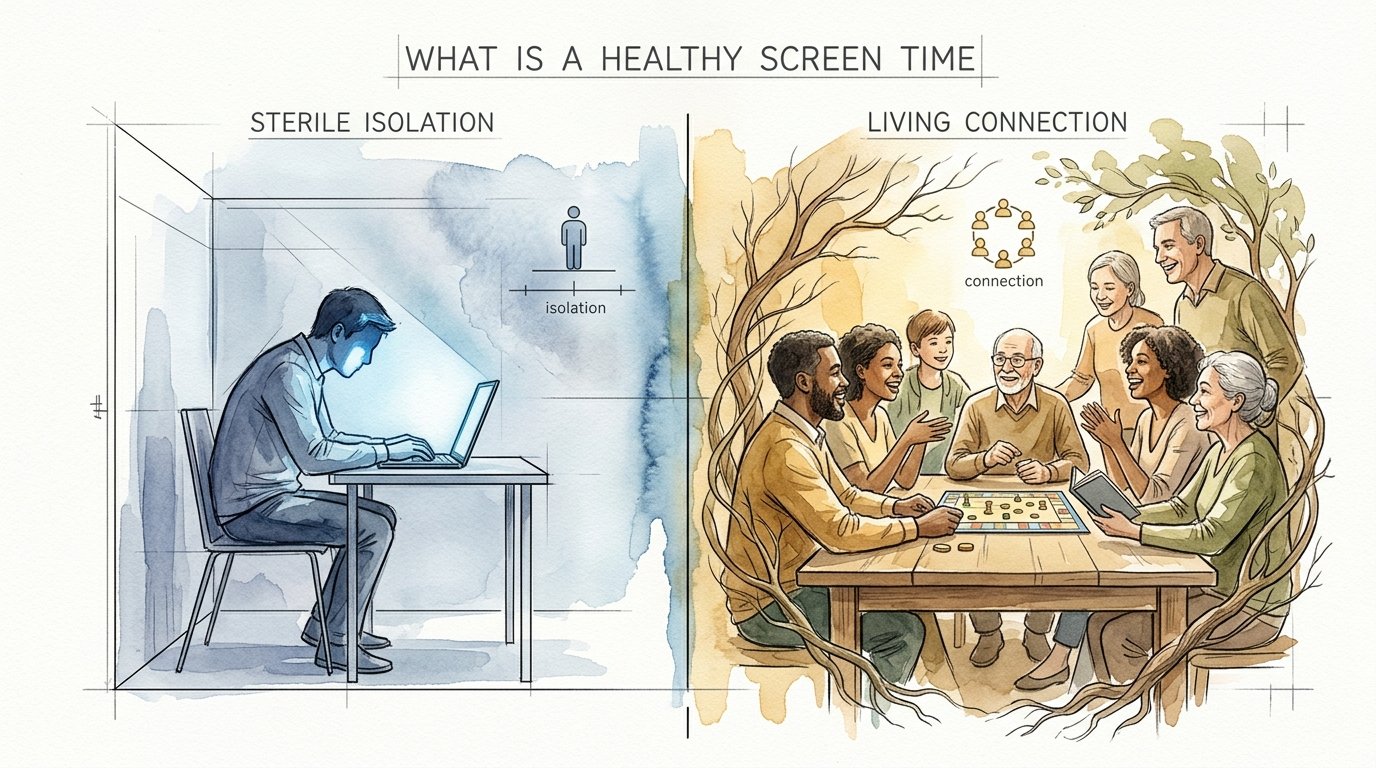
Healthy screen time isn’t just a number—it’s the difference between a dead connection and a living interaction. We focus so much on the hours that we forget the quality. If your screen time facilitates real-world connection, it’s not ‘bad’ time.
what is a healthy screen time
Healthy screen time is defined by intentionality rather than just the clock. In 2026, experts have moved beyond the “stopwatch” method of digital management. The American Academy of Pediatrics now prioritizes quality, context, and conversation over strict hourly limits for most age groups.
Think of digital use like food. A high-protein meal is not the same as a bowl of sugar, even if they have the same calories. Passive scrolling is the “junk food” of the digital world. Active creation, learning, or video-calling family is the “nourishment.”
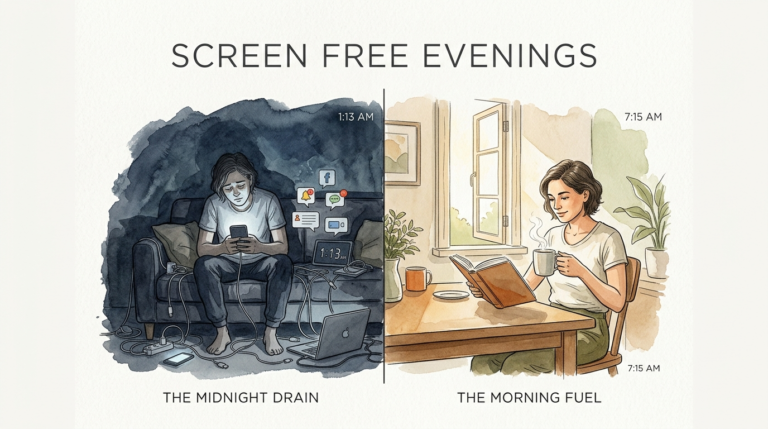
Real-world application means checking your digital health by how you feel after use. Do you feel drained or inspired? A healthy relationship with your device supports your goals without displacing sleep, exercise, or face-to-face interaction. It exists to serve you, not to keep you trapped in a loop.
How the Digital Connection Works
Understanding your screen time requires looking at the neurobiology of the “pull-to-refresh” mechanism. Your brain treats notifications like unexpected rewards. This releases dopamine, the chemical responsible for craving and seeking. Most apps use engagement-based design to keep you stuck.
To take control, you must shift from a passive consumer to an active user. Start by auditing your apps. Separate them into “Tools” and “Slot Machines.” Tools are things like Maps, Notes, or your Camera. Slot Machines are social feeds and games designed to keep you scrolling.
Practical techniques involve creating “friction” between you and the habit. Moving social media apps off your home screen is one step. Setting your phone to “Grayscale” mode is another. Removing color makes the screen less stimulating for your brain’s reward center.
The Measurable Benefits of Quality Connection
Switching to a healthy digital routine offers immediate psychological relief. Users report lower levels of anxiety and a significant increase in their attention span. When you stop “continuous partial attention,” your brain can finally reach a state of deep focus.
Improved sleep is a primary physical benefit. By reducing blue light exposure—specifically wavelengths in the 460 to 500 nm range—you allow your body to produce melatonin naturally. This regulates your circadian rhythm and improves your energy levels the following day.
Stronger real-world relationships are the ultimate advantage. When your screen time is used for “Living Connection” rather than “Sterile Isolation,” you bridge gaps. Video chatting with a distant parent or learning a new skill via a tutorial translates digital time into real-world value.
Challenges and Common Pitfalls
The biggest mistake is the “all-or-nothing” approach. Many people try a 30-day digital detox, only to binge on social media the moment the challenge ends. This happens because they haven’t redesigned their digital environment.
Another pitfall is “The Second Screen” phenomenon. Watching TV while scrolling on your phone creates a cognitive overload. This shatters your ability to concentrate and leads to mental fatigue. You aren’t relaxing; you are overstimulating your Salience Network.
Many users also fall for “Engagement-Based Design.” Features like autoplay and infinite scrolls are engineered to bypass your willpower. Expecting yourself to simply “use the phone less” without changing your settings is like trying to diet in a room full of candy.
Limitations and Realistic Constraints
Healthy screen time isn’t always a choice for everyone. Modern work often requires 8 to 10 hours of computer use. In these cases, the “number” of hours is irrelevant because the context is productive labor.
Remote students and those with physical disabilities also rely on screens for essential accessibility. For these groups, technology isn’t an obstacle to life—it is the gateway to it. The goal is to manage the *leisure* screen time that follows the mandatory use.
Environmental factors also play a role. If you live in an area with limited outdoor space or social centers, screens might be your primary source of community. In such scenarios, the focus should be on shifting toward high-quality, interactive platforms rather than mindless consumption.
Comparing Digital States
Understanding the difference between isolation and connection helps you curate your habits. Use this table to evaluate your current digital activities.
| Activity Type | Interaction Level | Psychological Impact | Best Practice |
|---|---|---|---|
| Doomscrolling | Passive | Higher Anxiety / Comparison | Limit to 15 mins |
| Video Calling | Active | Increased Connection | Schedule Weekly |
| Online Learning | Active | Skill Growth | Use Dedicated Times |
| Binge-Watching | Passive | Dopamine Fatigue | Set an Episode Limit |
Practical Tips for Digital Balance
Apply the 20-20-20 rule to protect your eyes. Every 20 minutes, look at something 20 feet away for 20 seconds. This simple habit prevents digital eye strain and keeps your focus sharp during long work sessions.
Establish “Phone Parking” zones in your home. The kitchen table and the bedroom should be tech-free zones. This ensures that mealtimes and sleep cycles remain sacred and uninterrupted by pings or lights.
Use warm-white LED lighting (2700K to 3000K) in your living spaces during the evening. This is more effective for sleep hygiene than blue-light-blocking glasses alone. It signals to your brain that the day is ending, making it easier to disconnect.
Advanced Considerations for Practitioners
For those looking to optimize further, consider the philosophy of Digital Minimalism. This isn’t about avoiding tech; it’s about only using the best tool for the job. If you can do a task on a laptop, don’t do it on your phone. The phone is too tempting for distractions.
Understand the “Executive Control Network” (ECN). Research shows that problematic smartphone use weakens the ECN, which is responsible for memory and decision-making. To strengthen this, practice periods of “forced boredom” where you sit without a device for 10 minutes a day.
Algorithmic awareness is another high-level skill. Recognize when a feed is trying to anger or shock you to keep you clicking. By identifying the “Salience Network” triggers, you can consciously choose to disengage before the dopamine loop takes over.
Real-World Scenarios
Consider a remote worker who spends 9 hours on a laptop. Their “screen time” is high, but if they use those screens for coding and meetings, it’s productive. Their healthy screen time strategy involves a “Hard Shutdown” at 6 PM, where all devices are put in a drawer.
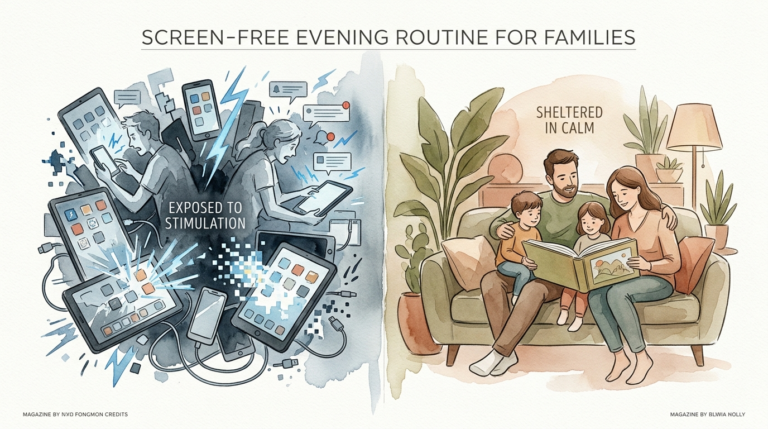
Contrast this with a parent managing a toddler’s tablet. Instead of using the iPad as a “digital babysitter,” the parent practices “Co-viewing.” They watch high-quality educational content together and talk about it afterward. This turns a passive screen into a social learning tool.
In both cases, the clock matters less than the intent. The worker protects their rest, and the parent protects the child’s development. Both are successfully navigating the digital ecosystem without falling into the trap of sterile isolation.
Final Thoughts
Healthy screen time is a moving target that changes with your life stage and goals. It is about reclaiming your attention from systems designed to steal it. When you control the device, you open the door to genuine connection.
Start by making one small change today. Turn off non-human notifications or switch your screen to grayscale. These micro-habits beat willpower every time and build the foundation for a sustainable digital life.
The goal isn’t to live in the dark—it’s to use the light to enhance your real world. Experiment with these strategies and find the balance that makes you feel most alive. Your time is your most valuable asset; don’t let a screen spend it for you.
Sources
1 theashnow.com | 2 abundancetherapycenter.com | 3 youtube.com | 4 choc.org | 5 psu.edu | 6 newcanaanpediatrics.com | 7 medium.com | 8 commonwealthpeds.com | 9 bagby.co | 10 benchmarkemail.com | 11 aaronshamp.com | 12 rawbare.com | 13 medium.com