healthy screen time schedule
Hard time-limits often backfire. Integration and transition periods are the secrets to a sustainable digital schedule. Life doesn’t happen in 60-minute blocks. Learn how to build a flexible, integrated schedule that respects both your productivity and your peace.
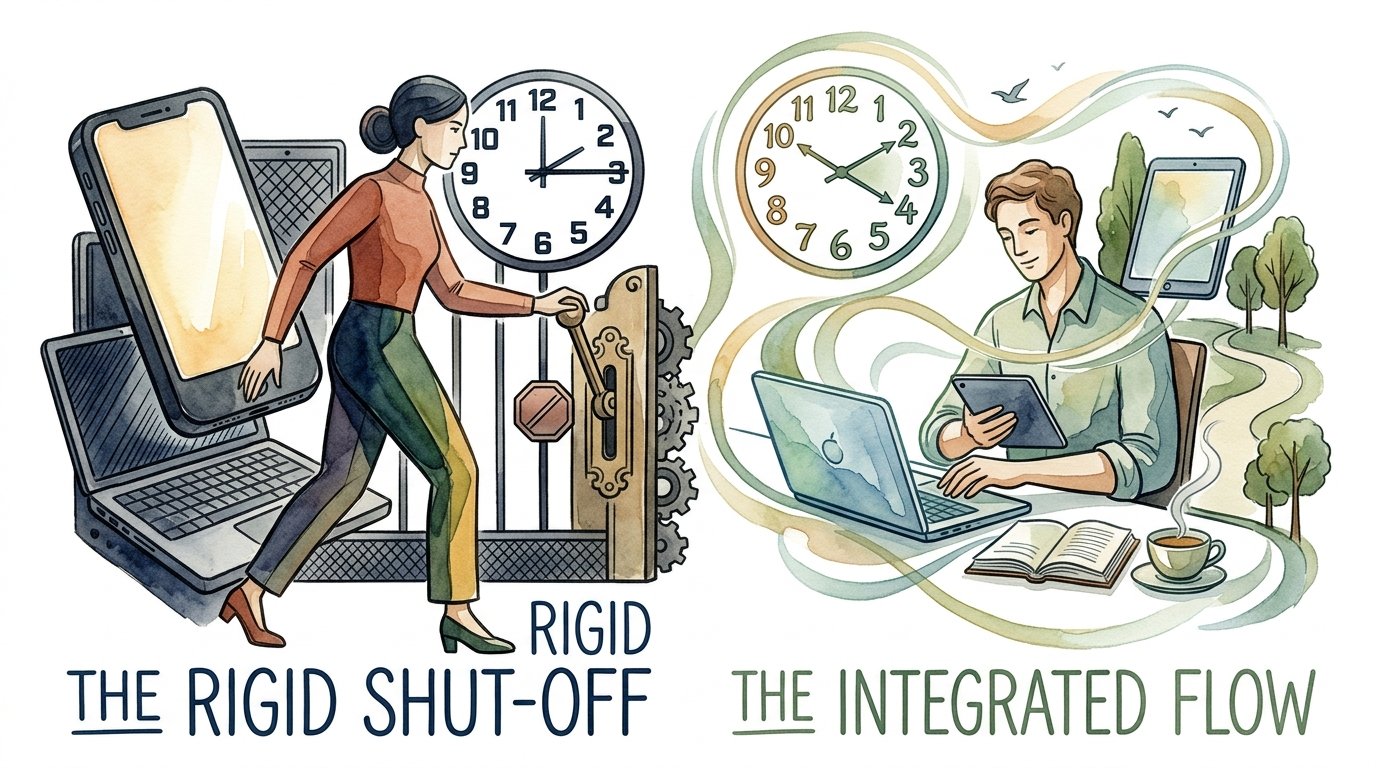
Most people treat their phones like a light switch. They think they can stay “on” until 10:00 PM and then suddenly flip to “off” and expect to sleep. It doesn’t work that way. Your brain needs a ramp, not a cliff.
When you try to force a rigid shut-off, you trigger a stress response. You worry about what you missed. You feel restricted. Eventually, you rebel against your own rules and end up scrolling until 2:00 AM. There is a better way to live in a digital world.
healthy screen time schedule
A healthy screen time schedule is a deliberate framework that balances digital utility with physical and mental recovery. It is not about reaching a magical “zero minutes” of phone use. Instead, it is about intentionality and ensuring that your devices serve your goals rather than dictating your mood.
In practical terms, this means moving away from “time policing” and toward “energy management.” A healthy schedule recognizes that a 30-minute Zoom call for work has a different neurological impact than 30 minutes of doom-scrolling through news headlines.
Real-world digital health focuses on three pillars:
- Intentionality: Knowing exactly why you are picking up the device before you touch it.
- Transition: Giving your nervous system time to downshift between high-stimulation digital tasks and low-stimulation physical life.
- Environment: Designing your physical space so that the default choice is the healthy one.
Think of your digital life like a professional athlete’s training. You don’t just sprint and then sit down. You warm up, you perform, and you cool down. Your brain requires the same courtesy.
The Architecture of an Integrated Flow
Building a sustainable schedule requires a shift in mindset. Instead of fighting your devices, you integrate them into a rhythm that respects your biology.
The 20-20-20 Micro-Reset
The most basic building block of a healthy schedule is the 20-20-20 rule. Every 20 minutes, look at something 20 feet away for at least 20 seconds. This simple act resets your eye muscles and prevents the “perma-stare” that leads to headaches and brain fog.
Digital Buffer Zones
Stop scheduling meetings back-to-back. An integrated flow uses 5-to-10-minute “buffer zones” where you step away from all glass surfaces. Walk to a window. Get water. Stretch. These micro-breaks prevent the cumulative cortisol buildup that happens when we jump from one digital context to another.
The Slow Fade Technique
This is the antidote to the “Rigid Shut-Off.” Instead of an abrupt 9:00 PM phone ban, use a “slow fade.” At 8:00 PM, you might switch to grayscale mode. At 8:30 PM, you move from social media to a Kindle or a long-form article. At 9:00 PM, you move to audio-only content like a podcast or music. You are still “using tech,” but the stimulation level is dropping.
Benefits of a Flexible Digital Framework
Choosing a flexible, integrated approach over a rigid one offers measurable improvements to your daily life. It’s about more than just “using your phone less.”
Lowered Cortisol and Stress
Constant notifications trigger the amygdala, the brain’s threat-detection center. By creating a schedule that groups notifications into specific blocks, you lower your baseline stress level. You move out of “reactive mode” and into “proactive mode.”
Restorative Sleep Cycles
Research shows that blue light exposure within two hours of bed suppresses melatonin, the hormone responsible for sleep. An integrated schedule uses tools like “Night Shift” and physical filters, but more importantly, it reduces cognitive stimulation. When you wind down slowly, you fall asleep faster and reach deeper stages of REM sleep.
Enhanced Focus and “Deep Work”
When you aren’t constantly checking your phone, your “attention residue”—the mental fog left over from a previous task—dissipates. This allows you to enter a state of flow where complex work becomes easier and more enjoyable.
Common Mistakes to Avoid
Many well-meaning people fail at digital wellness because they fall into predictable traps. Recognizing these early can save you months of frustration.
The “All or Nothing” Fallacy
People often try to go from 10 hours of screen time to 2 hours overnight. This is the “crash diet” of productivity. It leads to a “binge-and-purge” cycle where you delete apps on Monday and reinstall them all by Thursday.
Relying on Willpower Alone
Willpower is a finite resource. If your phone is sitting on your desk, you are using mental energy just to *not* look at it. A better strategy is environmental design. Put the phone in a different room during work hours. Make the right choice the easy choice.
Ignoring the Transition
Trying to go straight from a high-intensity video game or a stressful work email to sleep is a recipe for insomnia. Your brain is chemically “wired” at that point. You must provide a bridge—like a physical book or a 10-minute meditation—to cross from the digital world to the physical one.
Limitations and Realistic Boundaries
No system is perfect, and a healthy screen time schedule must account for the messiness of real life. There are times when the “Integrated Flow” will be interrupted.
The On-Call Reality: If your job requires you to be available for emergencies, a strict “no phones after 8” rule is impossible. In these cases, your schedule must focus on *mitigation*—using audio-only alerts so you don’t have to look at the screen unless it’s a genuine crisis.
Social Obligation: We live in a digital society. Sometimes, staying connected is a form of care. A flexible schedule allows for late-night calls with distant family or friends, provided you use “low-stimulation” settings like lowered brightness and blue light filters.
The “Dopamine Trap”: Screens are designed to be addictive. Even with a great schedule, there will be days when you fall down a rabbit hole. The goal isn’t perfection; it’s a quick recovery.
The Rigid Shut-Off vs. The Integrated Flow
Understanding the difference between these two philosophies is the key to long-term success.
| Feature | The Rigid Shut-Off | The Integrated Flow |
|---|---|---|
| Transition | Abrupt / Hard Stop | Gradual / Step-Down |
| Mental Impact | High Restraint / Stress | High Awareness / Calm |
| Sustainability | Low (High failure rate) | High (Adaptable) |
| Flexibility | None | Context-Dependent |
| Tool Usage | App Blockers | Grayscale, Audio-only, Night Shift |
Practical Tips for Digital Integration
Ready to start? Use these actionable steps to reshape your digital relationship today.
- The “Phone Hotel”: Designate a drawer or a box in a common area where your phone “sleeps.” Once it’s in the hotel, it doesn’t come out until the morning.
- Grayscale Mode: Most of the “pull” of social media comes from the bright, notification-red colors. Turning your phone to grayscale makes it instantly less interesting to your brain.
- Batch Your Notifications: Use your phone’s settings to deliver notifications in a “summary” three times a day rather than as they happen.
- The Analog Morning: Don’t touch your phone for the first 30 minutes of the day. Read, drink coffee, or look at the horizon. This sets your brain’s “tempo” for the rest of the day.
- Physical Books: Keep a physical book on your nightstand. It provides the tactile sensation and narrative engagement your brain craves without the blue light.
Advanced Considerations for Practitioners
For those who have mastered the basics, consider how your digital schedule interacts with your biological rhythms.
Circadian Alignment
Your body is hard-wired to respond to the sun. High-intensity “blue” light in the morning is actually beneficial—it tells your brain to be alert. In the evening, you want “redder” light. Advanced practitioners use smart lighting in their homes to mimic the sun’s natural color shift, reinforcing the digital schedule with environmental cues.
Dopamine Fasting vs. Regulation
Rather than a full “fast,” focus on “dopamine regulation.” This involves identifying which digital activities provide a “quick hit” (scrolling) and which provide “long-term satisfaction” (learning a new skill via video). A high-level schedule prioritizes the latter and strictly limits the former to specific time blocks.
The Cognitive Cost of Context-Switching
Every time you glance at a notification, it takes an average of 23 minutes to return to full focus on your original task. Advanced digital schedules use “Monk Mode” blocks where all connectivity is physically severed for 90-minute intervals to maximize cognitive output.
Real-World Scenario: The Professional Reset
Meet Sarah, a marketing executive. She used to feel burned out by 3:00 PM every day. Her “Rigid Shut-Off” attempts failed because she was always worried about missing an email.
She switched to an Integrated Flow:
From 8:00 AM to 9:00 AM, she stays analog. She writes her “top three” goals for the day in a physical notebook. At 9:00 AM, she opens her laptop. Every 50 minutes, she takes a 10-minute “Digital Buffer,” walking to the kitchen for tea without her phone.
After work at 6:00 PM, she puts her phone in its “hotel” drawer. She checks it once more at 8:00 PM for any true emergencies. From 8:30 PM onwards, she uses the “Slow Fade”—moving to an e-reader with the backlight turned low, then finally to an audiobook as she stretches before bed.
The result? Sarah’s productivity increased because her focus was sharper during work hours, and her anxiety plummeted because she was no longer “policing” her minutes. She was managing her energy.
Final Thoughts
A healthy screen time schedule is not a prison sentence. It is a set of guardrails that allows you to enjoy the incredible benefits of modern technology without becoming a slave to it. By focusing on integration and transition rather than rigid restrictions, you build a lifestyle that is sustainable for years, not just days.
Start small. Choose one transition ritual—perhaps the “Analog Morning” or the “Slow Fade”—and practice it for a week. Notice how your brain feels. Notice the reduction in eye strain and the improvement in your mood.
The digital world isn’t going anywhere. Your job is to learn how to move through it with grace, intentionality, and a deep respect for your own peace. Experiment with these frameworks, find what fits your specific life, and reclaim your attention today.
Sources
1 medlineplus.gov | 2 sleepeducation.org | 3 themindfulnessapp.com | 4 mayoclinichealthsystem.org | 5 alignlife.com | 6 jaimedicalsystems.com | 7 additudemag.com