Improving Child Focus After Screen Time
High-speed apps leave a child’s mind in pieces; here is how we put the puzzle back together in one week. Every swipe on a tablet is a tiny interruption to a child’s developing focus. After months of digital ‘chaos,’ we hit the reset button. By day 4, the frantic jumping from toy to toy stopped, and a deep, quiet concentration we hadn’t seen in years finally returned.

Improving Child Focus After Screen Time
Restoring a child’s attention span is about more than just hiding the iPad. It is a fundamental recalibration of the brain’s reward system. Modern digital environments are designed to capture attention through high-frequency rewards. These rewards, known as dopamine hits, train the brain to expect instant gratification. When a child moves from a fast-paced game to a slow-paced book, the brain perceives a “boredom crisis.”

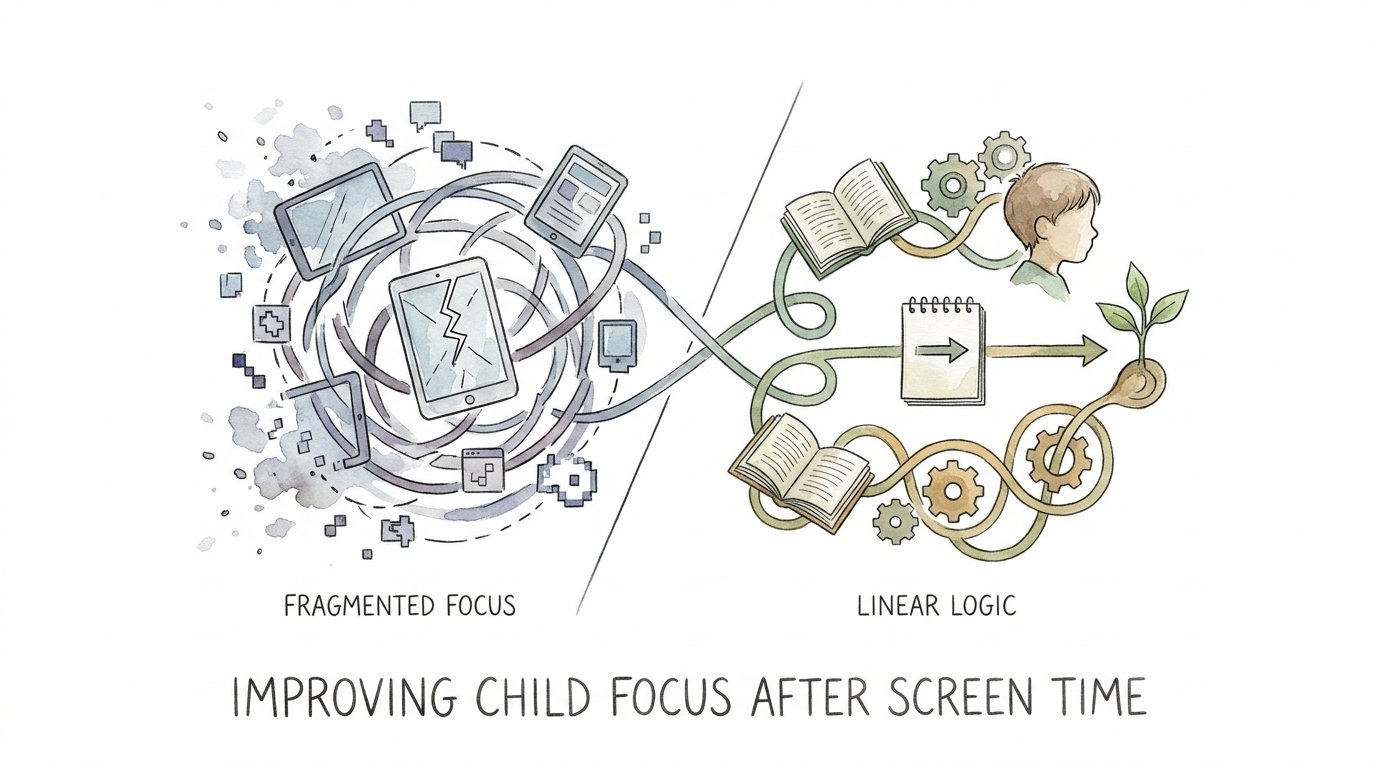
This phenomenon exists because young brains are highly plastic. They adapt to whatever environment they spend the most time in. If that environment is a series of 15-second video clips, the brain optimizes for short-term bursts of interest. This creates a state of fragmented focus. The child becomes an expert at “scanning” but loses the ability to “sustain.” Improving child focus after screen time requires a deliberate shift back to slower, linear activities.
Real-world situations often highlight this struggle. You might notice your child cannot finish a single drawing without asking for a snack or a new toy. Perhaps they struggle to follow a multi-step instruction like “put your shoes on and grab your coat.” These are signs that the executive function system—the brain’s command center—is fatigued. It has been sidelined by the more primitive, reactive attention system triggered by screens.
Focus is a muscle that requires resistance to grow. High-speed apps remove all resistance. They provide the “fun” without the effort of imagination or problem-solving. To fix this, we must reintroduce healthy resistance. We must teach the brain that staying with a single task is rewarding, even if the reward takes longer to arrive.
The 7-Day Digital Reset Protocol
Step-by-step intervention is the only way to avoid a total household collapse. Cold turkey approaches often lead to intense meltdowns because the brain is experiencing a literal chemical withdrawal. A structured week allows the nervous system to downshift gradually. Follow this sequence to reclaim the “green zone” of calm focus.
Day 1: The Awareness Audit
Begin with a quiet observation of the current digital landscape. Track every minute of usage across all devices. Notice the “technoference” in your own life as well. Children mirror parental habits more than they follow parental rules. Use this day to explain the “experiment” to your child. Frame it as a way to “grow our brain muscles” rather than a punishment.
Day 2: Silence the Pings
Notifications are the enemy of deep work. Disable every sound, vibration, and pop-up on all family devices. This removes the “cue” that triggers the urge to check a screen. The goal is to return control to the user. On this day, focus on “brain-neutral” time. This includes simple chores or quiet play where no external stimulation is provided.
Day 3: The Slow-Zone Strategy
Designate specific rooms as “Tech-Free Zones.” The dining table and bedrooms are non-negotiable. These areas must remain sanctuaries for conversation and sleep. Introduce a “Slow-Zone” activity, such as a large puzzle or a Lego set with no manual. These tasks require the brain to engage in “Linear Logic”—following a path from start to finish without skipping ahead.
Day 4: The Transition Bridge
Meltdowns usually happen during the shift from high-dopamine to low-dopamine states. Use “bridge” activities to ease this gap. If they have had screen time for a school project, follow it immediately with 15 minutes of “heavy work.” Pushing a vacuum, carrying groceries, or doing wall pushes helps regulate the sensory system. This physical input “grounds” the brain after it has been “floating” in a digital space.
Day 5: Deleting the ‘Slot Machines’
Remove apps that use “infinite scroll” or “autoplay” features. These are designed like slot machines to keep the user engaged indefinitely. Replace them with “Active” tech tools if necessary. Coding apps or digital art programs require more cognitive effort than passive watching. However, the ideal replacement is a physical book or a long-form audio story.
Day 6: Boredom as a Tool
Allow the child to be bored for a sustained period. Boredom is the precursor to creativity. When the brain is not being fed external data, it must generate its own. This activates the “Default Mode Network,” which is crucial for self-reflection and imaginative play. Resist the urge to “fix” their boredom with an activity. Let them find their own way out of the lull.
Day 7: The Grand Fast
Complete a full 24-hour fast from all personal electronics. Spend the day in nature or engaged in a family project like cooking a complex meal. Nature is a powerful restorer of attention. Research into “Attention Restoration Theory” shows that natural environments allow the “directed attention” system to rest. By the end of this day, you should see a marked improvement in eye contact and task persistence.
The Benefits of Restoring Focus
Observable changes in behavior are often the first sign of success. When the dopamine loops are broken, children exhibit higher emotional resilience. They can handle a “no” without a catastrophic meltdown because their reward system is no longer on a hair-trigger. This emotional stability is the foundation for all other learning.
Academic performance often sees a secondary boost. Improved focus allows for better “Working Memory” retention. A child who can stay focused for 20 minutes will absorb significantly more information than one who checks out every 90 seconds. They begin to develop the ability to think deeply about a subject rather than just skimming the surface.
Social skills also improve through face-to-face interaction. Screens strip away the subtle cues of human communication—tone, facial expression, and body language. Restoring focus allows children to re-engage with these cues. They become better at empathy and turn-taking because they are “present” in the conversation rather than distracted by a digital ghost.
Challenges and Common Pitfalls
Parental fatigue is the most significant hurdle. It is much easier to give a child a tablet than to engage in a 30-minute board game after a long workday. Many resets fail because the parents are not ready for the “rebound” of energy that comes when screens are removed. Be prepared for a week of increased demands on your own attention.
Misunderstanding the “Withdrawal” phase is another frequent error. The irritability and lethargy seen on Day 2 and 3 are not signs that the reset is failing. They are signs that it is working. The brain is adjusting to lower levels of stimulation. Shouting at a dysregulated child only increases the “red chaos” in their brain. Maintaining a calm, steady presence is vital during these transitions.
Expect resistance and “boredom complaints.” These are defensive mechanisms of a brain that has been over-stimulated. A common mistake is to provide too many structured activities to replace the screens. This just replaces one form of external stimulation with another. The goal is to foster “Internal Drive,” which only grows in the absence of constant external entertainment.
When a Digital Reset May Not Be Ideal
Realistic constraints must be considered. In modern schooling, many assignments are delivered via digital platforms. A total “fast” may not be possible during the school week. In these cases, focus on “Intentionality.” Use the device only for the task and close all other tabs. The “one-tab rule” is a practical way to maintain focus during necessary screen use.
Children with diagnosed neurodivergence, such as ADHD or Autism, may have different baseline needs. While a reset is still beneficial, the “withdrawal” phase can be significantly more intense. These children often use screens as a form of sensory regulation or “stimming.” Abrupt removal without professional guidance can lead to extreme distress. For these families, a “tapering” approach is often more effective than a 7-day fast.
Environmental limitations also play a role. If a child lives in an area with no safe outdoor space, the “Nature” component of the reset becomes difficult. In such scenarios, focus on “Indoor Micro-Nature.” This can include indoor gardening, bird-watching from a window, or even listening to high-quality nature soundscapes while drawing.
Comparison: Fragmented Focus vs. Linear Logic
Understanding the difference between these two states helps in choosing the right activities for your child. Most digital content promotes fragmented focus, while traditional learning requires linear logic.
| Feature | Fragmented Focus | Linear Logic |
|---|---|---|
| Primary Stimulus | Fast scene cuts, notifications, “Likes” | Reading, puzzles, narrative threads |
| Brain State | Hyper-aroused, reactive, scanning | Calm, active, deep-processing |
| Reward Speed | Instant (Milliseconds) | Delayed (Minutes to Hours) |
| Mental Energy | High consumption, low retention | Sustainable use, high retention |
| Skill Required | Reflexive response | Sustained executive function |
Practical Tips for Sustaining Progress
Actionable advice ensures the 7-day reset becomes a permanent lifestyle change. Start by “Greening” the environment. Research suggests that even a single houseplant in a study area can improve concentration. Keep the physical workspace “Logic-Ready”—this means having all necessary tools (pencils, paper, books) within reach to prevent the need for “task-switching.”
- Use Visual Timers: A physical sand timer or a “Pomodoro” clock helps children see the passage of time. This reduces the anxiety of “how much longer?”
- The “Checklist” Method: Breaking a large task into three small, checkable steps provides a healthy dopamine hit upon completion. This mimics the reward of a game but links it to a real-world achievement.
- Model Deep Work: Let your child see you reading a physical book or working on a hobby without your phone nearby. Explain what you are doing: “I am focusing on this one thing right now.”
- The “Heavy Work” Hack: If focus wavers, engage in five minutes of physical resistance. Pushing against a wall or doing “bear crawls” helps reset the nervous system.
Establishing a “Tech Contract” can also prevent future slippage. This agreement should define when, where, and for how long screens are used. Including the child in the negotiation increases their “Buy-In.” When they feel like a partner in the process rather than a subject of a rule, they are more likely to self-regulate.
Advanced Considerations for Serious Practitioners
Deepening your understanding of neuroplasticity can help you tune the reset for your specific child. The brain “prunes” connections that are not used. If a child never practices “Directed Attention,” the neural pathways for that skill weaken. Conversely, every hour spent in deep, focused play strengthens the white matter pathways that promote language and reading skills.
Executive function is not a single skill but a suite of abilities. It includes “Inhibitory Control” (resisting the urge to swipe) and “Cognitive Flexibility” (shifting from one task to another without a meltdown). Advanced practitioners should identify which specific “leg” of the executive function chair is the weakest. If the child struggles with transitions, focus on “Bridge” activities. If they struggle with focus, focus on “Timing” games.
Consider the “Circadian Impact” of screen use. Blue light at night suppresses melatonin, leading to poor sleep quality. A sleep-deprived brain cannot focus, regardless of how many detoxes it undergoes. A non-negotiable rule should be the removal of all screens 60 to 90 minutes before sleep. This allows the brain to transition into the “Delta” and “Theta” waves required for restorative rest.
A Realistic Scenario: The Weekend Intensive
If a 7-day protocol feels impossible, a 48-hour “Weekend Intensive” can still yield results. Imagine a Saturday morning where all phones are placed in a basket at 8:00 AM. The family spends the morning at a local park. There is no checking of maps or taking of “perfect” photos. The focus is entirely on the environment and each other.
The afternoon is spent on a “Master Task.” This could be building a birdhouse or baking a complex loaf of bread from scratch. These tasks have a “Natural Logic”—you cannot bake the bread before you knead the dough. This forced sequence retrains the brain to follow a linear path. By Sunday evening, the “frantic” energy often subsides, replaced by a more settled, attentive demeanor.
Numerical tracking helps prove the point. During a typical screen-heavy weekend, a child might “switch” activities 50 times an hour. After a weekend intensive, that number often drops to 5 or 10. They stay with a single toy for 20 minutes instead of 2. This 10x improvement in “dwell time” is the metric of success.
Final Thoughts
Reclaiming a child’s focus is one of the most challenging yet rewarding tasks a parent can undertake. High-speed apps have a massive head start in the battle for your child’s mind, but they are not invincible. The brain’s natural state is one of curiosity and engagement with the physical world. By removing the “digital noise,” you allow that natural state to resurface.
Remember that this is a journey of progress, not perfection. There will be days when the “reset” feels like a failure and the tablet feels like the only solution. In those moments, do not shame yourself. Simply perform a “24-hour reset” and start again. The goal is to build a lifestyle where screens are a tool for the user, rather than the user being a tool for the screen.
Encourage your child to notice how they feel after the reset. Ask them, “Do you feel calmer? Is it easier to read your book today?” Helping them develop this “Internal Awareness” is the ultimate victory. It turns a parental rule into a personal skill that will serve them for the rest of their lives. Start today by choosing just one “Slow-Zone” and see what happens when the pings stop and the thinking begins.
Sources
1 childcareed.com | 2 thejacobsladdergroup.org | 3 childrenandscreens.org | 4 substack.com | 5 childrenandscreens.org | 6 peaceathomeparenting.com | 7 dragongym.com | 8 well-concepts.com | 9 sodexo.com | 10 nih.gov | 11 pxdocs.com | 12 youtube.com | 13 hiyahealth.com | 14 rayitoschools.com | 15 piqe.org | 16 nih.gov | 17 udemy.com | 18 neurodiversecounseling.com | 19 buildingbrains.ca | 20 childmind.org | 21 familyitguy.com