Family Emergency Preparedness Activities
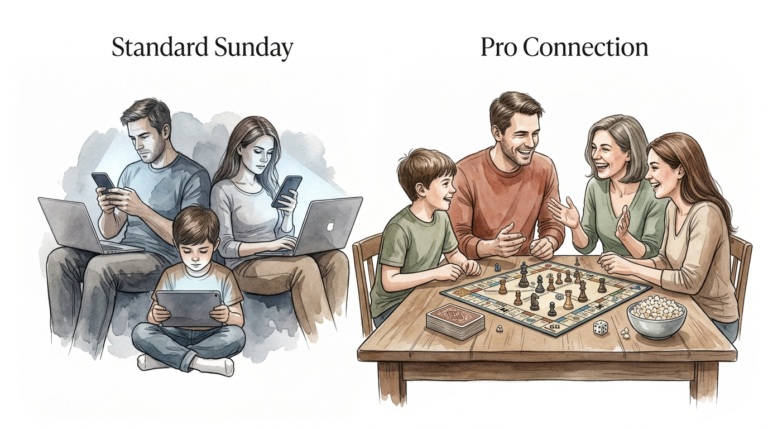
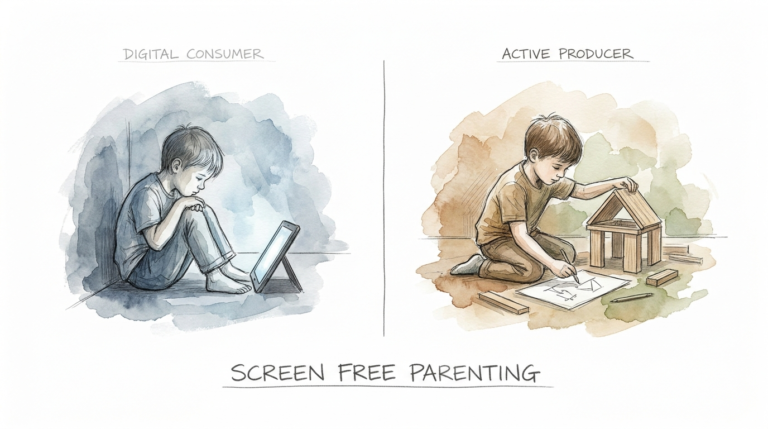
What happens to your family’s connection when the power goes out—does the conversation end, or does the real adventure begin? We’ve outsourced our basic survival to apps and ‘smart’ devices that go dark the second the grid flickers. Real bonding happens when you stop being consumers of safety and start being producers of it. Turn your next family night into a mission: mapping your resources, learning manual tools, and building the confidence that no blackout can ever dim.
Modern life is incredibly convenient until it isn’t. Most households operate on a “just-in-time” delivery system where water comes from a tap, heat comes from a distant plant, and information comes from a glass screen. When these systems fail, the lack of preparation often leads to panic. Shifting from a state of total dependence to one of household autonomy is not just about hoarding cans of beans; it is about building a culture of readiness within your family unit.
This article explores how you can transform “scary” emergency planning into engaging, high-energy family activities. We will move beyond the boring checklists and dive into practical drills, manual skill-building, and the mindset shift required to thrive when the world goes quiet. Whether you are a total beginner or a serious practitioner, these strategies will help you turn your home into a fortress of self-reliance.
Family Emergency Preparedness Activities
Family Emergency Preparedness Activities are structured exercises designed to teach survival skills, test equipment, and refine response plans in a low-stress environment. These activities range from simple scavenger hunts to full-scale “off-grid” weekend simulations. Instead of lecturing your children about fire safety, you are showing them how to navigate a smoke-filled room or how to signal for help using non-digital tools.
These activities exist to bridge the gap between theoretical knowledge and muscle memory. In a real crisis, your brain often shifts into a “fight, flight, or freeze” mode. Well-practiced drills ensure that your family “defaults” to a productive action rather than freezing in place. This approach is used by first responders and military units worldwide because it builds a “unit cohesion” that is just as applicable to a suburban household as it is to a specialized team.
Think of your family as a small crew. In a professional crew, every member knows their station and their task. Preparedness activities allow your “crew” to identify who is the best at navigation, who handles the medical kit with a steady hand, and who can keep the group’s spirits high when things get difficult. It turns a potential disaster into a series of solved problems.
The real-world application is simple: the more you play the “what if” game in the backyard, the less power the “what if” has to scare you when it happens for real. You are essentially “pre-gaming” the emergency so that when the lights go out, the only thing that changes is the atmosphere—not your ability to function.
How to Implement Family Drills and Games
The transition from a passive household to an active “unit” starts with movement. You cannot build resilience by sitting on the couch. Here is a step-by-step guide to gamifying your family’s preparedness journey.
The Disaster Supply Scavenger Hunt
Gather the kids and give them a “mission list.” This list should include essential items like flashlights, extra batteries, the manual can opener, and the first aid kit. Set a timer and see who can find the most items in five minutes. This helps everyone learn exactly where resources are stored so they aren’t hunting for a flashlight in total darkness later.
“Lights Out” Surprise Night
Without warning, flip the main breaker to your house on a Friday evening. Announce that the “grid” is down for the next four hours. This forces the family to use their emergency lighting, figure out how to cook without a microwave, and find ways to stay entertained without Wi-Fi. It is the ultimate stress test for your current gear and reveals “holes” in your plan faster than any checklist.
The Manual Tool Workshop
Dedicate an afternoon to “analog” skills. Teach everyone how to use a hand-crank radio to find the NOAA weather station. Show them how to operate a manual can opener or a P-38 military opener. If you have a gravity-fed water filter, let the kids assemble it and pour in “dirty” water to watch it come out clean. Mastering these manual tools builds a sense of agency that “smart” tech can never provide.
Mapping the Neighborhood “Treasure Hunt”
Print out a physical map of your neighborhood. Walk the area as a family and mark down “resources” and “hazards.” Mark things like the nearest fire station, high ground for flooding, and secondary exit routes. For the kids, turn it into a game where they have to find “landmarks” that would help them navigate home if they didn’t have a GPS.
Benefits of Active Family Preparedness
Engagement is the best antidote to anxiety. When children (and adults) feel like they have a job to do, they feel more in control of their environment. This psychological shift is one of the most measurable benefits of practicing these activities.
Building “Survival Confidence”: There is a profound difference between knowing a first aid kit exists and knowing exactly how to apply a bandage. Practical drills build confidence by proving to each family member that they are capable of taking care of themselves and each other. This confidence translates to other areas of life, fostering a resilient “can-do” attitude.
Family Bonding and Communication: Modern families are often siloed into their own digital worlds. Preparedness drills require intense communication and teamwork. You have to talk, listen, and coordinate. These shared experiences create strong memories and reinforce the idea that the family is a team that works together toward a common goal.
Identifying Gear Failures: You do not want to find out your flashlight batteries are corroded when the power actually goes out. Regular activities serve as a “quality control” check for your equipment. If a hand-crank radio breaks during a game, it is a minor inconvenience. If it breaks during a hurricane, it is a crisis.
Practical Skill Acquisition: These activities teach skills that are useful far beyond emergencies. Learning to read a map, use basic tools, and perform first aid are life skills that every individual should possess. You are essentially giving your family a “hidden curriculum” of self-reliance that will serve them for decades.
Challenges and Common Mistakes
The biggest hurdle in family preparedness is often the “Fear Factor.” If you present emergency planning as a terrifying list of “things that will kill us,” you will get pushback. Most people avoid preparedness because it makes them uncomfortable to think about bad things happening.
Mistake: Making it Too Scary. Forcing children into high-intensity, realistic disaster simulations can cause trauma rather than build resilience. Keep the tone light and adventurous. Frame it as “Hero Training” or an “Exploration Mission.” The goal is to make the response second nature, not to induce a panic attack.
Mistake: The “Set It and Forget It” Mentality. Many families buy a pre-made “72-hour kit” and stick it in the back of the closet. This is a false sense of security. Gear degrades, food expires, and children outgrow their emergency clothes. Without regular activity, the kit becomes a useless box of mystery items.
Mistake: Relying Solely on Technology. Many “prepper” gadgets are just as grid-dependent as your phone. Solar chargers are great, but they don’t work in a week of rain. If your “plan” requires a 5G signal to function, you don’t have a plan; you have a hope. You must practice the “analog” version of every task.
Mistake: Neglecting the “Boring” Stuff. It is fun to buy a new survival knife, but it is “boring” to memorize phone numbers. However, in a real crisis, knowing your out-of-state contact’s number by heart is infinitely more valuable than a tactical blade. Do not let the “cool factor” distract you from the essential logistics.
Limitations and Realistic Boundaries
No amount of “Hero Training” can prepare you for every possible variable. It is important to acknowledge where your household autonomy meets its limit. Understanding these boundaries helps you make better decisions about when to stay and when it is time to evacuate.
Environmental Constraints: If you live in a small apartment in a dense urban center, your ability to store six months of water is physically limited. You cannot practice “homesteading” skills in a 20th-floor condo. In these cases, your preparedness activities should focus more on “mobility” and “networking” rather than “stockpiling.”
Physical and Health Limits: Drills must be adapted for all family members. An “evacuation drill” that requires a three-mile hike isn’t realistic if you have a family member with mobility issues. Your activities must account for real-world health constraints. A plan that ignores the needs of the youngest or oldest members is a plan that will fail.
The “Expert” Trap: You can practice drills every week and still not be an expert in emergency medicine or structural engineering. Recognize that there are times when professional help is the only solution. Household autonomy is about self-sufficiency, not isolationism. Knowing how to call for help and when to yield to professionals is a sign of a mature preparedness plan.
Grid Dependent vs. Household Autonomy
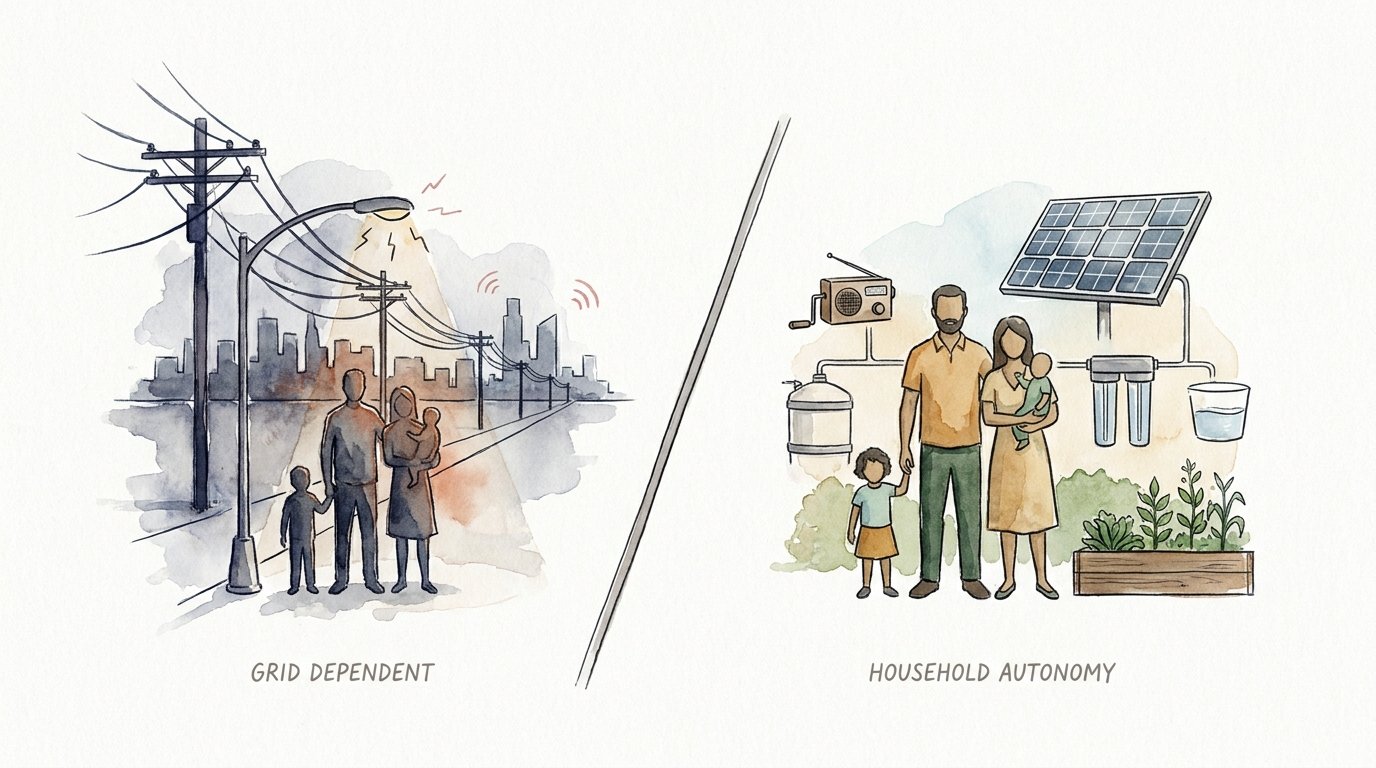
Understanding the difference between being GRID DEPENDENT and achieving HOUSEHOLD AUTONOMY is the core of modern preparedness. One relies on external systems that are prone to “cascading failures,” while the other focuses on localized resilience.
| Feature | Grid Dependent | Household Autonomy |
|---|---|---|
| Resource Source | Municipal pipes, power lines, and supermarkets. | Rainwater catchment, solar storage, and deep pantry. |
| Information | Requires Wi-Fi/Cellular signal and charged devices. | Physical maps, hand-crank NOAA radio, and pre-printed plans. |
| Skill Level | Low. Requires knowing how to pay a bill. | Moderate to High. Requires manual tool mastery and maintenance. |
| Response to Failure | Panic and reliance on government/NGO aid. | Calm execution of pre-practiced contingency plans. |
Moving toward autonomy doesn’t mean you have to live in a cave. It means you have a “redundancy” for every critical system. If the water main breaks, you have a filter. If the power goes out, you have a battery bank. If the internet dies, you have a physical library of information. This table highlights that the cost of autonomy is often an investment in skill rather than just money.
Practical Tips and Best Practices
If you want to take your family’s preparedness to the next level, focus on these actionable “best practices.” These tips are designed to be applied immediately with minimal cost.
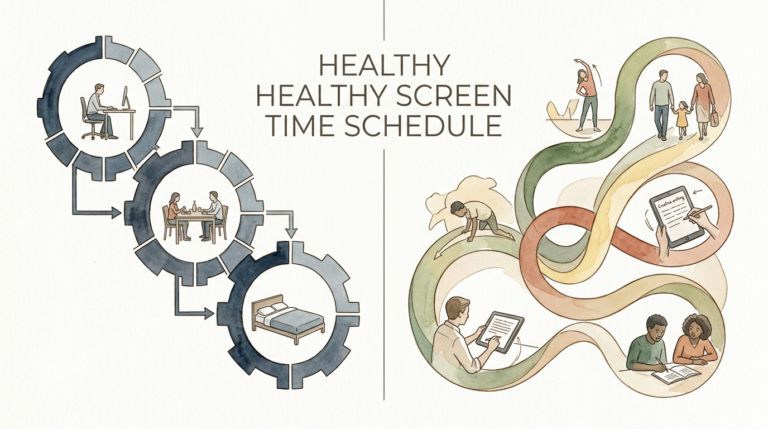
- The 6-Month Rotation: Set a recurring calendar alert for “Prep Day.” Every six months, rotate your stored food, check the expiration dates on your first aid supplies, and swap out seasonal clothes in your “Go-Bags.” This keeps your gear fresh and your mind focused.
- The “ICE” Challenge: Challenge everyone in the family to memorize three phone numbers: an out-of-town contact, a local relative, and a neighbor. Test them during car rides. If they can’t remember the numbers, they “lose” a small privilege like choosing the radio station.
- Assign Specific “Stations”: Give every family member a job. The “Bag Boss” is responsible for grabbing the emergency kit. The “Water Warden” handles the filtration setup. The “Comms Captain” manages the radio. Giving everyone a title increases their sense of duty and focus.
- Nighttime Evacuation Drills: Most fires and emergencies happen when people are sleeping. Practice your escape routes at 9:00 PM in the dark. You will be surprised at how much harder it is to find a window latch or a door handle when you can’t see your hands.
- Physical Documentation: Keep a “Family Readiness Binder” that contains physical copies of IDs, insurance policies, and maps. Store this in a fireproof safe, but make sure the adults and responsible teenagers know exactly where it is.
Advanced Considerations for Serious Practitioners
For those who have mastered the basics, it is time to look at the “second-order” effects of a crisis. This involves going beyond your four walls and looking at the legal and communal aspects of resilience.
Legal and Administrative Resilience: Do you have a “Power of Attorney” or a “Guardianship Affidavit” in place? If parents are separated from children during a major disaster, legal documents can facilitate reunification and allow trusted friends to make medical decisions. This is the “boring” prep that saves lives. Consider using a “Digital Vault” with zero-knowledge encryption to store these documents so they can be accessed anywhere in the world.
Community Mutual Aid: No family is an island. A truly resilient household is part of a resilient neighborhood. Start a “Neighborhood Watch” or a simple text group with your closest neighbors. Share your skills—if you are great at first aid and your neighbor is a plumber, you have a natural partnership. Building these social bonds is the ultimate form of “force multiplication” in a crisis.
Redundant Communications: If you are serious about autonomy, you should look into GMRS or HAM radio licenses for the adults in the family. These systems allow you to communicate over several miles without relying on cell towers. Practicing with these radios during family hikes or “treasure hunts” makes the tech feel like a tool rather than a novelty.
Scenario: The 48-Hour Household Lockdown
To see how all of this comes together, imagine a realistic training scenario for your family. This is the “Final Exam” of family preparedness.
The Scenario: At 6:00 PM on a Friday, you announce a “48-Hour Lockdown.” A simulated storm has knocked out power, water, and internet. No one is allowed to leave the property, and no “grid” resources can be used.
Step 1: The Activation (Hours 0-2). The “Bag Boss” gathers the emergency kits. The “Water Warden” fills up the bathtubs and starts the filtration system. The “Comms Captain” turns on the NOAA radio. The family eats a “pantry-clearing” meal of perishable items from the fridge before they spoil.
Step 2: The Analog Transition (Hours 12-24). By Saturday morning, the novelty has worn off. The kids are bored. This is when you break out the board games, the physical books, and the “Manual Tool Workshop.” You cook lunch over a camp stove or a charcoal grill. You practice the “What-if” tabletop games: “What if the back door was blocked? How would we get out?”
Step 3: The Endurance Test (Hours 24-48). Sunday is about conservation. You learn how much water you actually use to wash a dish or brush your teeth. You realize that your “solar lantern” doesn’t last as long as the box said it would. You record these findings in your “Family Readiness Binder.”
The Conclusion: When the 48 hours are up, you have a family meeting. What was the hardest part? What gear failed? What do we need more of? This single weekend provides more data and more confidence than years of watching “prepper” videos on YouTube.
Final Thoughts
Preparedness is not a destination; it is a way of life. It is the steady transition from being a consumer who waits for help to a producer who provides it. By turning these lessons into engaging family activities, you are removing the fear from the unknown and replacing it with the power of competence. You are teaching your family that while they cannot control the world, they can always control their response to it.
Start small. Do a scavenger hunt this weekend. Buy a manual can opener and let the kids open the soup. Memorize one phone number. These tiny actions are the “atomic units” of resilience. Over time, they compound into a household that is not just ready for a blackout, but ready for anything life throws its way.
Remember, the goal isn’t just to survive—it’s to thrive. When the power goes out, your family shouldn’t be the ones sitting in the dark waiting for a light to flicker back on. You should be the ones with the lantern lit, the radio tuned, and the conversation just beginning. That is the true adventure of autonomy.
Sources
1 dryerfirefighters.com | 2 nctsn.org | 3 arrl.org | 4 utah.edu | 5 ironcladfamily.com | 6 michigan.gov | 7 oklahoma.gov | 8 uwsp.edu