Hands-on Fraction Activities
The mess on your counter isn’t a chore; it’s the only place where ‘half of three-quarters’ actually makes sense to a child. Most parents see a spilled bag of flour as a nuisance. A Lead Content Strategist sees a 3D laboratory for cognitive development. When a child has to physically double a recipe, they are performing high-level mental scaling that no worksheet can replicate. Embrace the mess; it’s where the math lives.
Fractions are often the first place where young students lose their confidence in mathematics. The shift from whole numbers—where bigger numbers always mean “more”—to fractions—where a bigger denominator actually means a smaller piece—can be a cognitive whiplash. Traditional workbooks attempt to solve this with 2D drawings of pizzas and pies. But a drawing of a pizza isn’t a pizza. It doesn’t have weight, it doesn’t have smell, and you can’t eat it if you get the answer right.
Stepping into the kitchen changes the stakes. In this environment, math is no longer an abstract requirement. It is a functional tool. If you miscalculate a fraction on a test, you lose a point. If you miscalculate a fraction in a cake recipe, the cake doesn’t rise. This immediate, sensory feedback creates a “sticky” learning environment that paper and pencil simply cannot match.
Hands-on Fraction Activities
Hands-on fraction activities involve the physical manipulation of objects to represent parts of a whole. In a kitchen setting, this means using measuring cups, spoons, and the food itself as “manipulatives.” This approach moves the student from rote memorization to genuine conceptual comprehension. Instead of just hearing that 1/4 is smaller than 1/2, a child physically sees that it takes two 1/4 cups to fill a single 1/2 cup.
These activities exist because human brains, especially young ones, are wired for spatial and tactile learning. Research indicates that children are often visual learners who grasp concepts faster through tangible parts than through plain text. When a child divides a fruit or cuts a pizza, they are actively constructing their understanding of what a fraction represents. This is not just a “fun” way to learn; it is a foundational pedagogical method that bridges the gap between home and school.
Real-world application is the primary driver here. We use fractions every day when we split a check, tell time, or follow a set of instructions. In the kitchen, fractions are the primary language of measurement. This provides a natural and intuitive context. A child doesn’t need to be told that 1/2 + 1/2 = 1 when they are holding two half-cups of water and pouring them into a single-cup container. The physical reality proves the mathematical theory instantly.
The Power of the Unit Fraction
Everything in the kitchen starts with the unit fraction—the building block of all other fractional numbers. When you give a child a 1/4 measuring cup and ask them to measure out 3/4 of a cup of flour, you are teaching them that 3/4 is actually “three units of 1/4.” This helps eliminate the common confusion where children view the numerator and denominator as two separate whole numbers rather than a single value.
Multi-Sensory Feedback Loops
Cooking provides a rich environment filled with sights, smells, and textures. This multi-sensory experience reinforces mathematical concepts in a powerful way. A child who smells the cookies baking knows they have successfully navigated the “math” of the recipe. Conversely, the natural consequences of an error—such as a cookie that is too salty or a batter that is too dry—serve as unforgettable teaching moments that stick far longer than a red mark on a worksheet.
How to Transform Your Kitchen into a Fraction Lab
Turning your kitchen into a learning environment requires intentionality rather than expensive equipment. You already have the tools: measuring cups, spoons, a knife, and basic ingredients. The key is to shift the role of the child from a passive observer to a “lead investigator.”
Start with a simple recipe that uses common fractions like 1/2, 1/3, and 1/4. Before you begin, have the child identify all the fractions in the ingredient list. Ask them to predict which ingredient they will have the “most” of and which they will have the “least” of based only on the numbers. This builds estimation skills and number sense before the first bowl even hits the counter.
Next, implement the “scoop and pour” method. Instead of using the exact cup size requested, challenge the child to use a smaller unit. If the recipe calls for 1 cup of flour, give them only the 1/4 cup measure. Ask them: “How many of these smaller scoops will we need to reach the whole?” This physical repetition of counting 1/4, 2/4, 3/4, 4/4 creates a rhythm that reinforces the concept of equivalent fractions and addition.
Step-by-Step Scaling
Scaling a recipe is the ultimate kitchen math challenge. Choose a small batch of cookies or muffins and tell the child you need to “double the batch.” This forces them to perform mental or written multiplication of fractions.
- Identify the original measurement (e.g., 3/4 cup sugar).
- Perform the calculation (3/4 + 3/4 or 3/4 x 2).
- Visualize the result (6/4 cups, which becomes 1 and 1/2 cups).
- Physically measure out the new total to verify.
The Pizza Method for Division
Division is often the hardest fractional concept to visualize. Use a round pizza or a cake to demonstrate this. Ask the child to cut the pizza into halves, then quarters, then eighths. This demonstrates that as the denominator grows (2 to 4 to 8), the actual size of the piece shrinks. It also allows for a visual demonstration of equivalent fractions: show them that two 1/8 slices are exactly the same size as one 1/4 slice.
Benefits of the Kitchen Classroom
The practical benefits of learning math through cooking extend far beyond the dinner table. This approach cultivates a deeper conceptual knowledge of the relationships between the numerator and the denominator. Students who learn through these hands-on activities often develop stronger math skills and retain those concepts longer than those who rely strictly on paper-based practice.
Confidence is perhaps the greatest measurable benefit. Many children feel “math anxiety” when faced with a page of numbers. In the kitchen, that anxiety often disappears because the goal is to make something delicious, not to get an “A.” This low-pressure environment allows children to experiment, make mistakes, and correct them without the fear of judgment.
Problem-solving and critical thinking become second nature in the kitchen. When a child realizes they are out of the 1/2 cup measure and must figure out how to use the 1/4 or 1/3 cup instead, they are engaging in real-world logic. This type of proportional reasoning is an early precursor to advanced mathematics like algebra and geometry. It teaches them that math is a flexible tool rather than a rigid set of rules.
Social and Collaborative Growth
Kitchen math is rarely a solitary activity. It encourages collaboration between parents and children or among siblings. Discussing measurements and verbalizing the thought process helps solidify understanding. When a child has to explain to their parent why four quarter-teaspoons are equal to one whole teaspoon, they are mastering the material through teaching.
Immediate Results and Retention
Studies suggest that humans struggle to transfer knowledge from abstract word problems to real-life situations. Learning *in* the situation removes this barrier. The immediate result of a successful calculation—a perfect batch of brownies—acts as a dopamine-driven reinforcement of the mathematical principle. This leads to higher retention rates compared to “drill and kill” worksheet methods.
Challenges and Common Mistakes
The transition from paper to the pantry isn’t always seamless. One of the most frequent errors children make is applying whole-number logic to fractions. This leads to “Misconception #1”: thinking that a larger denominator means a larger fraction. They see the number “8” and assume 1/8 must be bigger than 1/4. The kitchen solves this visually, but parents must be prepared to address the confusion as it happens.
Another common pitfall is the “Adding the Denominator” mistake. When doubling a recipe, a child might look at 1/2 + 1/2 and decide the answer is 2/4. This happens because they are trying to apply standard addition rules to every number they see. In the kitchen, you can show them that 2/4 is actually the same as 1/2. If they add two half-cups and get another half-cup, the physical volume will clearly show their math is wrong.
Language Confusion
The language of fractions can be incredibly tricky for beginners. Words like “third,” “fourth,” and “quarter” often have dual meanings in everyday speech. A child might confuse the “third” item in a line with the “one-third” measurement of a cup. Clear, consistent terminology is essential to avoid these linguistic traps.
The Accuracy Gap
Precision is vital in baking, but young children often struggle with “leveling” their measurements. An “extra” tablespoon of flour might seem small, but it can significantly change the ratio of a recipe. Parents should emphasize the importance of precision as part of the mathematical process. This teaches children that in both math and science, the details matter.
Limitations of the Kitchen Method
While the kitchen is a powerful lab, it does have its boundaries. Not all mathematical concepts scale linearly in cooking. This is a crucial limitation that even professional bakers must respect. For example, if you quadruple a bread recipe, you cannot always quadruple the yeast or the salt. These ingredients can become overpowering or cause the dough to behave unpredictably if scaled too aggressively.
Environmental factors can also skew the results. Humidity, altitude, and even the temperature of the room can affect how a recipe turns out, regardless of how perfect the math is. This can be frustrating for a child who has done the calculations correctly but still ends up with a failed bake. It is important to explain that cooking is a blend of math and chemistry, and sometimes the “chemistry” has its own rules.
Complexity Constraints
Most home kitchens are equipped only for basic fractions like 1/2, 1/3, 1/4, and 1/8. Teaching complex or irrational numbers through cooking is difficult because our tools aren’t built for it. You will rarely find a 1/7 or 1/13 measuring cup. For these more advanced concepts, the kitchen serves as a jumping-off point rather than a complete replacement for formal instruction.
Time and Resource Intensity
Teaching fractions in the kitchen takes significantly more time than doing a worksheet. It requires adult supervision, ingredients, and a willingness to clean up the inevitable mess. In a busy household, this isn’t always a feasible daily option. It is best used as a high-impact supplement to other learning methods rather than a 24/7 replacement.
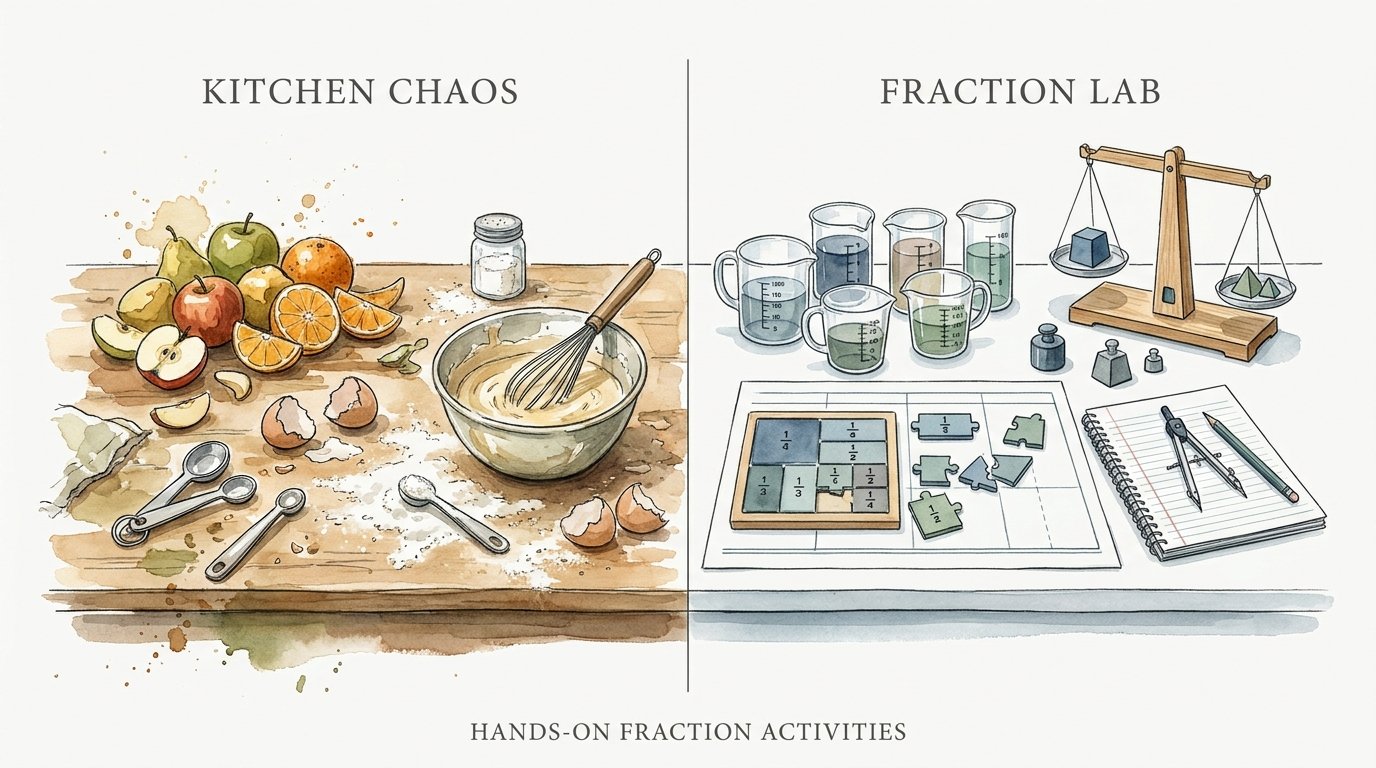
Kitchen Chaos vs. Fraction Lab
Understanding the difference between “just cooking” and “intentional learning” is key to making this work. While any kitchen activity is beneficial, a structured “Fraction Lab” approach focuses on the math.
| Feature | Kitchen Chaos (Casual) | Fraction Lab (Structured) |
|---|---|---|
| Primary Goal | Getting dinner on the table. | Understanding part-to-whole relationships. |
| Child’s Role | Following simple commands (e.g., “Pour this”). | Calculating measurements and scaling. |
| Math Focus | Incidental and unplanned. | Explicitly linked to denominators and ratios. |
| Tool Usage | Using the “right” cup for every step. | Using “unit cups” (e.g., measuring 1 cup using only 1/3). |
| Error Handling | Parent corrects mistakes immediately. | Errors are explored to see the impact on the bake. |
Practical Tips for Success
To maximize the educational value of your time in the kitchen, focus on small, consistent habits. Use clear measuring cups whenever possible. Being able to see the liquid level through the side of the container helps children visualize the “space” a fraction takes up.
Encourage your child to verbalize their thought process. Instead of asking “Is that enough?”, ask “How did you decide that three of those spoons would equal one tablespoon?” This forces them to access the mathematical part of their brain and reinforces the logic behind the action. It also gives you a chance to spot any misconceptions before they become habits.
Use Dry and Liquid Measures Appropriately
Teach the difference between volume and weight. While we often use “ounces” for both, a fluid ounce of water and an ounce of flour weigh very different amounts. This is a great opportunity to introduce the concept of density. Using a digital scale to measure ingredients in grams—a common practice in professional baking—introduces children to the metric system and the precision of mass-based measurement.
Make “Equivalent Fraction” Challenges
When you need 1/2 cup of an ingredient, hide the 1/2 cup measure. Tell the child: “The 1/2 cup is in the dishwasher. What other tools can you use to get the same amount?” This forces them to think about how 1/4 + 1/4 = 1/2 or how multiple teaspoons can build a larger unit.
Advanced Considerations: Baker’s Math
For serious practitioners or older students, the kitchen offers a gateway into “Baker’s Percentages.” This is the system professional bakers use to scale recipes with absolute precision. In this system, every ingredient is expressed as a percentage of the total flour weight. Flour is always 100%.
If a recipe calls for 500g of flour and 350g of water, the “hydration” is 70%. This allows a baker to understand the character of the dough at a glance. A 60% hydration dough will be stiff (perfect for bagels), while an 80% hydration dough will be wet and sticky (perfect for ciabatta). This level of math involves ratios, percentages, and decimals, providing a high-level challenge that feels like professional training.
The Scaling Factor
Professional scaling involves more than just multiplying by two. It requires calculating a “Scale Factor” by dividing the desired yield by the current yield. If a recipe makes 12 cookies but you need 30, the scale factor is 2.5. The student must then multiply every ingredient weight by 2.5. This is a rigorous exercise in decimal multiplication and helps bridge the gap between simple fractions and real-world industrial math.
Adjusting for Hydration and Absorption
Advanced kitchen math also considers the variability of ingredients. Flour absorbs more moisture in the winter than in the summer. A serious student can learn to adjust the “water fraction” based on the feel of the dough. This introduces the concept of variables and the scientific method—testing a hypothesis (adding 5% more water) and observing the results.
Example: The Cookie Scaling Scenario
Let’s look at a practical example of how to run a “Fraction Lab” session with a standard cookie recipe.
Imagine the original recipe for 12 cookies calls for:
- 3/4 cup brown sugar
- 1/2 cup softened butter
- 1 1/4 cups all-purpose flour
- 1/2 teaspoon baking soda
Your goal is to make 18 cookies. The first step is to determine the scaling factor. Since 18 divided by 12 is 1.5 (or 1 and 1/2), every ingredient must be multiplied by 1.5.
The Math Breakdown:
- Sugar: 3/4 x 1.5 (or 3/4 + 3/8) = 9/8 cups. Converting this back to kitchen tools, that is 1 whole cup plus 1/8 cup.
- Butter: 1/2 x 1.5 = 3/4 cup. This is a simple conversion that most children can visualize.
- Flour: 1 1/4 x 1.5 = 1.875 cups. This is where it gets tricky! 1.875 is 1 and 7/8 cups. The child has to figure out how to measure 7/8 using only standard tools (e.g., 1/2 + 1/4 + 1/8).
- Baking Soda: 1/2 tsp x 1.5 = 3/4 tsp.
By the time the dough is in the oven, the student has practiced multiplication of fractions, conversion of improper fractions to mixed numbers, and addition of unlike denominators. Most importantly, they have a tangible, delicious reward waiting for them.
Final Thoughts
The kitchen is the most sophisticated classroom in your home. By shifting your perspective from “making food” to “managing a 3D laboratory,” you provide your child with a mathematical foundation that is both deep and durable. Fractions stop being scary when they are simply the steps required to get to a fresh-baked cookie.
Embracing the mess on the counter is a small price to pay for the cognitive development taking place. Physical manipulation of parts and wholes builds an intuition for numbers that remains for a lifetime. It transforms math from a chore into a creative act, fostering a sense of mastery and curiosity.
Encourage your child to take the lead next time you cook. Let them calculate the scaling, handle the measurements, and observe the results. Whether the final product is perfect or a little “over-salted,” the lesson learned is invaluable. Math isn’t just on the page; it’s in the bowl, in the oven, and on the plate.
Sources
1 jillianstarrteaching.com | 2 demmelearning.com | 3 medium.com | 4 ebsco.com | 5 hessunacademy.com | 6 intellibricks.org | 7 smarthomeschooler.com | 8 mathsnoproblem.com | 9 theottoolbox.com | 10 utoronto.ca | 11 medium.com | 12 imthecheftoo.com | 13 medium.com | 14 komodomath.com | 15 theperfectloaf.com | 16 loaflyday.com | 17 thecookiecountess.com | 18 pressbooks.pub | 19 matthewjamesduffy.com