Diy Playground Shade Solutions
Are you building a sun-trap or a sanctuary for your children’s summer afternoons? Artificial shade traps heat; living shade breathes. Using the natural transpiration of plants, you can lower the temperature of a play area by 10 degrees without a single watt of power or a flapping piece of plastic.

Creating a cool, inviting outdoor space requires more than just blocking the sun. It involves managing the local microclimate to ensure that the air remains fresh and the surfaces stay safe to touch. When we rely solely on synthetic materials, we often overlook the thermal radiation that builds up beneath them.
This guide explores how to harness the power of biology to create a playground that stays naturally chilled. You will learn how to design, build, and maintain living structures that grow stronger and more effective every year. Whether you have a sprawling backyard or a compact urban lot, these techniques will help you reclaim your summer.
Building a living canopy is a journey into biophilic design. It transforms a static play area into a dynamic environment that changes with the seasons. Let us dive into the world of green architecture and discover how to build shade that truly lives.
Diy Playground Shade Solutions
Diy playground shade solutions refer to the creative methods homeowners and community builders use to shield play areas from intense solar radiation. These solutions range from temporary fabric tents to permanent living structures like willow domes or vine-covered pergolas. The primary goal is to prevent playground equipment from reaching dangerous temperatures while protecting children from UV exposure.

In the real world, these solutions are used in residential backyards, schoolyards, and public parks to extend play hours during the hottest parts of the day. Without effective shade, plastic and metal slides can reach temperatures exceeding 140 degrees Fahrenheit, which is hot enough to cause skin burns in seconds. Shade structures mitigate this risk by intercepting sunlight before it hits the equipment.
Think of a living shade solution as a biological air conditioner. While a plastic tarp merely blocks light, a plant-based canopy actively cools the air through a process called transpiration. This makes the space beneath a “living” roof significantly more comfortable than the space under a synthetic sail.
These projects are accessible to anyone with a basic set of garden tools and a bit of patience. You do not need an engineering degree to plant a series of fast-growing vines or to weave a willow tunnel. You only need a clear plan and an understanding of how plants interact with their environment.
The Science of Natural Cooling
Understanding why living shade works better than artificial materials starts with plant physiology. Plants are constantly moving water from their roots to their leaves. Once this water reaches the leaf surface, it evaporates into the atmosphere in a process known as transpiration.
This evaporation requires energy in the form of heat. As the water turns into vapor, it pulls heat from the surrounding air, creating a localized drop in temperature. Scientific studies indicate that a single large tree can transpire hundreds of liters of water per day, providing cooling equivalent to several room-sized air conditioning units.
Artificial materials like HDPE plastic or canvas do not have this capability. They block the sun but can become heat sinks themselves, radiating warmth downward onto the people below. If a synthetic shade sail is positioned too low or lacks adequate airflow, it can actually create a “greenhouse” effect that makes the play area feel stuffy.
Living canopies also provide a higher leaf area index (LAI). This means they have multiple layers of leaves that scatter and absorb light more effectively than a single sheet of fabric. This multi-layered approach ensures that even “dappled” sunlight is stripped of its most intense heat before it reaches the ground.
How to Build a Living Willow Dome
A willow dome is one of the most iconic and rewarding DIY playground shade solutions. It is a structure made of living willow whips that are planted directly into the ground and woven together to form a cave-like sanctuary. Because willow is incredibly hardy and fast-growing, you can establish a functional “play hut” in just one or two growing seasons.
Start by choosing a sunny spot with moist soil. Willows are water-loving plants, so they thrive in areas that stay slightly damp. Use a central stake and a piece of string to mark out a circle on the ground, typically between six and ten feet in diameter.
Purchase “green” or “live” willow whips during the dormant season, which is usually late winter or early spring. These are long, flexible branches that have been freshly cut. You will need about 30 to 50 whips for a medium-sized dome, depending on how dense you want the walls to be.
Create planting holes along your circular outline using a metal rod or a narrow spade. Space the holes about 12 inches apart, leaving a wider gap of about three feet for the entrance. Insert the thick end of the willow whips at least 10 to 12 inches into the soil to ensure they develop a strong root system.
Angle the whips slightly toward the center of the circle as you plant them. Once all the uprights are in place, take two opposite whips and bend them toward each other at the top. Secure them with biodegradable twine to form the first arch of your dome. Repeat this process with the remaining pairs until the basic skeleton is complete.
Now comes the weaving. Use smaller, more flexible whips to weave horizontally or diagonally through the uprights. This creates a “lattice” that strengthens the structure. As the willow begins to grow in the spring, it will sprout leaves and new branches, filling in the gaps and creating a dense, cool canopy of green.
How to Create a Vine-Covered Pergola
If you prefer a more traditional architectural look, a vine-covered pergola is an excellent alternative. This involves building a wooden or metal frame and training fast-growing climbing plants to cover the top. It provides a flat “ceiling” of shade that is perfect for covering sandboxes or seating areas.
Build your frame using pressure-treated wood or rot-resistant cedar. Ensure the posts are set in concrete footings to handle the weight of mature vines, which can become surprisingly heavy over time. A height of seven to eight feet is ideal for most playgrounds, allowing adults to stand comfortably while keeping the shade close enough to the play area to be effective.
Select your climbing plants based on your local climate and the speed of growth you require. For rapid results, many gardeners choose Star Jasmine or Clematis. If you want a more “forest-like” feel, Virginia Creeper is a vigorous grower that turns a stunning red in the autumn.
Plant your vines at the base of each pergola post. Use a small trellis or a series of guide wires to help the young plants reach the top of the structure. Once they hit the overhead beams, train them to grow horizontally across the joists by loosely tying the stems with garden tape.
Within two to three years, the foliage will form a thick mat that blocks the sun entirely. To maximize the cooling effect, ensure the pergola is oriented so that the prevailing summer breeze can flow through the leaves. This encourages the transpiration process and prevents stagnant air from building up.
Benefits of Living Shade Solutions
The most immediate benefit of a living canopy is the superior temperature control. Because plants are actively evaporating water, the air beneath them feels “fresher” and less oppressive than the air under a plastic tarp. This allows children to play for longer periods without the risk of heat exhaustion.
Beyond cooling, living structures offer immense sensory and psychological benefits. Being surrounded by greenery has been shown to reduce stress levels and improve focus in children. A living dome or tunnel is not just shade; it is a “secret garden” that encourages imaginative play and a connection with nature.
Living shade is also a self-healing investment. If a plastic sail rips, it must be replaced. If a willow branch breaks, the plant will simply grow a new one. Over time, the root systems of these structures also help stabilize the soil, preventing erosion in high-traffic play areas.
Finally, these structures support local biodiversity. They provide habitat for pollinators like bees and butterflies and nesting spots for small birds. This turns your playground into a living classroom where children can observe the cycles of life firsthand.
Challenges and Common Mistakes
One of the most frequent mistakes is choosing the wrong plant for the location. Many people plant willows in dry, sandy soil without providing enough supplemental water. Because willows are “riparian” plants (meaning they naturally grow near water), they will quickly wither and die if the soil dries out during a summer heatwave.
Structural failure is another common pitfall. Woody vines like Wisteria are incredibly heavy and can actually crush a lightweight trellis or a poorly anchored pergola. Always over-engineer your supports when planning for long-term vine growth. If your structure looks thin or flimsy, it likely will not survive a decade of heavy foliage.
Maintenance is often underestimated. Living structures are not “set and forget” projects. They require regular pruning to maintain their shape and to ensure they do not become too overgrown. If you neglect a willow dome for three years, it will turn into a messy thicket rather than a tidy play hut.
Lastly, pay close attention to plant toxicity. Some popular climbing plants, like Oleander or certain varieties of Ivy, can be harmful if the leaves or berries are ingested. Always verify that your chosen species is non-toxic and “child-safe” before planting it near a play area.
Limitations of Natural Shade
Patience is the primary limitation of any living shade solution. Unlike a fabric sail that provides instant relief, a living canopy takes time to establish. Even the fastest-growing willow dome will not offer full, dense shade until its second or third year. You must be willing to wait for your sanctuary to grow.
Environmental constraints also play a role. If your playground is in a deeply shaded area or under a heavy tree canopy already, a new living structure may struggle to get the sunlight it needs to thrive. Most fast-growing vines and willows require at least six hours of direct sun to maintain vigorous growth.
Seasonal dormancy is another factor. In colder climates, deciduous plants will lose their leaves in the winter. While this is great for letting the sun warm the playground during the chilly months, it means you have no shade during early spring or late autumn heat spikes. If you need year-round shade, you may need to combine living elements with permanent architectural features.
Living Canopy vs. Plastic Sails
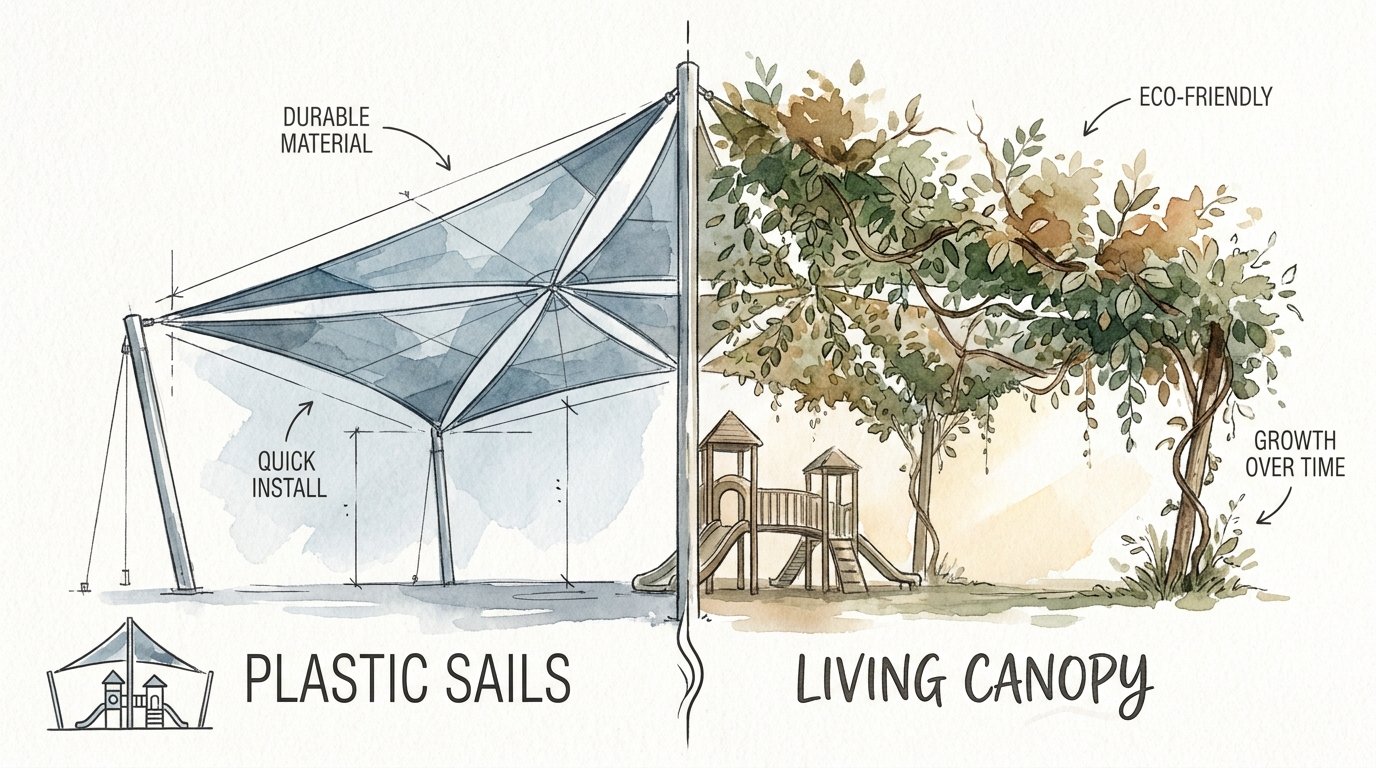
Choosing between a biological and a synthetic solution involves balancing speed, cost, and long-term performance. The following table highlights the key differences between these two popular approaches.
| Feature | Living Canopy (Willow/Vines) | Plastic Shade Sail (HDPE) |
|---|---|---|
| Setup Speed | Slow (1–3 growing seasons) | Instant (1 day) |
| Cooling Method | Shade + Transpiration | Shade only |
| Maintenance | Pruning, watering, weeding | Cleaning, tensioning, storage |
| Lifespan | Indefinite (with care) | 5–10 years (UV degradation) |
| Cost | Low (cuttings/seeds) | Moderate to High |
| Biodiversity | High (supports life) | None |
Practical Tips and Best Practices
To ensure your living shade thrives, focus on soil preparation. Before planting, mix in plenty of organic compost to improve water retention and provide the nutrients young plants need for rapid growth. A healthy start is the best way to cut down the time it takes to achieve a full canopy.
Automate your irrigation if possible. Especially for water-hungry species like willow, a simple drip irrigation system connected to a timer can be a lifesaver. This ensures that the roots stay moist even during family vacations or busy weeks, preventing the canopy from thinning out due to heat stress.
Mulch heavily around the base of your structures. A four-inch layer of wood chips or bark will suppress weeds, cool the soil, and hold in moisture. This is particularly important for living domes, as it protects the delicate new roots of the willow whips from the trampling feet of playing children.
Prune for density, not just for shape. By trimming the tips of new growth, you encourage the plant to branch out laterally. This “pinching” technique creates a much thicker wall of leaves, which blocks more light and increases the overall cooling surface area of the structure.
Advanced Considerations for Large Areas
For those managing larger play spaces or schoolyards, consider the “micro-forest” approach. This involves planting multiple layers of vegetation—tall canopy trees, mid-level shrubs, and groundcovers. This creates a vertical stack of transpiration that can drop the ambient temperature of an entire acre by several degrees.
Integrating “edible shade” is another advanced strategy. Grapes, hardy kiwis, or thornless blackberries can be trained over structures to provide both shade and a healthy snack for kids. However, this requires more intensive pest management and a commitment to cleaning up fallen fruit to prevent bees from becoming a playground hazard.
Soil microbiome health is also a factor in long-term success. Avoid using chemical fertilizers or pesticides near your living structures. Instead, encourage mycorrhizal fungi by using organic compost. These fungi form a symbiotic relationship with the roots, helping the plants find water and nutrients more efficiently, which makes them more resilient to drought.
Example Scenario: The Concrete Backyard Transformation
Imagine a typical urban backyard: a small patch of grass surrounded by a wooden fence and a concrete patio. In July, the heat radiating from the concrete makes the plastic slide too hot to use by noon. The family decided to implement two DIY playground shade solutions.
First, they planted a willow tunnel leading from the back door to the play set. By using 40 willow whips and a simple arched frame, they created a 10-foot “cool corridor” that stays 8 degrees cooler than the rest of the yard. The children now treat the tunnel as a “portal” to their play area, keeping them in the shade even as they move between the house and the equipment.
Second, they built a simple cedar pergola over the sandbox. Instead of a plastic cover, they planted Star Jasmine at each corner. By the second year, the jasmine had completely covered the top, filling the air with a sweet scent and providing a dense “living ceiling.” The total cost of the project was under $300, and it transformed a sun-scorched patch into a refreshing sanctuary that the children use all day long.
Final Thoughts
Building a living shade structure is an act of partnership with nature. It is a shift away from the “instant fix” of plastic and toward a more sustainable, breathing environment. While it requires more patience and maintenance than a store-bought sail, the rewards—in terms of cooling power, beauty, and child development—are immeasurably higher.
As you plan your playground, remember that the most effective shade is the kind that interacts with its surroundings. By choosing living materials, you are creating a space that doesn’t just block the sun, but actively works to cool the earth and the air. This creates a lasting sanctuary that will grow alongside your children.
Do not be afraid to start small. A single vine on a trellis or a tiny willow teepee can be the beginning of a much larger transformation. Apply the principles of transpiration and biophilic design today, and watch as your sun-trap playground turns into a thriving, cool oasis for generations to come.
Sources
1 laidbackgardener.blog | 2 modernfarmer.com | 3 homedepot.com | 4 makerpipe.com | 5 srpplayground.com | 6 playgroundsetc.com | 7 davesgarden.com | 8 youtube.com | 9 scirp.org | 10 inhabitat.com | 11 thrive.org.uk | 12 gba.org | 13 encyclopedia.pub | 14 housebeautiful.com | 15 journalofbiophilicdesign.com | 16 deesidewillow.com | 17 jonwilsoncanvasandshade.com.au | 18 struthersrecreation.com | 19 allplaydoesitall.com | 20 lowes.com | 21 mdpi.com | 22 usa-shade.com