Durable Diy Playground Materials
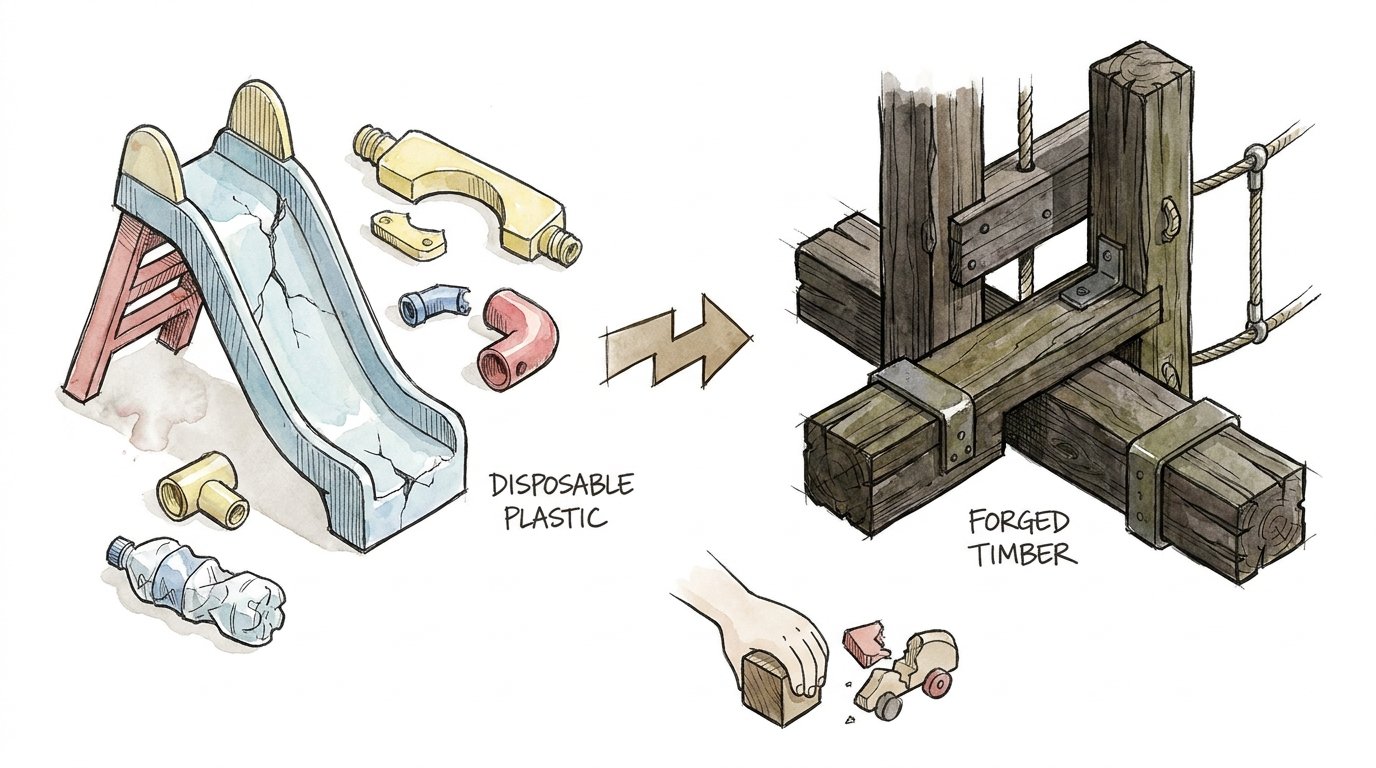
Will your grandkids play in this fort, or will it be sitting in a landfill by next summer? We’ve traded the weight of history for the convenience of plastic. One buys you a quiet weekend; the other builds a landmark that three generations of your family will climb. It’s time to stop building for the season and start building for the legacy.

Building a backyard playground is more than just a weekend project. It is an investment in your home’s history and your children’s physical development. When you choose materials that fight back against the sun, rain, and the relentless energy of a dozen neighborhood kids, you aren’t just saving money on repairs. You are creating a permanent theater for imagination.
This guide will walk you through the world of forged timber, industrial hardware, and safety standards that turn a simple swing set into a structural masterpiece. Whether you are a curious beginner or a serious practitioner, you’ll find the technical depth needed to build something that truly lasts.
Durable Diy Playground Materials
Durable DIY playground materials are the backbone of any structure intended to outlast childhood itself. While big-box stores often push thin-walled plastic kits, a legacy build focuses on high-density timbers, non-corrosive metals, and impact-rated surfacing. These materials exist to bridge the gap between “temporary toy” and “permanent architecture.”
In the real world, “durable” means more than just surviving a rainstorm. It means resisting the fungal decay that eats wood from the inside out, the UV radiation that makes plastic brittle, and the mechanical wear of swinging chains. Think of your playground like a deck that has to withstand a hurricane while simultaneously acting as a gymnastic studio.
Traditional materials like Western Red Cedar and Redwood have been the gold standard for decades because of their natural oils that repel rot. Modern innovations have added Robinia (Black Locust) and high-load structural screws to the DIY toolkit, allowing for designs that were once only possible for commercial-grade city parks.
Choosing Your Timber: The Biological Defense
Wood is a living material, even after it’s been milled. To build for generations, you must understand the cellular structure of the species you select. Not all wood is created equal when it is sitting in damp soil or baking under a July sun.
Naturally Rot-Resistant Woods
Western Red Cedar is the most common choice for premium DIY builds. It contains thujaplicins—natural chemical compounds that act as fungicides. This means the wood fights off rot without needing man-made chemicals. It is lightweight, which makes it easier to handle during construction, yet structurally stable enough to resist warping.
Redwood is the heavyweight champion of the West Coast. It is denser than cedar and offers even higher levels of tannin, which repels insects like termites and carpenter ants. While it comes at a higher price point, its dimensional stability is unmatched; it shrinks and expands less than almost any other softwood.
Robinia (Black Locust) is the “hardwood” alternative often used in high-end European playgrounds. It is incredibly dense and can last 50 years even in direct ground contact without any treatment. If you can source it locally, it is the ultimate “legacy” timber.
The Case for Pressure-Treated Lumber
Modern pressure-treated (PT) lumber, typically Southern Yellow Pine, has evolved. Older versions used arsenic (CCA), but today’s residential PT wood uses safer copper-based treatments like ACQ or MCQ. It is affordable and incredibly strong. However, it is prone to “checking” or cracking as it dries, which requires more frequent sanding to prevent splinters.
The Hardware That Never Quits
A playground is a dynamic system. Every time a child swings, they are applying “dynamic loads”—forces that shift and vibrate the entire structure. If you use standard zinc-plated screws, the moisture trapped in the wood will eat them alive within five years.
Stainless Steel vs. Hot-Dipped Galvanized
316-Grade Stainless Steel is the ultimate choice, especially if you live within 20 miles of the coast. It is virtually immune to rust. However, it is softer than carbon steel and more expensive. For most inland builds, Hot-Dipped Galvanized hardware is the practical winner. The “hot-dipped” part is critical; it creates a thick, sacrificial layer of zinc that can heal itself if scratched.
Structural Screws vs. Bolts
Forget the old-school lag bolts that require a massive pilot hole and a wrench. Modern structural screws (like GRK or Spax) are heat-treated for incredible shear strength. They feature “WAFER” heads that pull wood members together with hundreds of pounds of force without needing washers. For the main “pivot” points of a swing beam, however, Carriage Bolts remain king. Their rounded heads prevent snags on clothing, and the square neck locks into the wood to prevent the bolt from spinning.
Safety Surfacing: The Unsung Hero
The most durable wood in the world won’t matter if the ground underneath it is as hard as concrete. Fall protection is where the “legacy” build meets modern engineering. You are looking for materials that meet ASTM F1292 standards for impact attenuation.
- Engineered Wood Fiber (EWF): This isn’t your garden-variety mulch. EWF is made from virgin wood that is shredded to knit together. It forms a springy mat that can cushion falls from up to 10 feet if maintained at a 9-inch depth.
- Rubber Mulch: Made from recycled tires, this material never rots and offers the highest “critical fall height” protection per inch. It’s a “buy once, cry once” material that stays in place for decades.
- Poured-in-Place (PIP) Rubber: The gold standard for accessibility. It is a seamless, unitary surface that allows wheelchairs to roll easily. It requires professional installation but offers a 15-year lifespan with minimal maintenance.
How to Build for Longevity
Building a structure that lasts 30 years requires more than just good wood; it requires smart geometry and moisture management. If you trap water in a joint, that joint will rot, regardless of the species.
Step 1: Defeat the Ground-Contact Problem
The number one killer of playgrounds is “ground-line rot.” This happens where the wooden post meets the soil. To avoid this, never bury your posts directly in the dirt. Instead, use Galvanized Post Bases set into concrete footings. This keeps the end-grain of the wood—which acts like a bundle of straws—from sucking up moisture from the earth.
Step 2: Pre-Drill Everything
Even “self-tapping” screws can create micro-fractures in cedar or redwood. Over time, water enters these cracks, freezes, and expands them. Always pre-drill your holes to 75% of the screw’s diameter. This ensures the wood stays under “compression” rather than “tension,” significantly reducing the chance of splitting ten years down the road.
Step 3: Manage the “Use Zone”
A legacy playground needs space. Follow the CPSC guidelines: maintain a 6-foot “clearance zone” around the entire structure. For swings, that zone extends twice the height of the swing bar both in front and behind. This prevents children from colliding with the structure or fences, reducing mechanical stress on the frame.
Benefits of the Legacy Build
Why go through the trouble of sourcing 316-stainless hardware and Western Red Cedar? The benefits go far beyond aesthetics.
- Financial Appreciation: A well-built, architectural playground adds genuine value to your property. It looks like a permanent feature of the landscape, not a cluttered toy.
- Environmental Stewardship: Wood is a carbon sink. By choosing sustainably sourced timber over plastic, you are keeping petroleum-based products out of the ecosystem. At the end of its 30-year life, the wood is biodegradable; plastic is forever.
- Safety through Stability: Heavy timber structures don’t “walk” or shift. When three kids are swinging at once, a 4×6 cedar beam stays rock-solid, whereas a plastic or thin metal kit will flex and fatigue, leading to eventual structural failure.
Challenges and Common Mistakes
The biggest mistake DIY builders make is “Over-Tightening.” It’s tempting to crank down every bolt until it sinks into the wood. However, wood needs to breathe. When wood gets wet, it swells; if the bolt is too tight, the wood will crush its own fibers, creating a soft spot where rot can start.
Another common pitfall is ignoring Entrapment Hazards. Any opening between 3.5 inches and 9 inches is a “head entrapment” zone. If a child’s body can slip through but their head cannot, the results can be tragic. A durable build must also be a compliant build.
Finally, failing to “Dress” the wood is a frequent error. Even the most expensive timber needs to have its edges rounded over with a router. Sharp 90-degree corners are not just safety hazards; they are also where the wood’s finish will fail first, as stain cannot cling to a sharp edge as effectively as a radius.
Limitations: When This May Not Be Ideal
A heavy-timber legacy playground is not for every backyard. If you are living in a temporary rental, the labor and cost of a permanent build are hard to justify. These structures are heavy—often weighing over 1,000 pounds—and they are not designed to be disassembled and moved.
Environmental constraints also play a role. If your yard has a slope greater than 10 degrees, you will spend more on grading and retaining walls than on the playground itself. In these cases, a modular, adjustable kit might be a more realistic, if less durable, option.
Comparison: Material Life Cycle
| Material Type | Expected Lifespan | Maintenance Level | Initial Cost | Legacy Potential |
|---|---|---|---|---|
| Plastic Kits | 3–7 Years | Low (None) | Low | None |
| Pressure-Treated Pine | 10–15 Years | Moderate (Sealing) | Medium | Low |
| Western Red Cedar | 20–25 Years | Moderate (Staining) | High | High |
| Robinia Hardwood | 40+ Years | Low (Natural) | Very High | Excellent |
Practical Tips & Best Practices
If you want to truly push the lifespan of your build, look into Shou Sugi Ban. This is a traditional Japanese technique of lightly charring the surface of the wood. The carbonized layer is naturally resistant to bugs, fire, and rot. It creates a striking black aesthetic that requires almost zero maintenance.
Use Stainless Steel Swing Hangers with nylon bushings. Metal-on-metal contact creates friction, which creates heat, which wears down the hardware. Nylon bushings provide a silent, smooth, and nearly frictionless pivot that will last decades without squeaking.
Always use “Play-Grade” sand or gravel. Standard construction sand can contain silica dust or even small amounts of asbestos depending on the source. Play-grade materials are washed and sifted to ensure they are safe for skin contact and won’t compact into a hard “brick” over time.
Advanced Considerations: Engineering the Load
For those looking to build a multi-story fort, you must consider tributary loads. A 4×4 post is sufficient for a simple swing set, but if you are building a deck that will hold five adults and ten kids during a birthday party, you need 6×6 posts.
Consider the lever arm of your swing beam. A 10-foot beam creates massive torque on the main uprights. To counter this, use “A-frame” bracing with a 60-degree angle. This converts the lateral “swinging” force into vertical “compression” force, which wood handles much better.
For the serious practitioner, look into Timber Framing joinery. Instead of relying entirely on metal fasteners, use mortise-and-tenon joints secured with oak pegs. This allows the structure to move as a single unit, tightening its own joints as the seasons change. It is the pinnacle of the legacy build.
Example: The “Generational Fort” Scenario
Imagine building a 6×6-foot tower with an attached 12-foot swing beam.
By using Western Red Cedar 4x4s for the frame and 2x6s for the decking, you’ve chosen a material that won’t splinter as it ages. You set the posts on Simpson Strong-Tie galvanized bases, keeping the wood 2 inches above the concrete.
You assemble the frame using GRK Structural Screws, which won’t snap under the weight of the tower. For the surfacing, you dig out a 12-inch pit and fill it with 9 inches of Engineered Wood Fiber.
Ten years later, when your eldest child outgrows the swings, you replace the swing beam with a set of monkey bars. Because the main tower was built with legacy materials and structural hardware, the “bones” of the structure are as strong as the day you built them. Your only maintenance has been a fresh coat of UV-rated stain every two years.
Final Thoughts
Building for the legacy means rejecting the “disposable” culture of modern retail. It requires a shift in perspective—from seeing a playground as a temporary distraction to seeing it as a piece of backyard infrastructure. When you invest in the right species of timber, the correct grade of hardware, and the proper safety surfacing, you are creating a space that grows with your family.
The effort you put into pre-drilling holes, selecting stainless steel, and managing moisture today will pay dividends decades from now. There is a unique pride in watching your grandchildren climb the same ladder their parents once did.
Start small if you must, but start with quality. Choose one “forever” material over three “cheap” ones. The history of your backyard is written in the beams you raise today—make sure they are built to last.
Sources
1 wrighttimberframe.com | 2 timberkits.ca | 3 backyardoas.com | 4 miracleplaysystems.com | 5 macventureplay.co.uk | 6 assemblysmart.com | 7 framebuildingnews.com | 8 allaboutplaygrounds.com | 9 dougashy.com | 10 signetplay.co.uk