Cool Backyard Playground Ideas For Summer
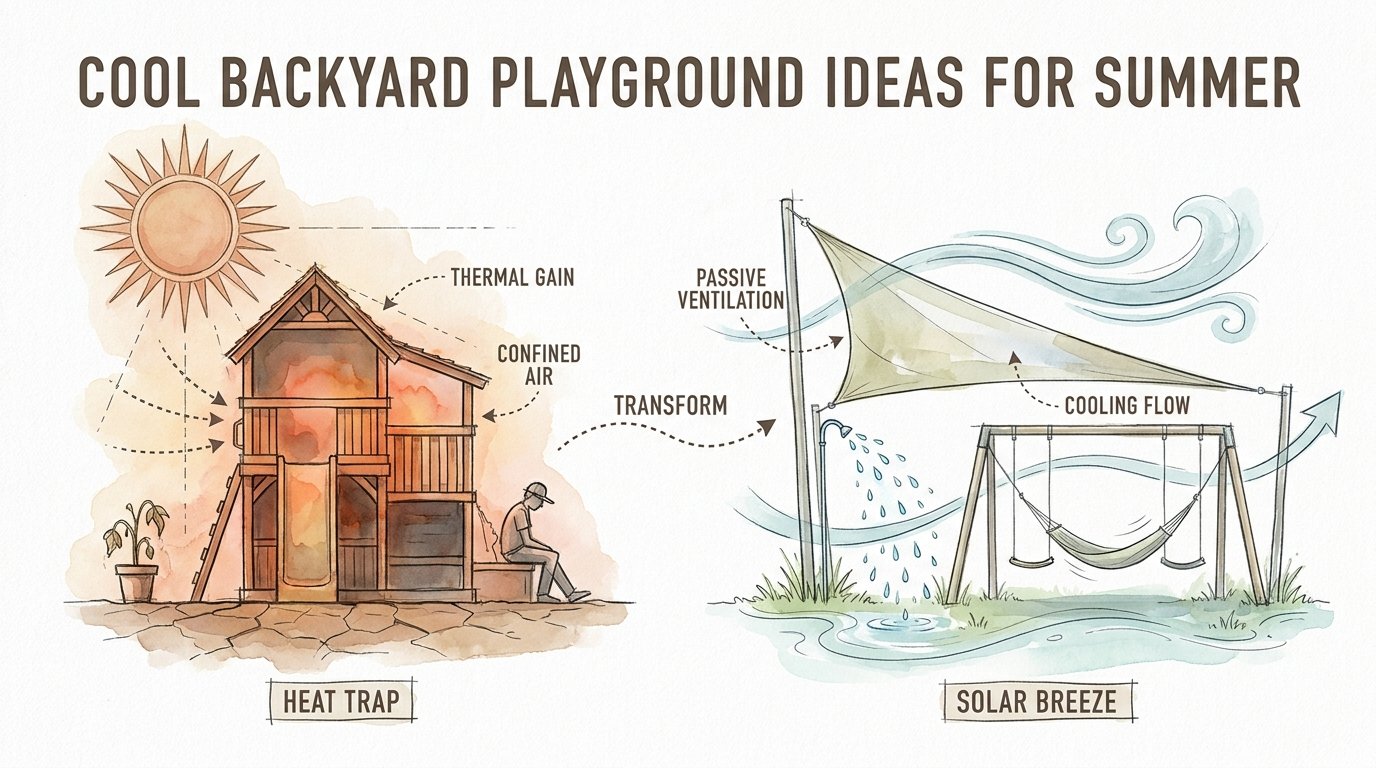
We are accidentally building ovens for our children when we could be growing sanctuaries. Synthetic playground materials can reach 160 degrees in direct sun. Passive design uses living structures and natural airflow to drop the temperature by 20 degrees without a single fan. Grow your playground, don’t just buy it.

The traditional backyard playground is a masterclass in heat absorption. We see shiny primary colors and think “fun,” but the thermal camera sees a different story. Dark rubber mats, black plastic slides, and metal ladders act as solar batteries, soaking up energy and radiating it back at our kids.

It matters because play shouldn’t come with a side of first-degree burns. When we shift toward passive design, we stop fighting the environment and start working with it. This guide is your blueprint for a “solar breeze” backyard—a space that stays naturally cool, sparks imagination, and grows stronger every year.
Cool Backyard Playground Ideas For Summer
Cool backyard playground ideas for summer prioritize thermal comfort and sensory engagement. Instead of the standard plastic tower, think of a living ecosystem designed for adventure. This approach moves away from the “heat trap” of synthetic turf and rubber mulch, opting for materials that transpire, reflect, and breathe.
Natural play spaces use items like logs, boulders, sand, and living plants to create a varied landscape. These environments aren’t just cooler; they are more complex. A child on a plastic slide has one way to go: down. A child in a “mist forest” or a willow tunnel has a thousand ways to explore.
Real-world examples include the “shaded valley” design, where the play area is slightly lowered into the ground to catch cool air. Others use “green caves”—structures made entirely of climbing vines and willow branches. These are not just toys; they are micro-environments that regulate their own temperature.
How the “Solar Breeze” Strategy Works
The “Solar Breeze” philosophy is about managing airflow and thermal mass. It focuses on three main principles: evapotranspiration, reflectance, and cross-ventilation. When these three align, you create a backyard that feels like it has its own air conditioning.
Evapotranspiration: The Plant’s AC
Plants are the ultimate cooling machines. They take in water through their roots and release it as vapor through their leaves. This process, called evapotranspiration, consumes heat energy from the air, effectively lowering the temperature. A living willow dome doesn’t just block the sun; it actively chills the air inside.
Thermal Mass and Specific Heat
Every material has a “specific heat” rating. This is a measure of how much energy is needed to raise its temperature. Materials like sand and rubber have low specific heat—they get hot almost instantly. Wood fibers and living grass have higher specific heat, meaning they stay significantly cooler even under intense noon sun.
Strategic Airflow
Hot air rises and gets trapped in “pockets.” If your playground is surrounded by a solid fence or thick, non-breathable hedges, you’ve created a heat trap. A “Solar Breeze” design uses permeable barriers, such as lattice or spaced pickets, and orients structures to catch prevailing summer winds. This keeps the air moving and prevents the “oven effect.”
Benefits of Growing Your Playground
Choosing a living, natural playground over a manufactured one offers measurable advantages for both the child and the environment.
Unmatched Temperature Control
A natural wood-fiber surface can be up to 60 degrees cooler than a black rubber mat. This isn’t just a comfort issue; it’s a safety requirement. When the ground is cool, kids can play longer and harder without the risk of heat exhaustion.
Enhanced Creative Development
Research shows that children stay engaged with natural elements for longer periods. Loose parts like sticks, stones, and sand encourage “open-ended play.” This builds problem-solving skills that a fixed plastic structure simply cannot provide.
Eco-Friendly Longevity
While plastic fades and cracks in the sun, a living willow dome or a cluster of shade trees only gets more resilient over time. You aren’t just buying a product that will eventually end up in a landfill; you are planting a legacy that improves soil health and supports local pollinators.
Challenges and Common Mistakes
The biggest mistake is treating a natural playground like a “set it and forget it” purchase. These spaces require a different kind of care.
The “Drought Trap”
Many people build living tunnels but forget that young plants need consistent water during their first two summers. If the willow dies, you’re left with a brittle, brown fire hazard instead of a cool sanctuary.
Ignoring Soil Drainage
Natural playgrounds often use sand or mulch. If you don’t plan for drainage, your cool summer oasis becomes a mosquito-breeding swamp after a thunderstorm. Always ensure the ground is graded to move water away from high-traffic zones.
Over-Pruning
It’s tempting to trim every stray branch, but those “wild” leaves are what provide the thickest shade. Learning the balance between structural safety and natural density is key to maintaining a functional microclimate.
Limitations: When Passive Design Needs Help
Passive design is powerful, but it isn’t magic. There are environmental boundaries you must respect.
Extreme Humidity
In very humid climates, evapotranspiration is less effective because the air is already saturated with moisture. In these areas, the “Solar Breeze” (airflow) becomes your most important tool. You may need to supplement natural shade with high-clearance shade sails to ensure air doesn’t stagnate.
Establishment Time
You can buy a plastic playset today and have it ready by dinner. A living structure takes seasons to reach full density. If you need a solution for *this* weekend, you’ll need to combine “quick fixes” like HDPE shade sails with your long-term “grown” structures.
Living Structures vs. Manufactured Units
To understand the difference, look at how they handle energy and maintenance.
| Feature | Living Structures (Willow, Vines) | Manufactured Units (Plastic, Metal) |
|---|---|---|
| Max Surface Temp | Ambient Air + 5°F | Ambient Air + 70°F |
| Cooling Method | Active Evapotranspiration | Passive Reflection (if light colored) |
| Maintenance | Watering, Weaving, Pruning | Power Washing, Checking Bolts |
| Durability | Self-Repairing (Grows back) | Degrades via UV Exposure |
| Impact on Soil | Increases Bio-diversity | Can Compress Soil/Leach Chemicals |
Practical Tips for a Cooler Playground
If you want to start today, follow these actionable best practices.
- Use Engineered Wood Fiber (EWF): It’s the gold standard for safety and temperature. Unlike bark mulch, EWF is processed to knit together, providing a stable surface that stays remarkably cool.
- Install Light-Colored Shade Sails: Choose white, cream, or light grey HDPE fabrics. These reflect a higher percentage of the sun’s radiation compared to dark blue or green sails.
- Plant Deciduous Trees: Maples or Oaks on the southwest side of the play area provide heavy shade in summer but drop their leaves in winter, letting the sun warm the ground when it’s cold.
- Check the “Hand Test”: Before letting kids play, place your palm on the surface for five seconds. If it’s too hot for you, it’s definitely too hot for them.
Advanced Considerations: The Physics of Play
Serious practitioners should look at the “Specific Heat” of their materials. Water has a specific heat of 4.18, making it the ultimate coolant. This is why integrated water play—like a simple hand pump and a shallow rock stream—is the most effective way to drop the temperature of a play zone instantly.
Also, consider the Albedo Effect. Surfaces with high albedo reflect most of the solar radiation. Light-colored sand has a much higher albedo than recycled tire mulch. By simply switching the color of your ground cover, you can change the local air temperature by several degrees.
Scenario: The “Green Cave” Transformation
Imagine a typical suburban backyard with a “Heat Trap” setup: a black rubber mat and a metal swing set. At 2 PM on a 90-degree day, the rubber is 155 degrees. The metal chains are too hot to touch. The kids are inside watching TV because the backyard is punishing.
Now, transform it using the “Solar Breeze” method. You replace the rubber with 12 inches of light-colored wood chips. You plant a circle of willow whips around the swing frame. Above the high-use area, you tension a cream-colored shade sail at a 15-degree angle to catch the afternoon wind.
The result? The wood chips stay at 92 degrees. The willow grows up and around the frame, creating a living “insulation” layer. The shade sail drops the temperature under the swings by 20 degrees. The kids are outside, building a fort in the cool, shaded “cave” you’ve grown for them.
Final Thoughts
The era of “burn-hazard” backyards is coming to an end. We are rediscovering that the best play equipment isn’t manufactured in a factory—it’s cultivated in the soil. By embracing passive design and living structures, we provide our children with more than just a place to burn off energy; we provide them with a resilient sanctuary.
Moving from a “Heat Trap” to a “Solar Breeze” environment requires a shift in perspective. It means trading the immediate gratification of plastic for the sustainable beauty of growth. It means understanding that a little bit of maintenance—watering a willow or raking some mulch—is a small price to pay for a playground that stays 20 degrees cooler.
Start small. Plant a single shade tree or build a small bean-pole teepee this summer. Watch how the temperature changes. Watch how your children gravitate toward the cool, living corners of the yard. Once you see the difference, you’ll never look at a plastic slide the same way again. Grow your playground. The results will flourish for years to come.
Sources
1 monkeybusinessdesign.co.uk | 2 urbancolab.design | 3 childhoodbynature.com | 4 softplay.com | 5 playgroundprofessionals.com | 6 parknplaydesign.com | 7 playsmartuk.co.uk | 8 playgroundsafety.org | 9 gardeningknowhow.com | 10 kompan.com