Sustainable Seasonal Traditions For Families
Why store plastic in the attic when you can grow your traditions in the garden? Most holiday decor is just a delayed trip to the landfill. Multi-use traditions turn the ‘stuff’ into a cycle. The centerpiece you admire on Tuesday becomes the soup you share on Friday. Teach your children that beauty and utility are the same thing.

When we think about family traditions, we often picture boxes of tangled tinsel and plastic ornaments stored in dusty corners of the garage. These items serve a purpose for a few weeks, but they eventually break, lose their luster, and contribute to the growing problem of household waste. Transitioning to sustainable traditions isn’t just about saving the planet; it is about reclaiming the rhythm of the seasons and creating memories that actually nourish your family.
Instead of purchasing mass-produced items, families are now looking toward the soil. A garden-based tradition is a living heritage that evolves as your children grow. It teaches them that the earth is not a supermarket but a generous partner. This shift from consumption to contribution changes the entire energy of the holiday season.
Whether you are harvesting rosemary for a winter wreath or pressing spring wildflowers for a summer table setting, you are participating in a regenerative cycle. These activities require more presence than clicking “buy now” on a website, but the reward is a deeper connection to your home and to each other.
Sustainable Seasonal Traditions For Families
Sustainable seasonal traditions are practices and rituals that use natural, renewable, or repurposed materials to celebrate the changing of the year. These traditions focus on the “cycle” rather than the “end.” In a typical household, a decoration is used and then discarded or stored. In a sustainable household, the decoration is often part of a larger ecological or culinary process.
The core philosophy here is that a tradition should leave the world better than it found it. This can mean using foraged materials that safely compost back into the soil, planting trees that will provide shade for decades, or preparing food that uses every scrap of the harvest. These traditions exist to ground us in the reality of our environment rather than the artificial cycles of retail sales.
In real-world terms, this looks like a family visiting a local u-pick farm instead of a big-box store. It looks like a child learning to identify edible berries for a necklace that will eventually be fed to birds during a cold snap. It is a way of life that values the story behind the object more than the object itself.
Families who embrace these traditions often find that their “holiday stress” decreases. There is less clutter to manage, fewer items to buy, and more time spent outdoors. The tradition becomes the activity of creation, not just the display of the finished product.
The Living Calendar: Year-Round Traditions
Sustainability is not a winter-only goal. To truly integrate these values, families can look at the entire calendar as a series of opportunities to connect with the earth. Each season offers unique materials and lessons that can be woven into a family’s culture.
Spring: The Season of Hope and Planting
Spring is the ideal time to start traditions centered around growth and renewal. One of the most powerful rituals is the “Growth Garden,” where each child is given a small patch of soil or a container to manage. They select seeds—perhaps edible flowers like pansies or snapdragons—and learn the patience required to nurture life from the soil.
Creating flower crowns is another timeless spring tradition. Using willow branches or soft vines as a base, families can weave in early blooms and fresh herbs. This activity connects children to the biodiversity of their local ecosystem and provides a beautiful, biodegradable accessory for spring celebrations. When the crown begins to wilt, it goes directly into the compost, feeding the very ground that grew it.
Summer: The Season of Abundance
Summer traditions often revolve around the harvest. Foraging for wild berries, such as blackberries or huckleberries, can become an annual competition to see who can fill their basket first. These berries aren’t just snacks; they become the base for wild fruit jams and jellies that will be enjoyed throughout the winter months.
Drying herbs is another essential summer practice. Bundles of lavender, sage, and mint can be hung from the rafters to dry. These bundles serve as fragrant, natural decor during the summer months and transition into functional pantry staples or handmade gifts as the weather cools. The act of “preserving the sun” through dried herbs is a powerful metaphor for children to understand.
Fall: The Season of Gratitude and Storage
As the air turns crisp, traditions shift toward preparation. The “Thankful Turkey” project is a favorite for many eco-conscious parents. Instead of a plastic centerpiece, families use a large pumpkin. Every day in November, family members write something they are grateful for on the pumpkin using a marker. On Thanksgiving, the pumpkin sits as a centerpiece of shared gratitude.
The “Great Pumpkin Smash” follows the holiday. Rather than letting the pumpkin rot in a bin, the family takes it to the garden, breaks it apart, and covers it with autumn leaves. This hands-on lesson in decomposition shows children how “waste” becomes the food for next year’s garden. It is a messy, joyful way to participate in the natural cycle of life.
Winter: The Season of Rest and Light
Winter is where sustainable traditions truly shine against the backdrop of modern overconsumption. Instead of tinsel, families can create popcorn and cranberry garlands. These look beautiful on a tree and, after the holidays, can be hung on outdoor branches to provide a festive feast for local birds and squirrels.
The “Solstice Soup” is another grounding tradition. Families collect the “last survivors” of the garden—root vegetables, hardy kale, and stored herbs—to create a communal meal. This ritual honors the end of the growing season and the start of the deep winter rest. It is a time for storytelling and reflecting on the year’s growth while the garden sleeps under a blanket of mulch.
How to Transition: Step-by-Step Implementation
Moving away from conventional, store-bought traditions requires a change in mindset. You do not need to throw away your existing decorations all at once. Instead, follow a gradual process to integrate natural elements and sustainable practices into your routine.
Phase 1: Audit and Repurpose
Start by looking at what you already own. The most sustainable item is the one that already exists. If you have an artificial tree or a collection of plastic ornaments, keep using them as long as they are functional. The goal is to stop the influx of new plastic. When something breaks, ask if it can be repaired or replaced with a natural alternative.
Phase 2: Source Locally
Identify your local resources. Find the u-pick farms, the farmers’ markets, and the nearby forests where foraging is permitted. Establishing a relationship with a local tree grower is better than buying a tree from a supermarket lot. These local connections ensure that your holiday spending supports your immediate community and reduces the carbon footprint of transportation.
Phase 3: Skill Building
Sustainable traditions often require basic “homesteading” skills. Teach your family how to tie a square knot for wreaths, how to use a dehydrator for citrus slices, or how to properly save seeds. These skills empower children and make the activities feel like a genuine craft rather than a chore. Start with one new skill per season to avoid feeling overwhelmed.
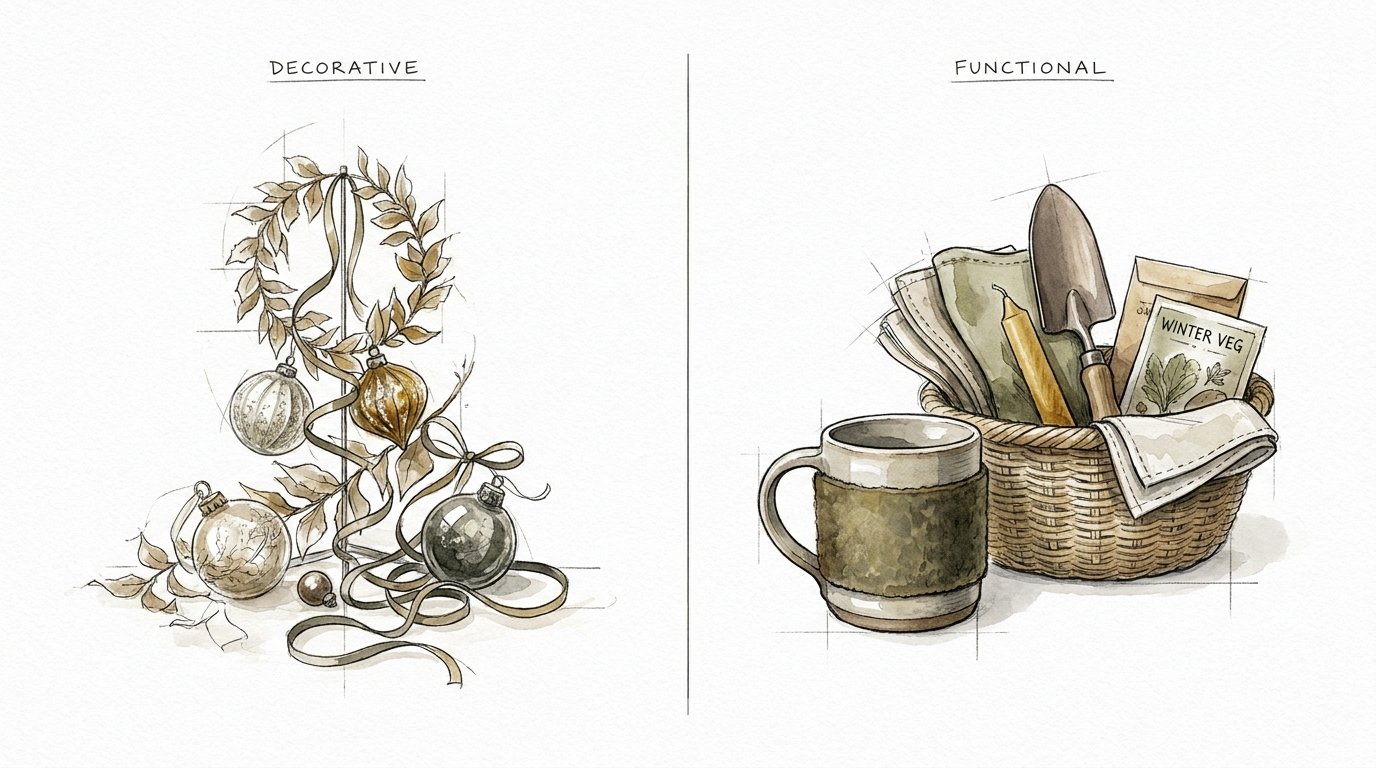
Decorative vs. Functional: The Shift in Value
The biggest hurdle in adopting sustainable traditions is moving past the idea that something must be “just for show.” In a regenerative home, the line between beauty and utility is blurred. We call this the “Functional Decor” approach.
| Factor | Decorative (Conventional) | Functional (Sustainable) |
|---|---|---|
| Material | Plastic, polyester, glitter | Herbs, wood, stone, food |
| Storage | Requires attic/garage space | Returns to the earth or pantry |
| Cost | Ongoing yearly purchases | Low cost, high labor/love |
| Lifespan | Linear (Store -> Trash) | Circular (Seed -> Table -> Soil) |
| Experience | Passive (Shopping/Unpacking) | Active (Growing/Crafting) |
When you choose functional decor, you are choosing a multi-purpose life. A rosemary wreath smells incredible and looks festive, but it also provides seasoning for your holiday roast. This efficiency is the hallmark of a sustainable home. It eliminates the need for “stuff” that serves only one purpose for two weeks a year.
Benefits of Growing Your Traditions
Adopting these methods provides measurable benefits that extend far beyond the aesthetic of your home. Families often report a significant shift in their overall well-being and financial health after making the switch.
Financial Savings: While there is an investment of time, the monetary cost of natural traditions is remarkably low. A pumpkin from a local farm is cheaper than a plastic Halloween set. Foraged pinecones are free. Over time, the “holiday budget” shifts from buying things to buying experiences, like a family trip to an apple orchard.
Emotional and Mental Health: Creating things by hand has a therapeutic effect. It slows down the frantic pace of the holidays and provides a sense of accomplishment. For children, the predictability of these seasonal rituals provides a sense of security and identity. They know that when the first frost hits, it is time to make the bird feeders, not just time to ask for toys.
Educational Value: These traditions are a hands-on science and ethics class. Children learn about life cycles, decomposition, biodiversity, and the importance of supporting local farmers. They develop a “land ethic”—a sense of responsibility for the environment that will stay with them for the rest of their lives.
Reduced Clutter: One of the most practical benefits is the lack of storage needed. When your decorations are edible or compostable, you don’t need dozens of plastic bins taking up space in your attic. Your home stays lighter and more manageable year-round.
Common Challenges and Pitfalls
Every transition has its hurdles. Understanding the common mistakes can help you navigate the shift to sustainable traditions more smoothly.
The “Ephemeral” Frustration: Many people are used to decor that looks the same on day 30 as it did on day one. Natural materials wilt, dry, and change color. This can be frustrating if you are chasing a “Pinterest-perfect” look. The key is to embrace the beauty of the temporary. Learn to appreciate the scent of drying needles or the rustic look of a fading leaf garland.
Safety Concerns: When foraging, it is easy to accidentally bring toxic plants into the home. For example, some red berries are festive but highly poisonous to children or pets. Always identify plants with 100% certainty before bringing them inside. Stick to well-known safe plants like rosemary, pine, and edible citrus until you are more experienced.
Time Constraints: Making a wreath takes longer than buying one. In our busy modern lives, time is the most valuable resource. If you try to do everything at once, you will burn out. Pick one tradition to “sustain-ify” this year and keep the rest of your routine as-is. Sustainability is a marathon, not a sprint.
Limitations and Realistic Constraints
Sustainable traditions are not a one-size-fits-all solution. There are realistic boundaries that might affect how you implement these ideas.
Geographic Limitations: Your traditions will be dictated by your climate. A family in Florida will have very different “seasonal” materials than a family in Maine. If you live in a desert, an evergreen wreath isn’t a sustainable local choice. You must look at what your specific ecosystem offers. This might mean celebrating with cacti or citrus rather than pine and holly.
Living Situations: Apartment dwellers may not have a garden to “smash a pumpkin” in. In these cases, sustainability might look like participating in a community garden or ensuring that all natural decor is small enough to be processed through a countertop bokashi bin or a local municipal composting program.
Physical Ability: Some traditional tasks, like chopping wood or hiking for forage, require physical stamina. It is important to adapt these traditions so every family member can participate. This might mean setting up a “crafting station” at the kitchen table for seniors or young children while others do the heavier gathering.
Practical Tips for Success
To get the most out of your sustainable traditions, apply these best practices for sourcing and maintaining your natural decor.
- Use the Oven: Dehydrate citrus slices, apples, and even some flowers on a low setting (around 170°F) for several hours. This prevents mold and preserves the color for the entire season.
- Beeswax is Your Friend: Use melted beeswax to dip autumn leaves. This preserves their vibrant colors and prevents them from becoming brittle, allowing you to use them in garlands for months.
- Hydration Matters: If you are using fresh greenery, treat it like a cut flower. Mist wreaths daily with water and keep them away from direct heat sources like radiators or fireplaces to prevent them from becoming a fire hazard.
- The 10-Year Rule: If you must use an artificial item, commit to using it for at least ten years. Research shows that this is the “break-even” point where an artificial tree becomes more sustainable than buying a new cut tree every year.
Advanced Considerations: The Regenerative Mindset
For those who want to take their sustainable traditions to the next level, consider the principles of permaculture and seed saving. A truly advanced tradition involves a multi-year feedback loop.
Seed Saving Rituals: At the end of the summer, gather seeds from your best-performing edible flowers or vegetables. Create “seed packets” with your children to give as holiday gifts. This ensures that your tradition literally grows in the gardens of your friends and neighbors the following year.
Living Heirlooms: Instead of a cut tree, consider a “living tree” in a pot. Some families use a Norfolk Island Pine or a small potted conifer that stays indoors during the winter and moves to the porch in the summer. Eventually, when the tree gets too large, it can be planted in the yard as a permanent monument to that decade of family life.
Dyeing with the Garden: Use plant scraps to create natural dyes for linens or Easter eggs. Onion skins create a beautiful copper color, while beet scraps produce a deep pink. This turns kitchen “waste” into a creative tool and teaches children about the hidden chemistry of the natural world.
Examples in Practice: The Friday Soup Concept
Let’s look at how this works in a real-world scenario. Imagine it is the week before a major winter holiday. Instead of buying a plastic centerpiece, the family spends an afternoon in the garden and kitchen.
They harvest several large branches of rosemary, some bay leaves, and a few sprigs of thyme. These are woven into a lush green runner for the center of the dining table. To add color, they tuck in a few whole pomegranates and some dried orange slices they prepared earlier in the week. The table looks stunning, smells like a forest, and cost nothing.
The holiday dinner passes, and the family is left with leftovers. On Friday, the “centerpiece” is dismantled. The rosemary and bay leaves go directly into a large pot with the turkey carcass and vegetable scraps. The pomegranates are juiced or eaten. The dried orange slices are saved to be used as ornaments next year or added to a batch of mulled cider. Nothing is wasted. The beauty of Tuesday becomes the nourishment of Friday. This is a functional tradition in its purest form.
Final Thoughts
Sustainable traditions are a powerful way to push back against the “throwaway culture” that has dominated our holidays for decades. By focusing on materials that are grown rather than manufactured, we teach our children that the most valuable things in life aren’t found on a store shelf. They are found in the dirt, in the kitchen, and in the time we spend working together.
The shift to a regenerative lifestyle doesn’t happen overnight. It starts with a single pumpkin, a handful of seeds, or a rosemary wreath. As you slowly replace plastic with plants, you will find that your home feels more connected to the world outside. Your attic will become emptier, but your memories will become richer.
Start small this season. Look at your garden or your local park and see what it is offering you. Whether it is a bowl of pinecones or a jar of wild berry jam, let it be the start of a tradition that grows alongside your family. Experiment, make mistakes, and enjoy the process of turning your home into a living part of the seasons.
Sources
1 aupairinamerica.com | 2 livablebuckhead.com | 3 simplelocallife.com | 4 shopequo.com | 5 securehomeexpert.com | 6 seasidesustainability.org | 7 iridanaturals.com | 8 passionlilie.com | 9 cottageonbunkerhill.com | 10 naturallymodernlife.com | 11 northshoreplantclub.com | 12 goodwillsv.org | 13 starofnature.org | 14 wishonevergreens.com | 15 foresthomesstore.com | 16 youtube.com | 17 youtube.com | 18 balsamhill.com | 19 housebeautiful.com