Physics Based Play For Family Bonding
If your backyard toy only has one verb, your kids will be bored by Monday. A slide is just a slide. But a rope and a pulley? That’s a crane, an elevator, a delivery system, and a physics lesson all in one. We ditched the plastic ‘one-hit wonders’ for multi-use tools that turn the whole yard into a laboratory.
Most modern toys are designed for specific, narrow actions. Press a button, hear a sound. Climb a ladder, go down the slide. This is linear play. It has a beginning and an end. Physics-based play is different because it uses the Theory of Loose Parts. This concept, introduced by architect Simon Nicholson, suggests that the richness of a play environment is directly proportional to the number of variables in it.
When you provide tools instead of toys, you invite your children to become engineers. You give them the power to modify their environment. A simple length of rope combined with a sturdy branch can become a dozens of different machines. This is where the magic happens.
Physics Based Play For Family Bonding
Physics-based play is the intentional use of simple machines and raw materials to solve problems in a backyard setting. It is not about sitting at a desk with a textbook. It is about moving heavy rocks, hauling buckets of water, and building structures that actually do work. This type of play bridges the gap between abstract science and the physical world.
In the real world, engineers use these same principles to build skyscrapers and bridges. When families engage in these projects together, they are not just “playing.” They are collaborating on complex tasks that require communication, hypothesis testing, and physical effort. It turns the weekend into an apprenticeship where parents and children learn the limits of friction, gravity, and mechanical advantage side-by-side.
Imagine trying to move a massive boulder that is too heavy for anyone to lift. In a standard play environment, that rock is just an obstacle. In a physics-based laboratory, that rock is a challenge. You might use a long wooden plank as a lever. You might set up a Z-drag pulley system to multiply your pulling force. This turns a chore into a triumph of the mind over matter.
How Simple Machines Transform the Backyard
To build a backyard laboratory, you need to understand the six classic simple machines. These are the building blocks of every complex device ever made. They do not require batteries or electricity. They rely entirely on the laws of the universe.
The Pulley System
A pulley consists of a wheel with a groove and a rope. It changes the direction of force, allowing you to lift things up by pulling down. This is much more ergonomic for the human body. Fixed pulleys are great for hauling supplies to a treehouse. Moveable pulleys and compound systems actually reduce the amount of effort needed to lift a load. If you use two pulleys, you can lift twice as much weight with the same amount of effort.
The Lever and Fulcrum
Archimedes once said that if you gave him a place to stand and a long enough lever, he could move the world. In your backyard, a lever is usually a long 2×4 board or a sturdy fallen branch. You place a “fulcrum”—like a smaller log or a stone—under the board near the object you want to move. When you push down on the long end, the short end exerts massive upward force. This is the perfect tool for extracting stubborn stumps or rearranging heavy landscaping stones.
The Inclined Plane
This is essentially a ramp. It is the most basic way to move a heavy object to a higher elevation. Instead of lifting a heavy crate of dirt straight up, you push it along a slope. You travel a longer distance, but the force required at any given moment is significantly lower. This teaches children about the trade-off between distance and effort.
The Archimedes Screw
If you want to move water from a lower pond to a higher mud kitchen, the Archimedes screw is the ultimate project. It consists of a pipe with a spiral inside. As you rotate the screw, small pockets of water are trapped and moved upward against gravity. It is a mesmerizing demonstration of how rotational motion can be converted into vertical transport.
Benefits of Mechanical Advantage Play
Choosing a laboratory over a plastic playset offers measurable developmental advantages. These benefits go far beyond simply burning off energy before bedtime.
- Critical Thinking: Children must analyze why a system isn’t working. Is there too much friction? Is the rope slipping? These are real-world problems that require logical solutions.
- Grit and Persistence: Physics doesn’t care about your feelings. If a lever isn’t positioned correctly, the rock won’t move. Children learn to fail, adjust, and try again until the laws of physics are on their side.
- Spatial Awareness: Handling ropes, pulleys, and long boards develops a deep sense of how objects interact in three-dimensional space.
- Gross Motor Development: Hauling ropes and balancing beams builds functional strength and coordination that “packaged” play often misses.
Parents also benefit. Instead of being a passive observer on a park bench, you become the lead engineer. You get to explain concepts like mechanical advantage and friction while actually seeing them in action. This creates a shared language of problem-solving that strengthens family bonds.
Challenges and Common Mistakes to Avoid
Setting up a backyard engineering zone is rewarding, but beginners often fall into predictable traps. Safety and efficiency are the primary concerns.
One frequent error is using the wrong type of rope. Hardware store twine or cheap plastic yellow rope is often too slippery or too weak. It can snap under tension or cause painful rope burn on small hands. Static climbing rope or high-quality paracord is a much better choice because it handles knots well and provides a consistent grip.
Another mistake is neglecting the fulcrum placement. When using a lever, the closer the fulcrum is to the load, the more power you have. Many people place the pivot point in the middle of the board. This creates a seesaw, which is fun for riding, but useless for lifting heavy objects. Move the pivot closer to the rock to feel the true power of the lever.
Friction is the silent enemy of all simple machines. A rope rubbing directly over a tree branch creates a massive amount of heat and resistance. This makes work harder and can damage the tree. Always use a proper pulley or a metal carabiner to create a smooth surface for the rope to glide over.
Limitations of Backyard Engineering
While simple machines are powerful, they have realistic boundaries. It is important to understand when a project might be too complex or dangerous for a home setup.
Height is a major constraint. Any platform or pulley anchor higher than 12 feet requires professional-grade safety equipment and fall protection. For most backyard laboratories, keeping everything below 6 to 8 feet ensures that falls are manageable with proper ground cover like wood chips or sand.
Weather also plays a role. Wooden beams can rot, and metal pulleys can rust if left exposed to the elements. A backyard laboratory requires more maintenance than a plastic slide. You must regularly inspect ropes for fraying and check that anchor points in trees haven’t become loose or overgrown.
One Action vs. Infinite Uses: The Comparison
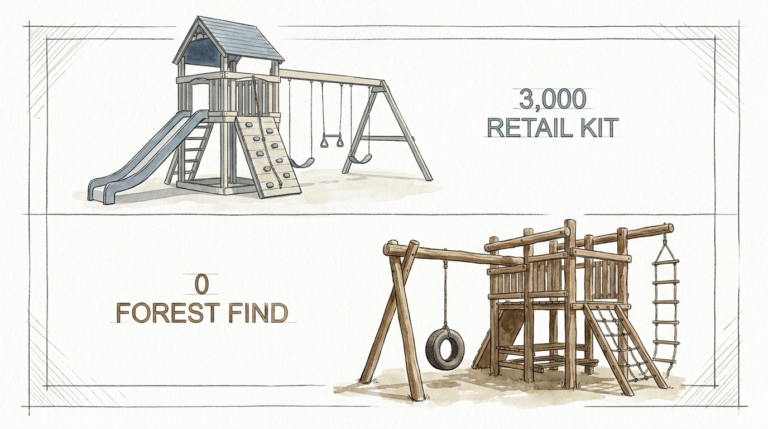
When deciding between a traditional play structure and a physics-based kit, consider the long-term engagement value. A standard playset is a “fixed” environment. A physics kit is a “fluid” environment.
| Feature | Traditional Playset | Physics-Based Kit |
|---|---|---|
| Primary Verb | Sliding, Swinging | Lifting, Hauling, Building, Modifying |
| Complexity | Low (Same every time) | Scalable (From simple to compound) |
| Longevity | Kids outgrow it in 3-4 years | Grows with child’s engineering skills |
| Space Needed | Large footprint | Minimal (Ropes and tools can be stored) |
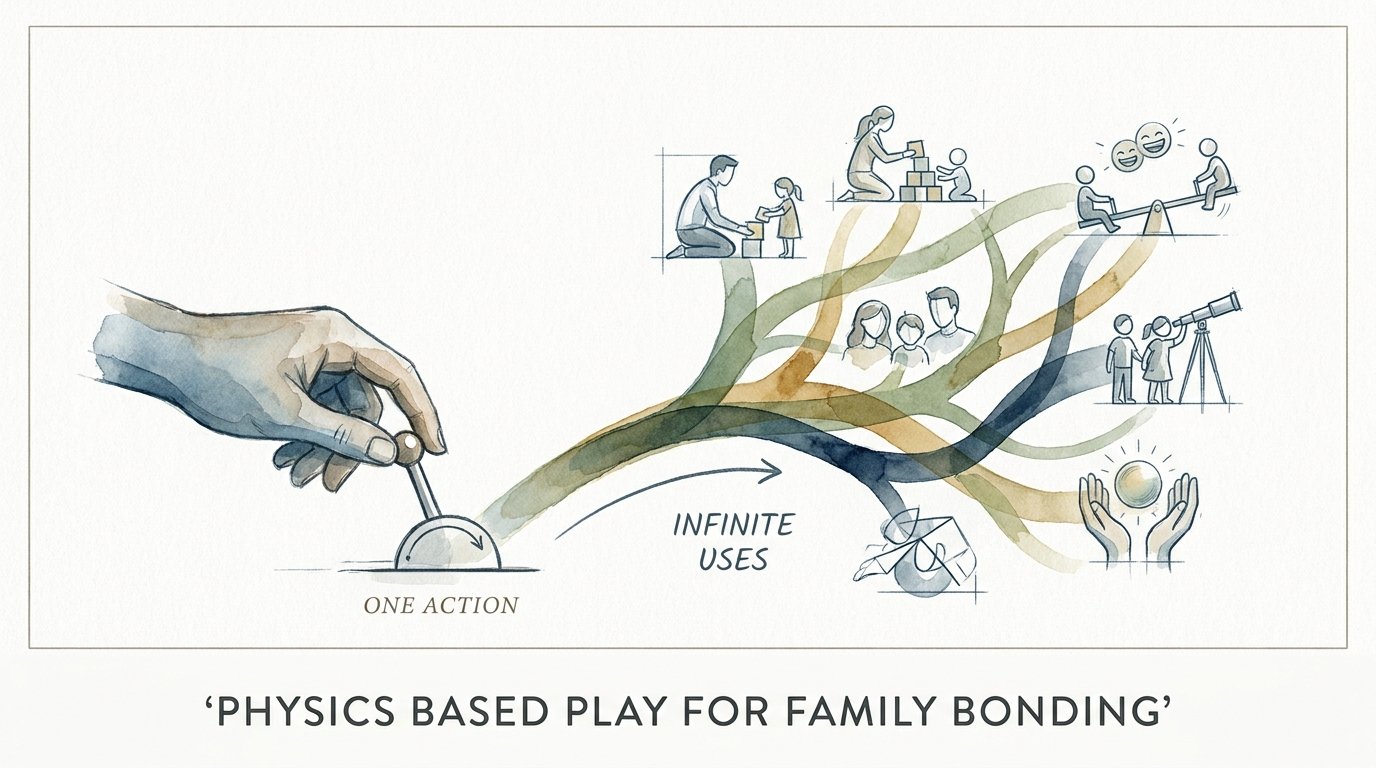
The traditional playset provides One Action. The child follows the intended path. The physics-based kit provides Infinite Uses. The child creates the path. This difference is why children spend hours playing with “trash” like boxes and sticks while expensive plastic sets sit empty.
Practical Tips for Setup
Creating a backyard laboratory doesn’t have to be expensive. You can start with a few basic items and expand as your children’s interest grows.
- Establish a “Loose Parts” Zone: Designate a specific area for logs, planks, and stones. This keeps the rest of the yard tidy while giving kids a clear workspace.
- Use Storage Buckets: Use heavy-duty 5-gallon buckets for two purposes. They are great for storing ropes and pulleys, and they serve as the perfect “load” for pulley experiments.
- Invest in Carabiners: Climbing-grade carabiners are the secret weapon of backyard engineering. They allow you to quickly clip and unclip different systems without tying complex knots every time.
- Install a “High Line”: String a tensioned rope between two trees. This serves as a track for horizontal pulleys, allowing kids to send “cargo” across the yard.
Focus on materials that are sensory-rich. Natural wood, heavy hemp rope, and cool metal parts provide a much better tactile experience than uniform plastic.
Advanced Considerations for Serious Practitioners
For families who want to take their engineering to the next level, consider the Z-Drag system. This is a 3:1 mechanical advantage setup commonly used in swiftwater rescue and technical climbing. It uses three segments of rope to pull a single load. By setting this up in the backyard, you can teach children how to move objects that weigh hundreds of pounds with just a light tug.
You can also explore gear ratios using old bicycle parts. By mounting different-sized sprockets on a wooden frame, kids can see how a large gear turning a small gear increases speed, while a small gear turning a large gear increases torque. This is the foundation of mechanical transmission.
Water systems offer another layer of complexity. Creating a series of “locks” or dams using PVC pipes and wood offcuts teaches the principles of fluid dynamics. Combine this with the Archimedes screw mentioned earlier, and you have a fully functional irrigation laboratory.
Example Scenario: The Treehouse Supply Lift
Let’s look at a practical application. A child wants to get a heavy bin of LEGOs up to their treehouse platform.
1. Initial Attempt: They try to carry it up the ladder. This is dangerous and tiring.
2. Basic Solution: They tie a rope to the bin and pull it straight up. This is a “fixed” pulley if they run the rope over a branch. It works, but they are still pulling 100% of the weight.
3. Engineering Solution: They add a second pulley to the bin itself. They anchor the end of the rope to the treehouse, run it down through the bin’s pulley, and back up.
4. Result: They now have a 2:1 mechanical advantage. They only have to pull with half the force. They notice they have to pull twice as much rope to get the bin to the top.
This moment of realization—that they traded distance for ease—is worth more than a dozen science worksheets. It is a firsthand experience of the Conservation of Energy.
Final Thoughts
Ditching the one-verb toys for a backyard laboratory changes the way your children view the world. They stop looking at obstacles as “unmovable” and start looking at them as engineering puzzles. This shift in mindset builds a foundation of confidence and competence that lasts a lifetime.
Whether you start with a single rope or a complex series of pulleys, the goal remains the same. You are giving your children the tools to experiment, fail, and succeed. You are moving from a world of passive consumption to one of active creation.
Experiment with these systems today. Start with a simple lever or a basic bucket lift. Watch how your kids engage with the physical laws of the universe. You might just find that the most valuable thing in your backyard isn’t a fancy playset, but the limitless potential of a curious mind equipped with a simple machine.
Sources
1 youtube.com | 2 youtube.com | 3 dcwater.com | 4 youtube.com | 5 netknots.com | 6 sfi.ie | 7 youtube.com | 8 frugalfun4boys.com | 9 playaustralia.org.au | 10 greenleaveselc.com.au | 11 ingridscience.ca | 12 quora.com | 13 littlebinsforlittlehands.com | 14 science-sparks.com | 15 firstschool.net | 16 trailism.com | 17 thecuriosityapproach.com | 18 alpinesavvy.com | 19 devineescapes.com | 20 mass.gov