Outdoor Movie Sound Systems
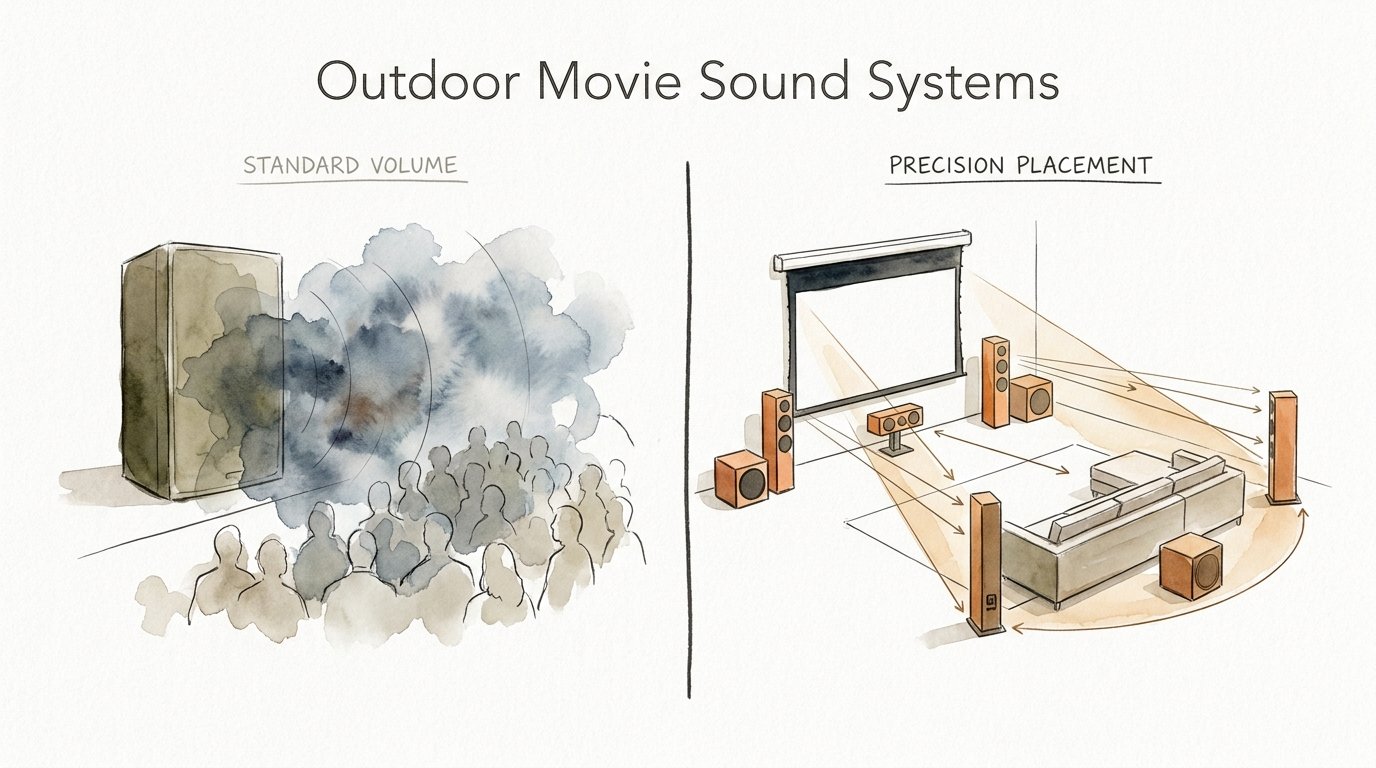
The loudest speaker isn’t the best speaker—it’s just the most likely to get you a noise complaint. Most people think outdoor movies require high volume. Pros know they require precision. By distributing smaller speakers closer to the listeners, you get theater-quality immersion without disturbing the entire neighborhood.

Setting up a backyard cinema feels like magic until the sound starts to fail. You might have a crisp 4K image, but if the audio sounds like it’s coming from a tin can at the bottom of a well, the experience is ruined. Achieving great outdoor sound is about overcoming the lack of walls. Indoors, your walls bounce sound back to your ears. Outdoors, that sound just keeps going until it hits your neighbor’s window or disappears into the sky.
This guide will help you master the art of the outdoor movie sound system. We will cover everything from basic Bluetooth setups to professional-grade distributed audio. You will learn how to fight ambient noise, sync your audio perfectly with the video, and keep your gear safe from the elements. Let’s turn your backyard into a sonic masterpiece.
Outdoor Movie Sound Systems
An outdoor movie sound system is a specialized audio configuration designed to deliver clear, impactful sound in an open-air environment. Unlike a standard home theater, these systems must compete with wind, crickets, traffic, and the vastness of the open sky. They range from simple portable speakers to complex multi-speaker arrays that wrap the audience in sound.
In the real world, these systems are used for everything from intimate family birthdays to massive “movies in the park” community events. The core goal is always the same: dialogue clarity. If your audience can’t hear what the actors are saying, they stop paying attention. High-quality outdoor systems focus on the “mid-range” frequencies where human speech lives.
Think of an outdoor sound system like a garden irrigation setup. You could use one giant high-pressure hose to water the whole yard from one spot, but you’d likely blast the plants in front and miss the ones in the back. A distributed system is like a sprinkler network. It puts smaller amounts of “water” exactly where it’s needed. This allows every guest to hear perfectly without needing to crank the master volume to painful levels.
How to Build Your Outdoor Audio Setup
Building a system starts with your source and ends with your speakers. The middle part is where most people get lost. You need a way to get the signal from your movie player (laptop, Roku, Blu-ray player) to your speakers without creating a lag that makes the movie look like a poorly dubbed foreign film.
Step one is choosing your connection type. If you are using a projector, check for an “Audio Out” or “Aux” port. Most entry-level setups run a 3.5mm cable from the projector to a powered speaker. For a more professional approach, you should run the HDMI from your player into an Audio Extractor or a Mixer first. This allows you to send the video to the projector and the audio directly to your speakers, bypassing the low-quality internal components of the projector.
Step two is speaker placement. Never put your speakers behind the screen or directly on the ground. Soil and grass are acoustic sponges; they will soak up your sound. Place your speakers on stands at ear level. If you have a large group, place a pair of speakers at the front corners of the seating area and another pair halfway back. This ensures the people in the “cheap seats” have the same experience as the front row.
Step three is power management. Most high-quality outdoor speakers are “active,” meaning they have a built-in amplifier and need to be plugged into a power outlet. Use outdoor-rated extension cords and a high-quality surge protector. If you are using “passive” speakers, you will need a separate amplifier kept in a dry, shaded area. Always tape down your cables to prevent guests from tripping in the dark.
Benefits of a Dedicated Sound System
The most immediate benefit is total immersion. When sound surrounds the audience, the environment disappears. You stop hearing the neighbor’s dog or the distant hum of the highway. A dedicated system provides “headroom,” which means the speakers can handle loud explosions or dramatic music cues without distorting or sounding “strained.”
Another major advantage is “Precision Placement.” By using multiple speakers, you can keep the volume lower overall while increasing clarity for every listener. This is a game-changer for neighborhood relations. You can enjoy a blockbuster at 10 PM without a visit from the local police because the sound stays focused on your seating area rather than radiating through the entire block.
Lastly, a professional-style setup offers better control over the “Soundstage.” This is the psychological effect where sounds seem to come from specific directions. In a movie, if a car drives from left to right on the screen, a good sound system makes that sound move across your yard. This adds a layer of realism that a single speaker simply cannot provide.
Challenges and Common Mistakes
The biggest enemy of outdoor cinema is “Bluetooth Latency.” Wireless speakers are convenient, but they often introduce a delay of 100 to 500 milliseconds. This results in “lip-sync” issues where the sound doesn’t match the actors’ mouths. It is incredibly distracting and can ruin a movie. To avoid this, always prioritize wired connections for the main audio feed.
Another common mistake is neglecting the “Bass Sink.” Low-frequency sounds (bass) require surfaces to bounce off of to feel powerful. In an open yard, bass literally disappears. Many people are disappointed when their expensive indoor subwoofer sounds weak outside. The fix is to use an outdoor-rated subwoofer and place it near a solid surface like a brick wall or a patio floor to help reflect those waves back toward the audience.
Cable management is the final hurdle. Most DIY setups end in a “spaghetti” mess of orange extension cords. This isn’t just ugly; it’s a massive safety hazard. People moving around in the dark to get popcorn will trip. Use cable ramps or gaffers tape to secure every run. Also, remember that long cable runs (over 50 feet) can lead to signal degradation. If you’re going long-distance, use balanced XLR cables instead of standard RCA or 3.5mm wires.
Limitations of Outdoor Audio
Environmental factors are the ultimate limitation. Wind can actually “carry” sound away or create a whistling noise in your speaker grills. Humidity can affect how sound travels, and extreme heat can cause amplifiers to overheat and shut down. You must accept that your backyard will never have the perfect acoustics of a sound-treated indoor theater.
Distance is also a hard limit. Sound follows the “Inverse Square Law,” meaning every time you double the distance from the speaker, the sound level drops significantly (by 6 decibels). This is why one giant speaker at the front of the yard is a bad idea. To cover a 100-foot deep yard, the front row would have to endure deafening volume for the back row to hear anything at all.
Finally, consider the legal limits. Most cities have noise ordinances that kick in after 9 PM or 10 PM. Even the best-placed system can get you in trouble if you’re watching an action movie with heavy bass. If you live in a very tight neighborhood, the ultimate limitation might be that you have to use a “Silent Cinema” setup with wireless headphones for everyone.
Wired vs. Wireless Comparison
Choosing between a wired and wireless system depends on your technical skill and your tolerance for glitches. Both have their place, but they serve different needs.
| Factor | Wired Systems | Wireless (Bluetooth/Wi-Fi) |
|---|---|---|
| Audio Sync | Perfect; zero latency. | Variable; often has lag. |
| Sound Quality | High fidelity; no compression. | Compressed; loss of detail. |
| Setup Time | High; requires cable runs. | Low; instant pairing. |
| Reliability | High; no signal drops. | Moderate; prone to interference. |
| Scale | Scalable to any size. | Limited by range (30-60 ft). |
Practical Tips and Best Practices
Always check the “IP Rating” of your equipment. IP stands for Ingress Protection. A rating of IPX4 means the speaker can handle splashes, making it safe for a humid night or a light drizzle. IP67 means it is fully dust-proof and can even be submerged. Never leave non-rated equipment outside overnight, even if the weather looks clear; morning dew can be just as damaging as rain.
Use the “Anchor Speaker” technique. Place your most powerful speaker (or soundbar) directly under the screen. This “anchors” the dialogue to the actors’ faces. Then, place your smaller satellite speakers to the left and right. This creates a natural soundstage that follows the action on screen. If you’re using a stereo pair, make sure they aren’t more than 20 feet apart, or you’ll get a “hole” in the middle of your sound.
Think about the ground surface. If your seating area is on a concrete patio, the sound will bounce harshly and create an “echo” effect. Throw down some outdoor rugs or blankets. Not only does this make it cozier for your guests, but it also acts as an acoustic treatment that absorbs reflections and makes the dialogue much easier to understand.
Advanced Considerations for Pro Setups
If you want to take things to the next level, look into “Digital Signal Processing” (DSP). Some high-end outdoor amplifiers allow you to tune the frequency response to your specific yard. You can boost the frequencies that are getting lost in the wind or cut the bass frequencies that are rattling your neighbor’s fence. This level of control is what separates a “backyard movie” from a “backyard cinema.”
Consider a “70-Volt System” for very large properties. Standard speakers lose power over long wire runs. A 70V system uses transformers to send audio over hundreds of feet with almost no loss. This is the technology used in theme parks and stadiums. It allows you to chain a dozen speakers together along a path or around a large pool with a single thin wire.
Subwoofer time-alignment is another pro secret. Because low-frequency waves are so long, they can reach the listener’s ear at a different time than the high frequencies from the main speakers. This creates a “muddy” sound. High-end receivers allow you to set the “distance” of each speaker in the menu. This adds a tiny delay to certain speakers so all the sound hits the listener’s ears at the exact same millisecond.
Example Scenarios
Scenario A: The Intimate Backyard (4-6 people). For a small family night, you don’t need a massive rig. A pair of high-quality, weather-resistant Bluetooth speakers with “Stereo Pairing” mode is often enough. Place them on small side tables on either side of the audience. Because the distance is short, latency is usually manageable, and the volume stays contained within a 15-foot radius.
Scenario B: The Neighborhood Block Party (30-50 people). This requires a “Point Source” system. Use two 10-inch or 12-inch powered PA speakers on tripods. Raise them so the bottom of the speaker is slightly above the heads of the crowd. This allows the sound to travel over the people in the front and reach the back. Connect these to a small 4-channel mixer so you can plug in a microphone for announcements before the movie starts.
Scenario C: The Estate/Large Event (100+ people). This is where you use “Distributed Audio.” You would set up “Delay Towers”—extra speakers placed 40 feet back from the main screen. These speakers are programmed with a specific millisecond delay so their output perfectly matches the sound arriving from the front speakers. This prevents an “echo” and ensures the people in the very back have a crystal-clear experience without the people in the front being deafened.
Final Thoughts
Building the perfect outdoor movie sound system is a journey of trial and error. Start with the basics: focus on dialogue clarity and getting your speakers up to ear level. You will quickly realize that “better” sound is almost always about “smarter” placement rather than just buying more wattage. Precision beats power every single time.
As you get more comfortable, experiment with different configurations. Try adding an outdoor subwoofer or a dedicated audio mixer to your chain. Each small adjustment brings you one step closer to that elusive “theater feel.” Remember to always respect your neighbors and protect your gear from the elements so you can enjoy your outdoor cinema for years to come.
Your backyard is waiting to be transformed. Whether it’s a simple soundbar or a complex multi-speaker array, the goal is the same—to create memories under the stars. Put in the work on your audio setup, and your guests will be talking about your movie nights long after the credits roll. Happy screening!
Sources
1 yamaha.com | 2 soundcore.com | 3 vailaudio.com | 4 sapphire.ca | 5 av-experience.com | 6 platinaudio.us | 7 outdoorcinemapro.com.au | 8 awolvision.com | 9 gearsource.com | 10 ultimea.com | 11 audioproreck.com | 12 cmi.com.au | 13 arendalsound.com | 14 dreamediaav.com | 15 zebozap.com | 16 carvinaudio.com