Open-ended Play Vs Tablet Apps Stats
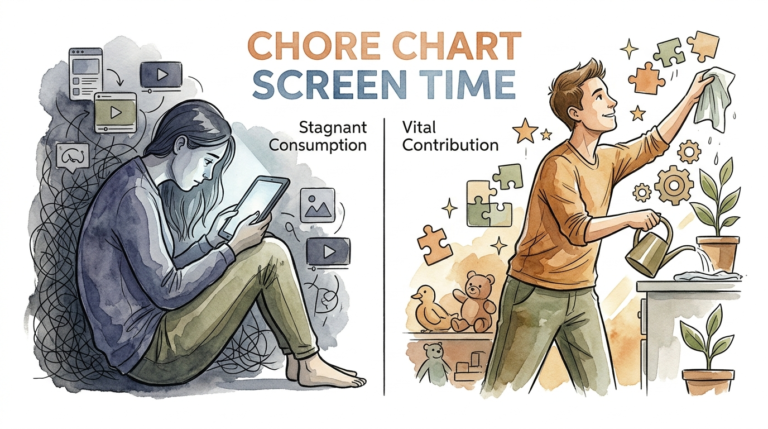
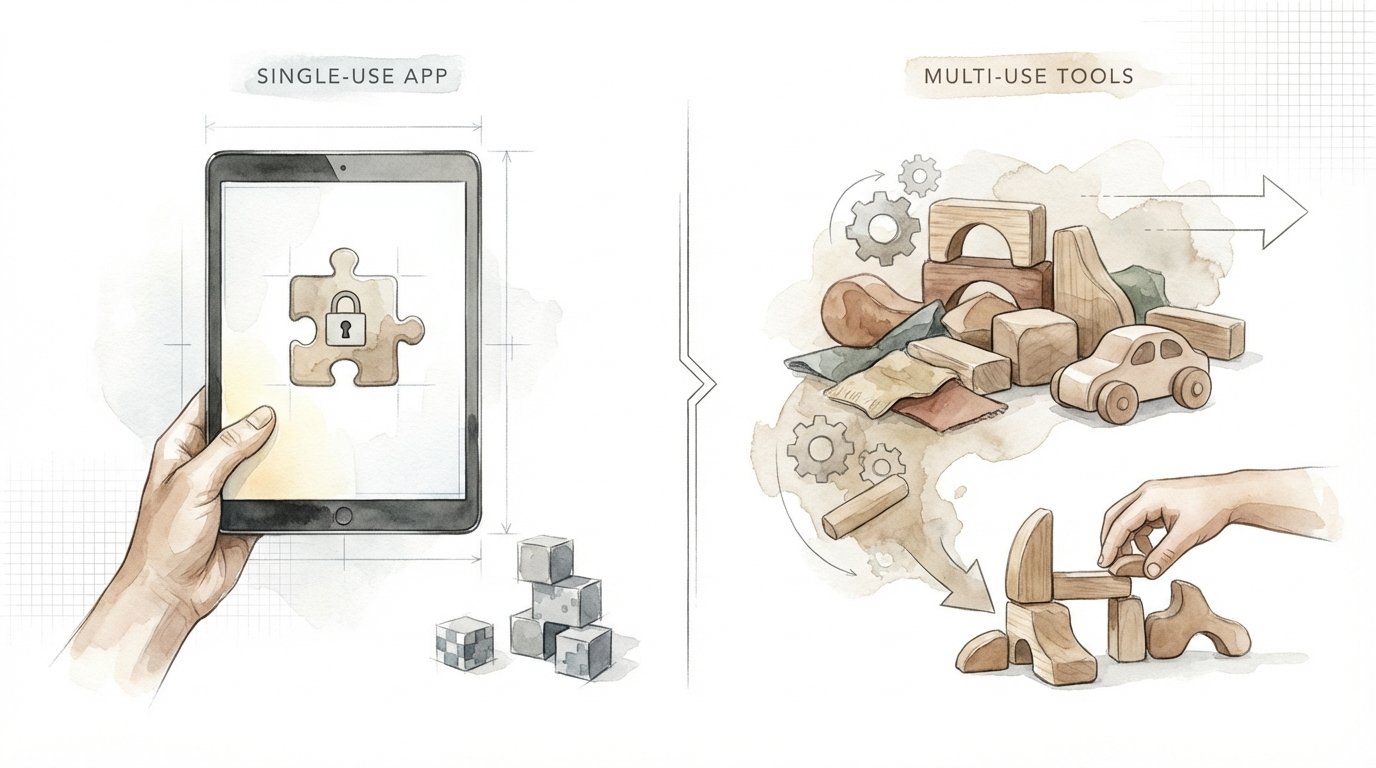
One has a million features but only one outcome; the other has zero features and a million possibilities. Research shows that ‘multi-use’ objects like sticks, boxes, and dirt trigger 4x more creative problem-solving neural pathways than ‘single-use’ digital games. An app tells you how to play; a stick waits for you to decide. Which one is truly ‘smarter’ for your kid?
Parents today are sold the dream of “educational technology.” We are told that a tablet filled with bright colors and dings will prepare our children for a digital future. Yet, the most sophisticated software on earth cannot replicate the cognitive demand of a simple cardboard box. This guide explores the massive divide between the scripted world of apps and the unscripted magic of open-ended play.
Open-ended Play Vs Tablet Apps Stats
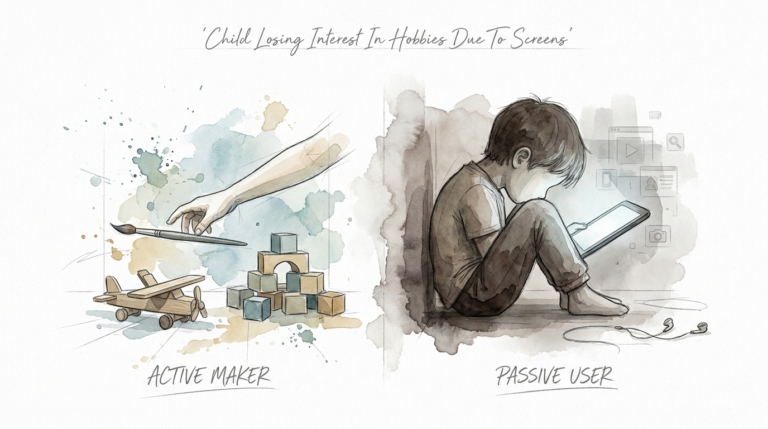
Open-ended play is any activity where children can choose their own direction without a predefined goal. It is the difference between a coloring book (where you stay inside the lines) and a blank sheet of paper (where the lines don’t exist yet). Tablet apps are often “closed-ended.” They have a right answer, a next level, and a specific reward for compliance.
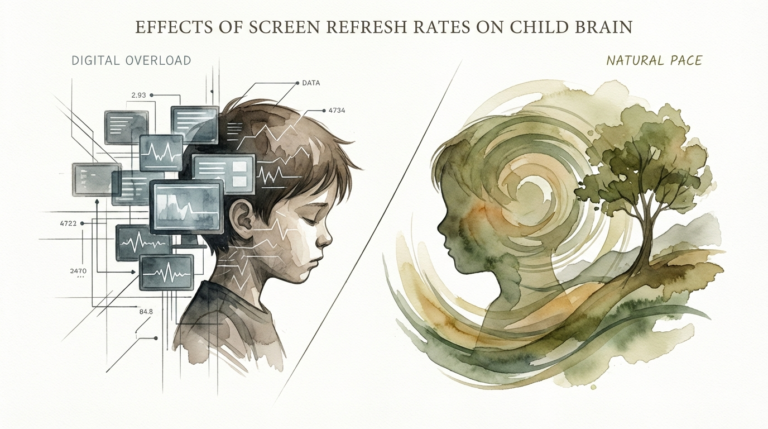
Recent longitudinal studies provide a startling look at how these choices affect the brain. Research published in JAMA Pediatrics found that one-year-olds exposed to more than four hours of screen time per day showed significant delays in communication and problem-solving by ages two and four. Conversely, a landmark study from the University of Toledo revealed that children in environments with fewer toys—specifically simple, multi-use ones—engaged in play that was twice as complex and long-lasting as those with a mountain of flashy gadgets.
The National Institutes of Health (NIH) conducted a massive study starting in 2018. They discovered that children spending over two hours a day on screens scored lower on language and thinking tests. Some children with high screen usage even showed a thinning of the brain’s cortex. This is the area responsible for critical thinking and reasoning. In real-world terms, the “smart” app might be making the learning process too easy, essentially “outsourcing” the child’s thinking to the software developer.
The Mechanics of Neural Scaffolding
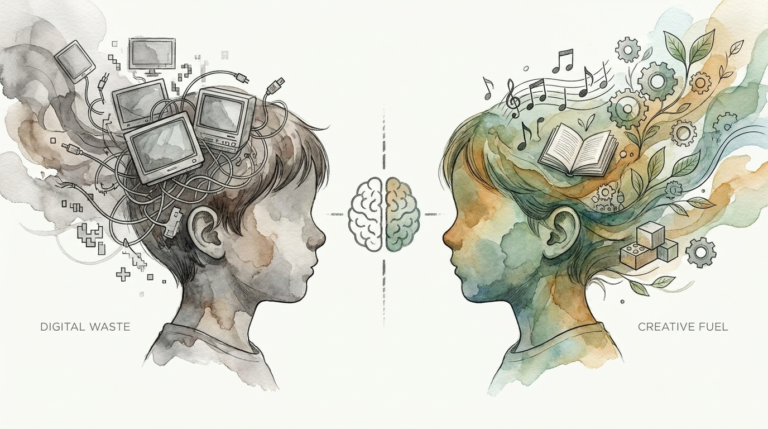
How does a child’s brain react to a stick versus a smartphone? When a child picks up a stick, their brain must immediately engage in symbolic substitution. They have to decide: Is this a sword? A magic wand? A fishing pole? This mental heavy lifting builds neural bridges between different regions of the brain.
Digital apps often rely on “bottom-up” processing. The bright lights and loud sounds grab the child’s attention automatically. This is passive engagement. Open-ended play requires “top-down” processing. The child must use their own internal drive to create focus and direction. This strengthens the prefrontal cortex, which is the command center for focus, emotional regulation, and planning.
Every time a child tries to balance a rock on a wobbly surface, they are conducting a mini-physics experiment. They are calculating weight, gravity, and friction. In a digital game, the physics are programmed. The child doesn’t learn the “why”—they only learn which button to press to get the star. Physical tools provide high-fidelity sensory feedback that screens simply cannot match.
The Core Benefits of Multi-Use Tools
Multi-use tools—often called “loose parts”—provide a range of developmental advantages that extend far beyond simple entertainment. These items include things like wooden blocks, fabric scraps, pinecones, and even kitchen utensils.
One of the most immediate benefits is the development of executive function. This is a set of mental skills that include working memory, flexible thinking, and self-control. When a child builds a fort out of blankets and chairs, they have to plan the structure, remember where the clips are, and pivot their strategy when the roof collapses. This is a high-level cognitive workout.
Social-emotional learning also flourishes in an open-ended environment. When two children play with a tablet, they are usually looking at the screen, not each other. When they play with a set of blocks, they must negotiate. They have to communicate their vision, handle disagreements, and cooperate to reach a goal. This builds empathy and language skills in a way that “co-op” digital games rarely do.
Fine and gross motor skills are another huge win for physical play. Swiping a finger across glass requires almost zero muscular effort. Lifting heavy boxes, threading string through beads, or climbing a tree requires precision and strength. These movements develop the cerebellar connections used for everything from writing to advanced mathematics later in life.
Common Pitfalls and the Boredom Hurdle
Transitioning from high-stimulation apps to “boring” sticks and dirt is not always easy. Many parents make the mistake of stepping in too soon. When a child says, “I’m bored,” our instinct is to provide a solution—usually a screen. This actually halts the creative process.
Boredom is the “waiting room” for creativity. It is the uncomfortable gap where the brain searches for something to do. If you fill that gap with an app, the search ends. If you leave the gap open, the child eventually looks at the items around them and begins to invent. Frequent mistakes include:
- Over-curating: Providing too many toys at once, which leads to “decision paralysis.”
- Focusing on the “Right” Way: Correcting a child who is using a toy in an unconventional way.
- Valuing the Product Over the Process: Asking “What did you make?” instead of “How did you do that?”
Avoid these pitfalls by becoming a “silent observer” rather than a “cruise director.” Let the child struggle with a problem for a few minutes. That struggle is where the neural pathways are actually being built.
Realistic Constraints: When Screens Win
Open-ended play is superior for development, but we live in the real world. There are times when a tablet is a valuable tool. Long-haul flights, waiting rooms, or moments when a parent needs fifteen minutes of absolute quiet are realistic scenarios where digital media can be a “sanity saver.”
The key is to view screens as a specific utility rather than a default state. Digital tools can also be “multi-use” if they are creative in nature. An app that allows a child to compose music or create a stop-motion animation is far more beneficial than one that simply requires them to tap bubbles.
Consider the “low cost of failure” in digital spaces. In the real world, if a child spills a bottle of paint, it’s a mess. On a digital drawing app, they can hit “undo.” This encourages experimentation without the fear of a mess. While it shouldn’t replace physical painting, it offers a different kind of creative freedom that has its own place in a balanced childhood.
Multi-Use Tools vs. Single-Use Apps Comparison
Understanding the differences between these two worlds helps in making better purchasing decisions for your home.
| Feature | Multi-Use Tools (Sticks, Blocks) | Single-Use Apps (Games, Puzzles) |
|---|---|---|
| Outcome | Infinite/User-defined | Fixed/Designer-defined |
| Sensory Input | 3D, Tactile, Weight, Texture | 2D, Visual, Auditory |
| Social Interaction | High (Negotiation, Eye Contact) | Low (Screen-focused) |
| Cognitive Load | High (Creative synthesis) | Low (Recognition and response) |
| Cost | Low to Zero | Moderate (Device + Subscriptions) |
Best Practices for an Open-Ended Home
You don’t need a massive budget to create a high-functioning play space. In fact, the less you spend, the more the children often learn. Start by implementing a toy rotation system. Instead of having fifty toys available, put out five. This forces the child to find new ways to use what is right in front of them.
Create a “Loose Parts Kit.” Fill a bin with safe, non-toxic items like corks, fabric scraps, large wooden rings, and cardboard tubes. These are “tools” rather than “toys.” They don’t have a face, a name, or a back-story. The child must provide all of those things.
Follow the 90/10 rule: The toy should do 10% of the work, and the child should do 90%. If the toy talks, sings, and moves on its own, it’s doing 90% of the work. If it sits there silently like a wooden block, the child has to do 90% of the work. This is the gold standard for healthy play.
Advanced Play Theory: The Zone of Proximal Development
Serious practitioners of child development often look at Lev Vygotsky’s Zone of Proximal Development (ZPD). This is the sweet spot where a task is just hard enough to be challenging but not so hard that it causes a meltdown. Open-ended play naturally adjusts to a child’s ZPD.
A toddler might use blocks to simply knock them down. A five-year-old uses the same blocks to build a complex bridge. The “tool” stays the same, but the complexity scales with the child’s ability. Digital apps struggle to do this. They use algorithms to “level up,” but those levels are artificial. They don’t account for the child’s emotional state or their specific interests in that moment.
Another advanced concept is Schema Play. Children often repeat patterns of behavior, such as throwing things (trajectory schema) or wrapping things up (enveloping schema). Multi-use tools allow children to satisfy these deep developmental urges. A tablet app that lets you “wrap a gift” is a poor substitute for the tactile experience of wrapping a real rock in a real piece of silk.
The Box Experiment: Theory in Practice
Consider the classic scenario of a child on their birthday. They receive a high-tech, battery-operated robot. For twenty minutes, they are transfixed. They press the buttons and watch it walk. But once they have seen all five of its “moves,” the novelty wears off. The robot is soon tossed aside.
Now, look at the large cardboard box the robot came in. The child climbs inside. It’s a boat. They tip it over. It’s a cave. They find a marker and draw windows. It’s a house. They spend the next three hours engaged in a deep state of “flow.”
Simple numbers back this up. The robot cost $50 and provided 20 minutes of scripted play. The box cost $0 and provided 180 minutes of unscripted play. The “return on investment” for the child’s brain is exponentially higher with the box. They practiced spatial awareness, narrative storytelling, and artistic expression all before lunch.
Reclaiming the Magic of Childhood
The battle between the stick and the app is not really about technology; it is about the “work” of childhood. Play is the primary way children learn how to exist in the world. When we give them tools with zero features, we give them the freedom to develop a million possibilities. We move them from being consumers of someone else’s imagination to being the creators of their own.
Start small. Turn off the tablet for one afternoon. Set out a few “loose parts” and see what happens. You might be surprised at the complex, brilliant worlds your child can build when they aren’t being told what to do by a screen.
Encourage the mess, embrace the boredom, and trust the process. The “smartest” toy in your house isn’t the one with the fastest processor. It’s the one that requires your child’s brain to do the most work. Experiment with this shift and watch as your child’s focus and creativity begin to thrive.
Sources
1 united4children.org (https://united4children.org/open-ended-play-and-school-readiness/) | 2 discoversaha.com (https://discoversaha.com/blogs/parents-corner/the-power-of-open-ended-play-nurturing-creativity-independence-and-development) | 3 creativechildrenscenter.com (https://vertexaisearch.cloud.google.com/grounding-api-redirect/AUZIYQHVF57o5fLrnFBnQLscxJhpBsmpn2rn9AWhL3bS0Xly7AedhYzvbr4ZoPAMzZlWTcati-wa79_paNhh9ncxNO_ND_vzqWu68PfkOKVtkYH_MgSiZnZYbxXhqOFDpN-tNLlfiR2hJ54Nm3P8qTvrqLQtoei__3fUy3M3cQga1kj_pwN5PFpvIPJce1oBhPs=) | 4 plusplususa.com (https://www.plusplususa.com/blogs/inspiration/what-is-open-ended-play) | 5 midpac.edu (https://www.midpac.edu/academics/elementary-school/blogs/blogdetails/~board/principals-blog/post/20240923-preschoolblog) | 6 nyp.org (https://www.nyp.org/healthmatters/what-does-too-much-screen-time-do-to-childrens-brains) | 7 jabaloo.com (https://jabaloo.com/blogs/education/the-neuroscience-behind-wooden-toys-how-natural-materials-impact-brain-development) | 8 bunnyhopkinstoys.com (https://bunnyhopkinstoys.com/blogs/child-development/screentime-vs-playtime) | 9 kidsusamontessori.org (https://kidsusamontessori.org/playtime-vs-screen-time-impact-on-early-childhood-development/) | 10 dudutoys.sg (https://dudutoys.sg/blogs/articles/the-impact-of-educational-toys-on-early-childhood-development) | 11 lillio.com (https://www.lillio.com/blog/the-benefits-of-loose-parts-play-for-young-children) | 12 oac.edu.au (https://www.oac.edu.au/news-views/loose-parts-play/) | 13 katiedavisresearch.com (https://katiedavisresearch.com/blog/whats-better-for-kids-play-digital-or-analog-loose-parts/) | 14 nih.gov (https://pmc.ncbi.nlm.nih.gov/articles/PMC12563978/) | 15 totalbalancehealth.com.au (https://www.totalbalancehealth.com.au/screens-vs-play-how-devices-and-play-based-learning-shape-childrens-brains/) | 16 amazonaws.com (https://scmainweb.s3.us-west-1.amazonaws.com/files/resources/naeyc-article-on-open-ended-apps-for-preschoolers.pdf) | 17 nih.gov (https://pmc.ncbi.nlm.nih.gov/articles/PMC10456023/) | 18 kidscareclub.com (https://kidscareclub.com/how-toys-affect-child-development/) | 19 enablrtherapy.com (https://www.enablrtherapy.com/how-toys-play-into-skill-development/)