Physical Symptoms Of Screen Overuse In Children
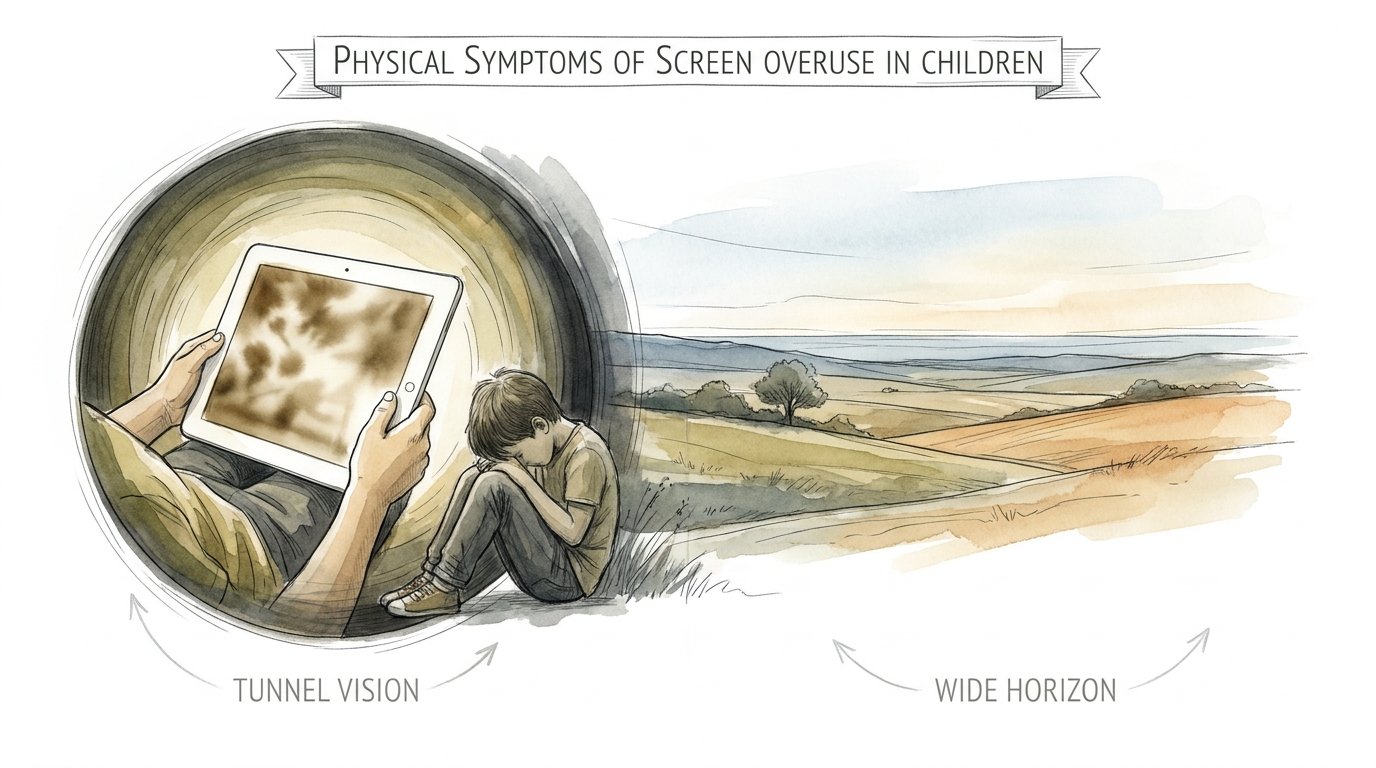
When the world further than arm’s length starts to look blurry or boring, the ‘habit’ has become a biological burden. Growing bodies and eyes need distance, sunlight, and movement. A major sign of overuse is when a child loses their ‘Wide Horizon’—the ability to notice, navigate, and appreciate the physical world around them.

The transition from outdoor play to digital immersion has happened faster than our biology can adapt. Today, children are navigating a world of pixels and backlit glass that demands constant, intense near-focus. This shift changes more than just their hobbies. It changes the physical structure of their eyes and the alignment of their spines.

Understanding these physical changes is the first step toward reclaiming a healthy balance. It is not just about “screen time” as a concept. It is about how the light, the distance, and the posture of the digital world interact with a growing body.
Physical Symptoms Of Screen Overuse In Children
Screen overuse manifests in several specific physical clusters. The most immediate is often Digital Eye Strain, also known as Computer Vision Syndrome (CVS). Unlike printed books, digital screens are made of pixels that lack the sharp edges our eyes prefer. This forces the focusing muscles to work harder, leading to eye fatigue, burning sensations, and frequent rubbing.
Nearsightedness, or myopia, is the most significant long-term physical change. Research from 2025 shows that for every additional hour a child spends on a screen daily, their risk of developing myopia increases by 21%. In some regions, myopia rates have reached 80% to 90% among school-leavers. This happens because the eye actually elongates. The body grows the eye longer to make near-focus easier, but this makes distant objects blurry.
Beyond the eyes, “Tech Neck” has become a pediatric epidemic. When a child tilts their head 60 degrees to look at a tablet, they place up to 60 pounds of force on their cervical spine. Over time, this leads to rounded shoulders, a weakened core, and persistent headaches. Parents should watch for a “forward head” posture where the ears sit in front of the shoulders.
Other common symptoms include:
- Dry Eyes: We normally blink 15 times per minute. On a screen, that rate drops by half. This leads to tear evaporation and itchy, red eyes.
- Meibomian Gland Atrophy: Heavy screen use is now linked to the shrinking of oil glands in the eyelids, which are essential for keeping eyes lubricated.
- Musculoskeletal Pain: Reports of low back pain and shoulder tension are rising in children as young as 10.
- Sleep Disturbances: Blue light suppresses melatonin, making it harder for children to fall into deep, restorative sleep.
How the Digital Trap Works on Growing Bodies
The human eye is an incredible piece of biological engineering. It is designed to scan the horizon, track moving objects, and switch focus between near and far. Digital devices hijack this system. They lock the eye into a fixed focal length for hours at a time. This “near work” sends a signal to the brain that the environment is small and close.
The eye responds by changing its shape. This is called “axial elongation.” The eyeball literally stretches. While this adaptation helps the child see the screen clearly, it creates a permanent refractive error. Once the eye has grown too long, it cannot “un-grow.” This is why myopia is a progressive condition that requires early intervention.
Blinking is another victim of the digital trap. When we focus intensely on a screen—whether for gaming or schoolwork—the brain prioritizes the visual information over the blink reflex. Reduced blinking causes the tear film to break down. This doesn’t just cause discomfort; it can lead to permanent damage to the ocular surface if the meibomian glands begin to waste away from lack of use.
Posture follows a similar downward spiral. The “Tech Neck” position isn’t just about the neck. It causes the chest muscles to tighten and the upper back muscles to overstretch and weaken. This imbalance travels down the kinetic chain, affecting the hips and even how a child walks. A child who spends six hours a day hunched over a screen is essentially “training” their body to stay in that collapsed position.
The Long-Term Benefits of the Wide Horizon
Restoring a “Wide Horizon” offers benefits that go far beyond better vision. When children spend time outdoors, their eyes are exposed to high-intensity natural light. This light triggers the release of dopamine in the retina, which acts as a “stop” signal for eye growth. This is the primary reason why outdoor time is the best defense against myopia.
Practical, measurable benefits of prioritizing the Wide Horizon include:
- Stabilized Eye Growth: Two hours of daily outdoor time can significantly reduce the risk of myopia progression.
- Improved Depth Perception: Navigating a 3D environment helps children develop the ability to judge distances, which is crucial for sports and safety.
- Core Strength: Movement in open spaces naturally engages the core and stabilizes the spine, reversing the effects of Tech Neck.
- Enhanced Peripheral Awareness: Children learn to notice things “out of the corner of their eye,” improving their spatial navigation and safety in crowded areas.
Choosing to prioritize distance and sunlight isn’t just a health choice; it is a developmental one. A child with a Wide Horizon is more physically confident. They move through the world with better balance and coordination because their visual system is fully integrated with their vestibular (balance) system.
Common Mistakes: Falling into the Screen Trap
Many parents inadvertently make mistakes that exacerbate physical strain. One common error is allowing screen use in a dark room. The high contrast between a bright screen and a dark environment forces the eyes to work even harder to adjust, leading to faster fatigue and increased blue light exposure.
Another pitfall is the “tabletop slouch.” Many children use laptops or tablets on the floor or a bed. This forces a hunched position that lacks any ergonomic support. Even when sitting at a desk, screens are often placed too high or too low. The ideal position is slightly below eye level, about 18 to 28 inches away.
Parents also frequently forget the “Blink Rule.” Because we don’t realize we’ve stopped blinking, we don’t remind our children to do it. This leads to the “gritty eye” sensation that children often describe as “feeling tired,” when in reality, their eyes are just dehydrated.
The biggest mistake is the “all or nothing” approach. Abruptly cutting off all screens often leads to conflict and isn’t sustainable in a digital world. The key is managed use, ergonomic setups, and mandatory “eye breaks.”
Limitations of Digital Restrictions
It is important to acknowledge that we live in a digital age. Schools often require tablets for homework, and social lives are frequently conducted online. A total “digital detox” is often impossible and may even be socially isolating for older children.
Environmental limitations also play a role. Not every family has access to a safe, sunlit outdoor space for two hours every day. In urban environments, the “Wide Horizon” can be hard to find. Trade-offs are inevitable. If outdoor time isn’t possible, parents must focus on indoor ergonomics and frequent distance-gazing breaks to compensate.
Practical boundaries mean that some screen time is unavoidable. The goal shouldn’t be zero screens, but rather “high-quality” screen time. This means using larger monitors instead of small phones, maintaining proper lighting, and ensuring the child is sitting in a supportive chair.
Wide Horizon vs. Tunnel Vision
| Feature | Wide Horizon (Healthy) | Tunnel Vision (Overuse) |
|---|---|---|
| Primary Focus | Distances, peripheral motion, 3D space. | Fixed distance (12-20 inches), static pixels. |
| Eye Structure | Normal axial length; flexible focusing. | Axial elongation (myopia risk); rigid focus. |
| Posture | Upright, neutral spine, active core. | Forward head tilt, rounded shoulders. |
| Light Exposure | Full-spectrum sunlight (dopamine release). | Artificial blue light (melatonin suppression). |
| Blink Rate | 15-20 blinks per minute (hydrated). | 5-7 blinks per minute (dry/irritated). |
Practical Tips for Immediate Improvement
You can begin protecting your child’s physical health today with a few simple adjustments. These tips are designed to be actionable and easy to integrate into a busy schedule.
- The 20-20-20 Rule: Every 20 minutes, have your child look at something 20 feet away for at least 20 seconds. This relaxes the focusing muscles and resets the visual system.
- The Elbow Rule: Ensure the screen is at least the distance from the child’s elbow to their knuckles away from their eyes. This reduces the “near-work” strain.
- Outdoor Lunch: If two hours of outdoor time feels daunting, start with 30 minutes. Even eating lunch outside provides the high-intensity light eyes need to stay healthy.
- Ergonomic Check: Use a laptop stand or external monitor to bring the top of the screen to eye level. This prevents the “head-down” position.
- Screen-Free Hour: Establish a “no-screens” policy 60 minutes before bed. This allows the child’s natural melatonin to rise, ensuring better sleep.
Encourage “Blink Competitions” during gaming breaks. It sounds silly, but it brings conscious awareness to a subconscious reflex that screens tend to suppress. Keeping a humidifier in the room can also help alleviate dry eye symptoms during long study sessions.
Advanced Considerations for Long-Term Health
For parents who want to go deeper, consider the role of blue light and meibomian gland health. Blue light filters on devices are a good start, but they aren’t a cure-all. The real danger of blue light is its timing—specifically how it disrupts the circadian rhythm.
Advanced myopia management is another area to explore. If your child’s vision is already deteriorating, specialized treatments like orthokeratology (nighttime lenses) or low-dose atropine drops can help slow the elongation of the eye. Consult a pediatric optometrist who specializes in myopia control rather than just general vision checks.
Don’t ignore the “metabolic fingerprint” of screen time. Recent studies from 2025 have linked excessive screen use with higher cardiometabolic risk scores, including elevated blood pressure and insulin resistance. This is often tied to “stolen” sleep time. Prioritizing physical movement and sleep isn’t just about the eyes; it’s about the child’s entire metabolic health.
Realistic Scenarios: The Gamer’s Recovery
Imagine a 10-year-old named Leo. Leo spends four hours a day gaming. He complains of frequent headaches, his eyes are often red, and he sits with a significant “slump.”
The first step for Leo isn’t to take the console away. Instead, his parents move the console to a TV monitor across the room instead of a handheld device. This forces a more distant focal point. They introduce a “standing desk” option for his gaming sessions, which encourages movement and better spinal alignment.
They also implement a “Sunlight Credit” system: for every hour of gaming, Leo spends 30 minutes outside. Within three weeks, Leo’s headaches vanish. His “Wide Horizon” returns as he starts noticing the birds and neighbors during his outside time. His posture improves because he is no longer “locked” into a 12-inch focal range for the entire afternoon.
Final Thoughts
Screen overuse is a physical challenge that requires a physical solution. By focusing on the “Wide Horizon,” parents can protect their children from the long-term consequences of myopia, Tech Neck, and chronic eye strain. The goal is to move from a state of biological burden to one of biological balance.
The human body is resilient, especially in childhood. Small changes—like the 20-20-20 rule, proper ergonomic setups, and daily outdoor time—can yield massive results. These habits don’t just protect the eyes; they preserve the child’s ability to engage fully with the physical world.
Encourage your child to look up and look far. The digital world is vast, but the physical world is where they grow. By managing the tunnel vision of the screen, you are giving them the gift of a clear, healthy future. Start today by taking a walk outside and letting those growing eyes focus on the horizon.
Sources
1 luskinoic.org | 2 hopkinsmedicine.org | 3 stlouischildrens.org | 4 artisanpediatriceyecare.com | 5 highesthealthchiropractic.com | 6 ummhealth.org | 7 uclahealth.org | 8 healio.com | 9 theguardian.com | 10 myopiaprofile.com | 11 nih.gov | 12 aao.org | 13 berkeleyeye.com | 14 eyekraftersnj.com | 15 sciencedaily.com