Benefits Of Vinyl For Kids Development
Stop giving them ‘kid versions’ of life and start giving them the keys to the real world. We realized the ‘kid-safe’ audio player was just another wall between our child and the real world. It was a toy, not a tool. Teaching him to handle a real record wasn’t just about music—it was about respect for mechanics, steady hands, and the value of a physical object. He’s not ‘playing’ anymore; he’s participating.
In a world of swipe-to-skip and endless digital streams, the tangible nature of a vinyl record offers a grounding experience that modern technology simply cannot replicate. When we provide children with simplified, plasticized versions of adult tools, we often inadvertently rob them of the chance to develop real competence. Moving from a digital interface to an analog one is more than just a change in audio format; it is an invitation to engage with the physical world with intention and care.
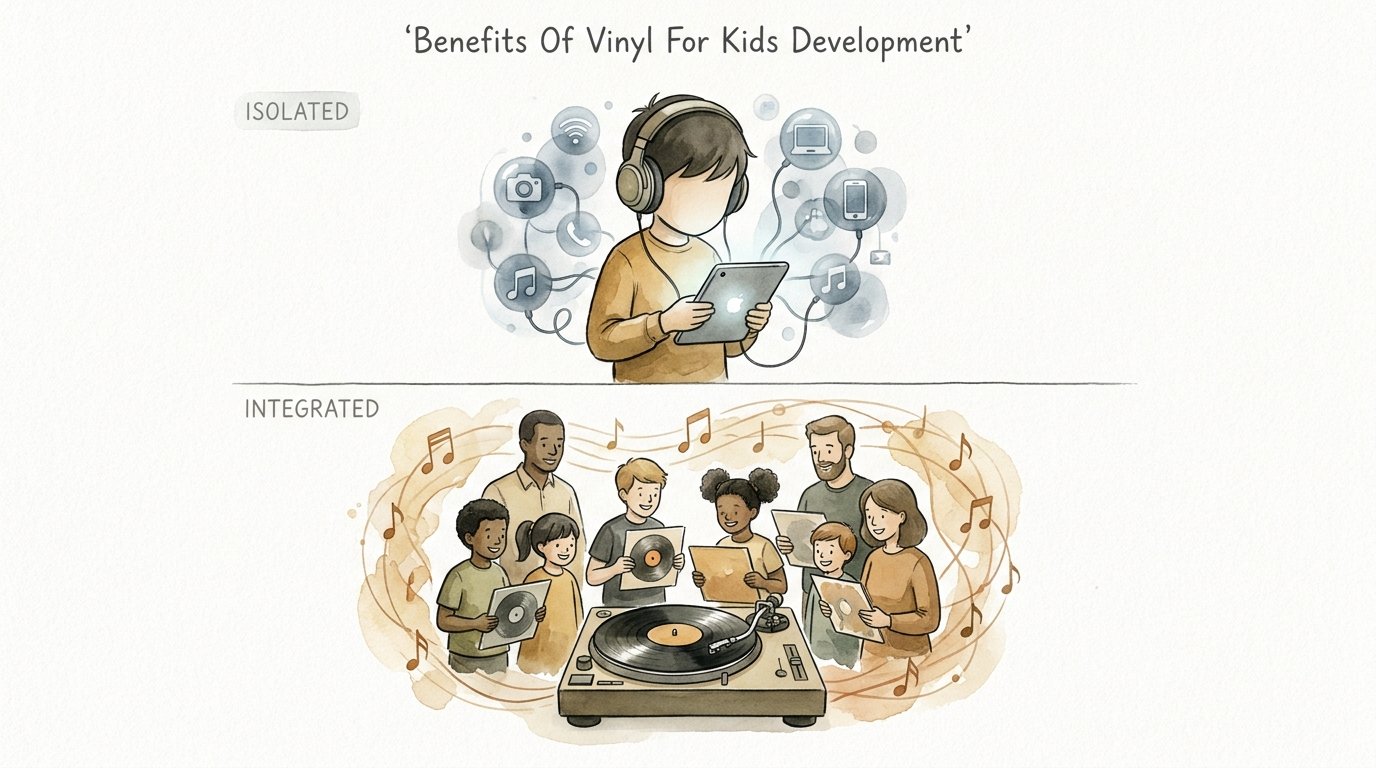
The transition to vinyl represents a shift from passive consumption to active engagement. Instead of a screen that demands zero physical precision, a turntable requires a series of deliberate, mechanical steps. This process bridges the gap between the child and the medium, turning a simple act of listening into a multi-sensory education in physics, art, and discipline.
Benefits Of Vinyl For Kids Development
Vinyl records serve as a unique developmental tool because they combine sensory input with mechanical complexity. Unlike a digital file, a record is a physical object where the music is literally etched into the surface. For a child, seeing the relationship between the spinning platter and the sound coming from the speakers provides a concrete lesson in cause and effect.
The primary benefit lies in the refinement of fine motor skills. To play a record, a child must learn to handle a 12-inch disc without touching its grooves, carefully align the center hole with the spindle, and use a cue lever to lower a delicate diamond-tipped stylus onto a specific moving target. These actions require a level of hand-eye coordination that tapping a “Play” button on a tablet never will. Research from the University of Toronto suggests that children who engage in active music-making or rhythmic interaction show improved neural pathways in the regions of the brain responsible for speech and motor control.
Furthermore, vinyl cultivates patience and delayed gratification. In the age of Spotify, if a child doesn’t like the first three seconds of a song, they skip it. Vinyl doesn’t allow for this. It forces the listener to experience the album as a cohesive piece of art. This “slow listening” encourages longer attention spans and a deeper emotional connection to the music. Studies have shown that infants and children synchronize their heart rates and exhibit higher engagement during live or high-fidelity musical experiences compared to compressed digital recordings.
Finally, the sensory and aesthetic experience of vinyl provides a “Montessori-style” refinement of the senses. Holding the large-format album art, reading the liner notes, and even the subtle “crackle and pop” of the needle hitting the groove creates a rich environment for exploration. It teaches a child to value the “unfiltered” version of reality over the sanitized, digital alternative.
The Mechanics of the Ritual: How to Teach Your Child
Introducing a child to a turntable should be treated as an apprenticeship. You are passing down a set of skills that require respect for the equipment. Start by explaining that the record player is a precision instrument, not a toy. This sets the tone for the entire experience.
The “Pizza Grip” and Record Handling
The first and most important rule is never to touch the grooves. Teach your child the “pizza grip”: place the thumb on the outer edge and the middle fingers on the center label. This allows them to move the record from the sleeve to the platter without transferring skin oils, which can trap dust and degrade sound quality over time. Practice this with a “beater” record first—something scratched and inexpensive—until their hands are steady.
Using the Cue Lever
Many beginners (and kids) want to drop the needle by hand. This is the fastest way to break a stylus. Teach them to use the cue lever. Explain that the lever is a hydraulic lift that protects both the needle and the music. Show them how to align the tonearm over the lead-in groove and then slowly lower the lever. This simple mechanical action is incredibly satisfying for a child and teaches them to respect the fragility of the system.
The Cleaning Ritual
Make cleaning part of the “play” process. Give your child an anti-static carbon fiber brush. Before the needle drops, have them gently hold the brush against the spinning record. This isn’t just about maintenance; it’s a “pre-flight check” that builds a habit of care. It transforms the act of listening from a distracted background activity into a focused, intentional event.
Choosing the Right Gear for a Family Setup
You don’t need a $5,000 audiophile rig to start, but you should avoid the ultra-cheap “suitcase” players found in big-box stores. These often have heavy tracking forces that can actually wear down records faster and offer poor sound quality that won’t capture a child’s interest.
| Feature | Entry-Level “Suitcase” Player | Reliable Starter (e.g., AT-LP60X) | Mid-Range / “Real” Setup (e.g., Fluance RT81) |
|---|---|---|---|
| Sound Quality | Thin, tinny speakers | Clear, requires external speakers | Rich, warm, audiophile-grade |
| Record Safety | High pressure, can damage grooves | Balanced tracking force | Adjustable counterweight |
| Ease of Use | Plug and play | Fully automatic (push button) | Manual (better for teaching skills) |
| Durability | Plastic parts, breaks easily | Sturdy metal/plastic hybrid | Wood/Metal construction |
The Audio-Technica AT-LP60X is a frequent recommendation for families because it is fully automatic. A child can press a “Start” button, and the machine handles the tonearm movement. However, if your child is slightly older (6+), a manual or semi-automatic table like the Fluance RT81+ or Angels Horn H002 is better. These require the child to actually move the arm, which provides a much better lesson in mechanics and steady-hand control.
Challenges and Common Mistakes
The most common pitfall is underestimating the fragility of the stylus. A child’s instinct is to “touch the shiny thing.” A single flick of a finger can snap a diamond tip off a cantilever, resulting in a $30 to $100 replacement cost. This is why the first few weeks must be strictly supervised. If they aren’t ready to handle the needle, they aren’t ready to use the player alone.
Another mistake is poor storage habits. Children are used to toys being thrown into bins. Records, however, must be stored vertically. Stacking records horizontally leads to warping, which makes the music sound like it’s underwater. Teach your child to “file” their records like books. Using protective outer sleeves can also turn the collection into a “gallery” where they can appreciate the art without worrying about tearing the cardboard jackets.
Finally, avoid low-quality replacement needles. If you do break a stylus, don’t buy the cheapest unbranded version on the internet. A poor-quality needle won’t just sound bad; it will physically “carve” into the vinyl, destroying your collection. Stick to the manufacturer’s recommended parts to ensure the longevity of your records.
Limitations of the Analog Approach
Vinyl is not a “set it and forget it” medium. If you want a child to have music for 12 hours straight while they play with Legos, a record player is the wrong tool. It requires a flip every 20 minutes. This can be a limitation in a busy household where parents don’t have the time to constantly monitor the turntable.
There is also the environmental constraint. Vinyl is sensitive to heat, sunlight, and vibrations. If your home has bouncy floorboards, the needle will skip every time a child runs past. You may need to invest in a wall-mounted shelf or a heavy isolation platform to make the system “kid-proof” in a high-traffic living room.
Lastly, cost is a factor. A single new record costs between $20 and $40. Compared to the “all-you-can-eat” model of streaming, building a vinyl library is an investment. This is why it’s essential to focus on quality over quantity. Choose albums that the family will want to listen to a hundred times, rather than chasing every fleeting pop hit.
Practical Tips for a Kid-Friendly Vinyl Station
- Height Matters: Place the turntable at a height where the child can see the platter clearly but can’t accidentally lean their weight on it. A dedicated “listening station” at chest height for the child is ideal.
- The “Beater” Collection: Go to a local thrift store and buy a stack of $1 records. Let these be the “training records” that the child can use to practice their grip and needle-drops. If they scratch a $1 copy of Sing Along with Mitch, it’s a cheap lesson.
- Visual Cues: Use small stickers on the player to indicate “Start,” “Stop,” and “Lift.” Visual aids help children navigate the machine independently once they’ve earned your trust.
- Color-Coded Sleeves: Use different colored outer sleeves to categorize music—blue for bedtime stories, red for high-energy dance parties, green for nature sounds. This helps pre-literate children “read” their collection.
Advanced Considerations: The STEM Connection
For older children or serious practitioners, a turntable is a gateway to STEM education. You can explain the physics of sound: how vibrations in a groove are converted into electrical signals by magnets in the cartridge. You can discuss “tracking force” and use a digital scale to measure the pressure the needle exerts on the disc. This turns music appreciation into a practical physics lab.
As they grow, involve them in upgrading the system. Let them help you choose a new pair of speakers or explain why a separate “phono preamp” improves the sound. This teaches them about signal paths and electronics. By the time they are teenagers, they won’t just know how to “play music”—they will understand the technology that makes it possible.
Example Scenario: The Sunday Morning Ritual
Imagine a typical Sunday. Instead of the child immediately asking for a tablet or a TV show, they walk over to the record shelf. They spend five minutes looking at the covers, finally settling on a classic jazz album or a 1970s folk record. They perform the “pre-flight” brush, lift the cue lever, and carefully drop the needle.
Because they had to “work” to get the music started, they actually sit and listen. They look at the artwork while the first side plays. When the side ends, they don’t wait for an algorithm to pick the next song; they get up, flip the disc, and start the process again. In this scenario, the record player isn’t just a gadget; it’s a meditation tool that has successfully slowed down the morning and centered the child’s focus.
Final Thoughts
Teaching a child to use a real record player is an act of trust. It signals to them that they are capable of handling adult tools and that their environment isn’t just a “kid-proofed” cage. By removing the “kid versions” of life, you provide them with a richer, more textured experience of the world. They learn that some things are worth the effort, that delicate things require respect, and that the best experiences often come from slowing down.
The journey into analog music is a lifelong one. Whether they grow up to be audiophiles or simply adults who appreciate the ritual of a physical object, the lessons they learn at the turntable—patience, precision, and presence—will serve them in every other area of their lives. Start small, supervise closely, and watch as the simple act of spinning a record transforms the way your child interacts with their world.
If you’re ready to make the switch, start by looking at entry-level manual turntables and visiting a local record store together. The “hunt” for the perfect album is just as much a part of the education as the listening itself. Encourage them to find something that speaks to them, and then give them the keys to unlock that music for themselves.
Sources
1 twlinch.com | 2 medium.com | 3 rediscoveranalog.com | 4 printyourvinyl.com | 5 reddit.com | 6 ibelieveinmontessori.com | 7 bigfudgevinyl.com | 8 youtube.com | 9 parklanejewelry.com | 10 youtube.com | 11 gunnarvinyl.com | 12 vinylpressing.com.au | 13 soundexchangetampabay.com | 14 yoursoundmatters.com | 15 treblezine.com | 16 nih.gov | 17 nymag.com | 18 popsci.com