Short Attention Span In Children Screen Time
We are training our children’s brains to discard information before they even process it. The ‘Infinite Scroll’ is the enemy of the ‘Deep Craft.’ If your child can’t focus on a single task for more than 60 seconds without seeking a digital hit, the habit has become a hunger. We must trade the swipe for the skill.
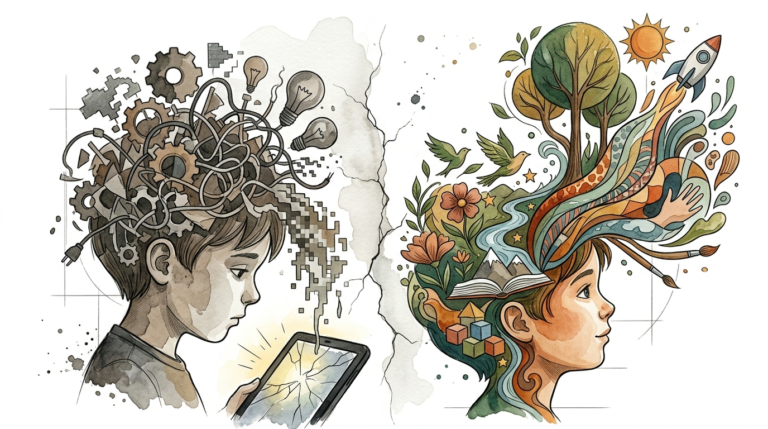
Every parent has seen the glazed look. A child sits motionless, thumb flicking upward with rhythmic precision. Seconds of a dance, a prank, a loud sound effect, and then—flick. The information is discarded. The brain hasn’t even begun to digest the content before the next hit arrives. We are witnessing a fundamental shift in how the human mind operates.
This isn’t just about “too much technology.” This is about the biological rewiring of a developing nervous system. When we prioritize the swipe, we sacrifice the ability to sit with a problem, to practice a craft, and to achieve the state of “flow” that leads to genuine mastery.
Short Attention Span In Children Screen Time
Short attention spans in children today are often the direct result of “digital over-stimulation.” The brain is a plastic organ, meaning it reshapes itself based on the environment. If that environment consists of 15-second TikTok videos and infinite scrolling feeds, the brain adapts to expect novelty every few seconds.
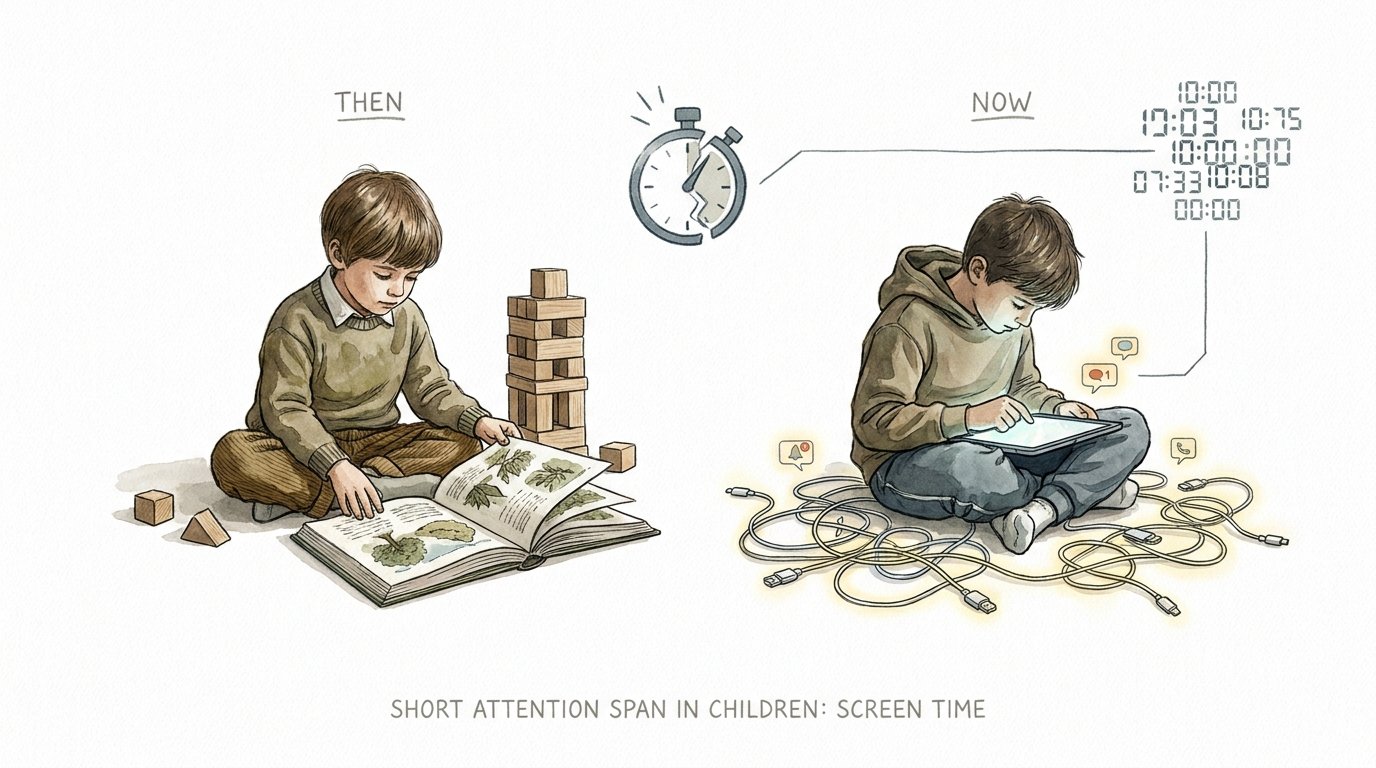
Research now shows the average attention span on a digital device has plummeted to just 47 seconds. For a child, whose prefrontal cortex—the part of the brain responsible for focus and impulse control—is still under construction, this constant stream of high-intensity stimuli is overwhelming. The brain learns that if it isn’t entertained within five seconds, it should move on.
In the real world, this manifests as frustration during homework. It looks like a “meltdown” when the iPad is taken away. These aren’t just behavioral issues; they are the symptoms of a brain struggling to function without a constant dopamine drip. We are seeing a “discarding” reflex where children ignore anything that requires effortful attention.
The Mechanics of the Digital Dopamine Loop
Digital platforms are engineered to exploit the brain’s reward system. Specifically, they target the Ventral Tegmental Area (VTA), a region that releases dopamine to drive motivation and reward. Every time a child swipes and finds a “funny” video, the VTA sends a surge of dopamine.
This creates a feedback loop. The brain craves the next hit. Because the feed is infinite, there are no “stopping cues.” In the past, a television show ended or a book reached the end of a chapter. Today, the content never stops. This constant stimulation leads to desensitization.
Desensitization means the brain’s dopamine receptors become less sensitive. Over time, the child needs more intense stimulation just to feel “normal.” Normal life—like reading a book or playing with blocks—starts to feel painfully boring by comparison. The “hunger” for the digital hit replaces the curiosity for the world.
How to Identify the Warning Signs
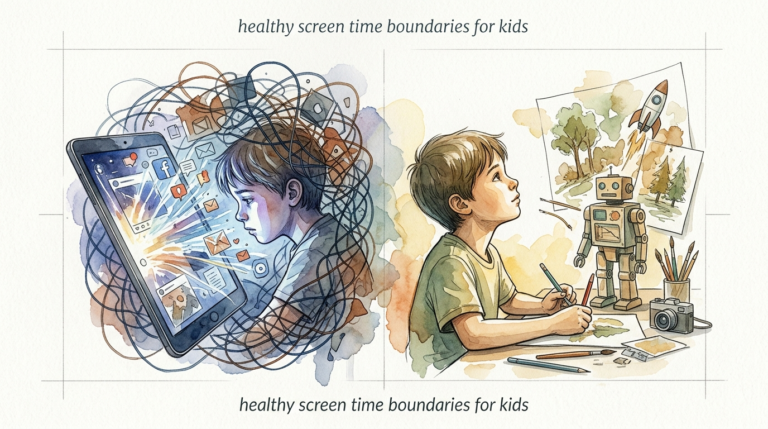
Identifying a struggling attention span early is crucial for intervention. Parents should look beyond the total “hours” spent on a screen and focus on the *type* of interaction. Passive scrolling is significantly more damaging to focus than active creation, such as digital art or coding.
Common signs of a screen-induced attention deficit include:
- Restlessness or irritability within minutes of starting a non-digital task.
- Inability to follow multi-step verbal instructions without getting distracted.
- Frequent “task-switching” where a child moves from one toy to another without completing a play cycle.
- Physical agitation, like foot-tapping or vocal outbursts, when screens are unavailable.
- Difficulty with “delayed gratification”—expecting immediate results for every effort.
These behaviors indicate that the child’s brain is “hyper-alert” but “hyper-fragile.” It is scanning for the next peak of excitement rather than settling into the trough of deep concentration.
The Benefits of Reclaiming the Deep Craft
Reclaiming focus isn’t just about removing a negative; it’s about adding a massive competitive advantage. In a world where most people have a sub-60-second attention span, the person who can focus for four hours on a complex problem becomes a “super-competitor.”
When children engage in “Deep Craft”—activities like woodworking, painting, long-form reading, or complex Lego builds—they are training their executive functions. They learn to manage frustration. They learn that the “messy middle” of a project is where the real growth happens.
Practical benefits of restoring focus include:
- Higher academic performance through better reading comprehension.
- Improved emotional regulation, as the brain is less prone to “dopamine crashes.”
- Increased social intelligence, as children can sustain eye contact and follow long conversations.
- Greater self-esteem derived from tangible, real-world accomplishments.
Common Challenges and Parent Pitfalls
The biggest challenge in this journey is the “Hypocrisy Trap.” Children model their behavior after their parents. If a parent is constantly checking their phone while talking to their child, they are reinforcing the idea that the digital world is more important than the physical one.
Another common pitfall is the “Cold Turkey Crash.” Abruptly removing all devices often leads to extreme emotional volatility. The child’s brain is literally going through a form of neurochemical withdrawal. This leads to a cycle of guilt where the parent gives the device back just to stop the screaming, which only reinforces the addiction.
Avoid using screens as a “public babysitter.” Using a phone to quiet a child in a restaurant prevents them from learning the vital skill of boredom. Boredom is the gateway to imagination. If we never let children be bored, they will never learn how to entertain themselves from within.
Limitations of the “Digital Detox” Approach
While a total detox can be helpful, it has practical limitations. We live in a digital world. Schools use iPads, and many future career paths require high levels of digital literacy. Simply banning screens doesn’t teach a child how to use them responsibly.
Environmental constraints also play a role. Families living in urban areas with limited access to nature may find it harder to replace “screen time” with “green time.” Additionally, children with existing neurodivergent conditions, such as ADHD, may be more naturally drawn to the high stimulation of screens, requiring a more nuanced, professional approach.
The goal should be “digital hygiene” rather than “digital abstinence.” It is about establishing boundaries that allow for the benefits of technology without the cognitive erosion of the infinite scroll.
Passive Consumption vs. Deep Craft
Understanding the difference between different types of engagement is essential for a healthy balance. Not all “screen time” is created equal.
| Feature | Passive Consumption (The Swipe) | Deep Craft (The Skill) |
|---|---|---|
| Brain State | Reactive, dopamine-driven. | Active, flow-state driven. |
| Attention Requirement | Low (5-15 seconds per unit). | High (30+ minutes per session). |
| Frustration Tolerance | Decreased. | Increased through “productive struggle.” |
| Output | None (Discarded information). | Tangible (Art, skill, knowledge). |
Practical Tips for Resetting the Brain
Resetting a child’s attention span requires a “bridge” back to the real world. You cannot expect a child to jump from a high-octane video game to a silent book instantly. You must use “High-Engagement Physicality” first.
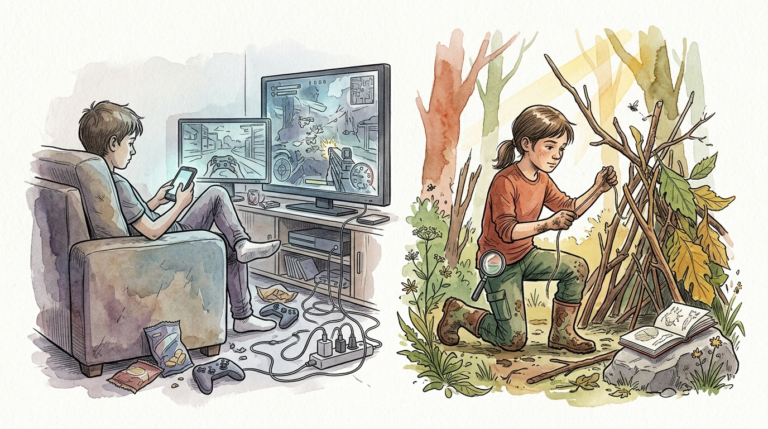
Start with “Green Time.” Exposure to nature has been shown to restore attention by calming the nervous system. A simple walk in the park or digging in a garden provides “soft fascination,” which allows the brain’s “hard focus” circuits to rest and recover.
Implement the “Hands-First Rule.” For every hour of digital consumption, require one hour of “hands-on” work. This could be cooking, building a model, drawing, or playing an instrument. Using the hands engages the motor cortex and forces the brain to plan, execute, and troubleshoot—the exact opposite of the swipe.
Use “Connection Bridges.” When screen time ends, don’t just turn it off. Spend five minutes engaging with what the child was watching or playing. Ask questions. Turn the passive experience into a social one before transitioning to the next task. This softens the dopamine drop and reduces meltdowns.
Advanced Strategies for Sustained Focus
For parents who want to go deeper, consider “Cognitive Endurance Training.” This involves gradually increasing the time a child spends on a single task. Start with 10 minutes of reading and slowly build to 40. Treat attention like a muscle that needs progressive loading.
Introduce “Open-Ended Play.” Avoid toys that have a single “correct” way to be used. Blocks, clay, and blank paper are superior because they require the child to generate the “novelty” themselves. This shifts the source of dopamine from the *device* to the *self*.
Consider the physical environment. A “Focus Sanctuary”—a desk or corner with zero digital devices in sight—can trigger a psychological shift. The mere presence of a smartphone, even if it is turned off, has been shown to reduce cognitive capacity. Keep the bedroom and the study area strictly analog.
Example: The Transition Scenario
Consider 10-year-old Leo, who spends three hours a day on short-form video apps. He is irritable, his grades are slipping, and he can’t finish a meal without asking for his phone. His parents decide to implement a “Deep Craft Transition.”
In week one, they don’t ban the apps. Instead, they introduce a “Build Before You Browse” rule. Leo must work on a large-scale Lego Technic model for 30 minutes before he can have his phone. The first few days are filled with complaints, but soon, the “productive struggle” of the Lego set starts to provide its own reward.
By week four, Leo is spending 90 minutes on the Lego set and has naturally reduced his screen time. His brain has relearned how to find satisfaction in slow, incremental progress. The “habit” has been traded for a “skill,” and his attention span has expanded from 45 seconds to nearly an hour of sustained focus.
Final Thoughts
The battle for our children’s attention is the defining parenting challenge of the digital age. We are not just fighting apps; we are fighting the very biological mechanisms that allow humans to learn and grow. Every time we choose the “skill” over the “swipe,” we are investing in our child’s future cognitive freedom.
It is never too late to start a reset. The brain remains plastic throughout childhood and adolescence. By creating an environment that rewards depth, movement, and physical creation, we can help our children move from being passive consumers to active masters of their own minds.
Start today by reclaiming one hour. Turn off the Wi-Fi, put the phones in a drawer, and put something real in your child’s hands. The “Deep Craft” is waiting, and it is the only way to ensure the next generation doesn’t just discard information, but truly understands the world.
Sources
1 sgu.ac.id | 2 east2westmama.com | 3 integrative-psych.org | 4 slicktext.com | 5 hellopediatrics.com | 6 economictimes.com | 7 sciencealert.com | 8 sambarecovery.com | 9 healthywithin.com | 10 peaceathomeparenting.com | 11 medium.com | 12 potsdam.edu | 13 thejacobsladdergroup.org | 14 frontiersin.org | 15 ucmas-usa.com | 16 chkd.org | 17 communityplaythings.com | 18 researchgate.net | 19 luriechildrens.org | 20 finalsite.net