limit screen time aesthetic vision board
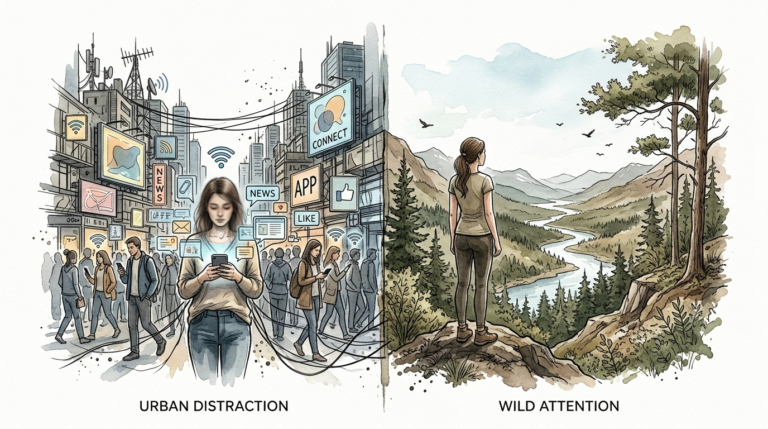
Your attention is a resource. Stop leaving it exposed to the endless scroll. If you want to limit your screen time, you need a vision for what you’re moving TOWARD. This aesthetic vision board is our blueprint for a slower, more intentional life.
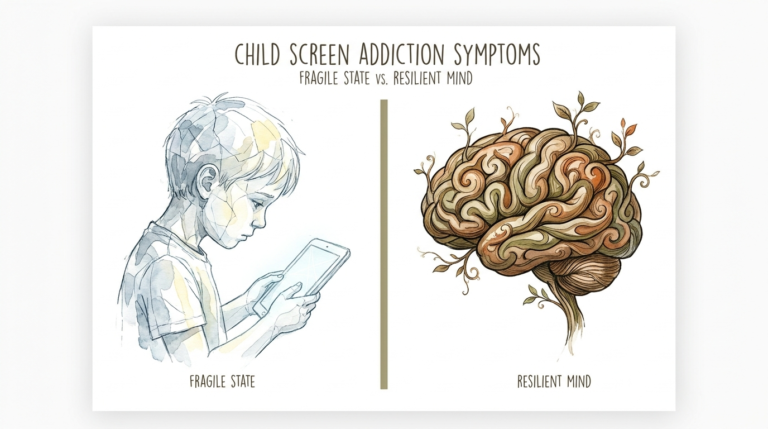
Most of us feel the weight of the digital world daily. We wake up and immediately surrender our focus to notifications. We trade our morning peace for a highlights reel of people we barely know. It feels like an addiction because, biologically, it is. The algorithm is designed to keep you looking, but your mind is designed for so much more than consumption.
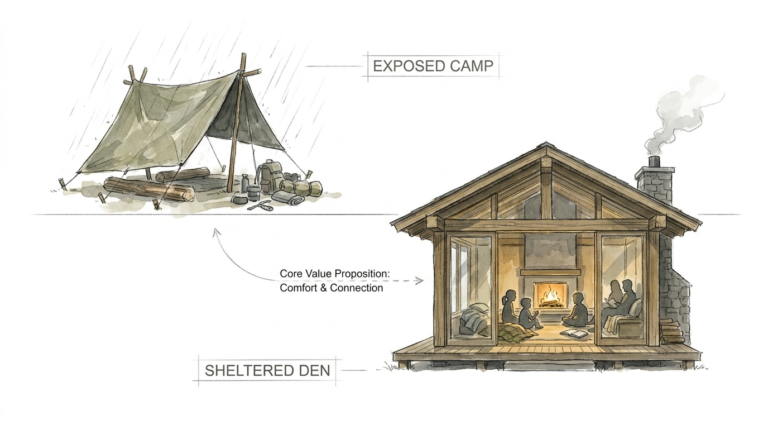
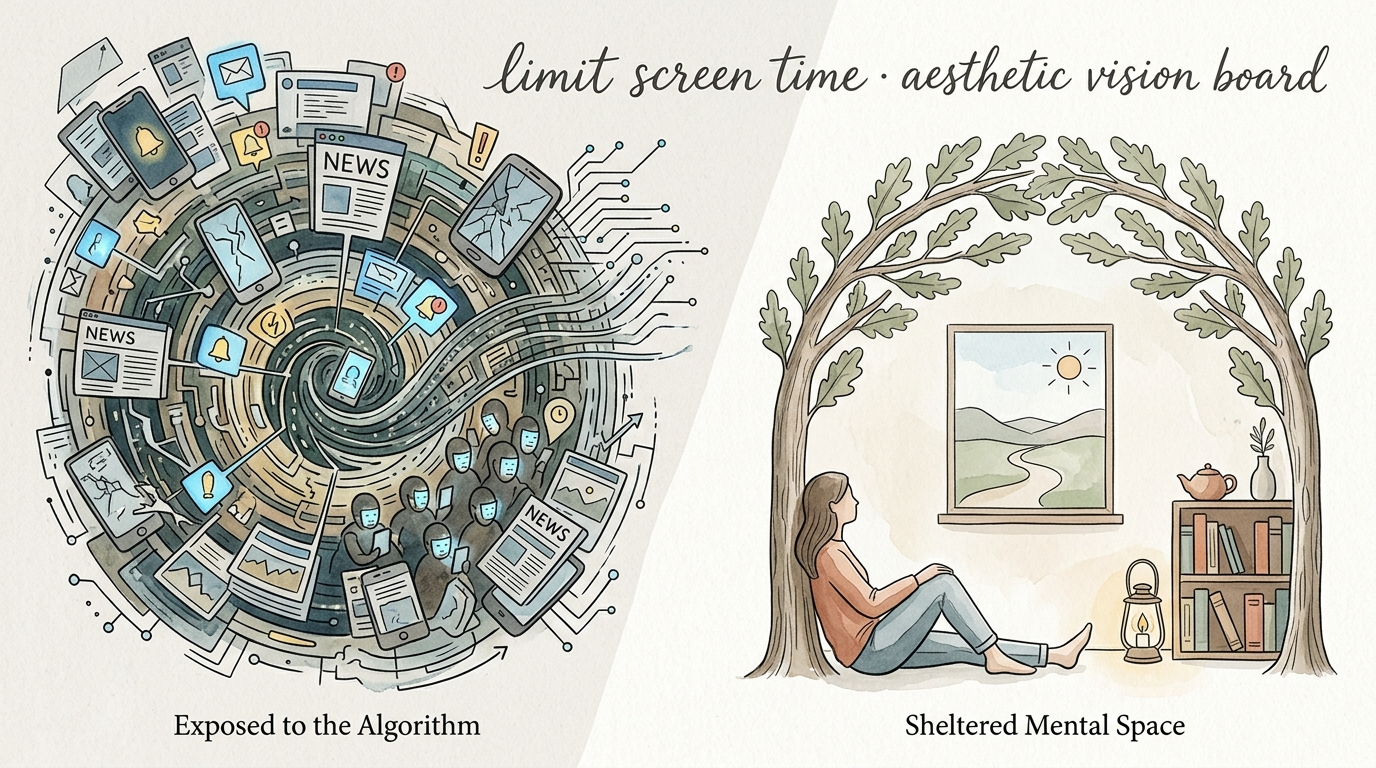
Creating a vision board specifically for digital minimalism isn’t just about “using your phone less.” It is about reclaiming the hours of your life that have been stolen by blue light. This article will guide you through the transition from a mind that is Exposed to the Algorithm to one that resides in a Sheltered Mental Space. You will learn how to use visual cues to rewire your habits and build a life that feels as good as it looks on your board.
We are going beyond the surface level of “pretty pictures.” We are diving into the neuroscience of habit change and the practical steps to make your vision a reality. Whether you are a burnt-out professional or a creative looking for focus, this is your roadmap to a slower, more vibrant existence.
limit screen time aesthetic vision board
A limit screen time aesthetic vision board is a curated collection of images, words, and textures that represent the “offline” version of yourself. It serves as a visual anchor. When the urge to doomscroll hits, this board reminds your brain of the tactile, real-world rewards waiting for you outside the glass screen. It is a psychological tool used to prime your subconscious to prioritize presence over digital noise.
This concept exists because willpower is a finite resource. You cannot simply “decide” to stop scrolling when your brain is being flooded with dopamine hits from every swipe. You need a compelling alternative. This board creates a “pull” toward a more fulfilling lifestyle—like reading a physical book, gardening, or having a slow coffee—making the “push” away from the phone feel less like a sacrifice and more like a choice.
Real-world applications of this board are diverse. Some people keep a physical version on their office wall to stay focused during deep work. Others use a digital version as their phone lock screen to serve as a “speed bump” before they unlock an app. It is a bridge between the life you currently have and the intentional life you are building.
Think of it as a mental filter. The reticular activating system (RAS) in your brain is constantly scanning your environment for things you’ve deemed important. By focusing on images of slow living and intentionality, you train your RAS to notice opportunities for those activities in your daily life. You start seeing the afternoon sun on your porch as an invitation to sit, rather than a background for a photo.
Building Your Blueprint: How to Create Your Vision Board
Creating an effective board requires more than just picking nice images. It requires a strategic approach to ensure the visuals actually trigger a change in your behavior. Follow these steps to build a board that works as hard as you do.
Step 1: The Vision Audit
Before you look at a single image, sit with a notebook. Ask yourself what a “perfect” phone-free hour looks like. Is it the smell of old paper in a library? Is it the feeling of soil on your hands? Define the specific textures and emotions you want to invite into your life. This audit ensures your board is grounded in your actual desires, not just generic “aesthetic” trends.
Step 2: Curating the Imagery
Search for images that feel “active” rather than passive. Instead of just a picture of a beautiful room, find an image of a hand holding a pen over a journal. Look for “process-oriented” visuals. These images represent effort and embodiment, which are key to shifting your identity from a “consumer” to a “creator.” Sources like Pinterest, Unsplash, or even old magazines are perfect for this.
Step 3: The Refinement Phase
Avoid the “clutter trap.” A vision board with too many images becomes white noise. Choose 5-7 core images that speak to different areas of your life: rest, creativity, connection, and health. If an image doesn’t evoke a physical sensation of “I want to be doing that right now,” discard it. Your board should feel like a breath of fresh air, not a messy to-do list.
Step 4: Adding Anchor Words
Words give your images a voice. Choose short, punchy phrases that challenge your current habits. “Deep Focus,” “Analog Morning,” or “Present over Perfect” are powerful anchors. Place these words near the images they complement to create a cohesive message for your subconscious mind.
Step 5: Placement and Integration
The best board in the world is useless if you never see it. If you choose a physical board, place it in the “danger zone”—the spot where you usually reach for your phone. If it’s digital, make it your wallpaper. This ensures that every time your brain looks for a digital escape, it is met with a reminder of your intentional goals.
The Benefits of Visualizing a Slower Life
The advantages of using an aesthetic vision board for screen time go far beyond just “scrolling less.” It is a fundamental shift in how you process your environment and your time.
Practical benefits include a significant reduction in digital eye strain and decision fatigue. By having a pre-determined vision of what you want to do with your free time, you eliminate the “what now?” moment that often leads to mindless browsing. You have already decided that your evening belongs to your hobbies, so the phone becomes an afterthought.
Mental health improvements are often the most profound. Users report lower levels of anxiety and a reduced sense of “FOMO” (fear of missing out). When you are deeply invested in your own “aesthetic” life, the digital lives of others lose their power over you. You are no longer comparing your behind-the-scenes to their highlight reel because your behind-the-scenes is actually enjoyable.
Measurable gains in productivity are common. Shifting from a state of “Exposed to the Algorithm” to a “Sheltered Mental Space” allows for deep work and creative flow. You are essentially building a wall around your attention. This wall is decorated with the very things that make your life meaningful, making it a place you actually want to stay.
Challenges and Common Mistakes
Many people fail at vision boarding because they treat it as “visual entertainment” rather than a tool for habit change. Understanding these pitfalls will help you stay on track.
The “Pretty but Passive” mistake is the most frequent error. If your board is full of images of people relaxing on beaches but you live in a city and work 50 hours a week, the disconnect will cause frustration. Your board must be aspirational but grounded in your reachable reality. Focus on “attainable aesthetics”—like a nicely set tea tray or a clean desk—rather than impossible fantasies.
Another challenge is the “Digital Paradox.” Creating a digital vision board on your phone can sometimes lead to more screen time if you get sucked into the design process for hours. To avoid this, set a timer for your creation session. Treat the board as a tool to get you OFF the device, not an excuse to stay ON it.
Finally, avoid “Goal Overload.” If your board has fifty different goals, your brain will shut down. This is called the “overchoice effect.” Keep your focus narrow. A vision board for limiting screen time should focus almost exclusively on the activities that replace the screen. Do not mix it with your financial goals, your fitness goals, and your travel goals unless they directly relate to your screen-free vision.
Limitations of Visualization
While powerful, a vision board is not a magic wand. It is a catalyst, not the cure itself. Realistic constraints must be acknowledged to ensure long-term success.
Visual cues cannot override physical addiction on their own. If you have a severe dependency on digital stimulation, you may need more intensive interventions like app blockers, “dumbphones,” or even professional support. The board supports the transition, but it does not do the hard work of resisting the dopamine loop for you.
Environmental limitations play a huge role. If your work requires you to be on a screen for eight hours a day, a vision board won’t change that. In these cases, the board serves to protect your *non-working* hours. It defines the boundary between “work-mode” and “life-mode.” You must accept that some screen time is necessary and use the board to reclaim what is left.
Trade-offs are also a factor. Choosing an analog life often means being slower to respond to messages or missing out on viral trends. You must be comfortable with the “JOMO” (joy of missing out). The board helps remind you why that trade-off is worth it, but the social friction of being “less online” remains a reality you will have to navigate.
Comparison: Digital vs. Physical Vision Boards
Choosing the right medium for your vision board depends on your lifestyle and your specific “trigger” points for screen use. Both have distinct advantages and drawbacks.
| Factor | Digital Board (App/Wallpaper) | Physical Board (Cork/Poster) |
|---|---|---|
| Accessibility | High; travels with you on your devices. | Low; stays in one room or space. |
| Distraction Risk | High; you are looking at it on a screen. | Zero; it is entirely offline. |
| Tactile Connection | None; just light and glass. | High; involves paper, glue, and textures. |
| Updates | Easy; swap images in seconds. | Manual; requires printing and re-pasting. |
| Psychological Impact | Effective as a “speed bump” for app use. | Deeply grounding; reinforces analog reality. |
For most people, a hybrid approach works best. Use a digital wallpaper to catch the initial “reflex” to check your phone, but maintain a physical board in your living space to reinforce the habit of being present. The physical board acts as the “North Star,” while the digital one acts as a daily nudge.
Practical Tips for Immediate Impact
Apply these techniques today to start seeing a difference in your screen time habits. These are the small adjustments that turn a “pretty board” into a functional tool.
- The Grayscale Trick: Set your phone to grayscale while looking at your physical vision board. This makes your phone look dull and unappealing compared to the vibrant, colorful life represented on your board.
- Morning Mirroring: Spend two minutes every morning looking at your board before you touch any technology. This “primes” your brain to look for the activities on the board throughout the day.
- Actionable Captions: Instead of just images, add small “if-then” captions. For example: “If I feel bored, then I will pick up my knitting.” This creates a direct neural pathway between the trigger (boredom) and the desired action (hobby).
- Rotate Your Vision: Change one image on your board every month. This prevents “image blindness,” where your brain stops noticing the visuals because they have become too familiar.
Consistency is more important than perfection. You don’t need a professional-grade collage; you need a collection of reminders that resonate with *you*. If a messy sketch of a tree makes you want to go for a walk more than a professional photograph does, use the sketch.
Advanced Considerations for Serious Practitioners
If you are ready to take your digital minimalism to the next level, you must consider the deeper integration of your vision board into your lifestyle systems. This involves moving from “visualizing” to “architecting” your environment.
Consider the concept of “Environmental Priming.” This means setting up your physical space to match the imagery on your board. If your board features a reading nook, you must actually clear a chair and place a book there. Your vision board is the blueprint, but your home is the construction site. The goal is to make the desired behavior the path of least resistance.
Scaling your intentional life also involves “Digital Sabbath” planning. Use your board to visualize what an entire 24-hour period offline looks like. What do you eat? Who do you talk to? What do you wear? By visualizing the details of a full day, you remove the anxiety of “empty time” that often prevents people from trying a total detox.
Finally, understand the “Identity Shift.” Serious practitioners stop saying “I’m trying to use my phone less” and start saying “I am someone who values presence.” Your vision board should reflect this new identity. Include images that represent the *character traits* of the person you are becoming—patience, curiosity, and calm—rather than just the actions they take.
Real-Life Scenario: The Transformation of a Morning Routine
Let’s look at how this works in practice by comparing two versions of the same person’s morning. We will call her Sarah.
Before the Vision Board: Sarah’s alarm goes off. She reaches for her phone and spends 45 minutes in bed scrolling through news and social media. She feels “behind” before she even stands up. Her brain is “Exposed to the Algorithm,” and she carries that scattered energy into her workday. She feels drained and uninspired.
After the Vision Board: Sarah creates a physical board featuring images of a steaming cup of tea, a sunrise from her balcony, and her favorite journal. She places this board directly across from her bed. When she wakes up, her eyes land on the board instead of her phone. The visual of the tea and the sunrise triggers a craving for peace rather than a craving for “likes.”
She leaves her phone in the drawer and follows the visual blueprint. She spends 20 minutes with her tea and journal. By the time she starts her work, she has already “won” the morning. She has inhabited her “Sheltered Mental Space,” and her focus is sharp. The board didn’t do the work for her, but it gave her brain a target to hit.
Final Thoughts
Your attention is the most valuable thing you own. Companies spend billions of dollars trying to capture it, but you have the power to take it back. A limit screen time aesthetic vision board is a simple, beautiful, and scientifically-backed way to remind yourself that life is happening right now, in the room you are standing in, not just in the palm of your hand.
Do not wait for the “perfect” time to start. Grab a few images today that make you feel calm and present. Put them somewhere you can see them. This small act is a declaration of independence from the endless scroll. It is the first step toward a life that is measured in moments of connection and creativity rather than minutes of screen time.
Experiment with different styles and mediums until you find what clicks. Whether you choose a minimalist digital wallpaper or a lush, tactile corkboard, the goal is the same: to move TOWARD the life you actually want to live. You are the architect of your own attention. Start building your vision today.
Sources
1 echo.market | 2 imagine.art | 3 pennstatehealth.org | 4 loradevries.com | 5 maytheartbewithyou.com | 6 thegoodtrade.com | 7 floridaarttherapyservices.com | 8 habitcoach.ai | 9 rachelletham.com | 10 modernmindtherapy.ca | 11 youtube.com | 12 marthabeck.com | 13 getvisigoal.com | 14 reddit.com