media agreement for kids
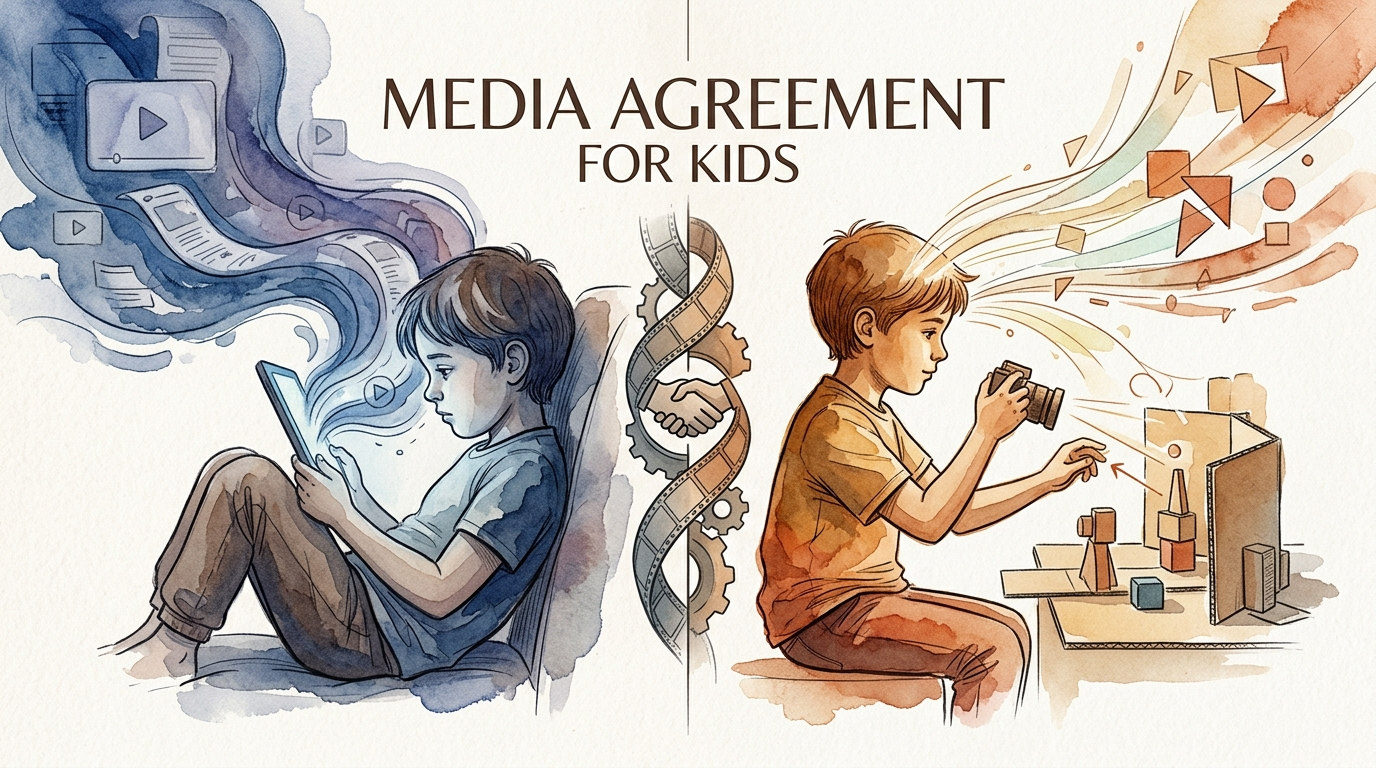
Shift their identity from content consumer to digital creator. A media agreement shouldn’t just say ‘no.’ It should define the ‘yes’—moving kids from being passive consumers of content to active producers and learners.
You are likely here because the “screen time battle” in your house has reached a fever pitch. Maybe you are tired of the glazed-over eyes or the tantrums when the tablet goes away. Perhaps you are worried about what they are seeing on social media. But there is a better way to handle tech than just being the “digital police.”
Think of a media agreement as a roadmap for your family’s digital life. It is not a list of punishments. It is a shared vision that empowers your kids to use technology as a tool for growth rather than just a source of distraction. When you change the conversation from “stop watching” to “start creating,” everything shifts.
In this guide, we will walk through how to build a rock-solid media agreement that actually sticks. We will explore the psychology of why kids get hooked and how you can flip the script to build future-ready digital skills.
media agreement for kids
A media agreement for kids is a written or verbal contract between parents and children that outlines the rules, expectations, and values surrounding digital devices. It covers everything from smartphones and tablets to gaming consoles and smart TVs. While it sounds formal, it is really about fostering open communication and building digital trust.
In the real world, these agreements serve as a safety net. Children’s brains are still developing, which means they often struggle with impulse control and long-term thinking. A media agreement provides the structure they need to navigate the internet safely. It isn’t just about limiting hours; it’s about defining what “healthy” looks like in a digital context.
Think of it like learning to drive a car. You wouldn’t hand a teenager the keys to a Ferrari and say “have fun” without lessons, a license, and a set of traffic laws. Digital devices are equally powerful and require a similar “graduated licensing” approach. The agreement is the manual that teaches them how to stay in their lane and avoid crashes.
How to Create Your Family Media Agreement
Creating a media agreement is a process, not a one-time event. If you want your kids to follow the rules, they need to feel like they helped write them. This is the secret to getting “buy-in” from even the most skeptical teenager.
Step 1: Set the Tone
Start by explaining the “why” behind the agreement. Frame it as an issue of safety and well-being rather than control. You might say, “We want you to have access to these amazing tools, but we also want to make sure you stay safe and get enough sleep.” This immediately lowers their defenses.
Step 2: Define the “When” and “Where”
Establish clear boundaries for device usage. Common “no-tech zones” include the dinner table, the car, and bedrooms. A popular rule is the “charging station” rule—all devices must be plugged into a central location (like the kitchen) by a certain time each night. This ensures that late-night scrolling doesn’t interfere with sleep.
Step 3: Categorize Content Types
This is where you shift from consumer to creator. In your agreement, distinguish between passive consumption (scrolling TikTok, watching Netflix) and creative production (coding, digital art, video editing). You might allow more time for “creative” tasks while keeping a tighter leash on “passive” ones.
Step 4: Discuss Digital Citizenship
Talk about how to treat others online. Include rules against cyberbullying, sharing private information, and posting photos of others without permission. This builds character and helps them understand that their digital footprint is permanent.
Step 5: Decide on Consequences
Be clear about what happens if the agreement is broken. Consequences should be fair and directly related to the infraction. If they use a phone in the bedroom after hours, the phone might be “retired” for 24 hours. The goal is to teach responsibility, not just to punish.
Benefits of a Proactive Media Agreement
Moving toward a formal agreement offers measurable advantages for both parents and children. It moves the family dynamic from constant conflict to a state of predictable expectations.
Reduced Daily Arguments: When rules are written down, you no longer have to negotiate every single time a device comes out. The agreement is the authority. You can simply point to it and say, “The contract says screens off at 7:00 PM.”
Development of Self-Regulation: By giving kids a voice in the process, you are teaching them how to manage their own time. This is a critical life skill. Over time, they will start to notice when they have been online too long and may even start “self-policing” their habits.
Encouragement of High-Level Skills: When your agreement prioritizes “creation over consumption,” you are essentially providing a scholarship for the future. A kid who spends their “screen time” learning to edit videos or design Minecraft mods is developing technical skills that are highly valuable in the modern job market.
Improved Mental Health: Clear boundaries around social media and late-night usage have been shown to reduce anxiety and improve sleep quality in children. The agreement acts as a barrier against the “always-on” culture of the internet.
Challenges and Common Mistakes
Even with the best intentions, family media agreements can fail. Knowing the pitfalls ahead of time allows you to build a more resilient system.
The “One-Size-Fits-All” Error: A 7-year-old and a 15-year-old should not have the same rules. Toddlers need strict “walled gardens” with curated content, while teens need more freedom to prove they can handle digital trust. If your agreement is too restrictive for older kids, they will likely find ways to hide their activity.
Lack of Parental Modeling: This is the biggest pitfall of all. If you tell your kids “no phones at the table” but then check your work email during dinner, the agreement is effectively dead. Kids do what we do, not what we say. You must be willing to sign the agreement and follow the same “no-tech zone” rules yourself.
Being Too Vague: Phrases like “use screens responsibly” are meaningless to a child. You need specific, measurable rules. Instead of “don’t stay on too long,” use “you have 60 minutes of gaming after homework is finished.”
The “Set It and Forget It” Mentality: The digital world moves fast. A new app could become a viral hit overnight, or your child might suddenly develop an interest in a new hobby. You should revisit and update your agreement every six months or at the start of every school year.
Limitations: When a Media Agreement Isn’t Enough
A media agreement is a powerful tool, but it is not a magic wand. There are situations where a simple contract may not be enough to manage the complexities of the digital age.
If a child is showing signs of genuine screen addiction—such as becoming aggressive when devices are removed or losing interest in all offline activities—professional help may be required. In these cases, a media agreement should be part of a broader clinical approach rather than the sole solution.
Environmental factors also play a role. If your child’s school requires heavy tablet use for homework, your “time limits” might need to be more flexible. Similarly, if your child’s entire social circle communicates through a specific gaming platform, cutting them off entirely could lead to social isolation. Balancing these real-world trade-offs requires ongoing parental intuition, not just a rigid document.
Passive Consumption vs. Creative Production
To truly shift your child’s identity from consumer to creator, it helps to see the difference clearly. Use the table below to help your kids understand why some screen time is “weighted” more heavily than others in your family agreement.
| Activity Type | Passive Consumption | Creative Production |
|---|---|---|
| Action | Scrolling, watching, swiping. | Building, coding, writing, filming. |
| Brain Engagement | Low; reactive mode. | High; problem-solving mode. |
| Long-Term Value | Entertainment only. | Skill acquisition & portfolio building. |
| Recommended Limit | Strict (e.g., 30-60 mins). | Flexible (e.g., as long as tasks are done). |
Practical Tips for Success
Ready to implement your agreement? Here are a few “pro tips” to make the transition smoother.
- Use a “Parking Garage”: Put a literal basket or box in the kitchen. When kids come home or it’s time for bed, their phones go in the “garage.” It removes the temptation to sneak a peek.
- The 5-Minute Warning: Never just snatch a device away. Transitioning out of a high-dopamine activity is hard. Give a 10-minute and then a 5-minute warning to let their brains prepare for the shift.
- Curate “Green-Light” Apps: Instead of just saying “no social media,” provide a list of apps you approve of. Focus on educational or creative platforms like Khan Academy, Scratch, or Procreate.
- Make it Physical: Print the agreement, have everyone sign it, and post it on the fridge. A physical document feels much more “official” and harder to ignore than a verbal promise.
Advanced Considerations for Serious Practitioners
For parents who want to go deeper, consider integrating **Digital Citizenship** into the agreement. This means moving beyond just “rules” and into “ethics.”
Talk to your kids about the **Attention Economy**. Explain how apps like TikTok and YouTube are designed to keep them watching for as long as possible. When kids understand that they are the “product” being sold to advertisers, they often develop a healthy sense of skepticism toward the platforms they use.
Another advanced technique is the **”Tech-Free Weekend.”** Once a quarter, have the entire family (parents included) go completely analog for 48 hours. This serves as a “dopamine reset” and helps everyone reconnect with offline hobbies like reading, hiking, or board games. It also proves that you don’t *need* devices to have a good time.
Real-World Example: The Miller Family Agreement
Let’s look at how this works in practice for a family with a 10-year-old (Leo) and a 14-year-old (Maya).
Leo loves Minecraft. His section of the agreement allows for 45 minutes of “Play Mode” but unlimited time in “Creative Mode” if he is working on his “Mars Colony” project. He must keep his laptop in the living room at all times.
Maya has her first smartphone. Her agreement focus is on social media. She is allowed to have Instagram, but her account must be private, and she must allow her parents to follow her. She has a “hard stop” at 9:00 PM when her phone goes into the kitchen charging basket.
Both kids have a “Parental Clause.” The parents agree not to post photos of the kids on Facebook without asking them first. This builds mutual respect and shows the kids that their digital privacy matters too.
Final Thoughts
A media agreement for kids is not about building a digital prison. It is about creating a safe harbor where they can learn to navigate the most powerful tools in human history. By focusing on the “yes” of creation rather than just the “no” of consumption, you are setting them up for a lifetime of digital success.
The most important part of any agreement is the conversation it starts. It gives you a reason to talk about technology every day without it being a lecture. It builds a bridge of trust that will be vital as they move into their teenage years and beyond.
Start small. Be consistent. And remember, the goal is to raise kids who use technology to build their dreams, not just to fill their time. Experiment with your rules, stay flexible as your kids grow, and don’t be afraid to lead by example. Your family’s digital future starts with a single page and a shared commitment.
Sources
1 screenwiseapp.com | 2 kidshubms.com | 3 kidshubms.com | 4 care.com | 5 meetcircle.com | 6 centerforonlinesafety.com | 7 sbesyes.org | 8 bark.us | 9 bark.us | 10 screenagersmovie.com | 11 psychologytoday.com | 12 pandasecurity.com | 13 jessicaspeer.com | 14 bark.us | 15 devorahheitner.com