device free dinner
Are your devices eating your family’s connection? Phones at the table aren’t just a distraction; they’re a barrier. Treating the ‘no-phone rule’ as an asset for connection rather than a nuisance transforms mealtime into the best part of the day.
Every notification that pings during dinner acts like a physical wedge. It pushes family members into their own individual digital “pods,” even while they sit inches apart. In an era where everyone is “always on,” the dinner table remains one of the last bastions of undivided attention. Protecting this space is not about being anti-technology; it is about being pro-connection.
Communication flourishes when eye contact and non-verbal cues are present. Modern life often reduces interaction to text bubbles and emojis, which lack the emotional depth of a face-to-face conversation. Reclaiming the dinner hour allows families to rebuild the social foundations that screens often erode.
device free dinner
A device free dinner is a dedicated period during a meal where all electronic devices—including smartphones, tablets, smartwatches, and televisions—are placed out of sight and out of reach. This practice establishes a sacred window for intentional human interaction. It serves as a physical and mental “off switch” for the digital world.
Real-world implementation often looks like a “phone parking lot” or a simple basket near the entrance of the kitchen. Families use this time to share stories, discuss challenges, and engage in the slow art of listening. The focus shifts from the global noise of the internet to the local reality of the people sitting across the table.
Research from the University of Arizona indicates that over 70% of parents and children use media during family meals. This high percentage suggests that the “digital nuisance” is now the default setting for the modern home. Turning the no-phone rule into a “connection asset” means choosing to prioritize the people in the room over the people on the screen.
Analogies help illustrate the impact. Imagine trying to have a deep conversation with someone who is wearing headphones and looking at a map. You might be in the same space, but you aren’t in the same experience. A device free dinner removes those headphones and puts the map away, allowing everyone to navigate the conversation together.
How to Implement a No-Phone Zone
Transitioning to a screen-free environment requires a combination of clear boundaries and engaging alternatives. Success rarely happens by accident; it happens through intentional system design.
Establishing a clear “Start” and “End” time prevents confusion. Everyone should know that as soon as the first plate hits the table, the devices go into a designated “parking lot.” This could be a decorative bowl, a charging station in another room, or even a literal wooden box with a lid. Physical distance from the device is crucial because the mere presence of a phone on the table—even if it is face down—reduces the quality of the conversation.
Modeling the behavior is the most critical step for parents. Children are highly sensitive to hypocrisy. If a parent insists on a no-phone rule but sneaks a glance at a work email under the table, the integrity of the rule collapses. Adults must lead by showing that they, too, can survive 30 minutes without a screen.
Creating a transition ritual helps lower the “digital heart rate.” Going from a high-dopamine environment like TikTok or a fast-paced work Slack channel to a quiet dinner can feel jarring. Playing soft music, lighting a candle, or even just taking three collective deep breaths can signal to the brain that it is time to slow down.
Actionable steps for a smooth rollout:
- Announce the change a few days in advance so it doesn’t feel like a sudden punishment.
- Pick a “parking spot” for phones that is out of sight but within earshot if there is a genuine emergency.
- Prepare “Conversation Starters” or “Question Cards” for the first few nights to fill the silence that usually leads to phone-reaching.
- Set a timer for 20 or 30 minutes to give younger children a sense of “light at the end of the tunnel.”
Avoiding the “Just This Once” trap is vital. Consistency builds the habit. Every time a parent makes an exception for a “quick text,” the message sent is that the digital world is more important than the family ritual.
Benefits of the Connected Table
Choosing a device-free approach offers measurable advantages that extend far beyond the kitchen. These benefits impact mental health, physical well-being, and social development.
Enhanced communication stands as the most immediate gain. Face-to-face interaction reinforces language skills and emotional intelligence. When children see their parents’ facial expressions and hear their tone of voice without distraction, they learn to mirror empathy and support. Studies show that mothers who use devices during meals have 39% fewer non-verbal interactions with their children, which can hinder early developmental milestones.
Improved mental health is another significant factor. Regular, undisturbed family meals are linked to lower rates of depression and anxiety in adolescents. These meals provide a “safety check” where parents can notice subtle changes in a child’s mood or behavior. Feeling “prioritized” by a parent who puts their phone away builds a child’s self-esteem and sense of belonging.
Physical health also receives a boost through mindful eating. Screens act as a distraction that blunts the body’s natural hunger and fullness cues. People who eat while staring at a screen often consume more calories and choose less nutritious foods. Removing the distraction allows the brain to process satiety signals properly, which can help prevent obesity and promote better digestion.
Social etiquette and patience are developed through this practice. A no-phone dinner teaches children (and adults) how to wait for their turn to speak, how to listen actively, and how to tolerate a moment of boredom without reaching for a digital pacifier. These “soft skills” are incredibly valuable in professional and personal life later on.
Challenges and Common Pitfalls
Implementing a new boundary usually meets resistance. Understanding where the friction points are allows you to prepare for them without getting frustrated.
Teenager pushback is the most common hurdle. For many teens, their phone is their primary social lifeline. Taking it away can feel like an act of isolation. Approaching this with empathy rather than authority helps. Explain that the goal isn’t to take away their friends, but to ensure they have a real-life connection with their family.
The “Work Emergency” excuse often derails adult participation. Many professionals feel they must be reachable at all times. This “on-call” mentality creates a background stress that prevents true presence. Creating a specific boundary—such as “I will check my phone once the dishes are in the sink”—allows for professional responsibility without sacrificing the family ritual.
Silence can be intimidating. Families who have spent months or years eating in front of a TV or with phones may find that they don’t know what to talk about. This “awkward silence” is often the point where someone reaches for a phone to relieve the tension. Pushing through that silence is where the real connection begins.
Common mistakes to avoid:
- Using the phone as a reward or punishment (e.g., “If you eat your peas, you can have your phone”).
- Leaving the TV on in the background, which is just another form of screen distraction.
- Getting angry or scolding when someone slips up; instead, gently remind them of the agreement.
- Making the dinner too long; start with 15 minutes and gradually increase the time as the habit takes hold.
Limitations and Realistic Constraints
While a device free dinner is an ideal, it may not work perfectly in every situation. Acknowledging these constraints strengthens the habit by making it flexible and realistic.
Solo diners may find that screens provide a sense of companionship. For someone living alone, a podcast or a video might be the only “voice” they hear during the evening. In these cases, the “nuisance” can actually be a comfort. However, the benefits of mindful eating still apply, and a solo diner might choose to have at least one screen-free meal a day to check in with themselves.
High-stakes professions sometimes require immediate responsiveness. A doctor on call or a first responder cannot always put their phone in another room. In these instances, the phone can stay on the person, but it should be used only for its intended emergency purpose. Making a quick “excuse me” to check a critical notification is different from mindless scrolling.
Cultural or environmental limitations might exist. In some households, the kitchen table is also the desk where a student does homework or a parent works late. If the physical space is shared with technology, clear cues—like clearing the “workspace” and setting a “meal space”—become essential to separate the two modes of being.
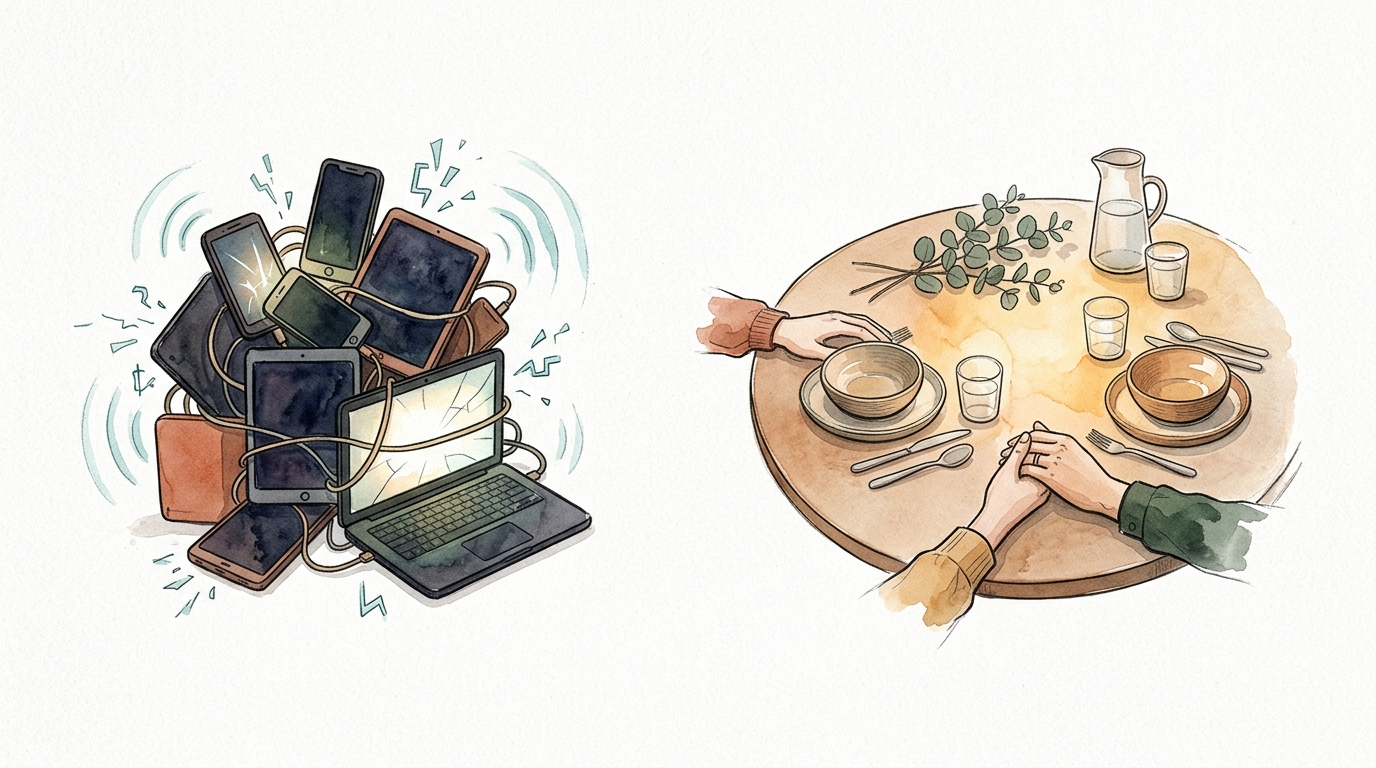
Distracted Table vs. Connected Table
The differences between a tech-saturated meal and a tech-free meal are profound. The following table highlights the measurable shifts in environment and experience.
| Feature | The Distracted Table | The Connected Table |
|---|---|---|
| Eye Contact | Minimal; gazes are directed downward at screens. | Frequent; family members engage directly. |
| Conversation Depth | Fragmented; focused on “surface” updates or silence. | Deep; includes storytelling and emotional check-ins. |
| Eating Awareness | Passive; higher risk of overeating or ignoring flavors. | Mindful; better digestion and appreciation of food. |
| Stress Levels | High; continuous notification pings cause cortisol spikes. | Low; the parasympathetic nervous system is activated. |
| Relationship Bond | Weakening; members feel “phubbed” or ignored. | Strengthening; members feel prioritized and heard. |
Practical Tips and Best Practices
Immediate application is the best way to see results. Small adjustments to the environment can make the transition to a device free dinner feel natural rather than forced.
Focus on the “Why” before the “How.” Discuss the benefits with your family. Frame the new rule as a way to “get more of each other” rather than “losing our phones.” When the goal is connection, the restriction feels like an investment.
Use conversation rituals to bridge the gap. The “High/Low/Buffalo” game is a classic: everyone shares the best part of their day (High), the most challenging part (Low), and something random or funny (Buffalo). This simple structure ensures everyone has a chance to speak and provides a clear path for the conversation.
Keep the environment inviting. Soft lighting, comfortable seating, and even a simple tablecloth can signal that the meal is a special event. When the setting feels intentional, the absence of technology feels less like a void and more like a space for relaxation.
Practical setup tips:
- Leave all phones in a charging dock in a different room to remove the “phantom vibration” effect.
- Turn off the TV and the tablet in the living room so the house is quiet.
- Keep a deck of cards or a small trivia book near the table for those nights when the conversation is slow.
- Invite guests to participate; most people are relieved to have a break from their devices when given permission.
Advanced Considerations for Long-Term Success
Serious practitioners of the device free dinner look beyond the 30-minute meal. They examine the broader digital ecosystem of the home to ensure the “connection asset” remains protected.
Modeling “Digital Discipline” throughout the day helps. If children see their parents putting their phones away when someone walks into the room, they learn that people always take priority over devices. This builds a household culture where the dinner rule is just one part of a larger philosophy of presence.
The “Distant Presence” effect is a psychological concept where the mere sight of a smartphone reduces the cognitive capacity of those around it. Advanced practitioners don’t just put phones face down; they remove them from the line of sight entirely. This clears the “mental bandwidth” required for deep empathy and creative problem-solving during dinner discussions.
Scaling the habit is also possible. Some families move from “Device Free Dinners” to “Device Free Sundays” or “Analog Vacations.” These extended periods of disconnection allow the brain’s dopamine receptors to reset, making the daily 30-minute dinner much easier to maintain.
Handling the “Photo Request” is a common modern dilemma. Someone might want to take a picture of a beautiful meal or a family moment. The best practice is to take the photo quickly before the “parking” begins, then put the phone away. Avoid the temptation to edit or post the photo during the meal, as this pulls the person back into the digital social loop.
Example Scenario: The Transition Week
Seeing the progression from a distracted home to a connected one helps set realistic expectations.
Monday: The rule is introduced. The family puts phones in a basket. The silence is thick and uncomfortable. Dinner ends in 12 minutes as everyone rushes to get their phones back.
Wednesday: A parent brings a “High/Low” question to the table. The conversation lasts 20 minutes. There is one minor argument about a work email, but the phone stays in the basket.
Friday: The family has a “Fancy Pizza Night.” No one mentions the phones. A story from school leads to a 40-minute discussion about hobbies and future plans.
Sunday: The dinner table feels like a sanctuary. The family realizes they feel less stressed and more aware of each other’s lives than they did the previous week.
This example illustrates that the first few days are often the hardest. The “crash” after the initial novelty is normal. Pushing through that second and third day is where the lasting habit is formed.
Final Thoughts
Reclaiming the dinner table from digital distractions is one of the simplest yet most powerful ways to strengthen a family. It transforms a routine chore into a daily ritual of renewal and connection. By removing the digital nuisance, you create a space where every member of the family feels seen, heard, and valued.
Success doesn’t require a perfect record. It requires a commitment to the principle that the people in your physical presence are your highest priority. Starting today with just one screen-free meal can begin a ripple effect that improves mental health, physical well-being, and relational depth.
Experiment with different conversation starters and parking spots. Find the rhythm that works for your unique household. Over time, the “no-phone rule” will no longer feel like a rule at all—it will simply be the way your family connects.
Sources
1 gabb.com | 2 familylife.com | 3 scrippsamg.com | 4 mobicip.com | 5 childrenslighthouse.com | 6 arizona.edu | 7 sdetiquette.com | 8 thekitchn.com | 9 thatdougsmith.com | 10 reddit.com | 11 kinnect.club | 12 100daysofrealfood.com | 13 scrippsamg.com | 14 hindustantimes.com | 15 100daysofrealfood.com | 16 genre.com | 17 genre.com | 18 medium.com | 19 seattlemedium.com