healthy screen habits
Stop reacting to the screen. Build a culture that doesn’t need one. Don’t just ban the tech today. Create the household rituals that ensure your kids grow up with digital self-control.
Parents often find themselves in a constant state of digital defense. You see a glazed look in your child’s eyes and you react by grabbing the iPad. You notice the grades slipping and you react by changing the Wi-Fi password. This is a game of Whac-A-Mole where the technology always has the faster mallet.
True digital wellness is not about the strength of your parental control apps. It is about the strength of your family culture. When you move from reactive banning to proactive ritual-building, you stop being a digital police officer and start being a digital mentor.
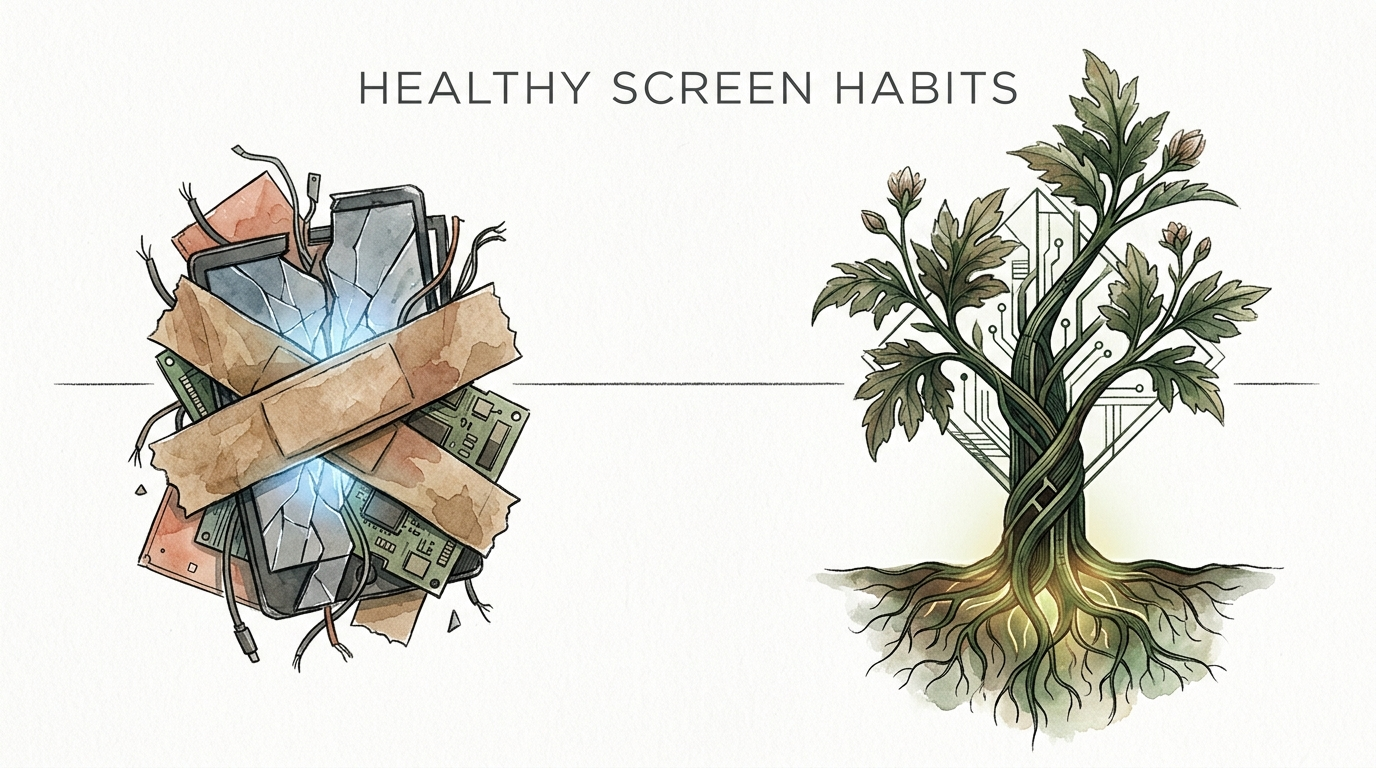
The goal is simple: raise children who can sit in a room with a smartphone and choose not to pick it up. This article explores how to bridge the gap between “The Temporary Patch” of external restrictions and “The Legacy Habit” of internal self-regulation.
healthy screen habits
Healthy screen habits are the intentional, repeatable patterns of behavior that dictate how we interact with digital devices. These habits are not just about “less time.” They are about “better purpose.”
In a world where the average teenager spends over eight hours a day on leisure screen time, these habits serve as the essential guardrails for mental and physical health. Research shows that high levels of self-regulation reduce the risk of problematic technology use and improve overall life satisfaction.
Healthy screen habits exist to protect the three pillars of human development: sleep, focus, and connection. Without these habits, the “variable reward” schedules of modern apps—designed to keep us scrolling—begin to rewrite our dopamine pathways.
In real-world terms, a healthy habit looks like a child who automatically puts their phone in a basket before dinner. It looks like a teenager who uses “Grayscale mode” to make their apps less enticing. It is the ability to feel boredom and see it as a creative opportunity rather than a digital emergency.
How to Build the Legacy Habit
Creating a legacy of digital self-control requires a shift from rules to rituals. Rules are enforced from the outside; rituals are owned from the inside. Follow this step-by-step process to build a culture of self-regulation.
Step 1: The High-Friction Environment
Willpower is a finite resource. Even adults struggle to resist a vibrating phone in their pocket. Designing a high-friction environment removes the need for constant willpower.
Establish a central “Charging Station” in a common area like the kitchen. All devices—including yours—live there after 8:00 PM. Physical separation is one of the most effective ways to reduce screen time. Studies suggest that simply having a phone in another room can increase cognitive capacity and focus.
Step 2: The Digital Sunset Ritual
Technology inhibits the production of melatonin through blue light exposure. A “Digital Sunset” is a household ritual where all screens go dark 60 to 90 minutes before sleep.
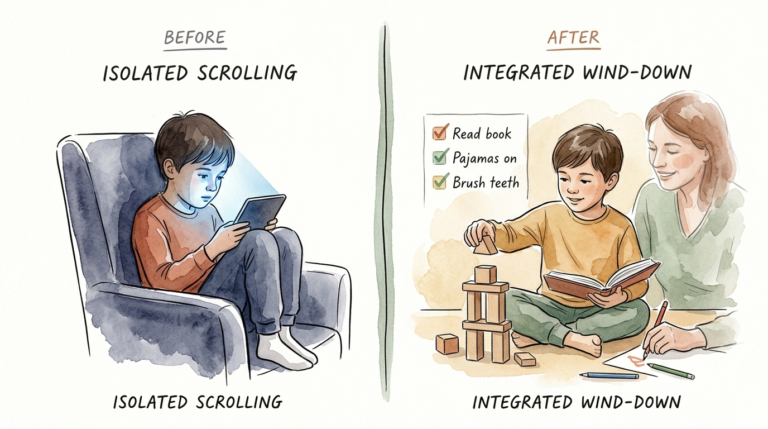
Replace the screen with a low-dopamine alternative. This might be a family read-aloud, a board game, or a simple stretching routine. The key is consistency. When the sun goes down, the screens go down. This ritual signals to the nervous system that it is time to transition from “seek mode” to “rest mode.”
Step 3: Teaching the “Pause and Pivot”
Self-control is a muscle that needs resistance training. Teach your kids to identify the “Zombies State”—that moment when they are scrolling without purpose.
Encourage them to use the “Pause and Pivot” technique. When they feel the urge to click “Next Episode,” they must pause for 60 seconds. During that minute, they ask: “Is this giving me value, or am I just avoiding boredom?” If the answer is avoidance, they pivot to a pre-planned “Analog Alternative.”
Step 4: The Boredom Challenge
Modern technology has effectively “killed” boredom. This is a problem because boredom is the primary driver of creativity and imagination.
Create a “Boredom Menu” in your house. This is a physical list of activities—drawing, Lego, yard work, or listening to music—that children can turn to when they feel restless. The goal is to train the brain to find internal stimulation rather than relying on external digital hits.
Benefits of Digital Self-Regulation
Choosing a ritual-based approach over a restriction-based approach offers measurable advantages for both the child and the parent.
- Improved Executive Function: Kids who practice self-regulation strengthen their prefrontal cortex. This leads to better decision-making in all areas of life, not just with technology.
- Reduced “Technoference”: When rituals are established, there are fewer interruptions to family bonding. This reduces the friction in parent-child relationships and fosters a deeper sense of belonging.
- Superior Sleep Quality: Eliminating screens before bed ensures deeper REM sleep. This is critical for memory consolidation and emotional regulation in developing brains.
- Long-Term Autonomy: Banning tech only works while the child is under your roof. Building rituals prepares them for the independence of college and adulthood, where no one is watching their screen time.
Challenges and Common Mistakes
The path to digital self-control is rarely linear. Most families fail because they fall into predictable traps.
One major mistake is “Inconsistent Modeling.” If you tell your child to put their phone away while you are simultaneously checking your email at the dinner table, the ritual will fail. Children are hyper-aware of parental hypocrisy. Your behavior is the loudest instruction they receive.
Another common pitfall is the “Dopamine Void.” When you remove a high-stimulation activity like gaming or social media, you leave a massive gap in the child’s neurochemistry. If you do not provide a compelling analog alternative, the child will feel intense irritability and restlessness. This often leads to “The Meltdown Trap,” where parents give the device back just to restore peace.
Avoid “Guilt-Based Messaging.” Using phrases like “You’re addicted” or “That screen is rotting your brain” creates shame. Shame triggers a stress response, and the easiest way for a child to soothe stress is to return to the digital comfort of their screen. Focus on the value of the ritual, not the “evil” of the device.
Limitations of the Method
No system is perfect, and building digital self-control has realistic boundaries. Environment and neurodiversity play massive roles in how effective these rituals will be.
Children with ADHD often have a lower baseline of dopamine. For them, the “Variable Reward” schedule of a video game isn’t just fun; it feels like a biological necessity. Rituals that work for a neurotypical child may require significantly more structure and external support for a child with executive function challenges.
School requirements also present a limitation. In many modern districts, homework is strictly digital. You cannot have a “No Screens After School” rule if the math assignment is on a Chromebook. This requires a nuanced “Whitelisting” approach where educational tech is treated differently than entertainment tech.
Finally, the age of the child dictates the strategy. A five-year-old needs “The Temporary Patch”—strict parental controls and zero autonomy. A sixteen-year-old needs “The Legacy Habit”—guidance, trust, and the space to make (and learn from) mistakes.
The Temporary Patch vs. The Legacy Habit
It is helpful to understand the difference between fixing a symptom and building a culture. Most parents rely on “The Temporary Patch.” While useful, it is not a long-term solution.
| Feature | The Temporary Patch | The Legacy Habit |
|---|---|---|
| Primary Tool | Parental Control Apps / Bans | Household Rituals / Modeling |
| Motivation | Fear of Punishment | Internalized Values |
| Focus | “What can’t I do?” | “What do I want to build?” |
| Maintenance | High (Constant policing) | Low (Self-sustaining) |
| Outcome | Rebellion when unsupervised | Digital Self-Control |
Practical Tips for Immediate Application
You can start shifting your family culture today with these actionable best practices.
- The 20-20-20 Rule: For every 20 minutes of screen use, look at something 20 feet away for 20 seconds. This simple ritual protects eye health and forces a “micro-break” in the dopamine loop.
- The One-Screen Rule: No “double-screening.” If the family is watching a movie, the phones stay in the other room. This prevents the brain from entering a state of hyper-stimulation.
- Create “Sacred Spaces”: Designate the dining table and the car as tech-free zones. These are the primary areas for face-to-face conversation. Protecting them ensures that digital life never fully replaces real life.
- Use Grayscale: Go into the accessibility settings of your child’s phone and turn on “Grayscale.” Removing the vibrant colors makes apps like TikTok and Instagram significantly less addictive.
Advanced Considerations: The Neurobiology of Screens
For those who want to go deeper, it is essential to understand why these rituals are so difficult to maintain. The “Caudate Nucleus” is the part of the brain tied to reward processing. Studies have shown that excessive gaming can actually reduce activity in this region, making the brain less responsive to normal, everyday rewards.
This means a child who spends six hours a day on Minecraft will find a walk in the woods literally “boring.” Their brain has been calibrated to a level of stimulation that nature cannot provide.
Building a “Legacy Habit” is effectively a process of neuro-recalibration. By consistently introducing low-stimulation rituals, you allow the dopamine receptors to “up-regulate.” Over time, the child’s brain regains the ability to enjoy slow-paced activities like reading, conversation, and creative play.
The “After-School Reset” Scenario
Imagine a typical Tuesday. Your 12-year-old son walks in the door after a stressful day at school. His usual reaction is to drop his bag and grab the Xbox controller to “decompress.”
In a culture of The Temporary Patch, you yell from the kitchen, “No Xbox until your homework is done!” He grumbles, procrastinates, and eventually sneaks a phone into his room.
In a culture of The Legacy Habit, the “After-School Reset” ritual is already in place. He knows the first 30 minutes at home are for a “Screen-Free Decompression.” He grabs a snack, talks to you for five minutes, and perhaps spends ten minutes shooting hoops in the driveway.
By the time he sits down for homework, his nervous system has transitioned from the high-stress environment of school to a calm state of focus. The Xbox is not “banned”; it has a specific time slot later in the evening, after the family ritual of dinner. The conflict is gone because the expectations are part of the household’s DNA.
Final Thoughts
Shifting from a reactive parenting style to a proactive, ritual-driven culture is the most important investment you can make in your child’s future. Technology is not the enemy, but it is a powerful force that requires a sophisticated defense. By building household rituals, you provide your children with the internal tools they need to navigate a digital world without losing themselves.
Success is not measured by a day with zero screen time. It is measured by the gradual development of your child’s ability to say “No” to the algorithm and “Yes” to the people in the room with them. This is the difference between a temporary fix and a lifelong legacy of self-control.
Start small. Choose one ritual—perhaps the Digital Sunset or the Tech-Free Dinner—and commit to it for 21 days. Be the role model your children need. As you build a culture that doesn’t need a screen to feel complete, you will find that the tech becomes what it was always meant to be: a tool, not a master.
Sources
1 theestablished.com | 2 offthemrkt.com | 3 techhealthyfamilies.com | 4 blankspaces.app | 5 harvard.edu | 6 luriechildrens.org | 7 skillbuildersaba.com | 8 howard.edu | 9 blog.google | 10 psychologytoday.com | 11 ballardclinic.com | 12 nih.gov | 13 rochester.edu