tips for no phone summer
The best summer memories aren’t captured in 4K; they’re lived in 3D. The ‘Summer of Scrolling’ is a trap. Switch from static indoor hours to dynamic outdoor adventures with these tips for an unplugged season.
Stop watching other people live their lives through a five-inch screen. This year, the goal is to be the protagonist of your own story. You deserve a season that feels long, vibrant, and real.
The weight of a phone in your pocket can feel like a leash. Cutting that cord isn’t just about deleting apps; it is about reclaiming your cognitive freedom. Let’s dive into how you can transform your next few months into a legendary, phone-free experience.
tips for no phone summer
A no phone summer is a dedicated period where you intentionally reduce or eliminate non-essential smartphone use to focus on real-world experiences. It is a tactical retreat from the digital noise that dominates modern life. Instead of constant pings, you prioritize presence, nature, and face-to-face connection.
This concept exists because our brains were not designed for the infinite dopamine loops of social media. In the real world, your attention is a finite resource. A “No Phone Summer” acts as a hard reset for your reward system, allowing you to find joy in simple things like a cold slice of watermelon or a long hike.
Think of it as a “Digital Defragging.” Just as a computer needs to reorganize its files to run faster, your mind needs a break from information overload to function at its best. This isn’t just for teenagers or people with “addictions.” It is a lifestyle optimization for anyone who feels like their time is slipping through their fingers.
How to Plan Your Unplugged Season
Success in a phone-free summer does not happen by accident. You need a strategy that covers your logistical needs while protecting your focus. Start by defining what “no phone” actually means for you. For some, it is a total “dumb phone” swap; for others, it is a strict set of time-based boundaries.
The first step is the Digital Audit. Open your screen time settings and look at the raw data. Most people are shocked to find they spend over five hours a day on their devices. Identify the “Time Vampires”—the apps that suck away your hours without providing actual value. These are usually social media, news aggregators, and infinite-scroll games.
Next, invest in Single-Purpose Devices. Our phones are dangerous because they are “everything machines.” When you use your phone for a camera, you are one tap away from checking your email. Reclaim your focus by using a dedicated digital camera for photos, a physical map for navigation, and a standalone MP3 player for music. This keeps your tools functional without the distraction of a browser.
Prepare your social circle before you go dark. Tell your friends and family how to reach you in an emergency. You are not “disappearing”; you are simply changing the medium of your presence. Provide a landline number or a specific time of day when you will check messages so that you don’t feel the pressure of constant availability.
Benefits of an Analog Summer
The most immediate benefit is the expansion of time. When you stop filling every “micro-moment”—like waiting for coffee or sitting on a bus—with scrolling, your days start to feel longer. This “Slow Time” is where creativity and deep reflection happen. You will find yourself noticing details in your environment that you previously ignored.
Improved sleep quality is a massive win. The blue light emitted by screens suppresses melatonin production and disrupts your circadian rhythm. By removing phones from the bedroom, you allow your body to wind down naturally. Most participants in a digital detox report falling asleep faster and waking up feeling more refreshed within just a few days.
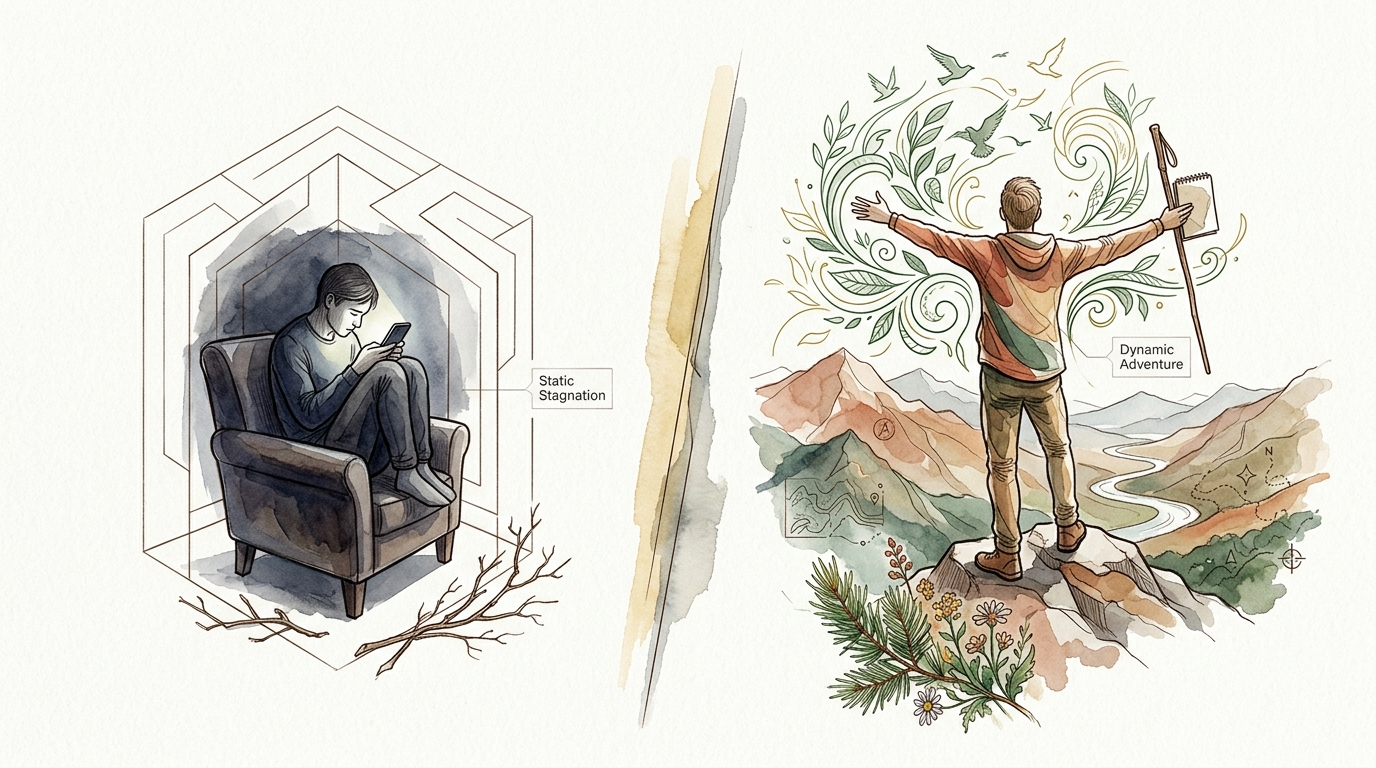
Mental health stabilizes when you remove the Comparison Trap. Social media is a highlight reel of everyone else’s life, which often leads to feelings of inadequacy or FOMO. Stepping away allows you to appreciate your own reality without comparing it to a filtered version of someone else’s. You move from a state of “Static Stagnation” to “Dynamic Adventure.”
Physical health also sees a boost. Without the lure of the screen, you are more likely to engage in movement. Whether it’s a walk around the block or a weekend camping trip, an unplugged life is naturally more active. You trade “Text Neck” and eye strain for fresh air and vitamin D.
Challenges and Common Mistakes
The biggest mistake is going “Cold Turkey” without a plan for boredom. Boredom is the primary trigger for phone use. If you don’t have a list of replacement activities ready, you will inevitably reach for your device the moment you feel a lull in the day. Have books, craft supplies, or sports equipment visible and ready to use.
Another pitfall is the “Utility Trap.” This happens when you keep your phone nearby “just for the GPS” or “just for the weather.” Before you know it, you are checking your Instagram feed. If you must use your phone for utility, use tools like the “Brick” app or physical phone lockers to keep distracting apps inaccessible.
Social friction is a real challenge. We live in a world that assumes 24/7 availability. You might feel anxious when you can’t immediately answer a text, or your friends might feel slighted. Clear communication is the only way to solve this. Explain that you are doing a summer challenge to be more present, and most people will actually be inspired by your choice.
Dopamine withdrawal is a scientific reality. For the first few days, you might feel irritable, restless, or “itchy” to check your notifications. This is your brain recalibrating its reward pathways. Understand that this discomfort is temporary and is actually a sign that the detox is working.
Limitations of the Phone-Free Method
A total “no phone” approach is not ideal for every career. If your job requires on-call availability or frequent digital communication, you cannot simply toss your phone in a drawer for three months. In these cases, the “Summer of Scrolling” can be mitigated by using work-only devices or setting strict “Office Hours” for your digital life.
Safety and logistics are practical boundaries to consider. If you are traveling solo in an unfamiliar city, having a smartphone for emergency calls and GPS is a responsible safety measure. The goal is to eliminate mindless scrolling, not to put yourself in physical danger. Use your phone as a tool, not as a tether.
Environmental factors can also play a role. If you live in an area with extreme heat or limited outdoor access, “getting outside” might be more difficult. In these situations, your “unplugged” activities should focus on indoor analog hobbies like reading, painting, or learning a new instrument.
Comparing Digital Stagnation vs. Dynamic Adventure
| Factor | Static Stagnation (Screen Time) | Dynamic Adventure (Unplugged) |
|---|---|---|
| Mental Energy | Drained by information overload. | Refreshed by sensory engagement. |
| Social Connection | Shallow interactions via likes/comments. | Deep, meaningful face-to-face talks. |
| Memory Formation | Blurred by repetitive scrolling. | Vivid, multi-sensory experiences. |
| Physical State | Sedentary and hunched. | Active and posture-aligned. |
Practical Tips for a Phone-Free Summer
- Use Grayscale Mode: Remove the color from your screen to make apps look less appealing. This kills the dopamine hit you get from bright icons.
- Establish Tech-Free Zones: Declare the dining table and the bedroom as “No Phone Zones.” Use a physical alarm clock instead of your phone.
- The “Phone Parking” Station: Create a designated bowl or shelf by the front door. The moment you walk in, the phone stays there.
- Delete Social Media Apps: If you must check them, do it on a desktop computer. The friction of logging in on a browser will naturally reduce your usage.
- Carry a Notebook: When you have a thought, a list, or a reminder, write it down on paper. This prevents the “I just need to check my notes” excuse for picking up the phone.
Focus on “Replacement Practices” that occupy your hands and mind. Gardening, watercoloring, or even a complex puzzle can provide the “flow state” that scrolling attempts to mimic but never achieves. When you are bored, sit with it for five minutes before reaching for a distraction. You will be amazed at what your brain creates when it isn’t being fed a constant stream of content.
Advanced Considerations for Digital Minimalism
For those who want to go beyond a temporary challenge, consider a permanent shift toward Digital Minimalism. This philosophy, popularized by authors like Cal Newport, suggests that technology should only be used if it serves a deeply held value. It isn’t about being anti-technology; it is about being pro-intentionality.
Think about “Scaling” your detox. You might start with “Phone-Free Fridays” and gradually expand to entire weekends. Over time, your tolerance for digital noise will decrease, and you will find yourself naturally reaching for your phone less often. You might even consider switching to a “minimalist phone” or a device with an e-ink screen that lacks a browser and social media.
Serious practitioners also look at “Cognitive Fitness.” Constant multitasking on a phone fragments your attention. Long-form reading and deep work are the weights you lift to rebuild your “attention muscle.” Use the summer to train your brain to focus on one thing for sixty minutes at a time. This skill is a superpower in the modern economy.
The “Perfect” Unplugged Summer Day
Imagine waking up at 7:00 AM without an alarm or a notification. You spend the first thirty minutes on your porch with a cup of coffee, watching the birds instead of checking the news. You have a ten-minute sunrise ritual—stretching or watering the herbs—that resets your internal clock.
At 10:00 AM, you head to a local trailhead. Your phone is in the glove box of the car for emergencies. You hike for three hours, noticing the smell of the pine trees and the sound of your own footsteps. You aren’t worried about getting the perfect “trail shot” for Instagram; you are just there.
By 3:00 PM, you are back home, working on a DIY project or reading a physical book in a hammock. When you get bored, you don’t scroll. You take a nap or start prepping a fresh dinner with local ingredients. You invite a friend over at 6:00 PM, and you talk for three hours without a single device buzzing on the table. You go to bed at 10:00 PM, and your mind is quiet.
Final Thoughts
The “Summer of Scrolling” is a default state, but it doesn’t have to be yours. By implementing these tips for a no phone summer, you are choosing a path of higher resistance that leads to a much higher reward. You are trading digital ghosts for real-world substance.
Remember that this journey is about progress, not perfection. If you slip up and scroll for an hour, don’t throw away the whole challenge. Just put the phone down and step outside. The sun is still out, the air is still warm, and the 3D world is waiting for you to participate in it.
Experiment with these strategies and see what works for your specific lifestyle. You might find that you don’t miss the digital noise at all. Reclaim your time, protect your focus, and make this the summer you actually remember.
Sources
1 medium.com | 2 vice.com | 3 dev.to | 4 ucdavis.edu | 5 stlouischildrens.org | 6 youtube.com | 7 youtube.com | 8 247dct.org | 9 247dct.org | 10 umccares.org | 11 truthcenterhh.com | 12 talkspace.com | 13 charleston.edu