screen free evenings
Our ancestors didn’t have blue light, and they slept better than we do. It’s time to go back to the glow. Modern lighting is a bio-hack in reverse. Reverting to ancestral light levels in the evening is the best sleep medicine.
We are living in a biological mismatch. For millions of years, the setting sun triggered a cascade of hormones designed to repair your body and brain. Now, we hit our eyes with the equivalent of high-noon sunlight at 10:00 PM. This digital glare isn’t just annoying. It’s a physiological emergency that stops your recovery in its tracks.
screen free evenings
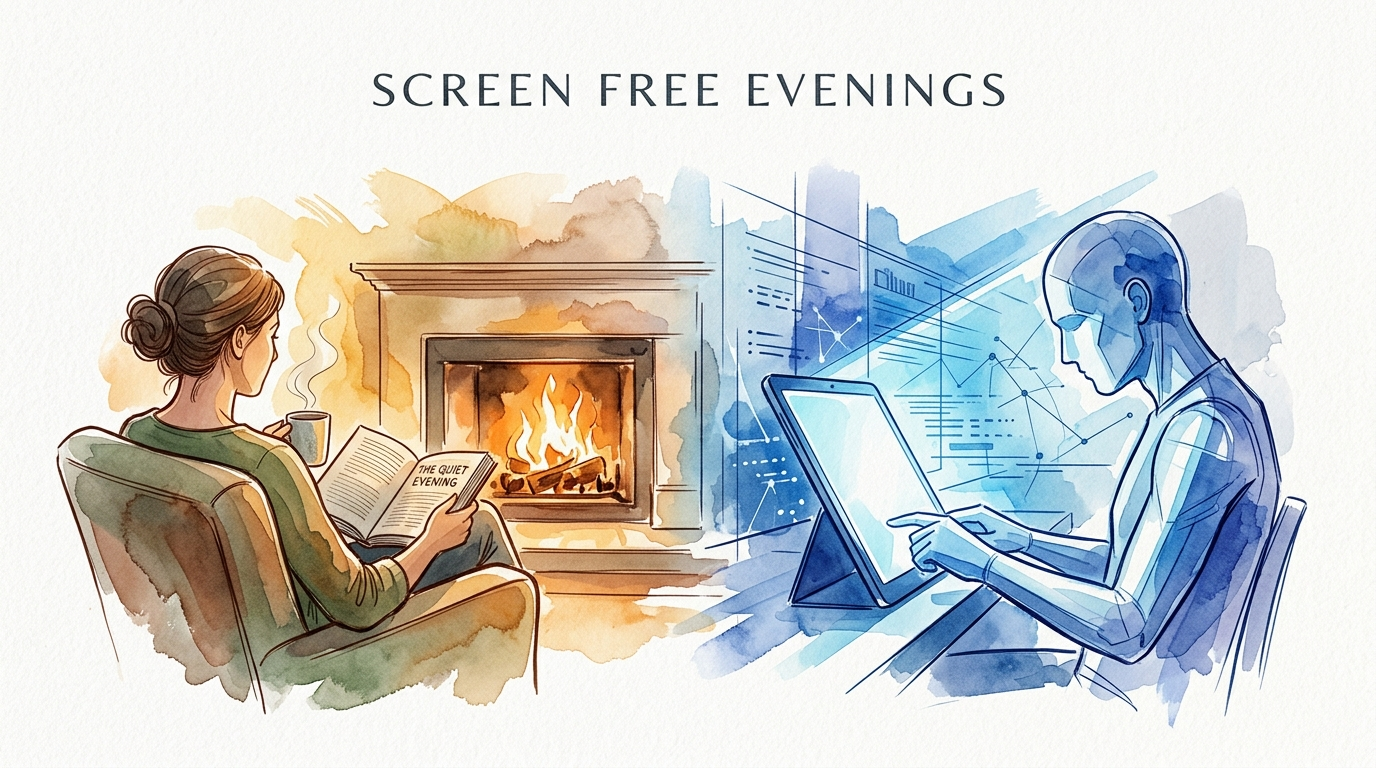
Screen-free evenings are a deliberate commitment to disconnecting from high-energy visible (HEV) light sources once the sun goes down. This practice involves more than just putting your phone in another room. It is a total environmental shift that honors your circadian biology.
Most people spend their nights bathed in the blue-rich light of smartphones, tablets, and LED overheads. These devices emit specific wavelengths that trick your brain into thinking it’s mid-day. Your brain receives a signal that the sun is up, so it refuses to release the chemicals you need to rest.
In the real world, this looks like a “digital sunset.” You transition from the high-stimulation environment of the modern world to the low-energy, warm environment of our ancestors. Think of it as a bridge between the chaos of the day and the deep restoration of the night.
This exists because our eyes contain specialized cells called intrinsically photosensitive retinal ganglion cells (ipRGCs). These cells don’t help you “see” shapes or colors in the traditional sense. Instead, they act as brightness sensors that communicate directly with your internal clock. When they see blue light, they keep the “on” switch flipped.
How the Biology of Light Works
Your brain is a light-sensitive computer. The central processor for your sleep-wake cycle is the suprachiasmatic nucleus (SCN). This tiny region of the hypothalamus sits right above your optic nerves to get the fastest data possible about the light environment.
Inside your eyes, a photopigment called melanopsin is the gatekeeper. Melanopsin is most sensitive to light in the 480-nanometer range. This is exactly the “cool blue” light emitted by your iPhone and those energy-efficient white LED bulbs in your kitchen.
When 480nm light hits the retina, melanopsin sends an immediate message to the SCN. The message is simple: “Stay awake.” The SCN then suppresses the pineal gland, which is responsible for producing melatonin. Melatonin is often called the “vampire hormone” because it only comes out in the dark.
Melatonin does more than make you sleepy. It is a master antioxidant that cleans up cellular debris and helps regulate your metabolism. If you have light hitting your eyes at night, you are effectively turning off your body’s primary repair system.
Recent studies show that even dim room light—around 65 to 100 lux—can suppress melatonin by more than 50%. Most modern living rooms are significantly brighter than that. You aren’t just staying awake; you are actively blocking your body from healing.
The Massive Benefits of the Glow
Switching to a screen-free evening creates a massive shift in your hormonal profile. The most immediate benefit is a decrease in sleep latency. This is the technical term for how long it takes you to fall asleep once your head hits the pillow.
When you remove the blue glare, your melatonin levels start to rise about two hours before your desired bedtime. This creates a natural “sleep pressure” that feels like a gentle wave rather than a forced shutdown. You will find yourself nodding off naturally instead of scrolling until your eyes burn.
Deep sleep is where the magic happens. By aligning with ancestral light levels, you improve the quality of your NREM (non-rapid eye movement) sleep. This is the stage where your body releases growth hormone to repair tissues and muscles.
Brain health also gets a major boost. During deep sleep, the glymphatic system flushes toxins out of your brain. Modern blue glare keeps you in lighter stages of sleep, which prevents this deep cleaning process from finishing. A screen-free night is a detox for your gray matter.
Metabolic health is another hidden win. Artificial light at night is linked to insulin resistance and weight gain. When you keep your circadian rhythms synced, your body processes blood sugar more efficiently. You might find that your late-night cravings simply disappear when you aren’t over-stimulating your brain with blue light.
Challenges and Common Mistakes
The “One Last Check” is the most common pitfall. You tell yourself you’ll just check your email or one social media notification. That single 30-second exposure to a bright screen is enough to reset your internal clock’s “reset” button.
Many people rely on “Night Mode” or “Blue Light Filters” on their devices. While these are better than nothing, they are often insufficient. Most software filters only shift the color slightly. They do not remove enough of the high-energy wavelengths to stop the suppression of melatonin.
Overhead lighting is another silent killer. We often remember to dim our phones but leave the powerful LED “daylight” bulbs on in the ceiling. Light coming from above is especially potent because the ipRGC cells are concentrated in the lower part of the retina. They evolved to sense the sky, not a campfire on the ground.
Social friction is a real challenge. Our modern culture revolves around late-night streaming and group chats. Deciding to go screen-free can make you feel disconnected from your social circle. This is a mental hurdle you must clear to prioritize your biological health over digital noise.
Limitations and Realistic Constraints
Winter months can be difficult for this protocol. In many parts of the world, the sun sets at 4:30 PM. Going completely screen-free for six or seven hours before bed is not practical for most people with jobs and families.
Work requirements often demand evening computer use. If you are a freelancer or have a high-stress job, you may not have the luxury of a 7:00 PM digital sunset. In these cases, you have to find middle-ground solutions rather than total abstinence.
Safety is a practical boundary. You cannot navigate a dark house or cook a meal in total pitch black. Pure ancestral darkness isn’t the goal; the goal is high-quality, low-energy light that doesn’t disrupt your hormones.
Emergency situations are the obvious exception. If there is a family emergency, your health protocol takes a backseat. The goal is 90% consistency, not 100% perfection that causes extra stress.
Modern Glare vs. Ancestral Firelight
Understanding the difference between light sources is key to making better choices. Not all light is created equal.
| Light Source | Kelvin (Color Temp) | Primary Wavelength | Melatonin Impact |
|---|---|---|---|
| Smartphone/Tablet | 5,000K – 6,500K | 450nm – 480nm (Blue) | Severe Suppression |
| Standard White LED | 3,000K – 4,000K | Broad Blue Peak | Moderate to High |
| Incandescent Bulb | 2,400K – 2,700K | Orange/Yellow | Low to Moderate |
| Candlelight | 1,500K – 1,800K | Red/Infrared | Minimal to None |
| Red LED Bulb | <1,000K | 630nm+ (Red) | None |
This comparison shows why candlelight and red light are the ultimate evening tools. They exist on the opposite end of the spectrum from the “high noon” blue light that keeps you awake.
Practical Tips for a Better Night
Start by swapping out the bulbs in your bedside lamps. Look for specialized red LED bulbs or “amber” sleep bulbs. These bulbs physically cannot emit blue light. They provide enough visibility to read or move around without triggering your brain’s “daytime” mode.
Invest in a pair of high-quality blue-blocking glasses. Look for glasses with dark orange or red lenses, not the clear ones sold at most retailers. The red lenses block 100% of blue and green light. These are your “biological armor” for when you absolutely must use a screen.
Implement a “Low Light Only” rule after 8:00 PM. Turn off all overhead lights. Use floor lamps or candles instead. Light coming from eye level or below is much less disruptive to your circadian rhythm than light shining down from the ceiling.
Replace scrolling with analog activities. Reading a physical book, journaling, or stretching are high-value alternatives. These activities calm the nervous system instead of spiking your dopamine. You will find that your mind stays quiet, making the transition to sleep much smoother.
Use a red-light nightlight in the bathroom. If you have to get up in the middle of the night, a blast of white light from a bathroom vanity will kill your melatonin production instantly. A dim red light allows you to see without waking your brain up.
Advanced Considerations for Practitioners
The “Green Light” factor is often overlooked by beginners. While blue light is the main culprit, research shows that green light can also suppress melatonin, though to a lesser degree. This is why red-tinted glasses are superior to orange ones—they block both the blue and green spectrums.
Consider the “Light History” of your day. Your sensitivity to light at night is partly determined by how much light you got during the day. Getting bright, natural sunlight in your eyes first thing in the morning (the “Huberman Protocol”) actually makes you more resilient to blue light in the evening.
Light flicker is another advanced concern. Many cheap LED bulbs flicker at a frequency invisible to the naked eye but noticeable to your nervous system. This can cause low-grade stress and headaches. High-quality, flicker-free “warm” bulbs are a worthwhile investment for a dedicated sleep environment.
Seasonal adjustments are mandatory. During the summer, you can stay active later because the sun stays up. In the winter, your body naturally wants to wind down earlier. Fighting this natural rhythm causes “social jet lag.” Try to adjust your digital sunset to follow the seasonal changes in natural light.
A 7-Day Ancestral Light Protocol
To see the benefits for yourself, try this one-week experiment. It doesn’t require expensive gear, just a change in habits.
Days 1-3: The Transition
Turn off all overhead lights two hours before bed. Use only one or two dim lamps. Put your phone in a drawer exactly 60 minutes before you intend to sleep. If you feel bored, that is a sign your brain is starting to downshift.
Days 4-5: The Deep Dive
Swap your bedside bulb for a red LED. Use candlelight for your evening meal. Avoid all screens entirely after 7:00 PM. Pay attention to how your eyes feel—they will likely feel less “strained” and more relaxed.
Days 6-7: The Observation
Keep the strict light protocol. Notice your wake-up time. Most people find they start waking up minutes before their alarm, feeling significantly more alert. This is the sign that your circadian rhythm has successfully re-anchored.
Final Thoughts
Living in a world of 24/7 illumination is a grand biological experiment, and the results are currently in: we are tired, stressed, and poorly recovered. Your brain wasn’t built for the LED era. It was built for the glow of the fire and the soft light of the moon.
By reclaiming your evenings and removing the digital glare, you are giving your body permission to heal. This isn’t about being a luddite or hating technology. It is about using light as a tool rather than letting it use you.
Start tonight. Turn off the big lights. Put the phone away. Let the red and orange hues take over. You will be amazed at how much better you feel when you finally stop fighting the sun. Lower the lights, raise your health, and go back to the glow.
Sources
1 sleepandsinuscenters.com | 2 sleepeducation.org | 3 cdc.gov | 4 plumcitycare.com | 5 sleepfoundation.org | 6 nih.gov | 7 foundmyfitness.com | 8 nih.gov | 9 geneticlifehacks.com | 10 pnas.org | 11 mcgill.ca | 12 jaimedicalsystems.com | 13 hatch.co | 14 ies.org | 15 frontiersin.org | 16 nih.gov