no screen activities
Your child was built for the wild, not the interface.
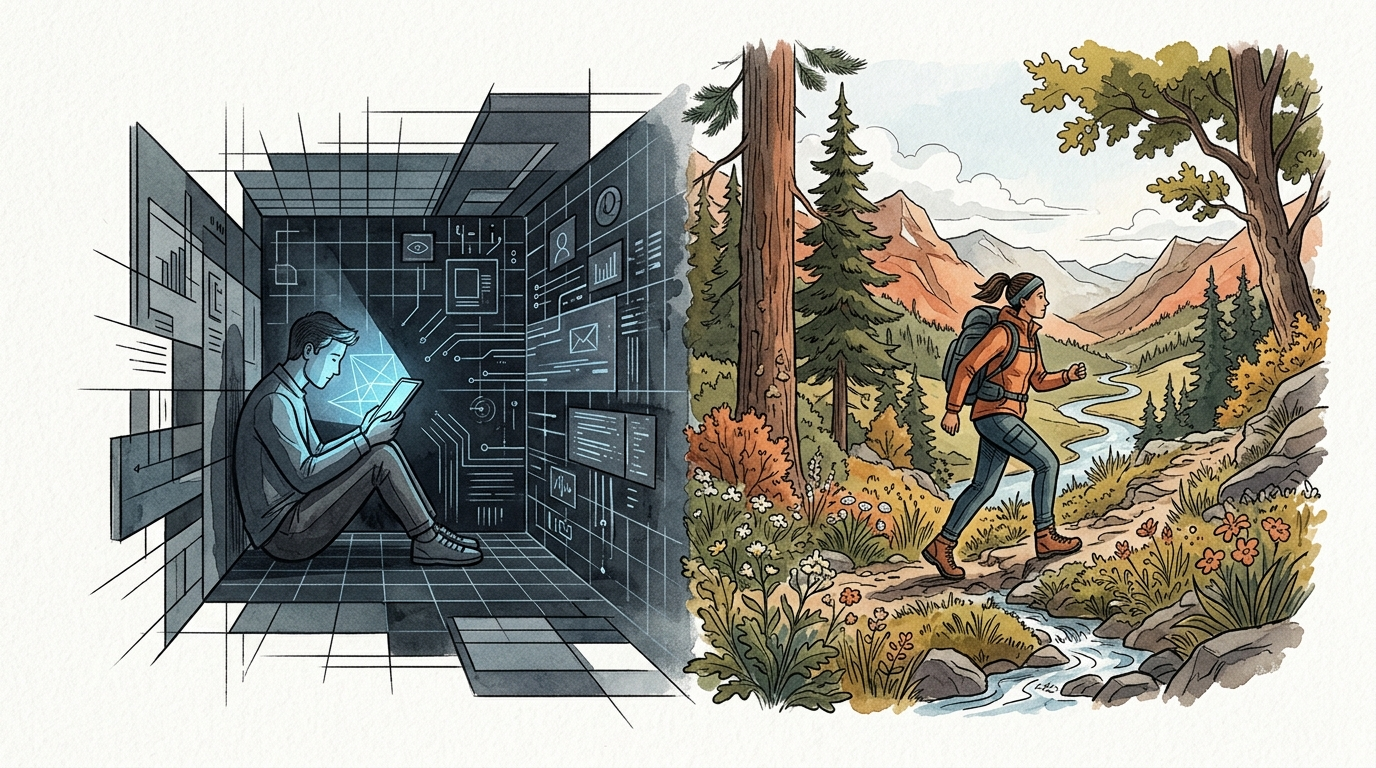
The digital world is a simulation. The real world is a sensory explosion. Here are the ‘wild’ activities your kids are actually craving.
Modern childhood has shifted from the mud of the backyard to the glow of the tablet. While digital tools offer convenience, they lack the raw, multi-sensory feedback required for healthy human development. When a child interacts with a screen, they are engaging a narrow band of their potential. They use their eyes and perhaps a thumb. But when they step into the wild, every nerve ending ignites.
This matters because the brain is a “use it or lose it” system. Sensory deprivation during key developmental windows can lead to issues with balance, coordination, and emotional regulation. Reintroducing wild experiences is not just about “fun.” It is about biological necessity.
The Synthetic Interface vs The Wild Experience is a choice between a curated, low-resolution life and a chaotic, high-definition reality. One depletes a child’s “directed attention” reserves, while the other restores them. If you want a child who is resilient, creative, and physically capable, you must give them back the wild.
no screen activities
No screen activities are experiences that engage a child’s entire body and all five senses in a non-digital environment. These are not just “boredom busters.” They are high-intensity sensory inputs that the human brain evolved to process. These activities exist to ground a child in physical reality, teaching them the laws of physics, biology, and social negotiation through direct experience.
In the real world, these activities look like “risky play” or “unstructured exploration.” Think of a child balancing on a fallen log. To the parent, it looks like a potential fall. To the child’s brain, it is a complex calculation of gravity, friction, and proprioception. Every micro-adjustment of their ankles is a data point that no app can provide.
These activities are used in forest schools, occupational therapy, and traditional communities to build “anti-fragility.” An anti-fragile child does not just survive stress; they grow from it. By engaging in “wild” play, children learn the boundaries of their own bodies and the physical world.
Examples of these activities include:
- Mud Kitchens: Combining water and earth to create tactile “confections.”
- Tree Climbing: Assessing vertical risk and testing grip strength.
- Loose Parts Play: Using sticks, stones, and tires to build structures.
- Tracking and Foraging: Sharpening visual acuity and pattern recognition.
How It Works: The Mechanics of Wild Play
Wild play works by stimulating the vestibular and proprioceptive systems. The vestibular system, located in the inner ear, manages balance and spatial orientation. The proprioceptive system, found in muscles and joints, tells the brain where the body is in space. Screens provide almost zero input for these systems, which is why many “screen-heavy” children appear clumsy or restless.
To implement these activities effectively, you must follow the “Just Right Challenge” principle. This means providing an environment that is challenging enough to be exciting but safe enough to prevent serious injury. You are not throwing a child into a survival situation; you are scaffolding their independence.
Step one is to provide the “loose parts.” Nature is full of them. Instead of a plastic toy with one function, a stick can be a sword, a fishing pole, or a structural beam for a fort. This ambiguity forces the brain to engage in divergent thinking.
Step two is to step back. The “how” of wild play requires adult silence. When you tell a child “be careful,” you interrupt their internal risk-assessment process. Instead, observe from a distance. Let them struggle with a heavy rock or a slippery slope. The learning happens in the struggle, not the completion.
Benefits of the Wild Experience
The practical, measurable benefits of “rewilding” a child are extensive. Research shows that outdoor time can act as a natural “reset” for the nervous system. While screens often leave children irritable and distracted due to depleted “directed attention,” nature recharges these cognitive reserves.
Mental Health and Resilience: Exposure to nature is proven to lower cortisol levels and decrease symptoms of anxiety. Children who engage in risky play—climbing high or moving fast—develop a higher “threat threshold.” They become less likely to panic in stressful situations later in life because they have practiced managing fear in a controlled environment.
Physical Coordination: Navigating uneven terrain builds core strength and fine motor skills. Activities like picking up small pebbles or stripping bark from a stick provide better “hand-eye” training than any video game. These skills translate directly into better handwriting, athletic performance, and general physical confidence.
Immune System Support: There is a biological advantage to getting dirty. Exposure to the diverse microbes found in soil helps prime a child’s immune system, potentially reducing the risk of allergies and asthma. The “hygiene hypothesis” suggests that our overly sanitized, indoor lives are making us more susceptible to illness.
Challenges and Common Mistakes
The biggest challenge to rewilding childhood is parental anxiety. We live in a risk-averse society where every scrape is seen as a failure of supervision. This “safety-first” mindset can ironically make children less safe by preventing them from learning how to manage risk.
The “Be Careful” Trap: Constantly shouting warnings at a child prevents them from listening to their own instincts. If they are always looking at you for safety cues, they aren’t looking at the slippery branch or the sharp edge. The mistake is thinking that “safety” means the absence of risk. True safety is the presence of competence.
The “Perfect Environment” Fallacy: Many parents think they need a national park to provide a wild experience. This is not true. A small patch of dirt, a pile of wood chips, or a single tree can provide hours of deep engagement. The mistake is overcomplicating the setup. Nature provides the complexity; you just provide the access.
The Cleanliness Obsession: Seeing mud as “dirt” rather than a sensory medium is a major hurdle. If you are worried about the laundry, the child will feel the tension and hold back. To avoid this, dedicate a set of “wild clothes” that are meant to be ruined. This removes the psychological barrier for both parent and child.
Limitations and Constraints
While wild play is essential, there are realistic constraints. Weather is the most frequent excuse, though as the saying goes, “there is no bad weather, only bad clothing.” However, extreme heat, cold, or storms do require practical boundaries. You must balance the desire for “wildness” with the reality of frostbite or heatstroke.
Urban environments also present limitations. Not every child has access to a forest. In these cases, you must look for “pocket wilds.” This might be a community garden, a neglected corner of a park, or even a large planter box on a balcony. The limitation is often more about imagination than geography.
Another practical boundary is physical ability. Children with mobility or sensory processing challenges may find “wild” environments overwhelming or inaccessible. In these situations, the “wild” must be brought to them through tactile bins, indoor water play, or modified outdoor paths. The goal is the sensory input, not necessarily the location.
The Synthetic Interface vs The Wild Experience
To understand why “no screen activities” are superior for development, look at the measurable differences between the two modes of existence.
| Factor | Synthetic Interface (Screen) | The Wild Experience (Nature) |
|---|---|---|
| Sensory Input | 2D Visual, Mono/Stereo Audio | 3D Visual, Full Audio, Olfactory, Tactile, Proprioceptive |
| Feedback Loop | Predictable, Coded, Instant | Unpredictable, Biological, Variable |
| Dopamine Type | Fast-Spike (Addictive) | Slow-Release (Sustained Satisfaction) |
| Metabolic Cost | Sedentary, Low Energy | Active, High Energy, Growth-Oriented |
| Attention Demand | Directed (Depleting) | Fascinated/Involuntary (Restorative) |
Practical Tips for Success
You can start rewilding your child’s daily routine immediately with a few simple adjustments. You don’t need a curriculum; you need a change in perspective.
- The Outdoor Go-Bag: Keep a bag by the door with towels, a change of clothes, a magnifying glass, and a small trowel. If the barrier to entry is low, you are more likely to go out.
- Create a “Yes” Space: Designate a part of the yard or a local park where the child is allowed to dig, pull leaves, and get as messy as they want. Knowing there is a “Yes” zone reduces parental stress.
- The 1000 Hours Outside Goal: Track your outdoor time. Having a goal helps you prioritize the wild experience over the convenient interface.
- Follow the Interest: If your child is obsessed with bugs, buy a field guide and go on a “Bio-Blitz” in the backyard. If they like building, give them real hammers and nails (with supervision).
- Seasonal Scavenger Hunts: Create lists of things to find that change with the seasons—acorns in the fall, animal tracks in the snow, specific flowers in the spring.
Advanced Considerations for Serious Practitioners
For those who want to go beyond the basics, consider the concept of “Ecological Literacy.” This is the ability to understand the systems that support life on Earth. When a child learns to identify trees or understand the water cycle through a creek in their neighborhood, they aren’t just playing; they are becoming scientifically literate.
Advanced practitioners also focus on “Primitive Skills.” Learning to tie a bowline knot, build a debris hut, or start a fire with a flint and steel provides a massive boost to a child’s self-efficacy. These skills are “hard” and require persistence. In a world of instant gratification, the “hard” things are where character is built.
Consider the “Deep Play” state. This is when a child becomes so absorbed in an activity that they lose track of time. This is the natural state of learning. To facilitate this, you must provide long, uninterrupted blocks of time. An hour is rarely enough; three hours is the sweet spot for a child to move past “boredom” and into deep, creative flow.
The “Creek Expedition” Scenario
Imagine a Saturday morning. Instead of the usual tablet time, you drive to a local creek. You bring nothing but an old pair of sneakers and a bucket.
At first, the child stands on the bank. They are used to the “user-centered” design of an iPad where everything reacts to their touch. The creek doesn’t care. It is cold, the rocks are slippery, and the water is moving.
The child takes a step. They slip. Their brain immediately fires a dozen signals to their core and ankles to stabilize. They find a “crayfish” under a rock. This is a high-definition sensory moment: the smell of the damp earth, the scuttle of the legs, the cold water on their wrists.
Three hours later, they are covered in silt, exhausted, and remarkably calm. They have engaged in physics (damming the stream), biology (observing the crayfish), and risk management (navigating the rocks). They return home not “wired” and irritable, but deeply satisfied. This is the power of the wild experience.
Final Thoughts
Rewilding your child is an act of rebellion against a domesticating culture. It is a commitment to the “sensory explosion” of reality over the “simulation” of the interface. By prioritizing no screen activities, you are giving your child the tools they need to build a robust, capable, and resilient brain.
The transition may be messy. There will be laundry, there will be scraped knees, and there will be moments of genuine boredom. But on the other side of that boredom is a level of creativity and self-reliance that no app can simulate.
Start small. Open the door. Let them walk until their feet get sore and dig until their fingernails are black. Your child was built for the wild. It is time to let them back in.
Sources
1 letgrow.org | 2 teddylabels.com | 3 activeforlife.com | 4 integrityinc.org | 5 wisconsinyouthcompany.org | 6 theguardian.com | 7 naturescoutscollective.com | 8 compasschildcare.com | 9 youtube.com | 10 bu.edu | 11 nih.gov | 12 unicef.org | 13 youtube.com | 14 proverbs31girl.com | 15 gardenmontessorischools.com | 16 nih.gov | 17 getthekidsoutside.com | 18 inhf.org