
family activities without screens
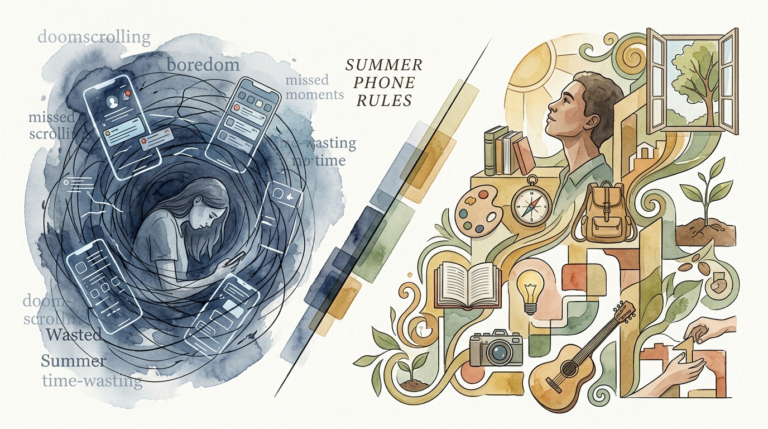
Digital simulations can’t replicate the biological joy of tactile play. We traded mud for pixels and wonder for scrolling. It’s time to bring the family back to the real world with these screen-free activities that actually stick.
Finding ways to reconnect doesn’t have to feel like a chore. Modern life often pushes us toward “synthetic dopamine” through endless scrolls and notifications. These digital rewards are quick but shallow. True connection happens when we engage our senses and each other in the physical world.
This guide provides a roadmap for parents who want to reclaim their living rooms. You will discover activities that build skills, reduce stress, and create memories that don’t require a charging cable.
family activities without screens
Family activities without screens are intentional moments where digital devices are set aside to prioritize physical, social, and creative engagement. This concept isn’t just about “turning things off.” It is about turning toward more meaningful forms of interaction.
In a world where 81% of children under 13 now have their own device, the default mode of play has become solitary and digital [1.1.5]. Screen-free activities break this “cocooning” behavior. They force us to look up, make eye contact, and use our hands to manipulate the environment [1.5.4].
These activities exist in various forms, from high-energy outdoor sports to quiet, focused indoor crafts. They are used in homes to improve sleep, in schools to boost focus, and in therapy to strengthen emotional bonds. Think of it as a return to “embodied interaction,” where we learn through our physical experiences rather than just observing them on a flat surface [1.5.2].
How to Successfully Unplug Your Home
Transitioning a tech-heavy household into a screen-free haven requires more than just hidden chargers. It requires a strategy that reduces friction and replaces the digital void with something better.
Start by modeling the behavior yourself. Children are highly sensitive to parental screen use. If you are constantly checking emails, they will struggle to see the value in staying offline [1.4.1]. Designate specific “Screen-Free Zones,” such as the dining table or bedrooms, to promote uninterrupted connection [1.1.5].
The “Boredom Box” Technique
Prepare for the inevitable “I’m bored” complaints by creating a curated bin of low-prep activities. Include items like modeling clay, old magazines for collages, and a deck of cards. This shifts the burden of “what to do” from the parent to the child’s own imagination.
Scheduling the Detox
Don’t aim for perfection immediately. Try a “Screen-Free Sunday” or a “No-Tech Hour” after school. Many families find success with a “Screen-Free Week” once a year to reset habits and rediscover old hobbies [1.4.3].
Focus on Interactive Co-Play
When you do engage in an activity, make it interactive. Traditional board games are excellent because they require turn-taking and emotional regulation. Unlike solo digital play, these games create a shared social space where multiple people can see each other’s faces and emotions [1.5.4, 1.5.5].
The Proven Benefits of Going Screen-Free
Stepping away from devices offers measurable advantages for both children and adults. Research indicates that excessive screen time—often more than 3-4 hours daily—is linked to obesity, sleep disorders, and mental health challenges like anxiety and depression [1.3.2, 1.3.8].
Physical Health and Vision
One of the most immediate benefits is the reduction of myopia (nearsightedness) risk. Recent studies found a clear dose-response relationship between digital screen time and vision issues, with the risk increasing sharply for children spending more than 1 hour a day on devices [1.1.6]. More outdoor time and less “near work” can protect developing eyes [1.3.7].
Cognitive and Language Development
For younger children, language development depends heavily on what screens replace. When digital content replaces conversation, reading, and physical play, language outcomes tend to be worse [1.1.6]. Tactile play, like building with blocks or playing in nature, boosts vocabulary and nurtures parent-child relationships [1.5.4].
Dopamine Regulation
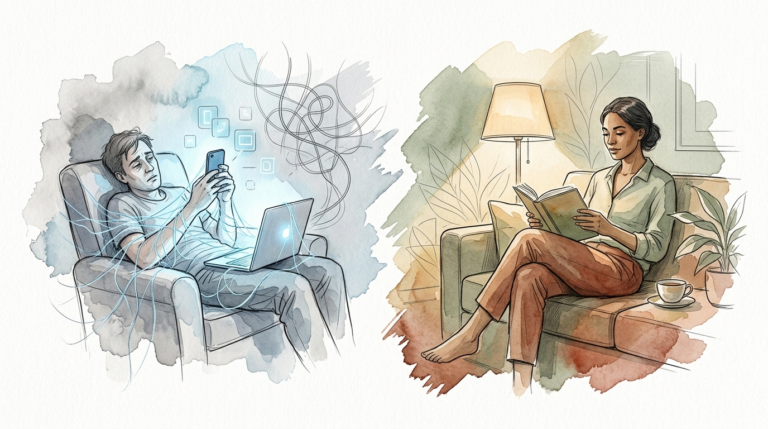
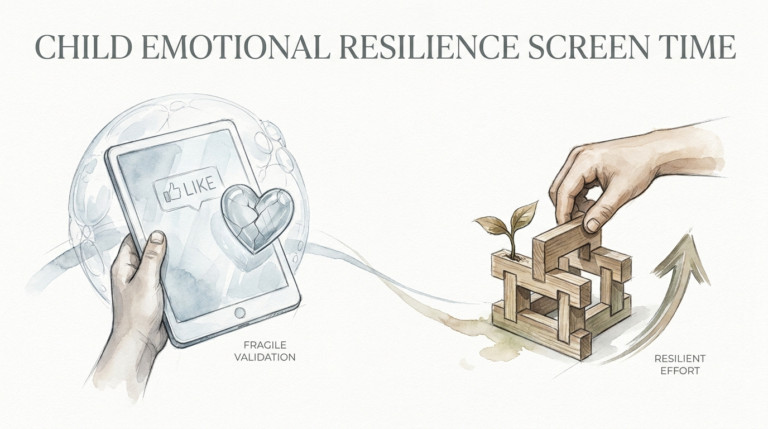
Screens are designed to trigger frequent dopamine hits. This creates a “dopamine loop” that can make offline life feel dull by comparison [1.4.7]. Engaging in slower, more challenging tactile activities helps recalibrate the brain’s reward system, leading to better impulse control and focus [1.5.1].
Common Challenges and Pitfalls to Avoid
Even the best-laid plans can face resistance. Understanding why these hurdles exist makes them easier to overcome.
The “Withdrawal” Phase
When screens are removed, children often experience irritability or withdrawal. This happens because their brains are habituated to high-intensity digital stimulation. Expecting this reaction allows you to remain calm and patient rather than viewing it as a failure of the activity [1.1.6].
Using Screens as a “Babysitter”
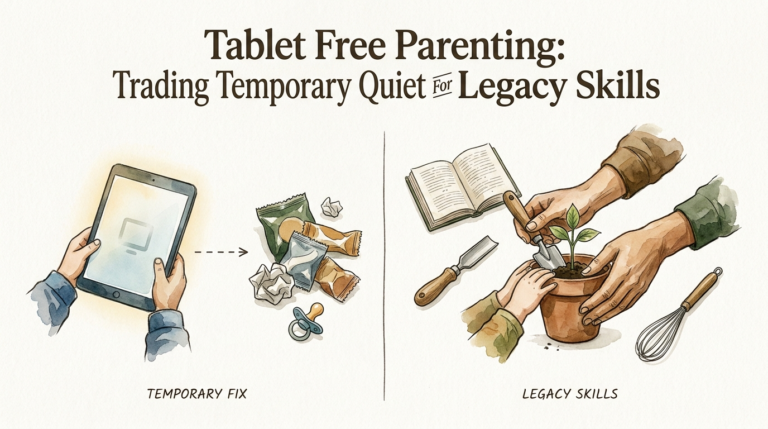
Many parents rely on screens to manage household tasks or take a break. It’s a common trap because it works in the short term. However, this creates a dependency where children lose the ability to entertain themselves independently [1.1.5].
Complexity Overload
Avoid choosing activities that require hours of setup or expensive materials. If a craft is too complex, it becomes a source of stress rather than joy. Stick to simple, “iterative” play where kids can test and try out their own ideas without a rigid set of rules [1.5.5].
Limitations and Realistic Boundaries
Total digital abstinence is rarely the goal for a modern family. There are situations where screens can be beneficial or even necessary.
Educational screen time, when used with parental involvement, can enhance learning in subjects like math and reading [1.1.2]. Video chatting with distant relatives is another widely accepted exception, even for very young children [1.1.2, 1.3.7].
Environmental limitations also play a role. Families in urban areas with limited access to greenspace may find it harder to implement nature-based activities [1.1.1]. In these cases, focus on “indoor camping” or hallway sports to maintain the screen-free spirit [1.2.5].
Comparing Play Types: Tactile vs. Digital
Understanding the fundamental differences between these two modes of play helps you choose the right balance for your family.
| Feature | Tactile / Physical Play | Digital / Screen Play |
|---|---|---|
| Interaction | Embodied and multi-person [1.5.2] | Often solitary and “cocooned” [1.5.4] |
| Attention | Higher focus, fewer distractions [1.5.1] | Fragmented, high stimulation [1.4.7] |
| Physicality | Active movement and sensory engagement | Sedentary with repetitive motions |
| Dopamine | Steady, natural rewards | High-intensity, synthetic loops [1.4.7] |
Practical Tips for Immediate Implementation
Ready to start today? Use these low-barrier ideas to get your family moving.
- The Neighborhood Scavenger Hunt: Create a list of local items to find, like a specific bird, a red door, or a blooming flower [1.2.2].
- Minute to Win It: Use household items for quick challenges, such as seeing how many Cheerios can be stacked on a noodle in 60 seconds [1.2.6].
- Chalk Town: Turn your driveway into a giant canvas. Draw roads, bridges, and parks for kids to navigate with bikes or scooters [1.2.6].
- Family Pizza Night: Let everyone create their own masterpiece in the kitchen. Cooking together is a high-sensory, high-reward activity [1.2.4].
- Living History: Have children interview a grandparent or older neighbor about their life. This builds empathy and social skills without a device in sight.
Advanced Strategies for Long-Term Success
For families who have mastered the basics, consider these ways to deepen the experience.
Independent Activity Cycles
Encourage “child-led, open-ended play.” This involves providing “loose parts”—like cardboard boxes, fabric scraps, or PVC pipes—and letting the children design their own worlds [1.5.3, 1.5.5]. This fosters deep creativity and problem-solving skills that digital games often simplify.
Community Engagement
Look for nature-based community programming. Neighborhoods with strong access to parks and community centers see higher success rates in screen-time reduction [1.1.1]. Joining a local gardening club or a hiking group can provide the social validation that teens often seek on social media [1.4.7].
Teen-Specific Routines
Build routines that meet a teen’s developmental needs for autonomy and mastery. Involve them in meal prep where they choose the recipe, or host “No-Phone Hangouts” with their friends where everyone checks their devices at the door [1.4.7].
Scenario: The Unplugged Weekend Itinerary
How does this look in practice? Here is a sample weekend for a family of four.
Saturday Morning: Visit a local farmers’ market or park. Engage in a “color hunt” where you find objects matching a specific hue in nature [1.2.5].
Saturday Afternoon: Set up a “Solar Oven” using a pizza box and aluminum foil to melt s’mores [1.2.6].
Saturday Evening: Flashlight Tag or Glow Stick Hide-and-Seek in the backyard [1.2.5].
Sunday Morning: Indoor fort building with every pillow and blanket in the house. Add “LEGO furniture” for extra detail [1.2.5].
Sunday Afternoon: A “Counting Walk” through the neighborhood using a click-counter for every tree or squirrel spotted [1.2.2].
Sunday Evening: A structured board game night or a “Minute to Win It” tournament [1.2.6].
Final Thoughts
Digital tools are a permanent part of our landscape, but they don’t have to be the center of our lives. By choosing tactile play, you are giving your family the gift of presence and sensory discovery. These screen-free moments build stronger brains and deeper bonds.
Small changes lead to significant results. Start with a single meal or one afternoon a week. You will likely find that the “biological joy” of real-world play is far more satisfying than any pixel on a screen.
Experiment with these ideas and see what resonates with your family. Whether it’s a messy kitchen experiment or a quiet walk in the woods, the best connections happen when the screens go down and the world comes alive.
Sources
1 childrensdayton.org | 2 macaronikid.com | 3 medlineplus.gov | 4 sanfordhealth.org | 5 substack.com | 6 sparklestories.com | 7 recordablebookbuddy.com | 8 disciplemama.com | 9 wisconsinyouthcompany.org | 10 herviewfromhome.com | 11 curiousneuron.com | 12 afterbabel.com | 13 substack.com | 14 screenagersmovie.com | 15 thekids.org.au | 16 nih.gov | 17 michiganmedicine.org | 18 thegeniusofplay.org | 19 hellopediatrics.com | 20 childrenandnature.org