Digital Achievements Vs Real World Skills
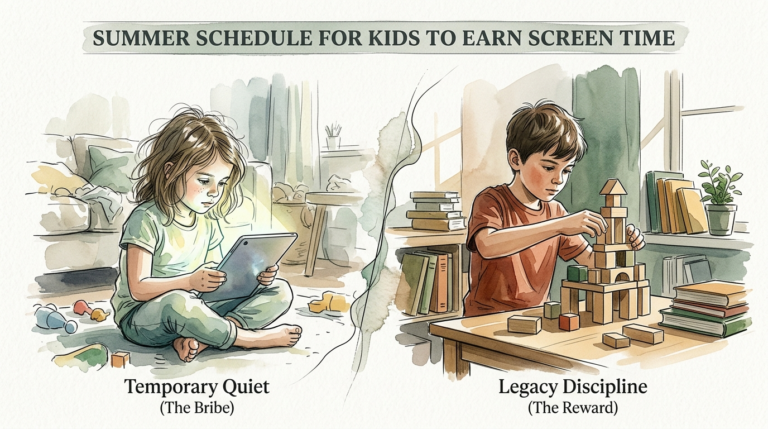
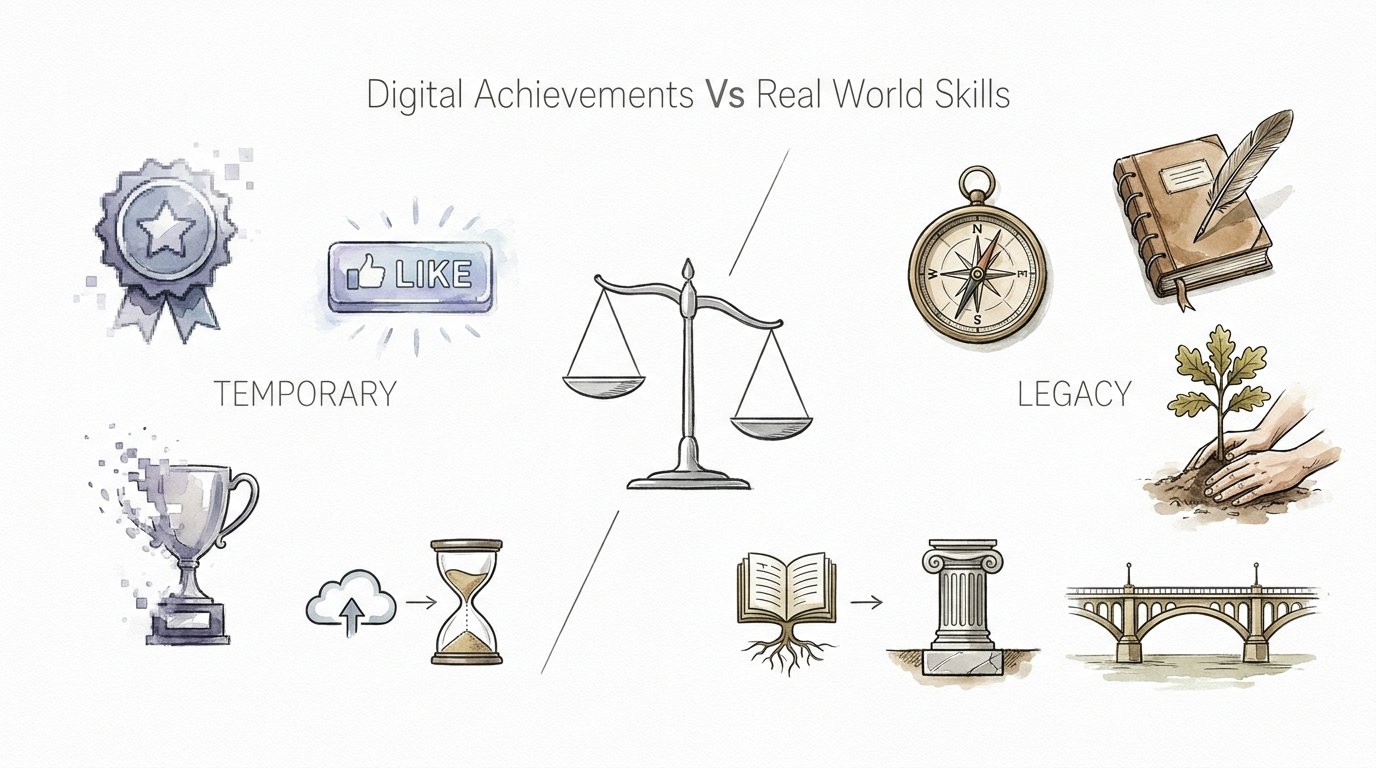
When they value digital inventory more than their own physical creations, the balance has shifted. We’ve traded the thrill of real-world mastery for the hollow pings of digital achievement. If your child can navigate a complex app but doesn’t know how to use a hammer or a needle, it’s time to trade temporary pixels for a lasting legacy.
We are living through a grand neurological experiment. Every swipe and every “level up” sends a rush of dopamine through our systems. Yet, we often feel more empty than ever after a day spent conquering virtual worlds. This is because we are designed for the physical. Our brains evolved to interact with three-dimensional space, resistance, and raw materials.
Transitioning back to tangible skills isn’t just a hobby. It is a fundamental reclaim of human capability. It is the difference between owning a skin in a video game and owning the ability to build a shelter or mend a garment. One is a temporary lease on a server; the other is a permanent upgrade to your personhood.
Digital Achievements Vs Real World Skills
Digital achievements are structured reward systems designed to keep users engaged through variable ratio reinforcement. These include badges, “streaks,” and virtual currency. They exist to simulate the feeling of progress. In contrast, real-world skills are the physical and cognitive abilities required to manipulate the environment. Think of woodworking, gardening, or basic home repair.
Virtual rewards mimic the brain’s “seeking system.” Research shows that dopamine spikes more during the pursuit of a digital goal than at the moment of achievement. This creates a “hedonic hamster wheel” where you are constantly chasing the next notification. Real-world skills offer a different neurochemical cocktail. They provide a sense of “effectance”—the deep satisfaction of seeing your direct impact on the physical world.
We see this divide in the workforce today. While 90% of high-skilled job postings now require advanced digital literacy, there is a massive decline in manual dexterity. Many “digital natives” can code a website but struggle to use a manual screwdriver without stripping the screw. This creates a dependency on external systems for every basic need, from food to shelter.
The Dopamine Trap: How Virtual Rewards Reshape the Brain
Understanding how digital rewards work requires a look at the striatum. This is the part of the brain responsible for motivation and reward. Digital platforms exploit “Reward Prediction Error.” When a reward is unexpectedly high—like a post going viral or a rare loot drop—dopamine neurons fire in a burst. This reinforces the behavior, making you crave more.
Physical tasks work on a “delayed gratification” model. You cannot “swipe” a garden into existence. You have to prepare the soil, plant the seeds, and wait for the sun. This process builds executive function and patience. Digital environments, however, favor immediate gratification. This can lead to a “dopamine deficit state” where natural, slow-moving rewards no longer feel satisfying.
To break this cycle, you must understand “digital friction.” In the digital world, friction is removed. Everything is one-click. In the physical world, friction is the teacher. The resistance of wood against a saw or the tension of a thread tells your brain about the material. This sensory feedback is what builds genuine neural pathways.
Benefits of Physical Mastery
Developing manual skills offers measurable neurological benefits. Hand-eye coordination exercises strengthen the right hemisphere of the brain. This is the area responsible for spatial awareness, imagination, and holistic thinking. When you use your hands, you aren’t just making an object. You are building a more resilient nervous system.
One major advantage is cognitive longevity. Studies from the National Institutes of Health suggest that manual dexterity is a key biomarker for neurological health. People with high grip strength and fine motor control often show slower rates of cognitive decline as they age. Your hands are literally the extension of your brain’s health.
Physical mastery also fosters independence. When you know how to repair your own tools or grow your own food, you are less vulnerable to supply chain disruptions or economic shifts. This is the “legacy” aspect. A digital achievement disappears when the server goes down. A physical skill stays with you for life and can be taught to the next generation.
Challenges of Shifting Focus
The biggest challenge is the “convenience culture.” We have evolved to prefer the path of least resistance. It is much easier to order a replacement on an app than it is to learn how to fix the broken item. This “replacement vs. repair” mentality has led to a massive loss of traditional knowledge.
Another pitfall is the “perfectionism” barrier. In a digital world, an “undo” button exists. Physical materials don’t have an undo button. A miscut piece of wood is a wasted piece of wood. This can be intimidating for those used to the safety of digital environments. Many people quit physical hobbies because they cannot achieve “Instagram-ready” results in their first hour.
Common mistakes include:
- Attempting complex projects without mastering basic tool safety.
- Buying expensive equipment before developing the fundamental skill.
- Prioritizing the “look” of the finished product over the “learning” of the process.
- Failing to set boundaries on screen time, which drains the mental energy needed for physical work.
Limitations of Physical Skills
Physical mastery has realistic constraints. It requires space, time, and often a financial investment in materials. You cannot “download” wood or steel. You must acquire it, store it, and deal with the waste it produces. This makes physical skills less “scalable” in the short term compared to digital ones.
Environmental limitations also play a role. You can code in the dark or in a small apartment. You cannot easily forge iron or run a table saw in a high-rise without significant specialized infrastructure. There is also a physical risk. Manual work involves sharp edges, heavy weights, and high temperatures. This requires a level of attention and safety discipline that digital tasks do not demand.
Finally, there is the “maintenance” factor. Physical skills require regular practice to keep the muscles and neural pathways sharp. If you don’t use a hammer for ten years, your aim will suffer. Digital skills, while they change fast, often rely on interfaces that remain somewhat intuitive once learned.
Comparison: Virtual Inventory vs. Physical Legacy
| Feature | Digital Achievement | Real-World Skill |
|---|---|---|
| Ownership | Conditional (Server-dependent) | Absolute (Personal Mastery) |
| Dopamine Type | High-Intensity / Short-Lived | Steady-State / Sustained |
| Resilience | Low (Useless in power outage) | High (Always accessible) |
| Brain Impact | Neural Hijacking / Focus Loss | Neuroplasticity / Cognitive Health |
Practical Tips for Building Real-World Skills
Start with “low-stakes” physical interaction. This is especially important for children and adults who have spent years in high-stimulus digital environments. You need to “re-sensitize” your brain to natural rewards.
- Embrace the “Manipulative”: Use physical tools that require fine motor control. For kids, this means playdough, LEGOs, or sewing kits. For adults, this might be restoring an old hand plane or learning to tie complex knots.
- Implement a “Dopamine Fast”: Set specific hours where all digital devices are off. Use this time only for physical work. This allows your baseline dopamine levels to reset, making the “slow” progress of manual work feel more rewarding.
- Follow the “One-In, One-Fixed” Rule: For every new thing you buy, commit to fixing something else that is broken. This forces you to engage with the mechanics of the objects in your life.
- Use “Hybrid Learning”: It is okay to use YouTube to learn a skill, but you must “do” while you “view.” Don’t just watch a woodworking video; have the wood in front of you and match the movements in real-time.
Neuroplasticity and the Artisan
Serious practitioners know that manual mastery is a form of moving meditation. When you enter a “flow state” during physical work, your brain’s prefrontal cortex partially shuts down. This reduces self-criticism and allows for peak performance. This state is harder to achieve in digital environments because of constant notifications and “multi-tasking” urges.
To scale your skills, focus on “transferable principles.” Learning how to sharpen a chisel will teach you about the physics of an edge, which then applies to kitchen knives, lawnmower blades, and scissors. This “principle-based” learning is what builds a legacy of knowledge rather than a collection of “hacks.”
Advanced practitioners should also consider “tactile memory.” Your fingers have a form of intelligence. Once you have hammered ten thousand nails, your body knows the angle and force required without your conscious mind needing to intervene. This “embodied cognition” is a level of human functioning that digital interfaces can never replicate.
From Screen to Shop: Real-World Scenarios
Consider the case of a teenager who is an expert in a farming simulation game. They know the optimal crop rotations and market prices within the code. However, when given a real seed and a patch of dirt, they may fail because they don’t “feel” the moisture level of the soil or recognize the sign of a pest.
The transition happens when that teenager starts a small “container garden.” They move from clicking a button to “watering.” They deal with the frustration of a plant dying and the thrill of the first harvest. This physical feedback loop builds a completely different set of neural connections than the game.
Another scenario involves home maintenance. Instead of calling a professional for a simple leaky faucet, an individual uses a wrench to take the handle apart. They see the worn-out O-ring. They feel the metal-on-metal contact. The moment the leak stops after they tighten the nut, they have achieved a real-world “level up” that actually saves them money and increases their property value.
Final Thoughts
The shift from digital inventory to physical legacy is a journey back to our roots. Digital achievements have their place—they are efficient and entertaining. But they cannot be the foundation of a meaningful life. When we neglect our hands, we neglect a massive portion of our cognitive potential.
Building real-world skills is an act of rebellion against a world that wants you to be a passive consumer. Every time you pick up a needle or a hammer, you are taking a step toward independence. You are choosing a lasting legacy over a temporary pixel.
Start today. Find one thing in your house that is broken and try to understand how it works. Put the phone in another room. Let your hands do the talking. You might be surprised at how much your brain has been waiting for this moment.
Sources
1 utopia-the-edit.ie | 2 psychologytoday.com | 3 netpsychology.org | 4 edutopia.org | 5 jpost.com | 6 makerkids.com | 7 youtube.com | 8 visuerlab.com | 9 nih.gov | 10 colorado.edu | 11 pinnacleblooms.org | 12 substack.com