Best Pretend Play Toys For Language Development
When the toy stops talking, the child finally starts thinking. In the 90s, our dolls were silent, so we had to give them a soul. Today, toys come with 50 pre-programmed phrases that actually rob our children of the chance to develop their own narrative voice. When a toy performs for the child, the child becomes an audience member instead of a creator. Here is why the ‘silent’ version leads to a 3x increase in complex vocabulary.
Language development isn’t about how many buttons a child can push. It is about the back-and-forth dance of human connection. When we hand a toddler a plastic phone that sings the alphabet, we think we are teaching them. In reality, we are often silencing the very interaction that builds a robust brain.
This article dives deep into why “boring” toys are actually the most sophisticated tools for growth. We will explore the science behind pretend play and how you can transform simple objects into a masterclass in communication. By the end, you will know exactly which toys deserve a spot in your playroom and which ones should stay on the shelf.
Best Pretend Play Toys For Language Development
The best tools for language development are open-ended toys. These are items that do not have a pre-defined “end” or a single way to play. Think of a wooden block versus a battery-operated robot. The block can be a phone, a piece of cheese, or a mountain. The robot is always just a robot.
In the real world, these toys act as a blank canvas for a child’s imagination. Speech-language pathologists prioritize these because they require the child to “generate” the language rather than just “consuming” it. When a child plays with a silent doll, they have to decide if the doll is hungry, tired, or excited. This decision-making process is where complex vocabulary is born.
Common examples of these powerhouses include dollhouses, play kitchens, animal figurines, and toolkits. They exist in every culture and have been the cornerstone of development for centuries. They allow children to rehearse real-world situations, like going to the doctor or ordering at a cafe, in a safe and low-pressure environment.
The Power of Figurines and Small Worlds
Small world play involves using miniature figures like animals, people, or vehicles. These toys are incredibly effective because they allow children to take a “God’s-eye view” of social interactions. They can manipulate the characters to resolve conflicts or practice polite greetings.
A simple farm set is a classic example. Instead of a farm that “moos” when you press a button, a silent farm requires the child to make the sound. This active participation reinforces the link between the object and the vocalization. It also encourages the use of prepositions like “in,” “on,” and “under” as the child moves animals around the barn.
How It Works: The Mechanics of Verbal Play
Pretend play works by stimulating the symbolic function of the brain. Around eighteen months, children begin to understand that one thing can represent another. A banana becomes a telephone; a cardboard box becomes a rocket ship. This is the same mental leap required for reading, where a squiggle on a page represents a sound.
The process of building language through play follows a specific sequence. First, the child engages in functional play, like pushing a car. Then comes symbolic play, where they make the car “go to work.” Finally, they reach sociodramatic play, where they take on roles and follow a complex narrative. Each stage requires more advanced linguistic structures.
Modeling and Expansion Techniques
You can accelerate this process through two key techniques: modeling and expansion. If a child says “Car go,” you don’t just nod. You expand it to “Yes, the blue car is going fast!” This adds adjectives and correct grammar without correcting the child directly. It provides a “linguistic scaffold” that they can climb when they are ready.
Self-talk is another vital strategy. This involves narrating your own actions during play. “I am stirring the soup. It’s very hot! I need to blow on it.” This constant stream of relevant, context-rich language is exactly what the developing brain craves. It links verbs to actions in real-time, making the vocabulary “sticky.”
Benefits of Silent, Open-Ended Play
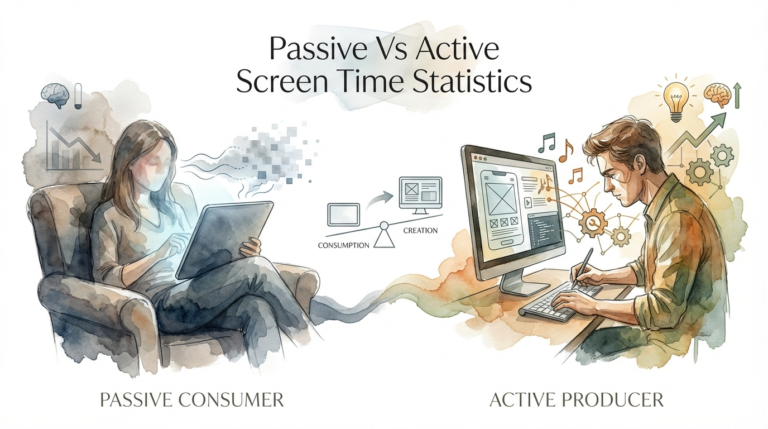
The most significant benefit is the massive increase in “conversational turns.” Research from Northern Arizona University found that when playing with electronic toys, parents spoke less, responded less, and used fewer content-specific words. In contrast, books and traditional toys more than tripled the use of animal names, colors, and spatial concepts.
Another advantage is the development of executive function. Because there are no pre-set rules, the child must plan the play. They have to decide what happens next, hold that idea in their working memory, and adjust when things “go wrong” in the story. This is the ultimate training ground for problem-solving and focus.
- Increased Vocabulary: Children use a wider variety of nouns and verbs when they aren’t restricted by a toy’s script.
- Better Social Skills: Acting out roles helps children understand different perspectives and empathy.
- Emotional Regulation: Play allows kids to process scary or new experiences, like a first haircut or a doctor’s visit.
- Grammar Mastery: Natural conversation during play exposes children to complex sentence structures they won’t hear from a talking toy.
Challenges and Common Mistakes
The biggest challenge is the “Educational Label” trap. Many electronic toys are marketed as “language boosters” or “brain builders.” Parents often buy these with the best intentions, thinking the toy will teach the child. However, the toy often ends up doing the work for the child, leading to passive entertainment rather than active learning.
Another mistake is over-directing the play. It is tempting to take over and show the child the “right” way to use a toy. When we do this, we shut down their creative engine. The child stops thinking about what *they* want to do and starts trying to figure out what *you* want them to do. This shifts the focus from communication to compliance.
Excessive noise is a practical pitfall. Battery-operated toys are often loud and repetitive. This can lead to sensory overload for the child and “parental burnout” for the adult. When the environment is too noisy, it is harder for the child to hear the nuances of human speech, which are essential for learning phonetics and tone.
Limitations: When High-Tech Has a Place
It is important to maintain a balanced perspective. Electronic toys are not “evil,” but they are often misused. They can be excellent tools for short-term entertainment, such as during a long car ride or a doctor’s waiting room. In these moments, their goal is distraction, not necessarily language education.
For children with specific developmental needs, certain electronic devices serve as essential communication aids. Augmentative and Alternative Communication (AAC) devices are high-tech, but they are designed to give the child a voice, not to replace it. These are exceptions where technology is a bridge to interaction rather than a barrier.
Budget and space are also realistic constraints. You do not need a massive playroom filled with expensive wooden toys. A simple collection of high-quality, versatile items is better than a room full of specialized gadgets. Focus on “multipurpose” over “niche.”
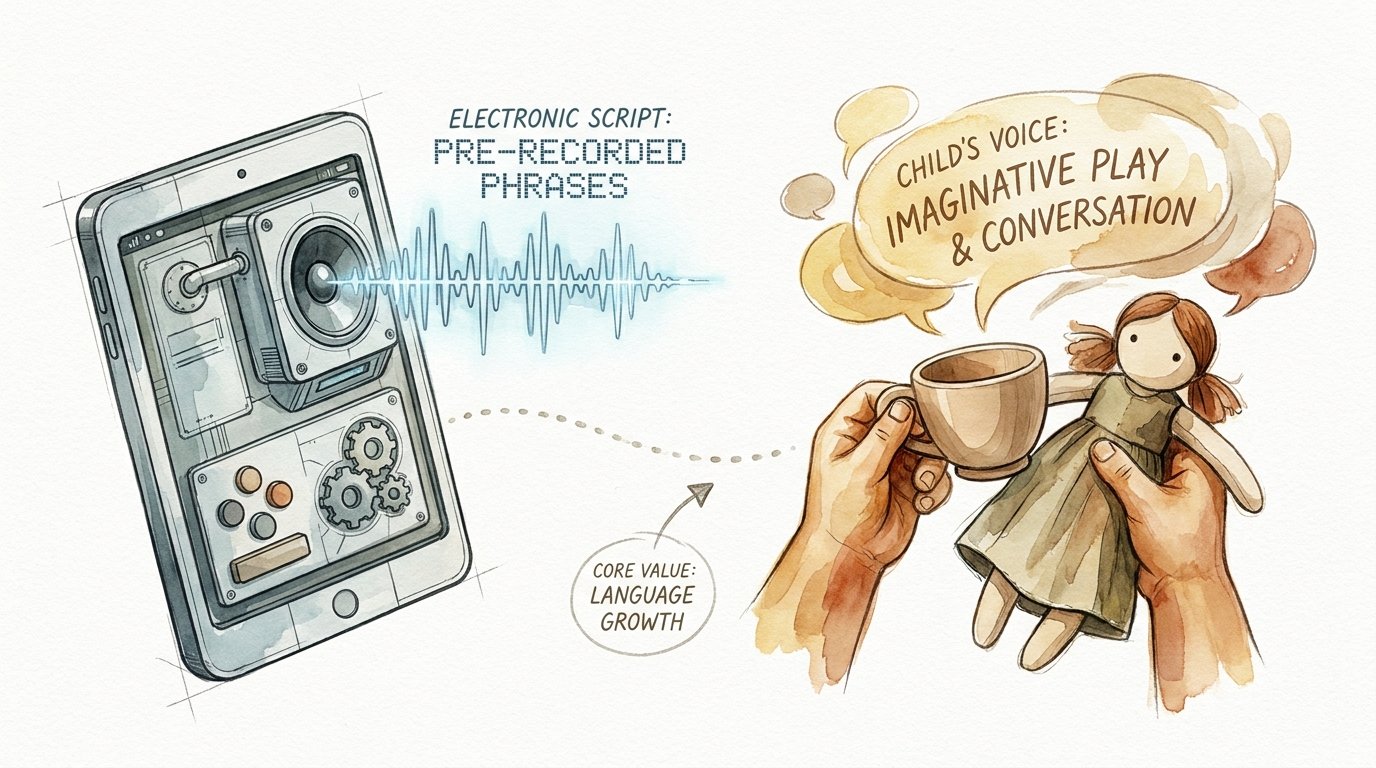
Comparison: Electronic Script vs. Child’s Voice
The difference between a “talking” toy and a “silent” toy is best understood by looking at who is in control of the narrative. The following table highlights how these two approaches impact the play environment.
| Feature | Electronic Script (Talking Toys) | Child’s Voice (Traditional Toys) |
|---|---|---|
| Primary Narrator | The Toy | The Child |
| Parental Involvement | Passive / Sideline | Active / Collaborative |
| Vocabulary Range | Fixed / Repetitive | Dynamic / Infinite |
| Cognitive Load | Low (Consumption) | High (Creation) |
| Attention Span | Short-term novelty | Long-term engagement |
Practical Tips for Language-Rich Play
To maximize language development, you need to change how you interact with the toys. The toy is just a prop; you are the catalyst. Start by getting down on the child’s level—physically. Being eye-to-eye makes communication more natural and allows the child to see your mouth movements.
Follow the “One-Up” rule. If your child is using single words, you respond with two-word phrases. If they use two words, you respond with three. This keeps the language level just slightly above their current ability, providing a clear path for growth without causing frustration.
- Narrate the “Quiet”: If the child is focused on a task, describe what they are doing. “You are putting the red block on top!”
- Use Wait Time: After asking a question or starting an action, wait 5–10 seconds. Give the child’s brain time to process and formulate a response.
- Ditch the Batteries: If a toy has an “off” switch, use it. See how the play changes when the toy stops performing.
- Focus on Verbs: Nouns are easy to learn. Verbs (running, eating, sleeping) are the engines of sentences. Use toys to act out these actions vividly.
Advanced Considerations: Scaling for Age
As children grow, their play should become more complex. For toddlers (1–2 years), focus on functional actions and simple labeling. For preschoolers (3–5 years), move into “thematic play.” This involves creating entire scenarios with a beginning, middle, and end.
You can introduce “decontextualized language” during this stage. This means talking about things that aren’t happening right now. For example, while playing with a toy kitchen, you might say, “Remember when we went to the real bakery and saw the big oven?” This links play to memory and future planning, which are high-level linguistic skills.
Consider the “90/10” rule for toy selection. A great toy should be 10% toy and 90% child. If the toy does 90% of the work—singing, dancing, and talking—the child is only left with 10% of the opportunity to learn. Reversing this ratio is the secret to long-term developmental success.
Examples of Language Growth in Practice
Let’s look at a realistic scenario involving a classic wooden train set. In a “low-language” environment, a child might just watch a motorized train go around a track. There is little reason for them to speak or for the parent to intervene.
In a “high-language” environment using a manual train set, the parent and child collaborate. The child says “Go!” and the parent responds, “The train is going over the bridge! Choo choo!” The child then picks up a cow figurine and says “Moo.” The parent expands: “Oh, the cow is waiting for the train. Stop, train! The cow needs to cross the tracks.”
In this second scenario, the child has used an imperative (Go), a sound effect (Moo), and observed complex concepts like “over,” “waiting,” “stop,” and “cross.” The absence of a motor forced the child to be the driver, the conductor, and the storyteller. This is where the 3x vocabulary increase actually happens.
Final Thoughts
The most powerful “educational” tool in your home doesn’t require an outlet or a charging cable. It is your own voice and the space you create for your child to find theirs. When we choose silent, open-ended toys, we are telling our children that their ideas are more interesting than a pre-recorded chip.
Transitioning away from flashy gadgets might feel strange at first. You might worry that your child will be bored. But boredom is often the precursor to creativity. It is the moment when the child stops waiting to be entertained and starts looking for ways to entertain themselves. That shift is where the real magic of language begins.
Start small. Take one battery-operated toy out of rotation this week and replace it with a set of blocks or some old hats for dress-up. Observe how the conversation changes. You will likely find that when the toy stops talking, your child finally has something to say.
Sources
1 mdsearchlight.com | 2 pathways.org | 3 cornerstonetherapy.co.nz | 4 habausa.com | 5 allisonfors.com | 6 everydaylanguageco.com | 7 speechietrish.com | 8 iu.edu | 9 ctdpediatrictherapy.com | 10 abcpediatrictherapy.com | 11 expressable.com | 12 cstacademy.com | 13 enablrtherapy.com | 14 substack.com | 15 queensletters.com