
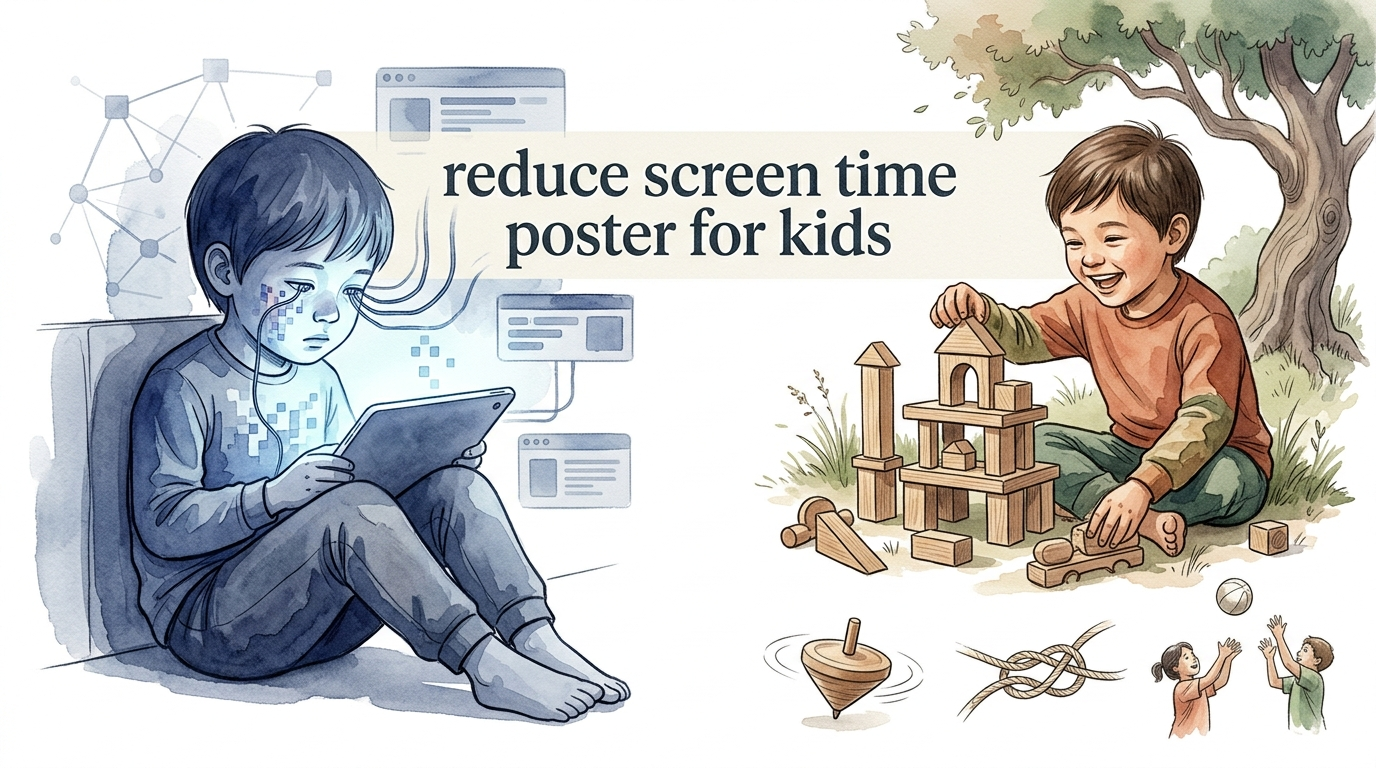
reduce screen time poster for kids
Are we raising children or consumers? The difference is in what their hands are doing. Modern screens provide simulation; ancestral play provides stimulation. Use this visual guide to help your kids trade the blue light for the bright light of real-world discovery.
Most parents feel the weight of the digital age every time a tablet glows in a dark room. You want your child to be savvy, but you also want them to be present. You want them to have the skills of the future without losing the grit of the past. This tension is where the “Modern Digital Trance” meets “Ancestral Hand-Eye Play.”
Getting a handle on screen time isn’t about being a luddite. It is about being an architect of your child’s environment. When you change what they see, you change what they do. A visual roadmap—a physical poster on the wall—can be the boundary that saves your afternoon from another digital meltdown.
reduce screen time poster for kids
A reduce screen time poster for kids is a visual anchor that translates abstract household rules into concrete, actionable steps. It serves as a permanent, non-negotiable “referee” in the home. Instead of you being the “bad guy” who says no, the poster becomes the standard that governs the day.
These posters usually take one of four forms: The Checklist, The Menu, The Swap, or The Agreement. The Checklist requires children to complete “real-world” tasks like making their bed or reading for 20 minutes before they can ask for a device. The Menu provides a list of screen-free alternatives when a child says, “I’m bored.” The Swap allows kids to “earn” minutes through chores or physical play. The Agreement is a signed contract between parent and child that outlines the “how, when, and where” of digital use.
In the real world, these posters act as externalized prefrontal cortexes. Since children’s brains are still developing the ability to regulate impulses, they need a physical reminder of the boundaries. A poster hanging on the refrigerator or the playroom door provides a visual cue that interrupts the automatic “grab the iPad” habit loop. It moves the decision-making process from a power struggle between parent and child to a predictable system.
How to Implement a Screen-Free Visual System
Creating a system that actually sticks requires more than just tape and paper. You have to build a bridge from the high-stimulation digital world back to the slower, richer physical world.
First, conduct a “Digital Audit” of your week. Note when the most friction occurs. Is it Saturday morning? Is it the transition after school? Identify these “danger zones” and design your poster to address them specifically. If mornings are the struggle, your poster should be a “No Screens Until…” checklist that includes breakfast, dressing, and one creative task.
Second, involve your children in the creation process. Research shows that children are more likely to follow rules they helped design. Ask them what they enjoy doing when they aren’t on a screen. If they love LEGOs, drawing, or climbing trees, make sure those are the “hero” activities on the poster.
Third, establish the “Dopamine Bridge.” Moving from a high-dopamine activity like a video game to a low-dopamine activity like cleaning a room is physically painful for a child’s brain. Use your poster to suggest a “medium-stimulation” transition activity, such as listening to an audiobook or doing five minutes of jumping jacks. This helps the brain recalibrate without a total emotional crash.
Finally, be consistent with the “Check-In” phase. The poster only works if the consequences and rewards are followed. If the rule is “No Minecraft until the dog is walked,” do not bend. The visual system depends entirely on its predictability.
Benefits of Returning to Real-World Discovery
Trading the blue light for the bright light offers measurable physiological and psychological advantages. The most immediate benefit is the restoration of the circadian rhythm. Blue light from screens suppresses melatonin more aggressively in children than in adults. By following a “Power Down” poster that starts 60 to 90 minutes before bed, you allow your child’s brain to enter its natural sleep-prep state.
Physical play also builds “Ancestral Hand-Eye” skills that a glass screen cannot replicate. When a child builds a fort or plays catch, they are engaging in three-dimensional spatial reasoning. They are learning about gravity, tension, and torque in a way that a physics simulator cannot teach. This “bottom-up” learning builds a more robust neural foundation for complex problem-solving later in life.
Emotional regulation is the third pillar of benefit. Real-world play involves frustration that doesn’t end with a “Reset” button. If a tower of blocks falls, the child has to manage that disappointment and try again. This builds “grit”—the ability to persist through boredom or failure. Digital environments often remove this friction, which can leave children ill-equipped for the “un-gamified” challenges of real life.
Challenges and Common Pitfalls
The biggest challenge is the “Dopamine Withdrawal.” When you first implement a screen-reduction poster, expect resistance. A child’s brain has been conditioned to expect a certain level of constant, easy stimulation. When that is removed, they may experience irritability, boredom, or even aggression. This isn’t “bad behavior”; it is a physiological response to a drop in dopamine.
Another pitfall is the “Parental Hypocrisy” trap. If the poster says “No Screens at the Table,” but you are checking your email during dinner, the system will fail. Children are expert observers of adult behavior. To make the poster effective, the “Screen-Free Zones” must apply to everyone in the house.
Overscheduling the “Alternatives” is also a common mistake. Sometimes parents fill the “Screen-Free Menu” with so many structured activities that the child never learns how to be bored. Boredom is the precursor to creativity. A good poster should leave space for “Unstructured Free Play,” where the child has to invent their own fun.
Limitations of the Poster Method
A poster is a tool, not a cure-all. It cannot compete with a genuinely addictive app design if the child is left entirely unmonitored. Some digital environments are engineered by thousands of designers to be “sticky.” A piece of paper on the wall is a weak defense against a billion-dollar algorithm if you don’t also have technical safeguards in place.
Furthermore, posters may not be ideal for children with certain neurodivergencies who require more dynamic or sensory-rich transitions. A child with severe ADHD might find a static checklist overwhelming or easy to ignore. In these cases, the “poster” might need to be paired with a physical timer or a “token economy” where they move a physical object to mark completion.
Finally, environmental limitations matter. If you live in a place where outdoor play is restricted by weather or safety, your “Alternatives Menu” needs to be much more robust and indoor-focused. You cannot simply tell a child to “go outside” if there is nowhere safe to go. The system must be adapted to your specific reality.
Simulation vs. Stimulation: The Play Matrix
Understanding the difference between digital simulation and ancestral stimulation helps you choose better activities for your poster.
| Feature | Digital Simulation (Screen) | Ancestral Stimulation (Real-World) |
|---|---|---|
| Feedback Loop | Instant, high-dopamine rewards. | Delayed, effort-based satisfaction. |
| Physical Effort | Minimal (fingers/thumbs). | Full-body engagement and muscle use. |
| Spatial Input | 2D plane; fixed focal length. | 3D environment; variable depth. |
| Creativity | Bound by the programmer’s rules. | Open-ended; limited only by imagination. |
Practical Tips for a Screen-Reduced Home
Start small. Do not try to go from six hours of screen time to zero in one day. Focus on winning one “territory” at a time. For instance, declare the “Dinner Table” and the “Bedroom” as permanent screen-free zones. Use your poster to reinforce these specific boundaries first.
Invest in “High-Friction” storage. Keep tablets and consoles in a drawer or a closet, rather than out on the coffee table. The more physical steps a child has to take to get to the device, the more “stop-and-think” time their brain has to process the rules on the poster.
Use “Audio Bridges.” If your child is used to constant visual stimulation, the silence of a screen-free house can be jarring. Audiobooks, podcasts for kids, or music can provide a “layer” of stimulation that doesn’t involve the addictive blue light of a screen. This is a great transition tool to include on your poster’s “Alternatives” list.
Advanced Considerations for Long-Term Success
For parents looking to go deeper, understand the difference between “Consumer” activities and “Creator” activities. Not all screen time is equal. An hour spent learning to code or editing a video is vastly different from an hour of passive scrolling. Your poster can reflect this by allowing more time for “Creative Digital Work” while strictly limiting “Passive Consumption.”
Consider the “Outdoor Light Quota.” Studies suggest that exposure to natural morning light helps reset the internal clock and improves mood. You might add a rule to your poster that requires 20 minutes of “sunlight exposure” before any digital device can be used. This aligns the child’s biology with the natural world before they enter the digital one.
Finally, think about the “Digital Shadow.” This is the data and footprint our children leave behind. By reducing screen time, you aren’t just protecting their eyes and brains; you are protecting their privacy. Use the poster as a jumping-off point to talk about why we value “real-world” time—it’s the only time that isn’t being tracked and sold.
Scenario: The Saturday Morning Transition
Imagine it is 7:00 AM on a Saturday. In the old routine, the kids would grab their tablets and sit on the couch for three hours. In the new routine, they walk into the kitchen and see the “Saturday Morning Rules” poster.
The poster says: “No screens until: 1. Breakfast is finished. 2. Pyjamas are off. 3. One ‘Nature Task’ is done (water the plants or check the bird feeder).”
The children follow the checklist. While watering the plants, they notice a new leaf or a bug. This sparks a question. That question leads to a book or a drawing. By the time they have “earned” their screen time, the “Digital Trance” has been broken by the “Ancestral Discovery” of the real world. They may still want the screen, but the desperation is gone.
Final Thoughts
Reducing screen time is not a battle against technology; it is a campaign for your child’s attention. A visual poster provides the structure they need to navigate a world that is designed to keep them hooked. By making the rules clear, visual, and consistent, you remove the friction of daily arguments and replace it with a system of shared expectations.
The goal is to move from a state of passive consumption to one of active creation. Whether they are building with blocks, climbing trees, or drawing in a notebook, every minute spent away from the screen is a minute spent building the neural pathways of a creator. Use these tools to give your children the gift of a world that is felt with the hands, not just seen with the eyes.
Start today by printing or drawing your first simple checklist. Place it where it can’t be missed. Watch as the house shifts from the quiet hum of digital consumption to the vibrant noise of real-world discovery.
Sources
1 nih.gov | 2 peaceathomeparenting.com | 3 clevelandclinic.org | 4 aap.org | 5 otdude.com | 6 childrensmn.org | 7 kidsfirstpediatrics.com | 8 curiousneuron.com | 9 yourmodernfamily.com


One Comment