screen free evenings
Is your evening screen habit stealing your tomorrow?
Screens are a drain on your cognitive battery. A screen-free evening is the ultimate fuel for a high-performance morning.
You might feel like you are winding down when you scroll through social media or binge-watch a series. In reality, you are engaging in a high-intensity cognitive tax that your brain has to pay for the next day.
This guide will show you how to trade the midnight drain for morning fuel. We will explore why stepping away from the glow of your devices is the single most effective way to reclaim your focus, energy, and sleep.
screen free evenings
A screen-free evening is a deliberate period before sleep where you eliminate all interaction with digital devices. This includes smartphones, tablets, laptops, and televisions. It is not just about turning off the lights; it is about turning off the stream of incoming data that keeps your brain in a state of high alert.
In our modern world, we use screens for everything from grocery shopping to navigation. However, the human brain was not designed to process rapid-fire visual stimulation and artificial blue light right before resting. When you practice a screen-free evening, you are essentially creating a “digital sunset.” You are mirroring the natural world where light fades, signaling to your body that it is time to recover.
Think of your brain like a high-performance engine. If you keep it revving at 5,000 RPMs until the second you turn the key off, the components wear down faster. A screen-free evening allows the engine to idle down naturally. It provides the space needed for your central nervous system to shift from “fight or flight” mode into “rest and digest” mode.
How to Implement a Digital Sunset Protocol
Transitioning to a screen-free lifestyle doesn’t happen by accident. You need a system that removes the friction of choice. If you have to decide to put your phone away every night, you will eventually lose to the dopamine-driven design of your apps.
Set a Hard Cut-Off Time
Start by choosing a time at least 60 to 90 minutes before you intend to sleep. This is your point of no return. Once the clock hits this time, all devices go into a charging station located outside of the bedroom.
Create an Environmental Trigger
Your environment should help you succeed. When the screens go off, change the lighting in your home. Dim the overhead lights and switch to warm, amber-toned lamps. This visual shift acts as a physical cue to your brain that the “active” part of the day is over.
Replace the Input
Nature hates a vacuum. If you just take away the phone, you will feel restless. You must replace screen time with low-stimulation analog activities. Consider these options:
- Reading a physical book or a dedicated e-reader with no backlight.
- Journaling or writing out your “to-do” list for the next day to clear mental clutter.
- Light stretching or mobility work to release physical tension.
- Engaging in a hobby like drawing, building models, or playing a musical instrument.
Use Technology to Fight Technology
If you struggle with willpower, use built-in features like “App Timers” or “Screen Time” limits. You can set your phone to automatically lock social media apps or enter “Do Not Disturb” mode at your designated cut-off time. This adds a layer of friction that makes it harder to mindlessly pick up the device.
The Biological and Cognitive Benefits
The advantages of cutting out screens aren’t just psychological; they are deeply biological. Research shows that even small changes in evening habits can lead to massive gains in productivity and health.
Melatonin Production and Sleep Quality
Your brain produces melatonin, the sleep hormone, in response to darkness. The blue light emitted by screens is specifically tuned to mimic sunlight. This tricks your brain into thinking it is midday. By removing screens, you allow melatonin to rise naturally. Studies have shown that every hour of screen use after bedtime can increase the chance of insomnia symptoms by nearly 60%.
Reduced Cortisol and Anxiety
Most digital content is designed to be stimulating or stressful. Whether it is a work email or a breaking news headline, screens keep your cortisol levels elevated. A screen-free evening lowers these stress hormones. This leads to a lower resting heart rate and a more peaceful transition into sleep.
Cognitive Recovery and Executive Function
When you sleep without the interference of blue light, you spend more time in deep sleep and REM cycles. This is when your brain “cleans” itself, removing metabolic waste and consolidating memories. High performers who unplug at least 30 minutes before bed have been shown to make 18% fewer reactive decisions the following day.
Improved Social Connection
Screens often act as a barrier between you and the people in your home. By removing the devices, you open up the opportunity for real conversation and presence. This strengthens relationships and provides a sense of emotional security that digital likes can never replicate.
Common Pitfalls and How to Avoid Them
Even with the best intentions, it is easy to slip back into old habits. Recognizing these pitfalls is the first step to staying on track.
The “One More Video” Trap
Algorithms are designed to keep you watching. You might tell yourself you’ll only watch one YouTube clip, but before you know it, an hour has passed. The solution is to never start the first video. Treat the cut-off time as an absolute rule rather than a suggestion.
Using TV as a “Sleep Aid”
Many people believe they need the TV on to fall asleep. In reality, the flickering light and changing audio levels prevent you from reaching the deepest stages of rest. If you need background noise, switch to a dedicated white noise machine or a fan. These provide consistent sound without the disruptive light.
The Bedroom Charging Station
If your phone is on your nightstand, you will check it. It is almost a reflex. Move your charger to the kitchen or a hallway. Use a traditional alarm clock if you are worried about waking up on time. Removing the temptation entirely is more effective than trying to resist it.
Work-from-Home Bleed
When your office is your living room, work can easily spill into your evening. Establish a “shut down” ritual. Close your laptop, put away your work notebooks, and physically change your clothes to signal that the workday is officially over.
Limitations: When This May Not Be Ideal
While the benefits are clear, there are situations where a strict screen-free evening is difficult to maintain.
Shift Workers and Emergency Responders
If you work night shifts or are “on call,” your schedule is dictated by external factors. In these cases, you might not be able to have a full 90-minute blackout. For these individuals, using blue-light-blocking glasses and minimizing screen brightness is a necessary compromise.
High-Stress Deadlines
Occasionally, a project may require late-night work. The key is to make this the exception rather than the rule. If you must use a screen late at night, try to use high-contrast “dark mode” settings and take frequent breaks to look away from the display.
Initial Boredom and Withdrawal
For the first few nights, you might feel incredibly bored or even anxious. This is a common reaction to dopamine withdrawal. Your brain is looking for the quick “hits” it gets from notifications. It is important to push through this phase. Usually, after 4 or 5 days, your brain adjusts, and the “quiet” of a screen-free evening becomes enjoyable rather than frustrating.
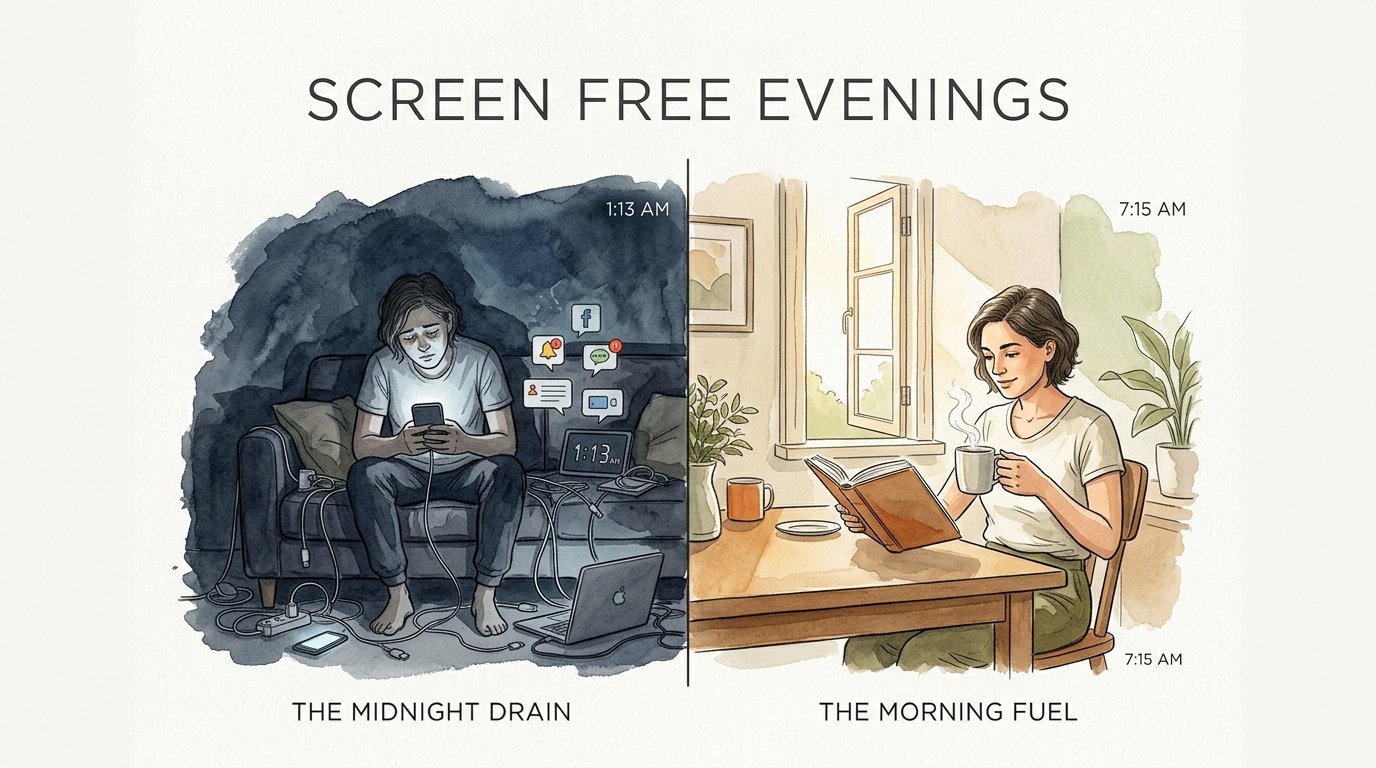
The Midnight Drain vs. The Morning Fuel
Understanding the difference between these two states can help you stay motivated.
| Factor | The Midnight Drain (Screen Use) | The Morning Fuel (Screen-Free) |
|---|---|---|
| Melatonin Levels | Suppressed; difficult to fall asleep | Optimized; natural sleep onset |
| Cortisol (Stress) | Elevated due to high-stimulation content | Lowered; central nervous system is calm |
| Focus Level | Fragmented; “Brain Fog” the next day | Sharp; high executive function |
| Emotional State | Higher risk of anxiety/irritability | More stable; improved empathy and mood |
| Decision Making | Reactive and impulsive | Proactive and strategic |
Practical Tips for Success
If you want to make this habit stick, focus on these actionable best practices.
- The 20-Minute Transition: If 90 minutes feels too long, start with 20 minutes. Gradually increase the time as you become more comfortable with the routine.
- Invest in Analog Entertainment: Buy books you actually enjoy, get a high-quality sketchbook, or stock up on board games. If you have “fun” things to do, you won’t miss your phone as much.
- Prep for Tomorrow: Use your screen-free time to lay out your clothes, pack your lunch, or review your calendar. This reduces morning stress and reinforces the “Morning Fuel” concept.
- Dim the House: Use smart bulbs to automatically shift to a warm red or orange hue at sunset. Red light has the least impact on your circadian rhythm.
- Practice Mindfulness: Use the quiet time to reflect on the day. A simple gratitude practice can lower your heart rate and improve your overall outlook.
Advanced Considerations for High Performers
For those who want to maximize their recovery, there are deeper strategies to consider.
Circadian Entrainment
A screen-free evening is only half the battle. To truly optimize your performance, you should seek out bright, natural sunlight as soon as you wake up. This “anchors” your circadian rhythm, making your evening wind-down even more effective.
Banking Sleep
If you know you have a high-stress period coming up, use your screen-free evenings to “bank” extra rest. By going to bed 30 minutes earlier and ensuring high-quality sleep through a digital detox, you build up a reserve of cognitive energy that helps you handle pressure more effectively.
Environmental Temperature Control
Your body temperature needs to drop slightly to initiate sleep. While you are in your screen-free window, keep your home environment cool (around 65°F or 18°C). The combination of darkness and a cool environment is a powerful physiological signal for deep sleep.
The 7-Day Transformation Scenario
Imagine a professional named Sarah. She used to scroll through her feed until midnight, often waking up at 7:00 AM feeling groggy and reaching for caffeine immediately.
Monday: Sarah sets her phone in the kitchen at 9:30 PM. She feels restless and checks the empty counter twice. She reads five pages of a book and falls asleep by 10:30 PM.
Wednesday: The “phantom vibration” syndrome starts to fade. Sarah spends her evening stretching and writing. She notices she isn’t hitting the “snooze” button on her alarm anymore.
Friday: Sarah feels a significant shift. Her morning “brain fog” is gone. She completes her most difficult work tasks before lunch. She realizes that her evening quiet time has become the part of the day she looks forward to most.
By Sunday, Sarah has reclaimed nearly 5 hours of sleep and improved her focus metrics. She isn’t just “getting by” anymore; she is performing at a higher level because she protected her evening energy.
Final Thoughts
A screen-free evening is not a punishment or a restriction. It is a strategic advantage. In a world where everyone is constantly “on,” the person who knows how to truly turn off is the one who will lead, create, and perform with the most clarity.
Start by choosing your cut-off time tonight. Protect that window of time as if your career and health depend on it—because they do. Trade the scrolling for stillness, and watch how your tomorrow transforms.
The midnight drain is a choice. The morning fuel is a habit. Which one will you choose tonight?
Sources
1 jaimedicalsystems.com | 2 thensf.org | 3 cdc.gov | 4 screenwiseapp.com | 5 swissflex.com | 6 forbes.com | 7 swgeneral.com | 8 aastweb.org | 9 sutterhealth.org | 10 sbm.org | 11 harvard.edu | 12 sleepeducation.org | 13 medium.com | 14 reddit.com