How To End Ipad Addiction In 7 Days
We thought being a good parent meant keeping them constantly entertained, but we were actually drowning their ability to think for themselves. For years, we lived in fear of the ‘I’m bored’ siren. We filled every gap with a screen or a performance. Then we spent 7 days doing the unthinkable: we stopped. This is the story of how doing ‘less’ for our kids gave them the space to finally become ‘more.’

Modern parenting has turned us into 24/7 cruise directors. We feel a twinge of guilt every time a child stares at a blank wall. We reach for the iPad like it’s a life raft in a sea of grocery store tantrums. But that life raft is actually an anchor. It’s tethering our children to a world of passive consumption and instant dopamine hits that their developing brains were never meant to handle.
Breaking this cycle isn’t about being “mean.” It is about a biological reset. It is about clearing the digital fog so your child can rediscover the world—and themselves. If you are tired of the glassy-eyed stares and the volcanic meltdowns when the battery dies, this 7-day plan is your roadmap to freedom.
How To End Ipad Addiction In 7 Days
iPad addiction is a state of neurological overstimulation where a child becomes dependent on high-frequency digital input to feel “normal.” It is not a lack of willpower. It is a biological response to the way apps are designed. Developers use “variable reward schedules”—the same tech used in slot machines—to keep kids clicking.
When a child uses a tablet, their brain’s reward center, the nucleus accumbens, is flooded with dopamine. This “feel-good” neurotransmitter reinforces the habit. Over time, the brain becomes desensitized. A simple wooden block or a walk in the park no longer provides enough stimulation to register on their dopamine-fried receptors. Everything else becomes “boring.”
Ending this addiction in 7 days requires a total system reboot. You aren’t just taking away a toy; you are allowing their brain’s neurochemistry to rebalance. This process exists because the human brain is plastic—it can adapt back to lower levels of stimulation if given the chance. In a real-world setting, this means moving from a state of “digital dependency” to “active engagement.”
The 7-Day Digital Reset Roadmap
This process is a marathon, not a sprint. You must commit to the full week without “cheating” for five minutes of peace.
Day 1: The Last Hurrah and The Audit
Do not just snatch the iPad away at 7:00 AM. Start with a family meeting. Explain that the “brain needs a vacation.” Use the word “vacation” or “reset” rather than “punishment.” Collect all tablets, handheld consoles, and even your own non-essential devices. Put them in a literal box and hide it.
Day 2: The Dopamine Crash
This is the hardest day. Expect irritability, lethargy, and perhaps a massive “extinction burst”—a psychological term for the spike in bad behavior that happens when a reinforced habit is suddenly blocked. Your child’s brain is literally “withdrawing.” Keep meals simple, avoid crowded places that trigger stress, and stay calm. Do not try to entertain them yet. Let them feel the weight of the “nothingness.”
Day 3: The Peak of Boredom
The “I’m bored” sirens will reach a fever pitch today. This is the “Valley of Death” for most parents. Your job is to stay neutral. When they say they are bored, respond with: “I can’t wait to see what you decide to do about that.” Do not offer suggestions. Boredom is the precursor to creativity. Their brain is beginning to search for internal ways to create dopamine.
Day 4: The First Spark
Usually, by Day 4, the fog starts to lift. You might see your child pick up a toy they haven’t touched in months. They might start a “project” that involves half the kitchen Tupperware and three rolls of tape. This is the “Discovery Phase.” Their brain is realizing it can create its own fun. Support this by making materials accessible—paper, dirt, water, blocks—but do not lead the play.
Day 5: Sensory Re-Engagement
Now that the digital noise is quieter, focus on the physical world. Take them outside. Long walks, digging in the dirt, or visiting a playground. The slow, rhythmic nature of physical play helps regulate the nervous system. You will notice their eye contact is better and their “trance-like” state has vanished.
Day 6: Rebuilding the Relationship
Without the screen between you, you’ll notice you have more “face time.” Use this day for a shared low-stim activity like baking bread, washing the car, or a board game. Focus on “co-regulation”—showing them how to enjoy a slow-paced activity without needing a screen to bridge the gap.
Day 7: The New Normal
Evaluate the week. Most parents see a 50% reduction in tantrums by Day 7. If you choose to reintroduce screens, do it with “hard-coded” rules. No iPads in bedrooms. No screens 90 minutes before bed. Use the “Grey-scale” trick—turn the screen to black and white in settings to make it less addictive.
How the “Reset” Works Neurologically
The success of a 7-day detox is rooted in the “up-regulation” of dopamine receptors. When a child is addicted, their brain actually “prunes” or hides dopamine receptors to protect itself from the flood of artificial stimulation. This makes everyday life feel dull and gray.
By removing the high-intensity input, the brain begins to “re-grow” its sensitivity. It takes about 48 to 72 hours for the initial withdrawal symptoms to peak and then subside. Once the receptors are sensitive again, the “small wins”—like finishing a puzzle or finding a cool bug—actually feel rewarding again. This is why kids who couldn’t focus for 30 seconds on a book suddenly start spending 20 minutes reading.
Benefits of a Screen-Free Reset
The most immediate benefit is emotional regulation. Without the constant cycle of dopamine spikes and crashes, children become more “even.” They can handle small frustrations without it turning into a world-ending event.
Another major advantage is independent play. We often complain that kids “don’t know how to play anymore.” This is because we haven’t given them the space to try. A digital reset forces the “Default Mode Network” (DMN) of the brain to activate. This is the system responsible for imagination, self-reflection, and creative problem-solving.
- Better Sleep: Eliminating blue light and high-energy content allows melatonin to rise naturally.
- Improved Social Skills: Kids look at faces more often, learning to read non-verbal cues they miss while staring at a screen.
- Physical Health: “Screen-time” is replaced by “movement-time,” which releases endorphins and builds motor skills.
Challenges and Common Mistakes
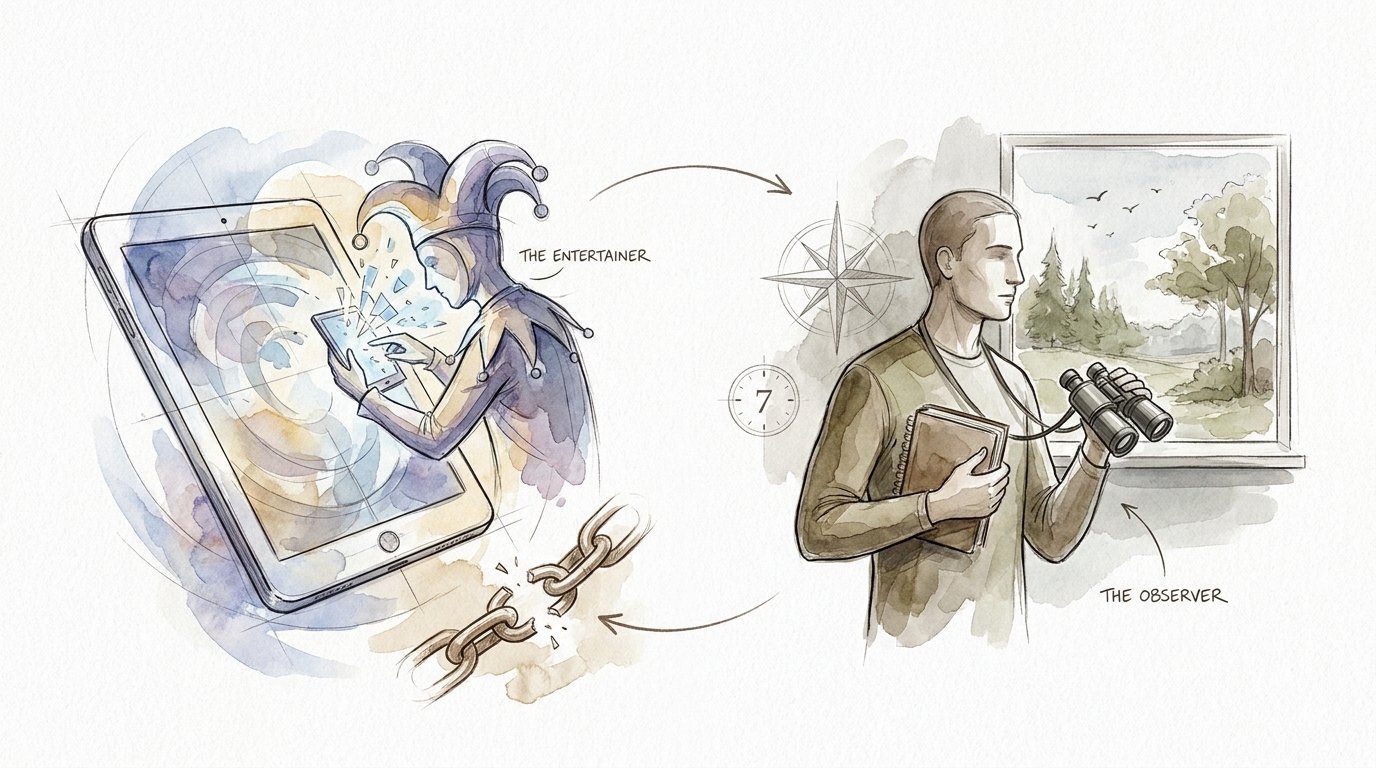
The biggest pitfall is “The Replacement Trap.” Many parents take away the iPad but then try to fill every second with “structured fun”—crafts, museums, and constant activities. This is just “The Entertainer” in a different hat. If you fill their time, they never learn to fill it themselves. You must allow the void of boredom to exist.
Another mistake is Parental Inconsistency. If you take away their screen but spend the whole day scrolling Instagram in front of them, the reset will fail. Children mirror your relationship with technology. You must go “low-tech” alongside them, at least during the hours they are awake.
Finally, watch out for “The Weekend Slip.” Many parents do great for four days and then give in on Friday night because they are tired. One hour of high-intensity gaming on Day 4 can reset the “withdrawal clock.” You must hold the line for the full 168 hours to see the neurological shift.
Limitations: When This May Not Be Ideal
A 7-day reset is a powerful tool, but it is not a cure-all for deep-seated behavioral issues or clinical conditions. If a child has severe ADHD or Autism, “cold turkey” might cause extreme distress that requires professional guidance. In these cases, a “tapering” method or a “sensory-friendly” digital plan might be safer.
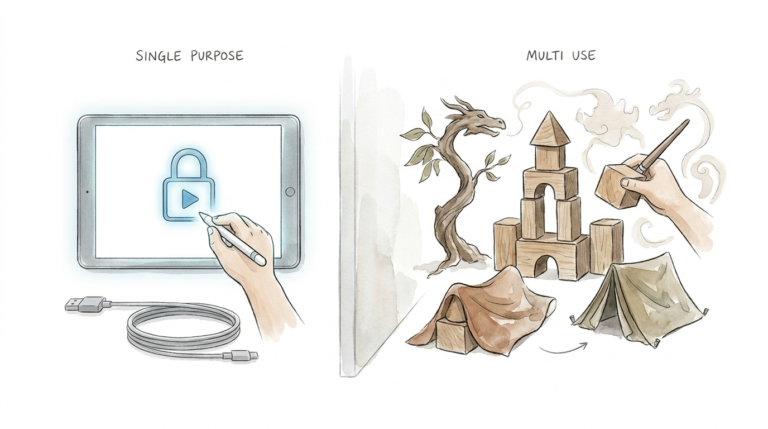
Environmental factors also play a role. If you live in a tiny apartment during a blizzard, the “go outside” advice is harder to follow. You must have a “prepared environment” indoors with open-ended toys (Legos, art supplies, silks) before you pull the plug on the digital world.
The Entertainer vs. The Observer
The key to long-term success is shifting your parenting identity.
| Feature | The Entertainer | The Observer |
|---|---|---|
| Primary Goal | Prevent boredom at all costs. | Allow boredom to spark internal growth. |
| Response to Tantrum | “What can I give you to stop this?” | “I’m here for you while you feel this.” |
| Play Style | Directs the child and suggests activities. | Sits nearby and waits for the child to lead. |
| Tool of Choice | iPad, flashy toys, structured classes. | Loose parts, nature, quiet time. |
| Long-term Result | Child becomes a passive consumer. | Child becomes a self-starting creator. |
Practical Tips for Maintaining Freedom
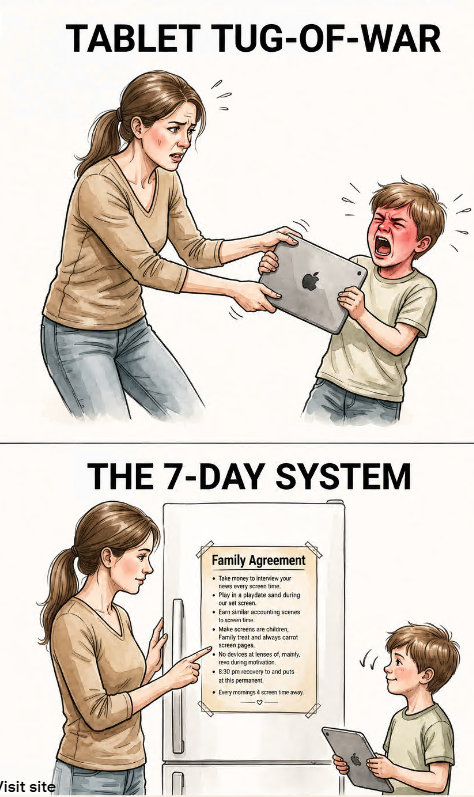
Once the 7 days are over, do not go back to the “all-you-can-eat” digital buffet. Establish a Family Media Plan. This is a written contract that outlines when and where screens are okay.
Use Environmental Design. Do not leave the iPad on the kitchen counter like a bowl of candy. Hide it in a high cabinet. If they have to ask for it, it breaks the “reflexive use” habit.
Grey-scale your devices. Go into the accessibility settings on the iPad and turn on “Grayscale.” Without the bright colors, YouTube and Roblox lose 70% of their “stickiness.” It becomes a tool rather than a drug.
Advanced Considerations: Content Curation
Not all screen time is created equal. After the reset, focus on “Slow Media.” Avoid “Short-form” content (TikTok, YouTube Shorts, Reels) which are specifically designed to keep the brain in a high-dopamine loop.
Instead, opt for “Long-form, slow-paced” content. Documentaries, audiobooks, or educational shows like “Mister Rogers” or “The Joy of Painting” provide information without the “staccato” editing that fries the attention span. The goal is to keep the “reward” of the screen proportional to the effort required to watch it.
A Real-World Example: The “Lego” Pivot
Consider a 6-year-old boy who spent 4 hours a day on an iPad. On Day 2 of his reset, he had a 40-minute meltdown. On Day 3, he sat on the floor and stared at a pile of Legos for an hour, occasionally kicking them in frustration.
On Day 4, something clicked. He started building a “spaceship.” By Day 6, he had built an entire “space city” that took up the living room floor. He wasn’t asking for the iPad because he was too busy “engineering.” His brain had successfully pivoted from a **Consumer Mindset** to a **Creator Mindset**. This shift only happened because his parents refused to “rescue” him from his boredom on Day 3.
Final Thoughts
The 7-day digital detox is the most difficult and rewarding thing you will do this year. It is a gift of “emptiness” in a world that is far too full of noise. By stepping back and doing less, you are finally allowing your child the space to grow into their own potential.
Remember, you are not “depriving” them of a toy; you are “restoring” their childhood. You will see their personality return, their curiosity reignite, and their focus deepen.
Start today. Box up the tablets. Brace for the “I’m bored” siren. And then, watch the magic happen as your children finally find the “more” they’ve had inside them all along. The iPad was never the bridge to their future—it was the wall standing in the way.
Sources
1 childcareed.com | 2 thejacobsladdergroup.org | 3 1stepfamilywellness.com | 4 childtherapycenterla.com | 5 healthywithin.com | 6 healthychildren.org | 7 daar.com.au | 8 strong4life.com | 9 kidslox.com | 10 integratedcareclinic.com | 11 learningrx.com | 12 kidsmentalhealthfoundation.org | 13 bubblesacademy.com | 14 commonwealthpeds.com | 15 aap.org | 16 todaysparent.com | 17 safariltd.com | 18 phillywaldorf.com | 19 nicklauschildrens.org | 20 drshimikang.com | 21 futurity.org | 22 getmanatee.com | 23 aap.org | 24 mayoclinichealthsystem.org | 25 greggfamilyeyecare.com