
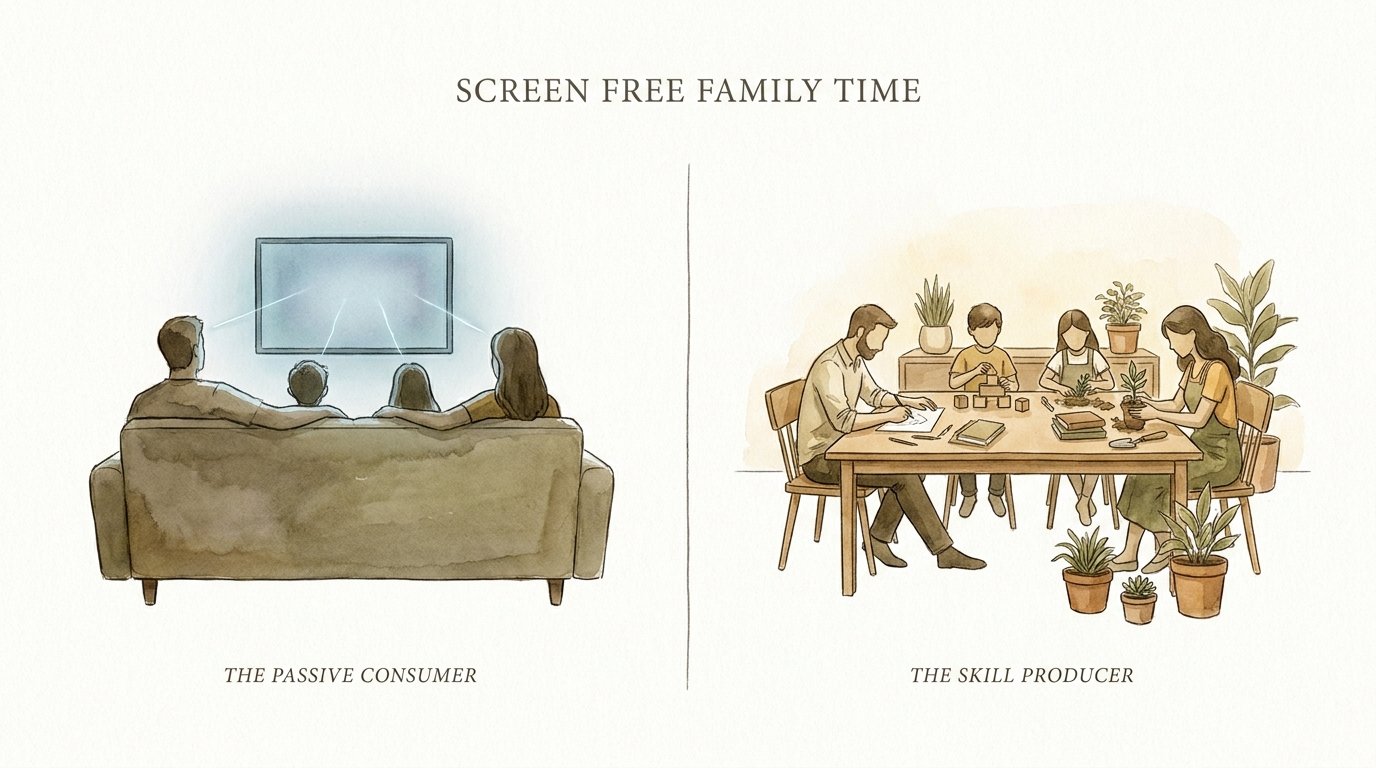
screen free family time
Stop watching others do what you could be doing together. Shift from consuming to producing. Real family time isn’t found in a feed. It’s found in the things you build, create, and produce together.
Most of us are stuck in a loop. We spend hours every day watching other families go on adventures, bake perfect sourdough, or build amazing treehouses on our screens. We are the ultimate passive consumers, trading our own potential memories for a high-definition view of someone else’s life. But here is the secret: that digital window is actually a wall. It keeps you from the very thing you are looking for.
Choosing to step away from the glow of a tablet or smartphone isn’t about being “anti-tech.” It is about being “pro-connection.” It is about reclaiming the hours that belong to your family and turning them into something tangible. Whether it is a garden, a dinner, or a handmade piece of furniture, the act of producing something together builds bonds that an algorithm simply cannot replicate.
In this guide, we are going to explore how to transition your household from a group of individuals staring at separate screens into a cohesive unit of skill-producers. We will look at why this shift matters, how to handle the inevitable “I’m bored” complaints, and what it looks like to build a legacy of shared competence.
screen free family time
Screen-free family time is the intentional practice of setting aside digital devices to engage in face-to-face, hands-on activities. In a world where the average American spends over 5 hours a day on their phone and teenagers can log nearly 9 hours of daily device exposure, screen-free time is a radical act of reclamation. It is the space where families stop being audiences and start being participants in their own lives.
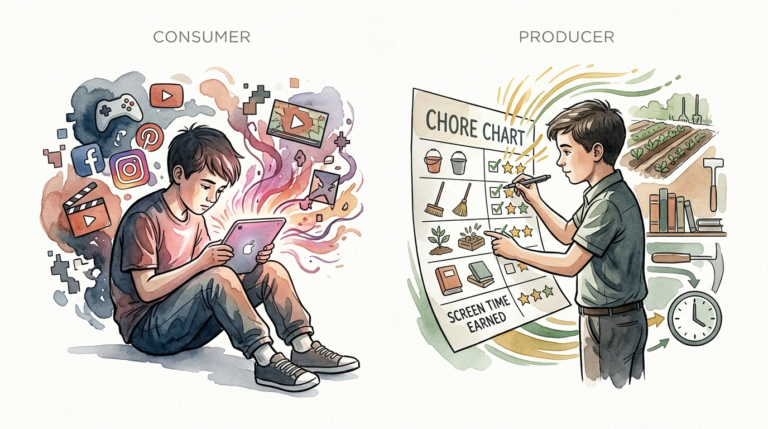
This concept is not just about turning off the TV. It is about a fundamental shift in mindset. Instead of looking for entertainment, you look for engagement. Instead of seeking a “like,” you seek a result. When you choose screen-free time, you are prioritizing the “skill producer” over the “passive consumer.” This means your family is no longer just taking in information; you are synthesizing it and using it to create something new.
Think of it like the difference between watching a cooking show and actually making a meal. One requires zero effort and leaves you with nothing but a fleeting sense of entertainment. The other requires focus, coordination, and physical effort, but it ends with a shared achievement you can actually taste. Real-world situations like family game nights, gardening, or collaborative DIY projects are the training grounds for life skills that screens simply cannot teach.
In practice, screen-free time exists as a buffer against the “comparison trap” found on social media. It allows children to develop their own sense of competence without constantly measuring themselves against curated highlights. It gives parents the chance to model focus and patience, showing their kids that the best things in life often take time and effort to build.
How to Shift from Consuming to Producing
Transitioning a family from passive consumption to active production does not happen by accident. It requires a system. If you just take away the phones without providing a path forward, you will be met with frustration and resistance. You need to build a “production pipeline” that makes the real world more interesting than the digital one.
First, identify the skills your family wants to acquire. This could be anything from basic woodworking and gardening to complex baking or even learning an instrument together. Start by creating a “Family Production Goal.” Instead of saying “let’s spend less time on phones,” say “let’s build a raised garden bed by next Saturday.” A specific, tangible goal provides the structure that screens usually provide for us.
Next, audit your environment. Most homes are designed for consumption. The furniture is pointed at the television, and the kitchen counters are covered in pre-packaged snacks. To become producers, you need a “maker space.” This doesn’t have to be a full workshop. It could be a dedicated craft table, a shared toolkit, or a corner of the kitchen where the kids are allowed to experiment with ingredients. When the tools of production are visible and accessible, they are much more likely to be used.
Finally, practice “collaborative learning.” One of the best ways to produce together is to learn a new skill as a team. This levels the playing field between parents and children. If no one in the family knows how to knit, buy some yarn and a book on basic stitches. The process of struggling, failing, and eventually succeeding together creates a shared history of resilience. You are not just making a scarf; you are producing a memory of overcoming a challenge together.
Benefits of the Production Mindset
The benefits of shifting toward a production-focused lifestyle are measurable and far-reaching. When you replace “screen time” with “build time,” you are investing in the long-term mental and physical health of every family member. It is a shift that pays dividends in confidence and connection.
Practical benefits include:
- Enhanced Cognitive Development: Hands-on activities like building models or solving complex puzzles require spatial reasoning and problem-solving skills that passive video consumption lacks.
- Improved Physical Health: Shifting to screen-free activities naturally increases movement. Whether it is a family hike or just working in the backyard, you are moving away from the sedentary habits linked to childhood obesity and heart disease.
- Better Sleep Quality: Reducing the “blue light” exposure from screens—especially in the two hours before bed—helps regulate melatonin production, leading to deeper and more restorative sleep for both kids and adults.
- Emotional Resilience: In the digital world, everything is instant. In the producer world, things fail. Bread doesn’t rise, or a birdhouse turns out crooked. Learning to deal with these small failures in a supportive family environment builds the “grit” kids need to succeed in the real world.
Beyond the individual benefits, the production mindset strengthens the “family identity.” You become the family that builds things, the family that grows their own food, or the family that plays music. This sense of belonging to a “producing tribe” is a powerful antidote to the isolation often caused by individual screen use.
Challenges and Common Mistakes
Moving away from screens is hard because screens are designed to be addictive. They provide a constant stream of dopamine that makes real-world activities feel “boring” by comparison at first. One of the biggest mistakes parents make is expecting the transition to be immediate and joyful. It won’t be.
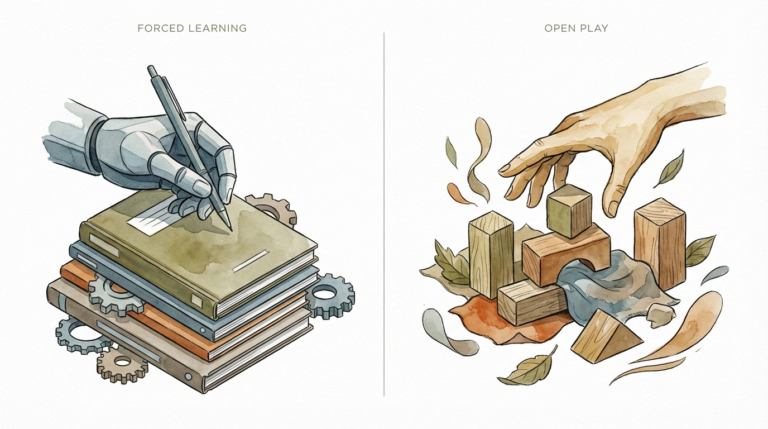
You will encounter the “Boredom Barrier.” When you first cut back on digital consumption, your children (and you) will likely feel restless and irritable. This is a natural withdrawal symptom from the high-stimulation environment of apps and games. The mistake is giving in too early. Boredom is actually the fertile ground where creativity grows. If you always fill the silence with a screen, your children never learn how to generate their own ideas.
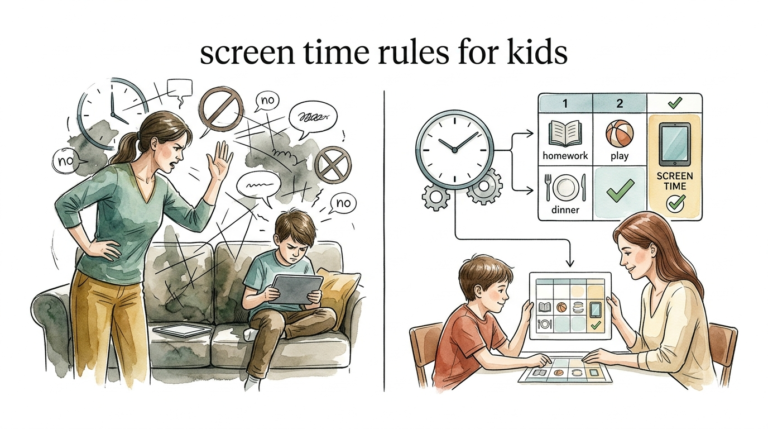
Another common pitfall is the “Heavy-Handed Approach.” If screen-free time feels like a punishment, it will be met with resentment. Avoid being the “tech police.” Instead, focus on the “Value Add.” Instead of “Put that phone away right now,” try “Hey, I need your help figuring out how to fix this loose table leg.” Invitation is always more effective than prohibition.
Finally, watch out for “Hypocritical Modeling.” If you are telling your kids to stay off their tablets while you are secretly scrolling through your email under the dinner table, the message is lost. Your children will do what you do, not what you say. You must be the lead producer in your home. If you want them to pick up a book, you need to be seen reading. If you want them to build, you need to be building.
Limitations and Realistic Constraints
While the goal is to shift from consuming to producing, we have to be realistic about the world we live in. Technology is a tool, and total elimination is often neither practical nor necessary. The key is understanding when technology helps production and when it hinders it.
There are times when screens are actually “producer tools.” For example, watching a 5-minute tutorial on how to prune an apple tree is a productive use of technology. The screen is facilitating a real-world action. The problem arises when the 5-minute tutorial turns into a 2-hour rabbit hole of “satisfying gardening videos.” You have to set boundaries to ensure the digital tool remains a servant to the physical task.
Environmental constraints also play a role. Families living in small urban apartments may not have the space for a woodworking shop or a massive garden. In these cases, production might look like digital content creation (making a family podcast), indoor hydroponics, or complex board games. The “production” doesn’t always have to be physical objects; it can be the production of ideas, strategies, and shared knowledge.
Finally, there are “Trade-offs” in time and energy. We all have busy lives, and sometimes a family movie night is exactly the low-energy connection everyone needs. The goal isn’t to be 100% screen-free 100% of the time. The goal is to ensure that passive consumption is the exception, not the default. It is about balancing the “easy” relaxation of a screen with the “rewarding” effort of a project.
Passive Consumer vs. Skill Producer
To truly understand the value of this shift, it helps to compare the two mindsets. One is focused on what the world can give you; the other is focused on what you can bring to the world. One is about accumulating experiences; the other is about accumulating competence.
| Factor | Passive Consumer | Skill Producer |
|---|---|---|
| Engagement | Watching someone else do it. | Doing it yourself. |
| Reward | Short-term dopamine hit. | Long-term sense of mastery. |
| Outcome | Nothing tangible remains. | A product, a skill, or a memory. |
| Cost | Low effort, high time cost. | High effort, high value return. |
| Social Value | Isolated scrolling/watching. | Shared learning and teamwork. |
As the table shows, the “Producer” path is harder but significantly more rewarding. While a consumer might know the names of all the characters in a popular show, a producer knows how to use a miter saw, how much water a tomato plant needs, or how to bake a loaf of bread from scratch. These are the skills that build a resilient life.
Practical Tips for Immediate Impact
If you are ready to start the shift today, you don’t need a complete lifestyle overhaul. Start with small, manageable adjustments that build momentum. These best practices will help you navigate the first few weeks of becoming a producing family.
First, implement “Screen-Free Zones.” The dining table and the bedrooms should be the first places where technology is banned. By reclaiming these spaces for conversation and rest, you create natural opportunities for production. If you can’t scroll at the table, you are forced to talk. If you can’t scroll in bed, you might actually pick up a book or talk to your partner.
Second, use the “10-Day Reset.” Challenge your family to a 10-day digital detox where all non-essential screen time is replaced with a specific family project. This could be anything from deep-cleaning and reorganizing the garage to learning five new campfire songs. The goal is to break the “muscle memory” of reaching for a phone and replace it with the habit of reaching for a tool.
Third, “Externalize Your Progress.” Create a visible chart in your home that tracks what you are producing. If you are starting a garden, put up a calendar showing when seeds were planted. If you are learning to bake, keep a log of every loaf and how it tasted. Seeing the tangible proof of your production is a powerful motivator to keep going.
Advanced Considerations for Serious Practitioners
For those who have mastered the basics of screen-free time and want to go deeper, the next level involves “Intergenerational Skill Transfer” and “Community Production.” This is where you move beyond your nuclear family and start connecting with the wider world through your skills.
Advanced families often look at “Homesteading-Lite” activities. This doesn’t mean moving to a farm. It means taking control of your basic needs. Can you produce your own soap? Can you preserve your own summer harvest? Can you repair your own appliances? When children see that their parents are not dependent on a “service economy” for everything, it changes their view of what is possible. They stop seeing themselves as “customers” of the world and start seeing themselves as “architects” of it.
Another advanced concept is “The Village Mindset.” In our digital age, we often look to influencers for advice. A producing family looks to their local community. Find the older neighbor who knows how to quilt or the family friend who is a master mechanic. Invite them over to teach your family. This creates a network of real-world mentorship that is far more valuable than any YouTube subscription.
Finally, consider “Production for Service.” Shift some of your family’s productive energy toward helping others. Bake bread for a neighbor, build a lending library for your street, or repair toys for a local charity. Producing for the sake of others is the ultimate evolution of the producer mindset. It takes the focus off the self and places it on the community, creating a sense of purpose that screens can never provide.
Examples of Family Production in Action
Let’s look at a realistic scenario: The Miller family. Like many, they realized that every evening was spent in “digital silos”—Mom on Facebook, Dad on Netflix, and the kids on TikTok or video games. They decided to implement a “Production Night” every Tuesday.
They started small by building a “Birdhouse Village.” This required them to:
- Research the types of birds in their local area (using the internet as a tool, then putting it away).
- Draw a design and create a “cut list” of lumber.
- Spend two hours in the driveway measuring, sawing, and hammering together.
- Spend the following weekend painting and mounting the houses.
The result? They didn’t just have three birdhouses. They had two kids who now know how to use a tape measure and a hammer. They have a backyard that is now full of life. And most importantly, they have a “shared language” of that project. Now, when they see a bird in their yard, they don’t look at their phones; they look at each other and remember the day they built that home together.
Final Thoughts
The transition from a passive consumer to a skill producer is one of the most rewarding changes a family can make. It is the difference between watching life happen and making life happen. While it requires more effort, more patience, and more “boredom” than scrolling through a feed, the results are permanent. You are building a foundation of competence and connection that will last a lifetime.
Remember that the goal is not perfection. You will have days where the screens win, and that is okay. The objective is to change the default setting of your home. You want your children’s first instinct when they are bored to be “What can I make?” rather than “What can I watch?” By reclaiming your time and your attention, you are giving your family the greatest gift possible: each other.
Start small, be consistent, and don’t be afraid to fail. The world doesn’t need more people watching; it needs more people doing. Lead your family into the world of production and watch as your relationships—and your skills—grow deeper than you ever thought possible.
Sources
1 medium.com | 2 markmerrill.com | 3 artofimprovement.co.uk | 4 substack.com | 5 kidsplaymuseum.org | 6 kidsplaymuseum.org | 7 haven-psychology.com | 8 haven-psychology.com | 9 monstermath.app | 10 getmanatee.com | 11 madeinapinch.com | 12 rolifeonline.com | 13 childrensdayton.org | 14 jessicafoley.ca | 15 fireflyin.org | 16 asu.edu

One Comment