Traditional Weaving For Toddler Fine Motor Skills
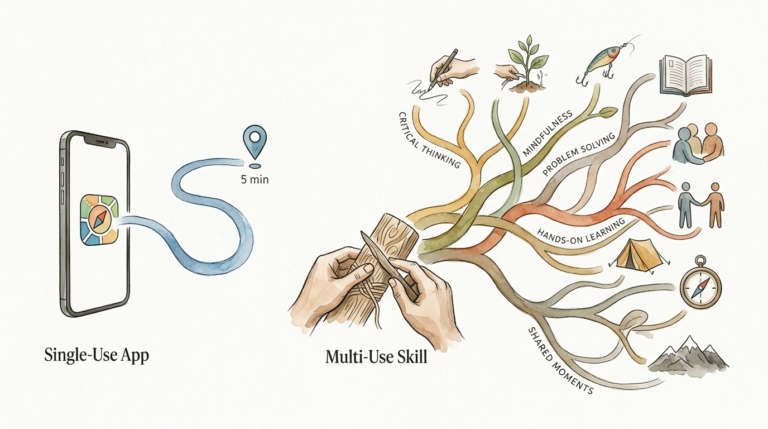
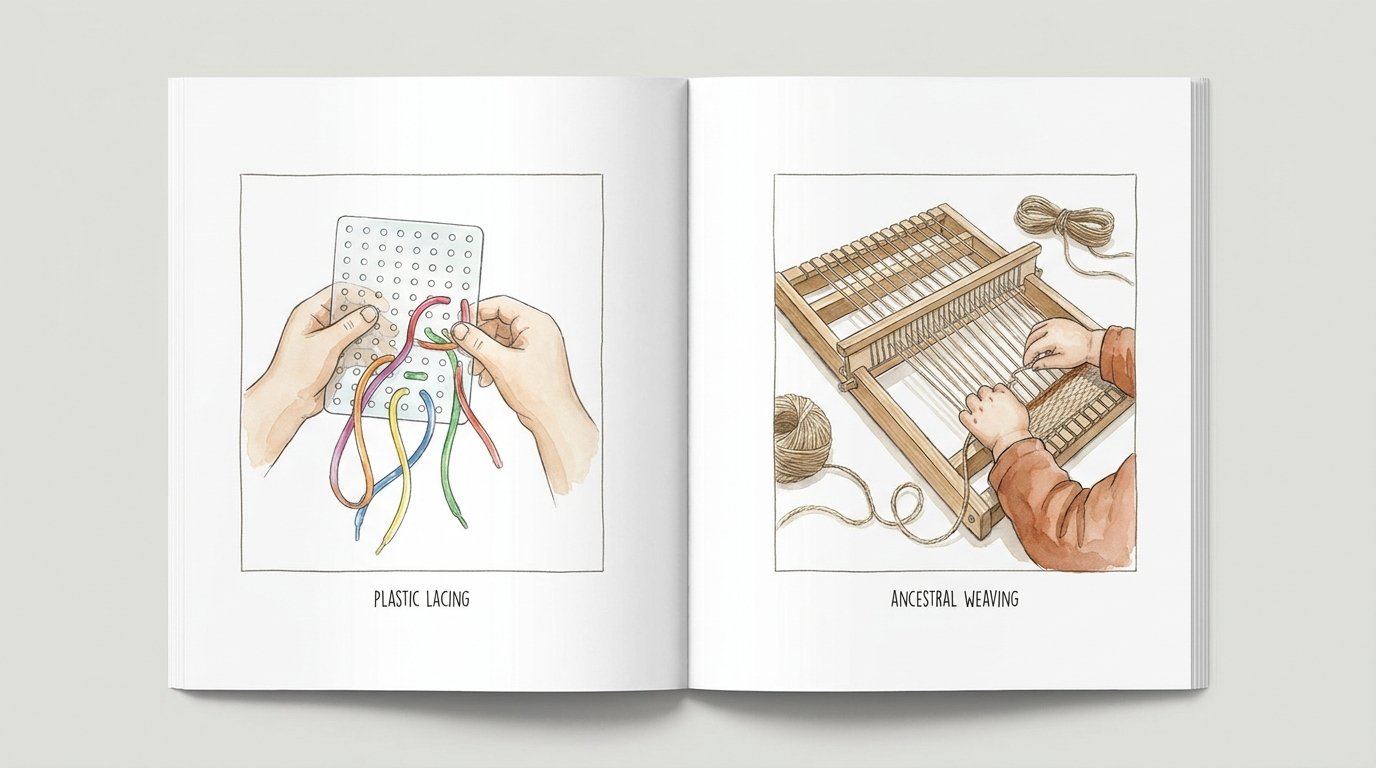
Plastic cards offer one repetitive motion, but the loom demands the same complex finger-work that built civilizations. We’ve replaced the complex, varied resistance of natural fibers with the slippery, predictable feel of plastic. Our ancestors didn’t use ‘motor skill boards’—they used the loom. Discover why raw wool and wooden frames develop deeper neural pathways than any ‘educational’ plastic card ever could.
Modern parenting often feels like a race to find the perfect “educational” toy. We browse aisles of primary-colored plastic, looking for something to help our toddlers develop the dexterity they need for life. Most of these toys are simplified versions of ancient tasks. They strip away the texture, the resistance, and the history, leaving behind a hollowed-out experience. Traditional weaving is different.
Traditional weaving is a sensory-rich, multi-dimensional exercise that engages the whole child. It isn’t just about moving a string through a hole. It involves the tension of the frame, the “grab” of the wool, and the rhythmic logic of over-and-under. This practice bridges the gap between raw nature and human ingenuity. It invites a toddler to participate in a lineage of makers that stretches back tens of thousands of years.
Traditional Weaving For Toddler Fine Motor Skills
Traditional weaving for toddlers refers to the simplified practice of interlacing fibers—usually natural wool or cotton—on a fixed frame or loom. Unlike commercial lacing cards that use a single plastic lace and pre-drilled holes, traditional weaving involves two distinct sets of threads: the warp and the weft. The warp threads are the stationary ones that provide structure, while the weft is the thread the child weaves through them. This setup introduces a level of complexity and physical feedback that modern plastic toys cannot replicate.
Small muscles in the hands and wrists get a comprehensive workout during this process. A toddler must use a pincer grasp to hold the fiber, a tripod grip if they are using a large wooden needle, and significant wrist rotation to navigate the “over-under” pattern. This isn’t just “busy work.” It is the foundational movement required for holding a pencil, buttoning a coat, and eventually tying shoelaces. It exists in the real world as the basis for all textile production, from the rugs under our feet to the clothes on our backs.
Imagine the difference between sliding a smooth plastic tip through a perfectly round, rigid hole and pulling a clump of sheep’s wool through a row of taut strings. The wool has “crimp”—a natural elasticity that pushes back against the hand. The wooden frame has a weight and warmth that plastic lacks. These variations force the brain to constantly adjust the amount of force the fingers apply. This constant calibration is exactly what builds the “deep neural pathways” mentioned earlier. It is the difference between a child learning a single “trick” and a child developing true motor intelligence.
The Mechanics of Movement: How to Start Weaving
Starting with a toddler requires a shift in perspective. You aren’t aiming for a finished tapestry; you are aiming for the movement. The first step is selecting a loom that suits their physical scale. A cardboard loom with wide notches is a perfect entry point. It is cheap, sturdy, and offers enough resistance to keep the warp threads in place. You can even use a simple branched stick from the backyard to create a “nature loom.”
Threading the loom, or “warping,” is usually a task for the adult. You want the vertical threads to be taut but not so tight that the cardboard bends. Use a thick, non-stretchy twine for the warp to give the child a stable base. For the weft—the part the child actually moves—choose “chunky” or “roving” wool. The thickness makes it easier to grip and provides immediate visual and tactile gratification. A single pass of thick wool fills up a lot of space, which helps keep a toddler’s interest.
Teach the “over-under” rhythm as a song or a chant. Physical therapists often recommend saying the words aloud to help the child synchronize their movements. Start the weft at one side, help the child pinch the end, and guide them under the first warp thread, then over the next. The “under” part is the most challenging, as it requires the child to lift the warp thread while pushing the weft through. This action develops the “helper hand” and encourages bilateral coordination.
Materials matter more than you think. Natural wool contains lanolin, which provides a slight tackiness. This helps the wool “stick” to itself, preventing the weaving from unraveling the moment the child lets go. Plastic laces, by contrast, are slippery and often frustrate beginners because they won’t stay put. By using materials with natural friction, you are setting the child up for success while engaging their sense of smell and touch in a way that feels “authentic.”
The Cognitive and Physical Benefits of the Loom
Weaving is one of the few activities that hits every major developmental milestone for fine motor skills simultaneously. The most obvious benefit is pincer grasp development. Every time a toddler picks up a piece of yarn, they are strengthening the connection between the thumb and index finger. This is the exact muscle group they will use for writing in a few years. Unlike lacing cards, which often use a thick plastic “needle” that encourages a palmar grasp, weaving with raw wool requires more delicate, precise finger-work.
Another massive advantage is bilateral coordination. This is the ability to use both sides of the body at the same time to complete a task. In weaving, one hand often holds the loom or stabilizes a warp thread while the other hand maneuvers the weft. This cross-communication between the left and right hemispheres of the brain is essential for everything from reading to playing sports. Weaving naturally forces this coordination without the child even realizing they are working.
Focus and hand-eye coordination are also at the forefront. A toddler has to visually track the path of the yarn, find the next gap, and then execute the physical movement to fill it. This requires a high level of “motor planning”—the ability to think through a sequence of movements before performing them. Because weaving is repetitive and rhythmic, it also serves as a gateway to “deep work” or “flow state.” A child who can sit for fifteen minutes and weave is developing the attention span they will need for formal schooling.
Sensory integration is perhaps the most overlooked benefit. Plastic is a sensory “dead end.” It is the same temperature, the same texture, and the same weight regardless of the environment. Natural wool is “alive.” It is warm to the touch, it has a distinct scent, and it responds to the humidity in the air. Exposing a child to these varied inputs helps them develop a more sophisticated tactile map of the world. It teaches them that the world is complex, textured, and varied, rather than flat and predictable.
Challenges and Common Weaving Mistakes
Frustration is the biggest hurdle in any fine motor activity. Toddlers are still learning to control their strength. A common mistake is using a loom that is too small or warp threads that are too close together. If the gaps are too narrow, the child’s fingers will get stuck, leading to an immediate “I can’t do it!” moment. Keep the warp threads at least one inch apart for a beginner. This gives them enough “air” to move their hands freely.
Selection of yarn is another area where things often go wrong. Many parents choose thin, “pretty” yarn that is meant for knitting socks. This is a nightmare for a toddler. Thin yarn is hard to see, hard to grip, and takes forever to build a row. It turns a fun activity into a tedious chore. Always opt for “super bulky” or even unspun wool roving. The goal is to make the “over-under” movement as obvious and tactile as possible.
Tension is the third great challenge. Toddlers often pull the weft thread too tight, which causes the loom to pull inward, creating an “hourglass” shape. While this is a classic mistake for even adult weavers, it can make the next row of weaving impossible for a child. You can prevent this by teaching the child to make a “rainbow arch” with the yarn before they beat it down. This extra slack ensures the loom stays straight and the work remains manageable.
Avoid the temptation to fix their mistakes immediately. If they go “over-over” instead of “over-under,” let it be. Correcting every stitch kills the joy of discovery. The child is learning the feeling of the movement, not the perfection of the pattern. Over time, they will notice the inconsistency themselves. That moment of self-correction is a much more powerful learning experience than being told what to do by an adult.
When Weaving Might Not Be Ideal
Context and timing are everything when introducing ancestral skills. If a child is in a high-energy, “big movement” phase of the day—perhaps right after a nap or during a playdate—asking them to sit at a loom will likely fail. Weaving is a “quiet time” activity. It requires a settled nervous system. If the child is currently struggling with severe sensory processing issues, the texture of raw wool might even be overwhelming. In those cases, starting with smooth cotton strips or even wide ribbons can be a gentler bridge.
Environmental factors play a role too. A loom requires a stable surface or a comfortable place to sit. If the child is trying to weave on a cluttered floor or in a high-traffic area, they will lose focus. Weaving is an invitation into a specific headspace. It works best when the surroundings are calm. Furthermore, if you are in a rush, don’t start. A “ten-minute weaving session” often turns into twenty minutes as the child gets into the rhythm. Interrupting that flow can lead to a meltdown.
Physical readiness is the final constraint. Most children are ready for very basic weaving around the age of two-and-a-half or three. If a child hasn’t yet mastered a basic pincer grasp or hasn’t shown interest in “crossing the midline,” they may find weaving more stressful than beneficial. You can test this by seeing if they can pass an object from one hand to the other. If they still prefer to keep their hands on their respective sides of the body, they might need more time with simpler gross motor tasks first.
Comparison: Plastic Lacing vs. Ancestral Weaving
Traditionalists and modern toy manufacturers often clash over what constitutes a “good” developmental toy. While both lacing and weaving develop fine motor skills, they do so in very different ways. The following table highlights the core differences between a standard plastic lacing set and the traditional loom approach.
| Feature | Plastic Lacing Cards | Ancestral Weaving (Loom) |
|---|---|---|
| Tactile Variety | Low. Smooth, uniform plastic surface. | High. Varied textures of wool, wood, and cotton. |
| Motor Planning | Simple. Point-to-point movement. | Complex. Over-under-through sequencing. |
| Hand Strength | Moderate. Focus on the pincer grip. | High. Focus on grip, pull, and resistance management. |
| Bilateral Integration | Basic. Holding a card while threading. | Advanced. Manipulating warp and weft simultaneously. |
| Sensory Feedback | Minimal. One sound, one feel. | Rich. Friction, elasticity, and “grab” of fibers. |
| Skill Leveling | Static. Once the card is laced, it’s done. | Dynamic. Can grow into patterns, colors, and textures. |
Cost is another factor. A plastic lacing kit might cost $20 and end up in a landfill. A cardboard loom is free, and a bag of wool roving can provide months of activity. The “maintenance” of a loom involves untangling yarn, whereas the maintenance of a plastic kit often involves searching for the one specific lace that went missing. For a parent looking for efficiency and value, the ancestral route is often the winner.
Practical Tips for a Successful Weaving Setup
Preparation is the secret to a happy weaving session. Before you invite the toddler to the table, make sure the loom is warped and the yarn is cut into manageable lengths. A piece of yarn longer than the child’s arm is a recipe for tangles. Cut the fiber into “working lengths” of about 12 to 18 inches. This allows the child to see the end of their task, which provides a sense of accomplishment every few minutes.
Consider using a “shuttle” for older toddlers. A shuttle is just a tool that holds the yarn, making it easier to pass through the warp. For a DIY version, you can wrap the yarn around a popsicle stick or a small piece of flat wood. This changes the grip from a pincer to a more “power-based” grip, which can be a good variation for tired fingers. It also helps the child see the yarn as it moves through the “tunnel” of the warp threads.
Incorporate nature into the process. Weaving doesn’t have to be limited to yarn. You can weave with long blades of grass, flexible willow branches, or even strips of old fabric. This reinforces the idea that weaving is a universal skill. It also changes the “resistance profile” of the activity. Grass is brittle and requires a light touch, while fabric strips are sturdy and can be pulled with more force. Switching materials keeps the neural pathways active and prevents the activity from becoming “predictable.”
Make it a social activity. Our ancestors wove in circles, sharing stories and songs. Sit with your child and weave your own loom alongside them. Modeling the behavior is much more effective than giving instructions. They will watch how you hold your hands, how you manage the tension, and how you tuck in the ends. This “side-by-side” work creates a bond and turns a developmental exercise into a cherished memory.
Advanced Considerations for Growing Hands
As the child masters the basic over-under pattern, you can begin to introduce patterning. This is where early math skills really shine. Ask them if they can go “under one, over two.” This requires them to count and look ahead, adding a layer of cognitive complexity to the physical task. You can also introduce color changes. Learning how to tie a new color onto the old one is a fine motor feat in itself, involving knotting and trimming.
Texture play can also be scaled up. Introduce wool that has been dyed with natural elements like onion skins or berries. Discussing where the color comes from adds a scientific and historical layer to the craft. You might also introduce “unprocessed” wool that still has bits of hay or a strong “sheepy” smell. This raw sensory input is grounding and connects the child to the source of their materials. It teaches them that their “educational toy” was once part of a living creature.
Scaling the loom is the next step. Once they can handle a small cardboard frame, move to a larger wooden frame loom. This requires more gross motor engagement, as the child might need to stand or move their whole body to reach across the warp. A larger loom also allows for multi-day projects. Working on a single piece of art for a week teaches patience and the value of “slow work.” In an age of instant gratification, the ability to stick with a project is a superpower.
Eventually, you can introduce the concept of the heddle. A heddle is a device that lifts every other warp thread at once, creating a “shed” for the yarn to pass through. This is a massive leap in complexity. It introduces the child to simple machinery and the principles of mechanical advantage. It shows them how human beings used their brains to make the work of their hands more efficient. This is the foundation of engineering and physics, taught through the medium of wool.
Real-World Scenarios: Weaving Success
Consider the case of a three-year-old named Leo. Leo struggled with holding a spoon and often got frustrated with puzzles. His mother set up a simple “nature loom” using two sturdy sticks and some heavy jute twine. She gave him thick strips of an old flannel shirt to weave. Initially, Leo just pulled the fabric through the strings randomly. He liked the feeling of the flannel “grabbing” the jute.
After a few days, his mother sat with him and wove a single row of “over-under.” Leo watched carefully. He tried to mimic her. He failed at first, going “over-over” and getting the fabric stuck. Instead of correcting him, his mother said, “Look how the fabric hides under the string there!” Leo poked at the “hidden” fabric. He realized the logic of the tunnel. Within a week, he was completing full rows. Two months later, his teacher noticed he was holding his crayons with a much more stable grip.
Another example involves a classroom setting. A teacher replaced the standard lacing cards in the “fine motor corner” with three large cardboard looms. She provided a basket of “art scraps”—ribbons, yarn, and strips of felt. Because the looms were large, two or three children often worked on the same one. This turned a solitary fine motor task into a collaborative social project. The children had to negotiate space, share materials, and even teach each other the “over-under” chant. The result was a classroom where fine motor work was the most popular activity, not because it was “educational,” but because it was meaningful.
Final Thoughts
Traditional weaving is more than a way to kill an afternoon. It is a return to a fundamental human movement. By stepping away from the “slippery and predictable” world of plastic, we give our children the gift of resistance. We give them the chance to feel the tension of the string and the warmth of the wool. These are the inputs that build not just strong fingers, but resilient minds.
Fostering fine motor skills through ancestral crafts like the loom prepares a child for the complexities of the modern world. It teaches them that anything worth making takes time, rhythm, and a bit of “finger-work.” It connects them to a history of makers and gives them a sense of agency over their physical environment. They aren’t just moving a piece of plastic through a hole; they are building a civilization, one thread at a time.
Experiment with your own looms. Don’t be afraid of the mess or the tangles. The beauty of the loom is that it can always be unraveled and started again. Encourage your child to find their own rhythm and choose their own textures. You might find that as their hands become more capable, their spirits become more settled. That is the true power of the ancestral loom.
Sources
1 kiddle.co | 2 artbarblog.com | 3 welcometonanas.com | 4 babysparks.com | 5 wonjo.kids | 6 bluebrontide.com | 7 childdevelopment.com.au | 8 holylamborganics.com | 9 waldorfhandwork.org | 10 theyoungandwell.com | 11 kineticedgept.com | 12 habitot.org | 13 pbs.org | 14 minimalisma.com | 15 childrenstherapyplace.com | 16 ebsco.com