Mess Free Boredom Busters For Kids
Why does a 50-cent stick of charcoal hold 10x the attention of a $10 coloring book? Standard boredom busters rely on pre-made lines. Pro-level play uses the textures of the home as the canvas. Introducing the concept of ‘Frottage’ turns your floor, your walls, and even your kitchen spoons into a hidden art gallery. It’s not just coloring; it’s an investigation of the physical world.
Mess Free Boredom Busters For Kids
Mess-free activities are the holy grail of parenting and education. Traditional art often involves paints that stain, glitters that linger for years, or markers that find their way onto sofa cushions. Frottage, or texture rubbing, offers a high-impact creative outlet with almost zero cleanup required. This technique involves placing a sheet of paper over a textured surface and rubbing it with a dry medium like a crayon or pencil to reveal the patterns beneath.
Frottage exists at the intersection of science and art. It relies on the principle of relief—the raised parts of a surface catch the pigment while the recessed parts remain blank. You see this in real-world situations like forensic detectives taking impressions of tire tracks or historians preserving the engravings on ancient stone monuments. In a home setting, it transforms mundane objects into extraordinary visual patterns.
Imagine your child discovering that the bottom of their sneaker has a geometric grid or that the kitchen strainer creates a series of perfect dots. These “magic reveals” keep kids engaged because they are discovering something hidden rather than just filling in a pre-drawn unicorn. The activity turns the entire home into a laboratory of tactile exploration.
Unlike digital entertainment, this method encourages movement and physical interaction with the environment. Kids must crawl, reach, and touch to find their next “canvas.” This physical engagement makes it a superior boredom buster for energetic children who need more than just a screen to occupy their minds.
How It Works: The Mechanics of Texture Rubbing
The core of frottage is remarkably simple, yet mastering it requires a bit of finesse. To start, you need a relatively thin sheet of paper and a drawing tool that can be used on its side. Most people find that unwrapped crayons or large graphite sticks work best because they cover more surface area quickly.
Place the paper firmly over the object you want to “capture.” Use one hand to hold the paper perfectly still; if the paper shifts, the image will become blurred or double-printed. With the other hand, apply the drawing tool using broad, even strokes. Instead of using the tip of the tool like you’re writing a letter, use the flat side to catch the high points of the texture.
Pressure is the most important variable in this process. Applying too much force can tear the paper, especially if the object underneath is sharp or very rough. Applying too little force results in a faint, unreadable image. Beginners should practice on a “test sheet” to find the “Goldilocks” level of pressure that reveals the pattern without destroying the medium.
Surrealist artist Max Ernst popularized this technique in the 1920s. He was inspired by the worn wooden floorboards of a hotel room. He realized that by rubbing over the grain, he could “see” new images in the patterns—mysterious forests, strange creatures, and alien landscapes. This process is called “automatism,” where the artist lets the material guide the creation rather than starting with a fixed idea.
Benefits of Texture Exploration
Engaging in texture rubbings provides significant developmental advantages for children of all ages. From a sensory perspective, it strengthens the neural pathways associated with touch and visual processing. Research indicates that texture exploration helps children interpret tactile information, which is a foundational skill for sensory processing and environmental awareness.
Fine motor skills get a massive workout during this activity. Holding a crayon on its side and maintaining consistent pressure requires a different set of muscles than standard writing. This builds hand strength and finger coordination, which are essential for later tasks like buttoning clothes, using scissors, and developing a mature pencil grip.
Language development is a natural byproduct of the “Texture Hunt.” As children move from the “bumpy” radiator to the “rough” brick wall or the “smooth” tile, they are forced to use descriptive adjectives. Parents and teachers can use this opportunity to introduce sophisticated vocabulary like “coarse,” “embossed,” “ribbed,” or “striated.”
Cognitive growth is supported through the “magic reveal” aspect of the craft. Children learn about cause and effect as they see how different amounts of pressure or different angles of the crayon change the output. They also engage in pattern recognition, identifying how a small texture on a spoon might look like fish scales or how a leaf vein looks like a branching river.
Common Mistakes and Pitfalls
One frequent error is using paper that is too thick. Heavy cardstock or high-quality watercolor paper often “absorbs” the texture, preventing the fine details from showing through. Standard printer paper or thin newsprint is usually the ideal choice for capturing intricate patterns.
Another common mistake is leaving the wrapper on the crayon. While it keeps hands clean, the wrapper prevents the side of the crayon from making full contact with the paper. Removing the paper sleeve allows for broad, sweeping strokes that capture the entire texture at once. If you want to avoid messy fingers, you can use specialized “block crayons” or graphite sticks designed for this purpose.
Movement of the paper is the “art killer” in frottage. Even a millimeter of shifting during the rubbing process will result in a muddy, indistinct image. Beginners often try to rub too fast, which leads to the paper sliding. Using a small piece of masking tape to secure the corners of the paper to the object can solve this problem instantly.
Choosing objects with too much “give” or softness is also a pitfall. Rubbing over a plush carpet or a soft fabric won’t work because the material moves away from the pressure. The best results come from hard, stable surfaces with clear, raised ridges.
Limitations of the Method
Frottage is highly dependent on the physical environment. If you live in a very modern, “minimalist” home with smooth walls and laminate floors, your texture options might be limited. You may need to supplement the activity with “found objects” from outside, like bark, stones, or coins, to provide enough variety for an extended play session.
Weather can be a constraint if you planned on an outdoor texture hunt. Wet surfaces do not take pigment well, and damp paper will tear almost instantly under the friction of a rubbing tool. This makes it primarily a dry-weather or indoor activity unless you have a covered porch or garage to work in.
Age limits also apply to the independent version of this activity. While toddlers love the sensory experience, they often lack the hand strength or the patience to hold the paper still. For very young children, this becomes a collaborative “team” activity where an adult holds the paper while the child does the rubbing.
Comparing Creative Outlets
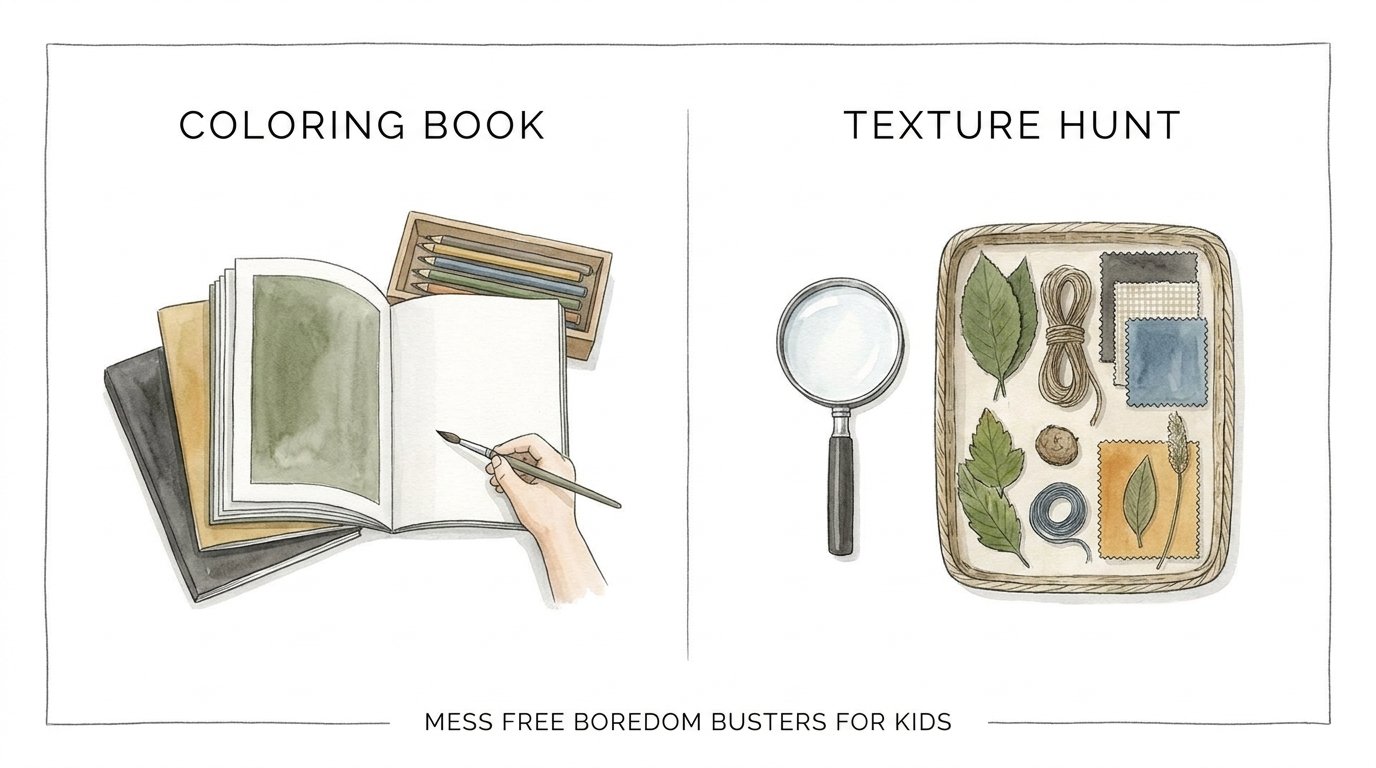
Understanding where frottage sits compared to other activities helps in choosing the right tool for the right mood. While coloring books provide structure, texture hunting provides discovery. Both have their place, but they serve different psychological needs.
| Factor | Standard Coloring Book | Frottage / Texture Hunt |
|---|---|---|
| Cost | $5 – $15 per book | Near zero (uses scraps) |
| Setup Time | Instant | 2–5 minutes |
| Cleanup | Minimal | Zero |
| Creativity | Low (follows lines) | High (exploratory) |
| Physical Activity | Stationary | Active movement |
Practical Tips for Success
Start by creating a “Texture Kit” for your child. This could be a small bin or bag containing several unwrapped crayons, a few graphite sticks, and a stack of thin paper. Having a dedicated kit makes it easier to launch the activity the moment boredom strikes. You might also include a small roll of “painter’s tape” to help secure paper to vertical surfaces like walls or doors.
Encourage the “Magic Reveal” mindset. Instead of telling the child what to rub, ask them to find three things in the room that feel “different” and see what they look like on paper. This turns the art project into a scavenger hunt, which significantly increases the “dwell time” or the amount of time the child stays focused on the task.
Layering is a pro-level tip that changes the game. Don’t stop at one texture. Rub a piece of lace in blue, then move the paper over a coin and rub it in yellow. The overlapping patterns create a rich, complex piece of art that looks much more sophisticated than a single-texture rubbing. This technique also teaches basic color theory as the blue and yellow rubbings overlap to create green.
Lighting matters more than you think. If you are struggling to find textures, use a flashlight held at a low angle across a surface. This “raking light” will cast long shadows on any bumps or ridges, making them much easier to see. This is a great way to “audit” your house for hidden art opportunities.
Advanced Considerations for Serious Practitioners
Experienced artists use frottage as a way to build a “texture library.” Instead of just making one-off drawings, you can create a collection of rubbings from different locations—the city park, an old library, or even different types of wood grain. These rubbings can then be cut out and used in collages or as reference material for more complex paintings.
Consider the medium beyond the crayon. For serious detail, use high-quality artist graphite or compressed charcoal. These materials provide a much finer grain and can pick up textures that wax crayons might miss. However, these are “messier” and may require a fixative spray (or a light coating of hairspray) once the artwork is finished to prevent smudging.
Grattage is the “sister” technique to frottage. It involves laying a canvas over a textured surface and scraping away layers of wet oil paint to reveal the pattern beneath. While much more advanced and messy, it shows the evolution of this concept in professional art. Serious practitioners can experiment with “wax resist” by doing a crayon rubbing first and then painting over it with watercolor; the wax will “pop” through the paint for a stunning effect.
Example Scenario: The Great Indoor Texture Hunt
To see how this works in practice, let’s walk through a typical 30-minute session. Start in the kitchen. Give the child a single sheet of paper and have them rub the “branding” or numbers off the bottom of a plastic container. Move to the sink and capture the mesh of the drain strainer. This provides two very different patterns: text and a fine grid.
Next, move to the living room. Look for a wicker basket or a textured rug. Have the child use a different color for this section. By the time you reach the bedroom, the paper might have 5 or 6 different colors and textures. This “traveling art” approach keeps the momentum high and prevents the “I’m bored” refrain from returning after five minutes.
Finally, bring the paper back to a table. Look at the completed page and ask the child what the shapes look like. A round coin rubbing might look like an eye, while the wood grain looks like hair. Use a regular marker to draw “on top” of the rubbings to turn the abstract textures into a recognizable character or creature. This combines the “automatic” nature of frottage with intentional drawing.
Final Thoughts
Frottage is a powerful reminder that creativity doesn’t require expensive kits or complex instructions. It relies on the simple curiosity of the human hand and the hidden patterns of our everyday environment. By shifting the focus from “filling in the lines” to “discovering the surface,” you unlock a more profound connection between the child and their world.
The beauty of this system is its scalability. It works for a three-year-old discovering a leaf for the first time, and it works for a professional artist looking for a new background texture. It is a tool for seeing, not just for drawing. It encourages us to slow down and appreciate the physical details we usually overlook.
Try it today with just a single crayon and a piece of scrap paper. Walk through your home and look for one surface you’ve never really “seen” before. Once you start hunting for textures, you’ll find that the world is much more interesting than a blank page could ever be.
Sources
1 roylco.com | 2 artinthebarn.life | 3 tate.org.uk | 4 jacksonsart.com | 5 kag.bc.ca | 6 medium.com | 7 nationalgalleries.org | 8 normanfirehouse.com | 9 wheatonarts.org | 10 artsproutsart.com | 11 floydlibrary.org | 12 podarprep.com | 13 rockstaracademy.com