Preschool Slate Vs Paper Worksheets
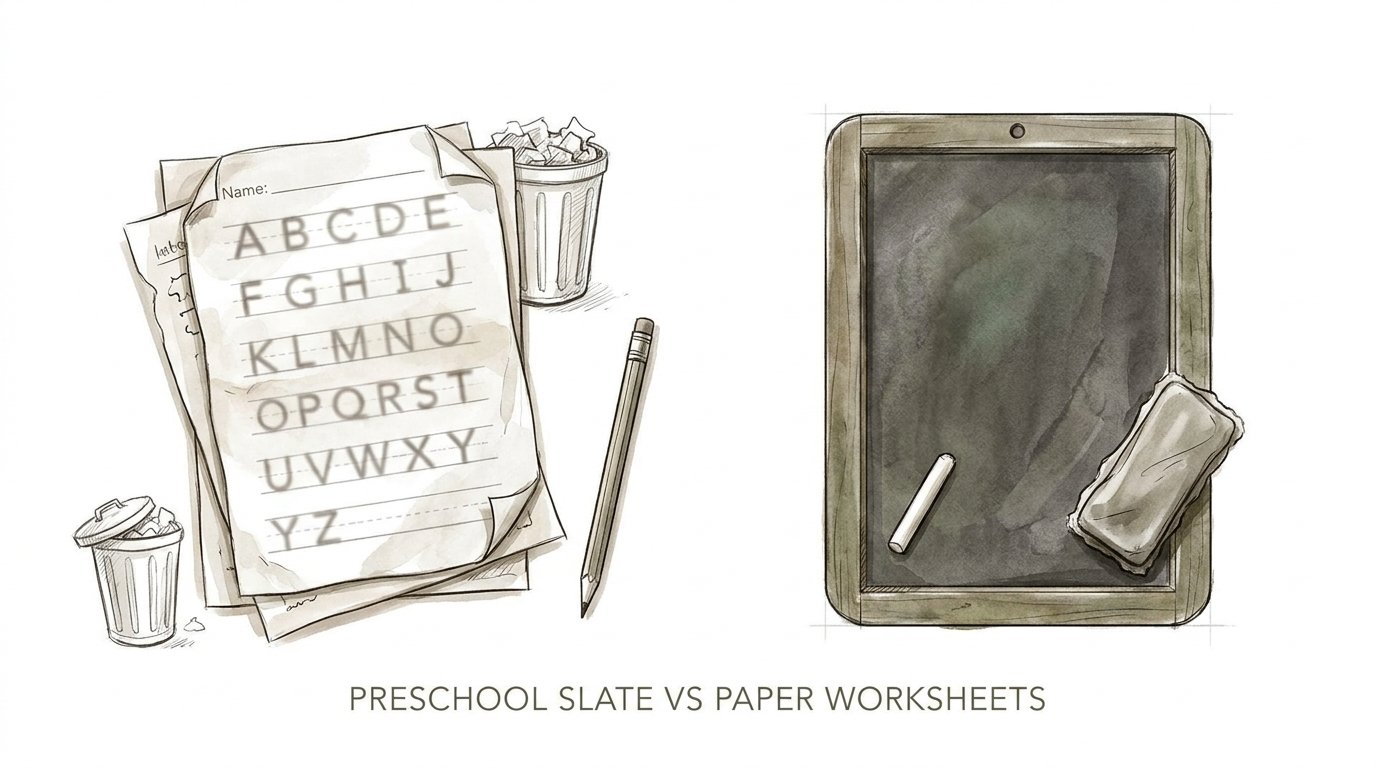
We are drowning our children in paper waste to teach a single letter, while our ancestors mastered literacy with a single stone. Modern preschooling relies on a mountain of paper that ends up in a landfill by Friday. Ancestral slates offered a feedback loop that paper can’t match: the weight of the stone, the friction of the soapstone, and the ritual of the ‘wipe’ that resets the mind for the next attempt. Is your child learning to write, or just learning to discard?
Preschool Slate Vs Paper Worksheets
The preschool slate is a reusable writing surface made from natural stone or high-quality chalkboard material. Historically, these were the primary tools for education before industrial paper production became cheap enough for mass consumption. In a modern context, they represent a return to tactile, sustainable learning.
Paper worksheets are single-use handouts designed for tracing, coloring, and early literacy exercises. While convenient for teachers to hand out, they create a massive environmental footprint. An average school can consume up to 320,000 sheets of paper in a single academic year, much of which is used for fleeting practice sessions.
Transitioning from DISPOSABLE PAPER to an ANCESTRAL SLATE shifts the focus from the product to the process. On a slate, the child focuses on the movement of the hand rather than the finality of the mark. This difference changes the psychological approach to learning, turning every mistake into a simple, temporary state that a damp cloth can fix.
How the Sensory Feedback Loop Works
Writing on stone involves a physical interaction called resistance. Unlike the slick surface of a tablet or the thin glide of a ballpoint pen, chalk or soapstone provides a grittiness that the brain can feel. This haptic feedback is essential for developing fine motor skills in young children.
Resistance helps the nervous system acknowledge the hand’s movement. When a child drags a piece of chalk across a slate, the vibrations travel up the writing tool into the fingers. This signals the brain to adjust pressure and direction with much higher precision than low-friction surfaces allow.
Muscle memory builds faster when there is something to push against. The “drag” of the stone forces the small muscles in the hand to engage fully. This strengthening process is the foundation of legible handwriting and long-term manual dexterity.
The Ritual of the Wipe
The act of erasing a slate is not just cleaning; it is a cognitive reset. Using a small sponge or cloth to clear the surface prepares the child for the next attempt. This ritual removes the “fear of failure” often associated with making a permanent mark on a expensive-looking worksheet.
Mistakes on paper are often crossed out or hidden with erasers that smudge. On a slate, the error disappears completely. This encourages experimentation and reduces the anxiety that stops many preschoolers from trying difficult letters like ‘S’ or ‘G’.
Benefits of Using a Slate
Cost-effectiveness is the most immediate practical advantage. A single high-quality stone slate can last through multiple children across several years. This eliminates the recurring expense of reams of paper and printer ink for homeschooling families or classrooms.
Sustainability becomes a lived lesson rather than a distant concept. Children see that their learning does not have to create a “mountain of waste” in the trash bin. Using a slate teaches the value of durable goods and the importance of resource management from a young age.
Neural pathways for literacy develop more robustly through multisensory input. The sound of the chalk, the smell of the stone, and the physical effort of the stroke combine to create a “triple-encoding” effect in the brain. This helps children retain the shapes of letters and numbers more effectively than visual-only methods.
Challenges and Common Mistakes
Fragility is the primary concern when handing a stone slate to a four-year-old. Natural slate can crack or shatter if dropped on a hard tile floor. Many parents make the mistake of not framing the slate in wood, which provides necessary shock absorption and a better grip for small hands.
Dust management is another hurdle for modern indoor environments. Traditional chalk creates fine particles that can irritate the respiratory system or create a mess on carpets. Using dustless chalk or natural soapstone pencils can mitigate this issue, but the surface still requires regular wet-cleaning to stay clear.
Record-keeping becomes difficult when the work is wiped clean every ten minutes. Parents often feel a loss of “progress tracking” because there is no physical folder of work to look back on. This mistake is a mental one; progress should be measured by the child’s current skill, not a stack of dead trees in a binder.
Limitations of Slate Learning
Portability can be a trade-off for durability. A heavy stone slate is harder for a child to carry in a backpack than a folder of paper. While handheld versions exist, they are still heavier and more cumbersome than a simple notebook.
Portfolio requirements in certain educational systems may necessitate paper evidence. If you are part of a school district that requires physical proof of every lesson for auditing, the slate cannot be your only tool. You must balance the “practice” on the slate with “final” entries on paper.
Color variety is limited compared to markers and crayons. While colored chalk exists, it lacks the vibrancy and precision of fine-tipped pens. For art projects requiring detailed layering or permanent display, the slate is not the ideal medium.
Practical Comparison
| Feature | Ancestral Slate | Paper Worksheets |
|---|---|---|
| Waste Generation | Zero (Reusable) | High (Daily Landfill) |
| Tactile Resistance | High (Ideal for muscle memory) | Low to Medium |
| Long-term Cost | Low (One-time purchase) | High (Recurring) |
| Storage | Takes up zero physical space | Requires folders and binders |
Best Practices for Introducing a Slate
Start with vertical surfaces if possible. Large wall-mounted chalkboards engage the child’s core and shoulder muscles, which are precursors to finger control. Research shows that writing on a vertical plane improves wrist extension and overall posture.
Use short pieces of chalk rather than long sticks. Small, “broken” pieces of chalk force the child to use a proper “pincer” grasp. This prevents them from “fisting” the writing tool and builds the specific muscles needed for later penmanship.
Clean the surface with a damp sponge rather than a dry eraser. A damp cloth removes all ghosting and prepares the stone for a fresh start. This prevents the “cloudy” look that can make it difficult for children to see their new marks clearly.
Advanced Considerations for Practitioners
Proprioception is the brain’s ability to sense the position and movement of the body. Writing on a slate provides intense proprioceptive input because of the force required to make a visible mark. For children with sensory processing issues, this can be a grounding activity that improves focus.
Neural mapping of letterforms is more permanent when the hand does more work. The brain’s motor cortex “remembers” the path of the hand more vividly when it encounters physical friction. This is why many occupational therapists recommend textured surfaces for children struggling with letter reversals.
Environmental psychology suggests that the permanence of paper can actually hinder the “drafting” phase of learning. By using a transient surface, you align the physical environment with the cognitive state of a beginner. This alignment creates a more fluid, low-stress learning experience.
Example Scenario: The Daily Ritual
Consider a morning literacy session with a five-year-old child. On Monday, they are introduced to the letter ‘B’. Instead of a packet of five worksheets, the child is given a single framed slate and a piece of soapstone.
The child attempts the first ‘B’. It is shaky and the curves are uneven. They take a wet sponge, wipe the stone, and watch the water dry for ten seconds. This pause allows them to visualize the shape again.
On the fifth attempt, the ‘B’ is clear and confident. There is no evidence of the previous four failures cluttering the desk or the bin. The child feels a sense of mastery because they have conquered the stone, and the only thing remaining is the skill in their hand, not the waste in the trash.
Final Thoughts
Ditching the mountain of paper for a single ancestral slate is a move toward intentionality. It respects the environment, the child’s developing brain, and the family’s budget. While paper has its place for final drafts and sentimental keepsakes, it is a poor tool for the repetitive, messy, and vital work of learning to write.
Embracing the slate means valuing the process over the product. It gives children the freedom to fail without consequence and the sensory tools they need to succeed. By returning to this ancient method, we provide a more solid foundation for literacy than any disposable worksheet ever could.
Experiment with a small slate in your next lesson. Watch how the child interacts with the stone compared to the paper. You may find that the simplest tools from our ancestors are still the most powerful ones for our future.
Sources