Backyard Water Engineering For Kids
Stop just getting the lawn wet and start teaching your child the invisible laws of hydraulic engineering. Water play usually means a wasted hose and a muddy yard. Introducing gravity-fed aqueducts turns a hot afternoon into a masterclass in physics and resource management. You are no longer just spraying a hose; you are designing a life-sized logic puzzle that teaches fluid dynamics through pure, unadulterated fun.
This transition from “flooding” to “engineering” changes the entire backyard dynamic. Children stop mindless splashing and begin observing how every drop moves, where it gathers speed, and why it stalls. You become the lead consultant on a civil engineering project that takes place right between the patio and the flowerbeds.
Backyard Water Engineering For Kids
Backyard water engineering is the practice of using gravity, pressure, and structural design to move water across a distance with a specific purpose. It moves beyond simple water tables and into the realm of infrastructure. In the real world, this is exactly how cities have survived for millennia. Civil engineers use these same principles to ensure that water flows from mountain reservoirs to kitchen taps without the need for massive, energy-consuming pumps at every stage.
At its core, this activity is about understanding the natural tendencies of liquids. Water always seeks the lowest point, but the “how” and “how fast” are determined by the path we build for it. When kids build a backyard aqueduct, they are simulating the irrigation systems of ancient Mesopotamia or the grand stone arches of the Roman Empire. They learn that water is both a resource to be conserved and a force to be directed.
This type of play exists at the intersection of environmental science and mechanical engineering. It introduces concepts like potential energy—the energy stored in water held at a height—and kinetic energy—the energy of that water in motion. Instead of reading about these in a textbook, your child feels the weight of the water and sees the erosion caused by a poorly angled flume.
The Mechanics of Flow: How Gravity and Pressure Work
Understanding how water moves requires a look at a few fundamental physics principles. Gravity is the primary “engine” of a backyard aqueduct. It pulls every molecule of water toward the Earth’s center, creating flow whenever a slope is present. However, gravity is only part of the story.
Hydraulic Head and Pressure
The term “head” refers to the height of the water source relative to the discharge point. A higher starting point creates more “head pressure.” This pressure is what forces water through narrow pipes or around corners. If your child wants a faster stream, they must increase the vertical distance between the start and the end of the run. This is a direct lesson in how potential energy converts into velocity.
Friction and Resistance
Every surface the water touches creates friction. Rough materials like wood or stone slow the water down more than smooth PVC or plastic gutters. Engineers must account for this “friction loss.” If a water run is too long and the slope is too shallow, the friction will eventually overcome the pull of gravity, and the water will stop. This teaches kids to choose their materials wisely based on the goals of their design.
Laminar vs. Turbulent Flow
Observe the water as it moves. Is it smooth and clear (laminar), or is it bubbling and chaotic (turbulent)? High-speed water hitting a sharp turn creates turbulence, which can cause overflows. Adjusting the “bank” of a curve or smoothing out a joint helps maintain laminar flow, ensuring more water reaches the destination. These adjustments are the hallmark of a true engineering mindset.
How to Build a Backyard Aqueduct
Creating a functional system requires a mix of planning and improvisation. You don’t need expensive kits to get started; the best lessons often come from repurposed materials that require creative sealing and support.
Step 1: The Survey
Walk the yard with your child to find the “natural grade.” You are looking for high points like a deck, a porch step, or a slight hill. Mark the starting point and the intended destination—perhaps a thirsty tree or a collection bucket for a “closed-loop” system.
Step 2: Material Selection
Collect a variety of “conduits.” Great options include:
- PVC Pipe: Cut these in half lengthwise to create open flumes.
- Vinyl Gutters: These are affordable, lightweight, and designed specifically for water flow.
- Pool Noodles: Slicing these in half creates flexible, waterproof channels that are perfect for tight turns.
- Bamboo: This offers a natural aesthetic and teaches kids about traditional irrigation methods used in Asia.
Step 3: Creating Supports
An aqueduct needs a “trestle” system to maintain its slope. Use wooden blocks, bricks, or even upside-down buckets. The challenge for the child is to ensure the slope is consistent. A sudden drop followed by a flat section will cause the water to pool and potentially breach the sides of the channel.
Step 4: Sealing the Joints
This is where the real engineering happens. Water is notorious for finding gaps. Use waterproof duct tape, plumber’s putty, or even large sponges to bridge the gaps between different sections of the run. This step emphasizes the importance of structural integrity and precision.
Benefits of Hands-On Hydraulic Play
The advantages of this activity extend far beyond a few hours of quiet time. It builds a foundation for advanced scientific thinking and environmental awareness.
Problem-Solving and Iteration
Rarely does an aqueduct work perfectly on the first try. A joint might leak, or the water might not have enough speed to clear a certain rise. This forces children to “iterate”—the process of testing, failing, analyzing, and trying again. This is the core of the engineering design process. They learn that failure is just a data point in the journey toward a working system.
Spatial Reasoning and Mathematics
Calculating the necessary slope (or “grade”) involves geometry and basic math. If a run is 10 feet long and needs a 1-inch drop per foot, how high does the starting point need to be? Visualizing how 3D objects fit together to create a continuous path strengthens spatial reasoning skills that are vital for future architects and builders.
Fine and Gross Motor Skills
Lifting heavy buckets to “charge” the system builds gross motor strength. Simultaneously, the delicate work of taping a joint or positioning a small water wheel requires fine motor control. It is a full-body workout for the brain and the muscles.
Challenges and Common Mistakes
Even experienced backyard engineers run into trouble. Recognizing these common pitfalls early can save a lot of frustration.
The “Flat Spot” Trap
The most frequent mistake is creating a section that is perfectly level. While it looks correct to the eye, water will eventually slow down and stall here. To avoid this, always use a level or a simple “gravity test” (dropping a marble) to ensure every inch of the path has a downward trajectory.
Over-Pressuring the Source
Using a high-pressure hose at the start of a small-scale aqueduct often leads to disaster. The sheer volume of water can overwhelm the channels, causing “bank erosion” or structural collapse. Teach your child to use a reservoir system—a bucket with a small hole or a valve—to provide a steady, controlled “head” of water rather than a chaotic blast from a nozzle.
Ignoring Structural Stability
Water is heavy. One gallon of water weighs approximately 8.3 pounds. If a child builds a long run supported only by flimsy cardboard boxes, the weight of the flowing water will eventually cause the supports to sag or buckle. Use sturdy supports and explain the concept of load-bearing to help them understand why their structure failed.
Limitations of Backyard Engineering
While the backyard is a great laboratory, it has its limits. Understanding these boundaries helps set realistic expectations for the project.
Vertical Constraints
Unless you have a multi-level deck or a significant hill, your “head height” is limited. This means your water runs cannot be infinitely long. Without a pump to recirculate the water to a higher elevation, the laws of thermodynamics dictate that your system must eventually end at the lowest point of your yard.
Environmental Impact
Repeatedly running water over the same patch of grass will lead to soil compaction and muddy “dead zones.” It is important to move the project periodically or design the discharge point to empty into a rain garden or a gravel-filled drainage area. This adds a layer of environmental engineering to the lesson.
Material Lifespan
Many DIY materials like cardboard or certain types of tape are not meant for prolonged water exposure. These are “temporary infrastructure” projects. If you want a permanent backyard water feature, you must transition to UV-resistant plastics, stone, or treated wood, which increases both the cost and the complexity of the build.
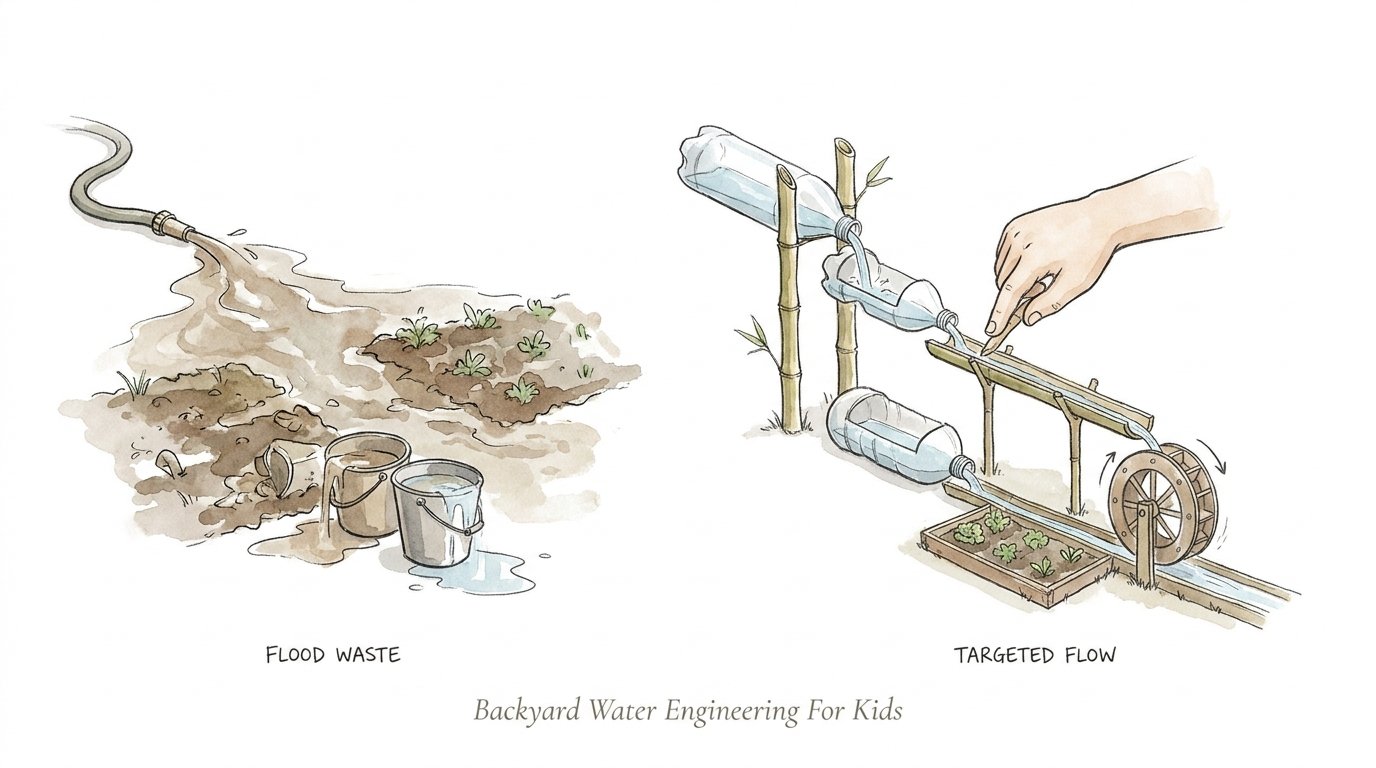
Flood Waste vs. Targeted Flow
A primary goal of this activity is moving from “Flood Waste” to “Targeted Flow.” This comparison helps children understand the value of water as a resource.
| Factor | Flood Waste (Standard Hose Play) | Targeted Flow (Aqueduct Engineering) |
|---|---|---|
| Water Usage | High (often hundreds of gallons/hour) | Low (often recirculated or used for irrigation) |
| Educational Value | Minimal (sensory only) | High (physics, math, logic) |
| Yard Impact | Large muddy pits and runoff | Controlled drainage or garden watering |
| Duration of Play | Short (until bored or soaked) | Extended (hours of building and testing) |
Targeted flow emphasizes efficiency. When a child sees that they can water an entire garden bed using just one bucket of water moved through a well-designed aqueduct, they begin to see the world through the lens of a conservationist.
Practical Tips and Best Practices
Maximizing the success of your backyard project requires a few “pro-level” adjustments.
- Use a “Header Tank”: Instead of sticking the hose directly into the run, fill a large 5-gallon bucket with a small spigot at the bottom. This provides a consistent flow rate, making it easier to diagnose slope issues.
- Color the Water: Adding a few drops of food coloring makes the water’s movement much more visible. This is especially helpful for identifying “dead zones” where water is pooling and stagnating.
- Incorporate Natural Elements: Encourage your child to use rocks and sand within the channels. This mimics a riverbed and introduces the concept of sediment transport and how obstacles create “eddies.”
- Document the Build: Have the child draw a “blueprint” before building and take “as-built” photos afterward. Comparing the plan to the reality is a fundamental practice in professional engineering.
Advanced Engineering Considerations
For kids who have mastered the basics, it is time to introduce more complex hydraulic components. These elevate the system from a simple slide to a functional machine.
The Archimedes’ Screw
This ancient device uses a rotating screw inside a hollow pipe to lift water against gravity. Building one from a PVC pipe and flexible tubing teaches children about rotational energy. It provides a way to move water from the bottom “reservoir” back to the top of the aqueduct, creating a self-sustaining cycle.
Siphons
A siphon allows water to flow “uphill” temporarily by using atmospheric pressure. This seems like magic to a child but is actually a brilliant demonstration of how pressure differentials work. Teaching a child how to “prime” a siphon using a simple garden hose or clear vinyl tubing opens up a world of possibilities for multi-level designs.
Check Valves and Gates
Introduce the concept of “control flow.” Using simple plastic flaps or even “dams” made of clay allows the child to divert water to different branches of the aqueduct. This simulates how modern water treatment plants and hydroelectric dams manage enormous volumes of water with precision.
Example Scenario: The Garden Irrigation Grid
Imagine your child wants to water three different potted plants at the far end of the yard. Instead of carrying a heavy watering can, they decide to build a 20-foot aqueduct.
They start the run on the top rail of the deck (the high head). They use split pool noodles for the long straightaways because they are lightweight and easy to support. As the run approaches the garden, they use a “Y-junction” made from a PVC T-fitting.
To ensure all three plants get equal water, they must calculate the flow distribution. They discover that if one branch is steeper than the others, it “steals” all the water. They have to adjust the supports (the trestles) until the flow is perfectly balanced. By the time the plants are watered, the child has successfully performed a multi-variable engineering task without even realizing they were “studying.”
Final Thoughts
Transforming backyard water play into an engineering project is one of the most rewarding ways to spend a summer afternoon. It replaces mindless consumption with active creation. Your child stops being a spectator and starts being a builder of systems, a solver of problems, and a steward of resources.
The beauty of water engineering is that the laws of physics never change. The same gravity that pulls water down a plastic gutter is the one that powers the world’s greatest waterfalls and sustains our global agricultural systems. Every leak fixed and every slope adjusted is a small victory for the scientific mind.
Encourage your child to look at the world through this new lens. Next time you see a storm drain or a roadside ditch, ask them how they would improve the flow. These small conversations are the seeds of a future career in science, technology, or engineering. Start building today, and watch as your yard becomes a vibrant laboratory of fluid dynamics.
Sources
1 cmsouthernmn.org | 2 khanacademy.org | 3 asla.org | 4 goric.com | 5 kidsdiscover.com | 6 youtube.com | 7 msstate.edu | 8 imthecheftoo.com | 9 si.edu | 10 greeneswcd.org | 11 google.com | 12 youtube.com | 13 uni.edu