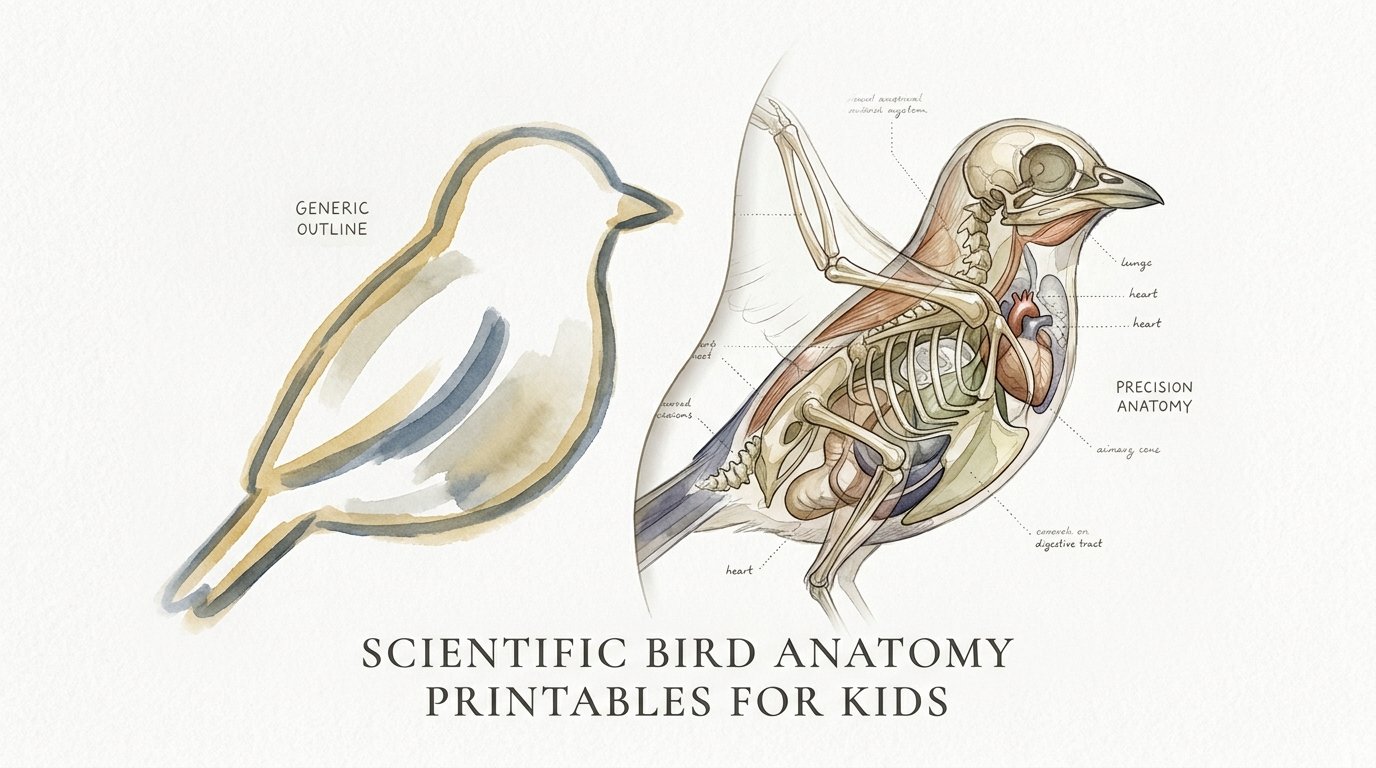
Scientific Bird Anatomy Printables For Kids
Are you teaching them to stay inside the lines or to understand the mechanics of flight? We’ve been feeding our kids ‘dumbed down’ versions of nature for years. A child’s brain is capable of mastering complex biological systems if we give them the right tools. Trade the generic coloring books for precision field guides and watch their observation skills explode.

You might think a six-year-old isn’t ready for terms like “furcula” or “proventriculus.” You would be wrong. Children are natural taxonomists. They love to name things, categorize them, and understand how they work. When we give them a generic bird outline, we rob them of the chance to see the genius of evolution.

Scientific bird anatomy printables for kids bridge the gap between art and ornithology. These aren’t just pages to fill with blue or red crayon. They are maps of biological engineering. They show how a creature weighing less than a lemon can cross oceans.
In this guide, you will learn why precision matters in nature study. We will look at the specific systems that make birds unique. You will also discover how to use these tools to turn a backyard walk into a high-level biology lab.
Scientific Bird Anatomy Printables For Kids
Scientific bird anatomy printables for kids are specialized educational resources designed to teach avian biology through visual mapping. Unlike standard coloring pages, these printables feature accurate skeletal structures, muscular systems, and internal organs. They often include labels for specific feather types and bone names.
These tools exist because standard curriculum often oversimplifies the natural world. Most kids know birds have wings and beaks. Very few know that a bird’s “knees” actually bend backward because they are walking on their toes. These printables bring those fascinating realities to light.
Ornithologists and educators use these diagrams to build foundational scientific literacy. You will find them in nature centers, high-end homeschooling programs, and university-level introductory courses. They serve as a bridge between curiosity and formal science.
Visualizing the “unseen” parts of a bird helps kids understand behavior. When a child sees the size of a bird’s pectoral muscles on a diagram, they understand why the bird needs to eat so much. The printable becomes a key that unlocks the “why” behind the “what.”
How Bird Anatomy Works: A Deep Dive for Young Learners
Bird anatomy is a masterclass in weight reduction and power. Every part of a bird is optimized for one of two things: flight or survival. When kids use scientific printables, they start to see these connections immediately.
The Skeletal System: Hollow and Strong
Birds have pneumatic bones. These are hollow bones filled with air sacs. This makes the skeleton incredibly light but still strong enough to withstand the pressures of flight. A bird’s skeleton often weighs less than its feathers.
The furcula, or wishbone, acts like a spring. It stores and releases energy during each wingbeat. Kids can find the furcula on a skeleton printable and see how it connects to the shoulders. This helps them visualize the bird as a living machine.
The Digestive System: No Teeth, No Problem
Birds cannot afford the weight of heavy jaws and teeth. Instead, they have a multi-stage digestive system. Food goes into the crop first for storage. This is a “doggy bag” that allows them to eat quickly and fly to safety to digest.
Next, food enters the proventriculus, where acids break it down. Then it hits the gizzard. This muscular organ often contains small stones or grit. The gizzard grinds the food just like teeth would. Mapping this on a printable helps kids understand how birds “chew” without a mouth.
The Respiratory System: Constant Oxygen
Birds have a “one-way” breathing system. While humans breathe in and out through the same tubes, birds use air sacs to keep air moving in a continuous loop. This means their lungs always have fresh, oxygen-rich air.
This high-efficiency system is what allows birds to fly at high altitudes where oxygen is thin. A scientific printable showing the anterior and posterior air sacs is essential here. It explains why a bird doesn’t get “winded” as easily as we do.
Benefits of Using Precision Anatomy Resources
Teaching with precision changes how a child’s brain processes information. It moves them from passive observation to active analysis. Precision printables offer several measurable advantages over generic alternatives.
Scientific illustration uses “dual coding.” This is a cognitive process where the brain stores information both visually and verbally. When a child labels a “remex” feather while looking at its asymmetrical shape, the memory sticks. It becomes a permanent part of their mental library.
Fine motor skills get a massive boost from these resources. Scientific printables require more control than a blank coloring page. Staying within the lines of a delicate humerus or radius bone builds the dexterity needed for writing and surgery alike.
These tools also foster a sense of “real” science. Children can tell when they are being given “kiddie” versions of a topic. Providing them with professional-grade diagrams shows them that you respect their intellect. This builds confidence and a lifelong love of STEM.
Challenges and Common Mistakes to Avoid
Many parents and teachers jump into bird anatomy without a plan. This can lead to overwhelm. The most common mistake is trying to teach every system at once. A bird has eleven major anatomical systems. Trying to label them all in one afternoon is a recipe for frustration.
Another pitfall is focusing on the name rather than the function. Knowing the word “pygostyle” is useless if the child doesn’t know it supports the tail feathers. Always link the anatomical part to a real-world action. Ask, “How does this part help the bird fly or eat?”
Using low-quality or inaccurate printables is also a risk. The internet is full of “bird diagrams” that are anatomically incorrect. Some show the legs bending at the wrong joints or put the crop in the wrong place. Always source your printables from reputable ornithology labs or science-based creators.
Finally, do not treat the printable as a test. It should be an exploration. If a child gets a label wrong, use it as a chance to look at a photo or a real bird. Science is about correcting models, not just being right on the first try.
Limitations of Anatomy Printables
Printables are powerful, but they have limits. A 2D piece of paper can never fully capture the 3D reality of a living bird. You cannot see the way a feather twists in the wind on a static page. Printables are a map, not the territory.
Environmental context is often missing from these diagrams. An anatomy sheet might show the heart, but it won’t show how that heart rate triples when a hawk is nearby. Printables should always be paired with field observation.
Some children may find the “clinical” nature of scientific diagrams less engaging than creative art. For these kids, the transition from generic coloring to scientific labeling needs to be gradual. You might need to blend the two approaches to keep their interest high.
Budget and access can also be a factor. High-quality, scientifically accurate printables often require a subscription or a specific curriculum purchase. While free versions exist, they may lack the depth needed for a serious practitioner.
Generic Outlines vs. Precision Anatomy
| Feature | Generic Coloring Page | Precision Anatomy Printable |
|---|---|---|
| Learning Goal | Color recognition and fun. | Biological understanding and logic. |
| Observation Skill | Low; focuses on the “idea” of a bird. | High; identifies specific structures. |
| Vocabulary | Basic (beak, wing, tail). | Advanced (keel, primary, crop). |
| Cognitive Load | Light; passive. | Medium to High; active analysis. |
Practical Tips for Teaching Bird Anatomy
Start with the feathers. They are the most accessible part of bird anatomy. Have kids find a feather outside and then use a “Feather Anatomy” printable to identify the rachis, barbs, and calamus. This immediate connection to the real world makes the paper come alive.
Use the “Build a Bird” method. Give the child a skeleton printable first. Once they understand the bones, overlay it with a muscular system sheet. Finally, add the feathers. Layering the systems helps them understand how the body is integrated.
Bring the printable into the kitchen. If you are preparing a whole chicken for dinner, you have a perfect anatomy lesson. Use your scientific bird anatomy printables for kids to identify the drumstick (tibiotarsus) or the wing (humerus, radius, ulna). Seeing the “real thing” confirms the diagram’s accuracy.
Encourage nature journaling alongside the printables. Have your student draw what they see at the bird feeder. Then, ask them to use their anatomy knowledge to explain why the bird is moving that way. Did that cardinal just use its gizzard to crack a seed? No, it used its beak! But the gizzard is working hard inside.
Advanced Considerations for Serious Practitioners
If you want to take bird study to the next level, look into feather mechanics. Not all feathers are for flight. Remiges (wing feathers) and rectrices (tail feathers) have specific asymmetrical shapes to create lift. Understanding the “vane” and the “leading edge” is advanced physics.
Skeletal fusion is another deep topic. Birds have many bones fused together, like the carpometacarpus in the wing. This provides the rigidity needed for flight. Comparing a bird’s “hand” bones to a human’s hand bones on a printable is a great lesson in comparative anatomy.
Investigate the role of the sclerotic ring. This is a ring of bone inside the eye of many birds. It helps hold the eye’s shape, especially in diving birds or raptors. Most generic bird guides ignore this, but it is a fascinating piece of engineering for an advanced student.
Scaling is also critical. A hummingbird’s heart beats 1,200 times per minute. An eagle’s heart beats much slower. Discussing how anatomy changes based on size and metabolic rate moves the lesson from simple identification to complex systems biology.
Example Scenario: The Backyard Blue Jay Investigation
Imagine a child watching a Blue Jay at a feeder. Usually, they would just say, “It’s a blue bird.” With a scientific printable in hand, the conversation changes. They notice the bird “pumping” its tail as it lands.
They look at their tail anatomy sheet. They identify the rectrices and realize the bird is using them as air brakes. They notice the bird grabbing a sunflower seed and flying away. They check the digestive system printable.
“He’s putting it in his crop!” the child says. They realize the bird isn’t eating it immediately; it’s storing it. Later, the child finds a blue feather on the lawn. They pull out their feather structure printable and look through a magnifying glass.
They see the tiny hooks (barbules) that act like Velcro. They “unzip” the feather and then “zip” it back together by smoothing it. They have just learned about pennaceous structure and preening. That one bird at the feeder is no longer just a “blue bird”; it is a living laboratory.
Final Thoughts
Scientific bird anatomy printables for kids are more than just paper and ink. They are invitations to see the world with more clarity and precision. By moving away from generic outlines, we give children the chance to engage with the actual mechanics of life.
This approach builds a foundation of scientific literacy that will serve them in every subject. It teaches them that the world is complex, beautiful, and understandable. When they learn to look for the keel of a bird or the barbs of a feather, they are learning how to be scientists.
Don’t be afraid of the “hard” words or the “complex” diagrams. Children are more capable than we often give them credit for. Start with one printable, a pair of binoculars, and a little curiosity. You might be surprised at how quickly their understanding of flight takes off.
Sources
1 allaboutbirds.org | 2 homesciencetools.com | 3 pheasant.com | 4 feathersnapcam.com | 5 extension.org | 6 aavac.com.au | 7 allaboutbirds.org | 8 fws.gov | 9 avianreport.com | 10 allaboutbirds.org | 11 scienceofbirds.com | 12 petco.com | 13 birdsandblooms.com | 14 thehomeschooldaily.com