Heritage Seed Saving For Kids
Why did our ancestors never have to buy seeds, and why have we forgotten the secret to an infinite harvest? We have traded 10,000 years of nutritional security for a packet of seeds that won’t even grow back next year. While modern seeds are designed for one-time use and corporate dependency, ancestral seeds were designed for legacy. Our new Seed Saving Printable Kit teaches your child to identify, harvest, and preserve the heritage varieties that our ancestors used to build civilizations.

Teaching a child to save seeds is like handing them the keys to a biological vault. It transforms them from a passive consumer into a producer of life. In a world where food systems feel increasingly fragile, this skill is a superpower.
Think about the history hidden in your garden. For millennia, farmers selected the best-tasting, hardiest plants and saved their offspring. This process created a massive living library of genetic diversity that was perfectly adapted to local soils. Today, we can reclaim that tradition right in our own backyards.
Every seed is a tiny time capsule of survival. When your child learns to crack open a dried bean pod or ferment a tomato seed, they are participating in a ritual older than written language. It is the ultimate lesson in patience, stewardship, and real-world science.
Heritage Seed Saving For Kids
Heritage seed saving is the practice of collecting, cleaning, and storing seeds from open-pollinated plants to grow again in future seasons. Unlike modern industrial seeds, these varieties have been handed down through generations of families and communities. They are the same plants that fed your great-grandparents.
This practice exists because it ensures the survival of specific plant traits like flavor, color, and disease resistance. In the real world, it is the foundation of food sovereignty and biodiversity. Without seed savers, thousands of unique vegetable varieties would simply vanish from the earth.
Imagine your garden as a family album. Each plant has a story, and saving the seeds is how we write the next chapter. It is used today by home gardeners, small farmers, and global seed banks to protect our planet’s nutritional future.
For children, this is a hands-on laboratory. They see the entire life cycle of a plant, from the first sprout to the final drying pod. It simplifies complex concepts like genetics and ecology into something they can hold in their hands.
How the Seed Saving Process Works
The journey from a flower to a stored seed follows a natural rhythm that kids can easily track. It starts with choosing the right plants. You only want to save seeds from your strongest, healthiest, and most delicious “parent” plants.
Pollination is the first step in the secret life of a seed. Insects, wind, or even a child with a paintbrush moves pollen between flowers to create the next generation. Once the plant is pollinated, it focuses all its energy on ripening those precious embryos.
Harvesting is the most exciting part for young gardeners. For “dry” seeds like beans or peas, you wait until the pods are brown, crispy, and rattle when shaken. For “wet” seeds like tomatoes or cucumbers, you wait until the fruit is fully ripe—sometimes even overripe.
Processing varies depending on the type of plant. Some seeds need a simple winnowing to blow away the chaff, while others need a short bath to remove protective gels. After cleaning, the seeds must be dried completely until they are hard enough to pass the “fingernail test.”
The Incredible Benefits of Saving Seeds
The most immediate benefit is financial freedom. Once you learn to save seeds, you never have to buy another packet of that variety again. One single tomato can provide enough seeds to plant an entire acre the following year.
Beyond the money, there is the advantage of local adaptation. Each year you save seeds from your own garden, those plants become better suited to your specific soil and climate. They become “custom-built” for your backyard, making them more resilient than store-bought options.
- Educational Mastery: Kids learn biology, math, and history through a single seasonal project.
- Nutritional Security: You control the genetics of your food, ensuring access to high-nutrient heirloom varieties.
- Legacy Building: Children can start their own seed collection to pass down to their own kids someday.
- Environmental Stewardship: Preserving rare varieties protects the planet’s genetic diversity against climate shifts.
It also fosters a deep sense of accomplishment. Watching a seedling grow from a seed you harvested yourself creates a level of pride that a store-bought transplant can never match. It teaches children that they have the power to sustain themselves.
Challenges and Common Mistakes
The most frequent error is harvesting too early. It is tempting to pick seeds as soon as the plant looks done, but immature seeds lack the energy to sprout. They must reach full physiological maturity on the plant to be viable.
Moisture is the ultimate enemy of the seed saver. If you store seeds that still have a tiny bit of dampness inside, they will grow mold or rot in their jars. Using a desiccant packet or performing a “snap test” on larger seeds can prevent this disaster.
Cross-pollination is another “silent” mistake that frustrates beginners. If you grow two different varieties of squash next to each other, the bees will mix them up. The resulting seeds might grow into a “mystery” vegetable that doesn’t taste anything like the original parents.
Labeling is a step that seems easy but is often forgotten in the excitement. A jar of brown seeds looks exactly like every other jar of brown seeds after six months. Always mark your containers with the variety name and the year of harvest immediately.
Limitations and Realistic Constraints
Not every plant is a good candidate for seed saving in every climate. Some plants, like carrots or onions, are biennials. This means they take two full years to produce seeds, which can be difficult in areas with extreme winters or limited garden space.
Space is a major constraint for serious seed purity. To prevent cross-pollination, some species require hundreds of feet—or even miles—of distance from other varieties. This makes saving seeds from crops like corn or pumpkins challenging in small suburban neighborhoods.
Population size also matters for genetic health. If you only save seeds from one single plant every year, the variety can eventually lose its vigor. To keep a lineage strong, you often need to save seeds from at least 5 to 20 different plants of the same type.
Finally, some modern hybrids are specifically designed to be sterile or “unstable.” If you try to save seeds from a typical grocery store tomato, you might end up with a plant that produces no fruit at all. This is why sticking to heritage and heirloom varieties is essential for success.
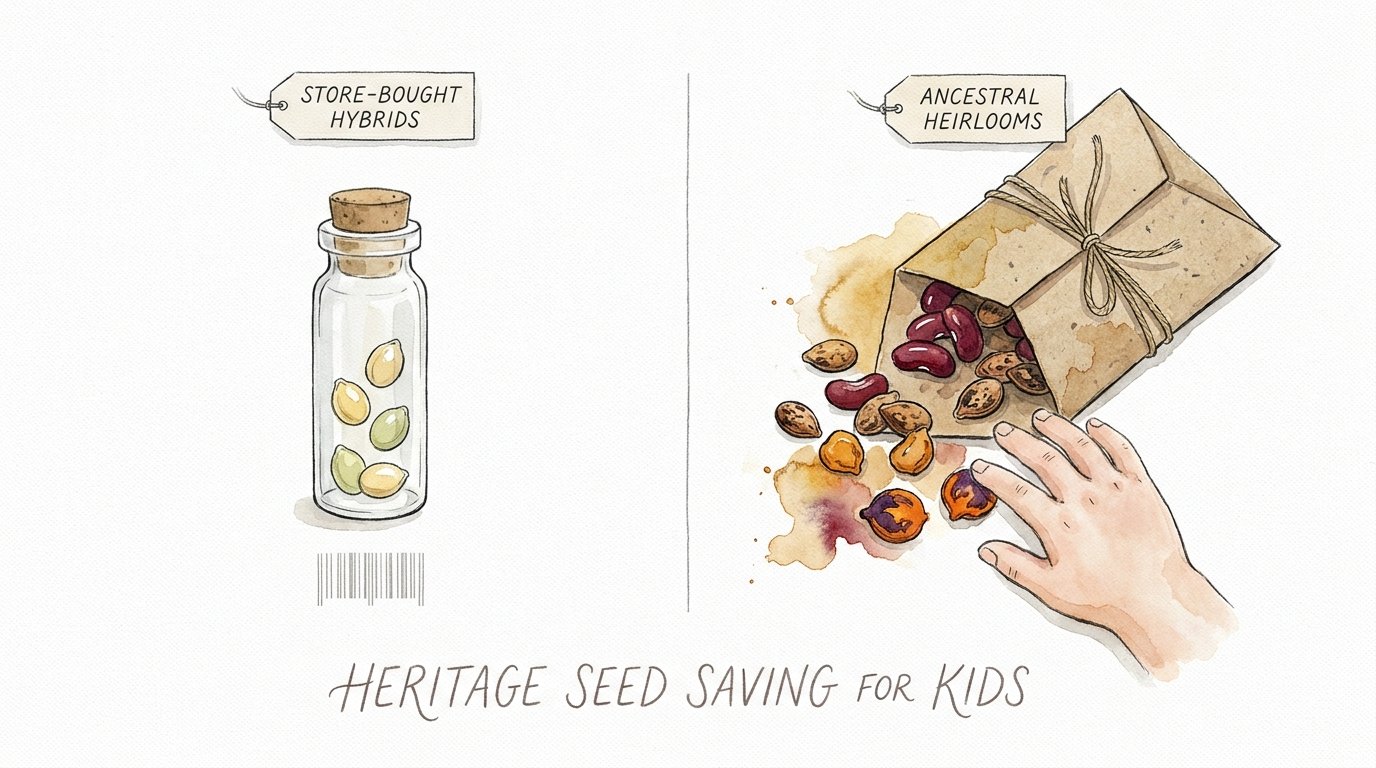
STORE-BOUGHT HYBRIDS vs ANCESTRAL HEIRLOOMS
| Feature | Store-Bought Hybrids (F1) | Ancestral Heirlooms |
|---|---|---|
| Predictability | High in the first year only. | High, generation after generation. |
| Seed Saving | Usually impossible; offspring won’t be “true.” | Easy; offspring are identical to parents. |
| Flavor Profile | Bred for shipping and shelf-life. | Bred for taste, sweetness, and complexity. |
| Cost | Requires annual purchase. | Free after the initial investment. |
| Resilience | Uniform; high risk of total crop failure. | Diverse; better adapted to local stress. |
The comparison reveals a clear trade-off between convenience and security. Hybrids are perfect for commercial farms that need every tomato to look identical. Heirlooms are for the family that wants a legacy of flavor and independence.
Practical Tips for Beginners
Start with the “Easy Three”: Peas, Beans, and Tomatoes. These plants are mostly self-pollinating, meaning they rarely cross-pollinate with their neighbors. They are the perfect “entry-level” crops for a child’s first seed-saving project.
Wait for the “crunch” when saving beans. The pods should feel like dry parchment paper before you open them. If you can’t snap the pod easily with your fingers, the seeds inside are likely still too wet for storage.
- Use Paper Bags: Collect seed heads in brown paper bags to catch seeds as they fall and allow for airflow.
- Ferment Tomatoes: Squeeze tomato seeds into a jar with a bit of water for 3 days to remove the sprout-inhibiting gel.
- The Freezer Trick: Storing fully dry seeds in the freezer can triple their lifespan.
- Shadow a Professional: Visit a local botanical garden or seed swap to see how the pros clean their harvests.
Encourage your child to keep a “Seed Journal.” Recording when the first flower opened and when the seeds were finally dry helps them understand the timing of nature. It turns a garden chore into a scientific investigation.
Advanced Considerations for Serious Practitioners
Isolation distances are the key to maintaining “true-to-type” seeds. While 10 feet is enough for most tomatoes, wind-pollinated crops like corn may need up to half a mile of distance to prevent unwanted mixing. Understanding these distances allows you to produce high-quality seeds for trade.
Hand-pollination is a technique used when space is tight. You can manually move pollen with a brush and then tape the flower shut or bag it to prevent insects from bringing in outside pollen. This gives you total control over the genetics of your harvest.
Genetic bottlenecking is a risk when saving from too few plants. Professional seed savers look for “population minimums” to ensure the variety stays healthy. For example, while you can save seeds from one cabbage plant, saving from 60 plants ensures the maximum genetic diversity for the future.
Consider the “Long Storage” method for rare varieties. Using vacuum-sealed Mylar bags with oxygen absorbers can keep some seeds viable for decades. This is how “doomsday” seed vaults operate, and you can mimic these techniques on a smaller scale at home.
Scenario: The “Glass Gem” Corn Experiment
Imagine a family planting a small patch of “Glass Gem” corn, a famous heirloom known for its translucent, rainbow-colored kernels. The children are tasked with selecting the three most beautiful ears from the harvest to be the “Seed Kings” for next year.
Throughout the winter, those ears hang in the kitchen, drying until the kernels are as hard as flint. In the spring, the kids shell the corn by hand, feeling the different textures of each color. They count out 100 seeds and plant them in a square block to ensure good pollination.
Because they saved seeds from the most vibrant ears, the second year’s harvest is even more colorful than the first. This is a real-world demonstration of selection. The children haven’t just grown a garden; they have actively improved a piece of living history.
Final Thoughts
Heritage seed saving is one of the few skills that pays dividends for a lifetime. It bridges the gap between the ancient past and an uncertain future. By teaching a child to save seeds, you are giving them the ultimate tool for self-reliance and environmental connection.
This journey starts with a single plant and a little bit of curiosity. You don’t need a farm or a degree in botany to be a guardian of the harvest. You only need the willingness to slow down and listen to what the plants are telling you as they go to seed.
Take the first step this season. Pick one variety of heirloom vegetable, watch it through its entire life cycle, and tuck those seeds away for next year. You will find that the more you give to the garden, the more it gives back—infinitely.
Sources
1 abundantborders.org.uk | 2 naturespath.com | 3 ucanr.edu | 4 burpee.com | 5 growveg.com | 6 homesteadingfamily.com | 7 greatamericanseedup.org | 8 seeds.ca | 9 medium.com | 10 growveg.com | 11 threeacrefarm.net | 12 joegardener.com | 13 seedsavers.org | 14 savingourseeds.org | 15 almanac.com | 16 farmaction.us | 17 kristitrimmer.com | 18 veggiegardenseeds.com.au | 19 botanicalinterests.com