Kinetic Math Activities For Kids
If math only lives on a piece of paper, your child’s brain will eventually treat it like a chore. For centuries, math was an observation of the physical world. Today, we’ve reduced it to symbols on a dead piece of paper. Living mathematics integrates physical movement and tactile feedback, ensuring the concepts are literally ‘felt’ by the nervous system. Stop the rote paper-shuffling and start the physical investigation.
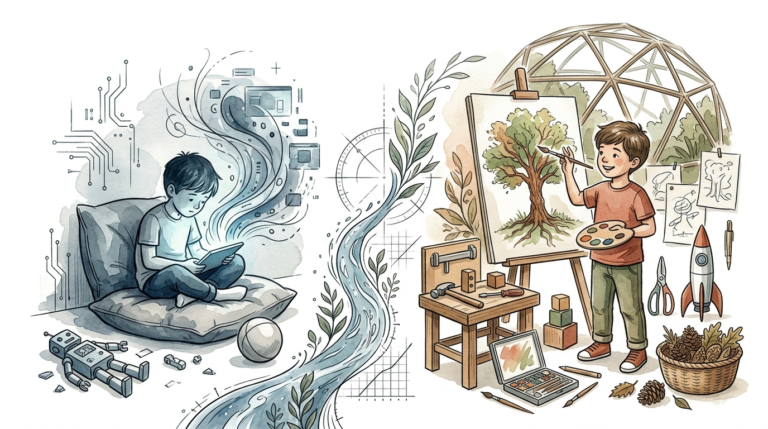
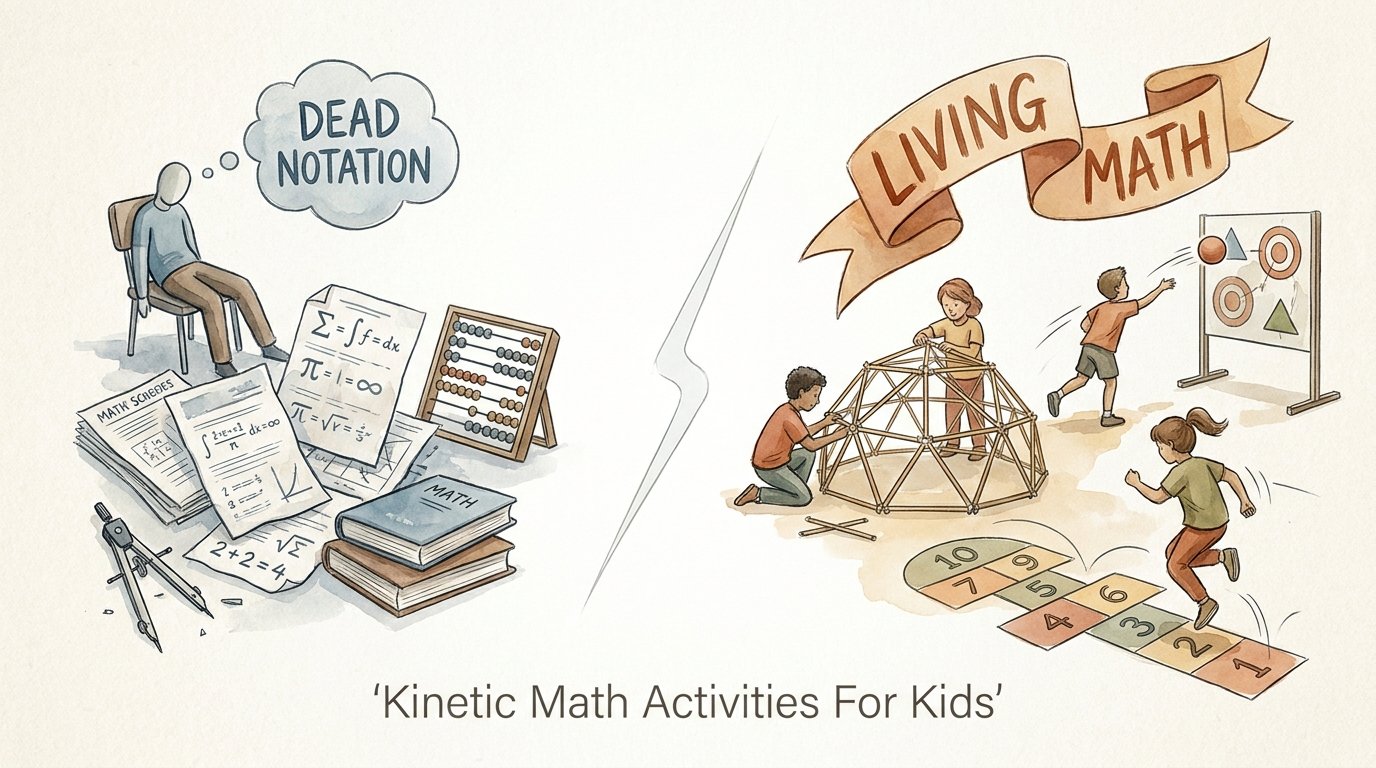
Math is not a spectator sport. When kids sit still for hours staring at black ink on a white page, their brains often go into a low-power mode. They see symbols as obstacles to overcome rather than tools for understanding reality. This gap between the abstract symbol and the physical truth is what we call DEAD NOTATION.
Switching to LIVING MATH changes everything. Kinetic math activities involve the whole body, turning a bedroom or a playground into a laboratory. This approach doesn’t just make math “fun.” It builds a bridge between the motor cortex and the logical centers of the brain. When a child jumps a distance or builds a structure, their muscles are doing the math before their conscious mind even writes it down.
Kinetic Math Activities For Kids
Kinetic math refers to any learning experience where physical movement is the primary vehicle for understanding mathematical concepts. This is also known as kinesthetic learning or embodied cognition. Instead of just seeing 2+2=4, a child experiences the “fourness” through four claps, four jumps, or walking four steps.
This method exists because human brains evolved to solve problems in motion. Ancient navigators calculated distances using the stars while physically steering ships. Builders measured the geometry of cathedrals with their feet and hands. In the real world, math is used to calculate the trajectory of a soccer ball, the weight of groceries, or the angles needed to build a bookshelf.
Kinetic activities translate these real-world uses into the classroom or home. Examples include walking a giant number line to understand negative numbers or using a jump rope to internalize multiplication tables. This movement creates a “physical anchor” for the memory. Research suggests that active participation can lead to retention rates as high as 75%, compared to only 10% for passive reading.
How To Implement Movement-Based Math
Starting with kinetic math requires shifting the focus from the worksheet to the environment. Start small and build up the complexity as your child becomes comfortable with the physical-to-abstract transition.
The Human Number Line
Create a large number line on the floor using masking tape or sidewalk chalk. Mark a center point as zero and extend positive and negative integers in opposite directions. Ask your child to “be the number” by standing on a specific spot.
To teach addition, have them walk forward. To teach subtraction, have them walk backward. This physical movement through space makes the concept of “moving toward zero” or “crossing into negatives” intuitive. They aren’t just flipping symbols; they are changing their position in the room.
Body-Base-10 and Geometry
Use the body to represent different values or shapes. For place value, a single child can be a “one,” ten children holding hands can be a “ten,” and a square of children can represent a “hundred.” In geometry, have children use their arms to form acute, obtuse, and right angles.
The Math Scavenger Hunt
Give your child a list of mathematical “targets” to find in the house or yard. They might need to find three objects with a combined weight of exactly five pounds or locate five right angles in the kitchen. Moving from room to room to solve these problems keeps the heart rate up and the brain engaged.
The Biological Benefits of Motion
Movement-based math provides measurable advantages for cognitive development. When children move, their bodies release endorphins and dopamine. These “happy chemicals” reduce math anxiety and create a positive emotional association with the subject.
Increased blood flow is another major factor. Physical activity boosts oxygen levels in the brain, which optimizes executive function and attention. Studies show that children with ADHD see a 48% improvement in attention levels when movement is integrated into their learning process.
Muscle memory also plays a vital role. Concepts like skip counting become rhythmic. A child who claps on every third number is using their motor cortex to “buffer” the multiplication sequence. This multi-sensory approach ensures that even if they forget the visual symbol, they remember the physical beat of the number.
Challenges and Common Pitfalls
The most frequent mistake is letting the movement overshadow the mathematics. If a game becomes too high-energy, the “math” part can get lost in the excitement. The child might focus entirely on winning a race rather than the equation they need to solve to get to the finish line.
Space is another common hurdle. Not every home or classroom has a 20-foot area for a number line. Many parents feel discouraged if they can’t set up elaborate obstacle courses. However, kinetic math doesn’t require a gymnasium. Even small movements, like finger-tracing numbers in shaving cream or standing up for every even number, can be effective.
Noise levels often rise during active learning. Educators and parents sometimes shut down kinetic activities because they feel “chaotic.” It is important to distinguish between “productive noise” (discussion and problem-solving) and “unproductive noise” (pure shouting). Setting clear expectations before the activity starts is essential for maintaining control.
Limitations of the Kinetic Approach
Physical mathematics is a powerful tool, but it is not a complete replacement for abstract notation. Eventually, math becomes too complex to walk out on a floor. High-level calculus or complex imaginary numbers require a level of abstraction that physical movement cannot fully represent.
Environmental constraints also play a role. Outdoor activities are weather-dependent, and indoor activities may be limited by furniture or safety concerns. Some children with physical disabilities may also find certain kinetic activities frustrating if they are not properly adapted for their specific needs.
Relying solely on movement can also lead to a “dependency” on physical aids. The goal of kinetic math is to build a mental model. If a child can only solve 5+5 by jumping 10 times, they haven’t yet reached the necessary level of fluency. The movement should be a scaffold, not a permanent crutch.
Dead Notation vs. Living Math
Understanding the difference between these two approaches helps you decide when to use each.
| Feature | Dead Notation (Traditional) | Living Math (Kinetic) |
|---|---|---|
| Primary Input | Visual (Reading symbols) | Tactile & Kinetic (Movement) |
| Engagement | Passive (Sitting) | Active (Moving) |
| Brain State | Logical/Symbolic only | Multi-sensory/Motor Cortex |
| Retention | Lower (Rote memorization) | Higher (Muscle memory) |
| Best For | Speed and Abstract proofs | Conceptual understanding |
Practical Tips for Success
Establish clear boundaries before any movement begins. Use a specific signal, like a bell or a “freeze” command, to bring everyone back to focus. This prevents the energy from spiraling into total chaos.
Integrate movement into transitions. If you are moving from the kitchen to the living room, ask your child to walk in “half-steps” or “double-steps.” This turns dead time into a mini-lesson on fractions or multiplication.
Use simple props to increase tactile feedback. Bean bags, hula hoops, and jump ropes are inexpensive but high-value tools. Throwing a bean bag onto a specific number on a chalk grid adds a hand-eye coordination challenge that reinforces the numerical target.
Encourage your child to “narrate” their movement. Ask them, “Why did you have to take three more steps to reach ten?” This forces them to translate their physical experience back into logical language.
Advanced Considerations: Vectors and Trigonometry
For older students, kinetic math can tackle advanced topics like vectors and trigonometry. A vector is simply a quantity with both magnitude (size) and direction. You can teach this through “Mathematical Orienteering.”
Give the student a “path” to follow: walk 10 meters at 45 degrees, then 5 meters due north. By physically walking these paths, they understand that the “resultant” (the straight line from start to finish) is the sum of those vectors. This makes the math of triangles and bearings feel like a real-world navigation problem rather than a set of confusing formulas.
Trigonometry can also be visualized through body ratios. Have a student stand next to a tree and measure their own shadow and height. By comparing the two, they can calculate the height of the tree using the tangent of the sun’s angle. This physical investigation proves that math is a universal code for the environment around them.
Example: The Coordinate Plane Game
Imagine a giant coordinate grid taped onto the driveway. The X-axis runs horizontally, and the Y-axis runs vertically. Two children stand at the origin (0,0).
Give them a set of “coordinates” to reach. For example, “Move to (3, -2).” The child must process that the first number means three steps to the right and the second number means two steps “down” or backward.
Introduce “Transformations” for a greater challenge. Tell the child on (3, -2) to “Reflect over the X-axis.” They must realize they need to jump to (3, 2). This immediate physical feedback makes the abstract rules of the coordinate plane much harder to forget.
Final Thoughts
Living mathematics is about returning math to its roots. By integrating movement, we allow children to experience concepts through their nervous system before they ever pick up a pencil. This builds a foundation of confidence that symbols on a page can never provide alone.
The goal is not to abandon worksheets forever but to ensure that when a child sees a number, they have a physical memory to attach it to. Movement turns a “chore” into an investigation. It replaces the “Dead Notation” of rote memorization with the “Living Math” of the physical world.
Experiment with these activities in your daily routine. Start with a simple number line or a geometry scavenger hunt. You will likely find that as the body moves, the mind opens. Math is all around us; it is time to get up and find it.
Sources
1 theresjustonemommy.com | 2 reddit.com | 3 iheartteachingelementary.com | 4 planbook.com | 5 loveoutdoorlearning.com | 6 mathandmovement.com | 7 monstermath.app | 8 cognitivecardiomath.com | 9 curriculumresources.edu.gh | 10 nasa.gov | 11 nationalmathfoundation.org