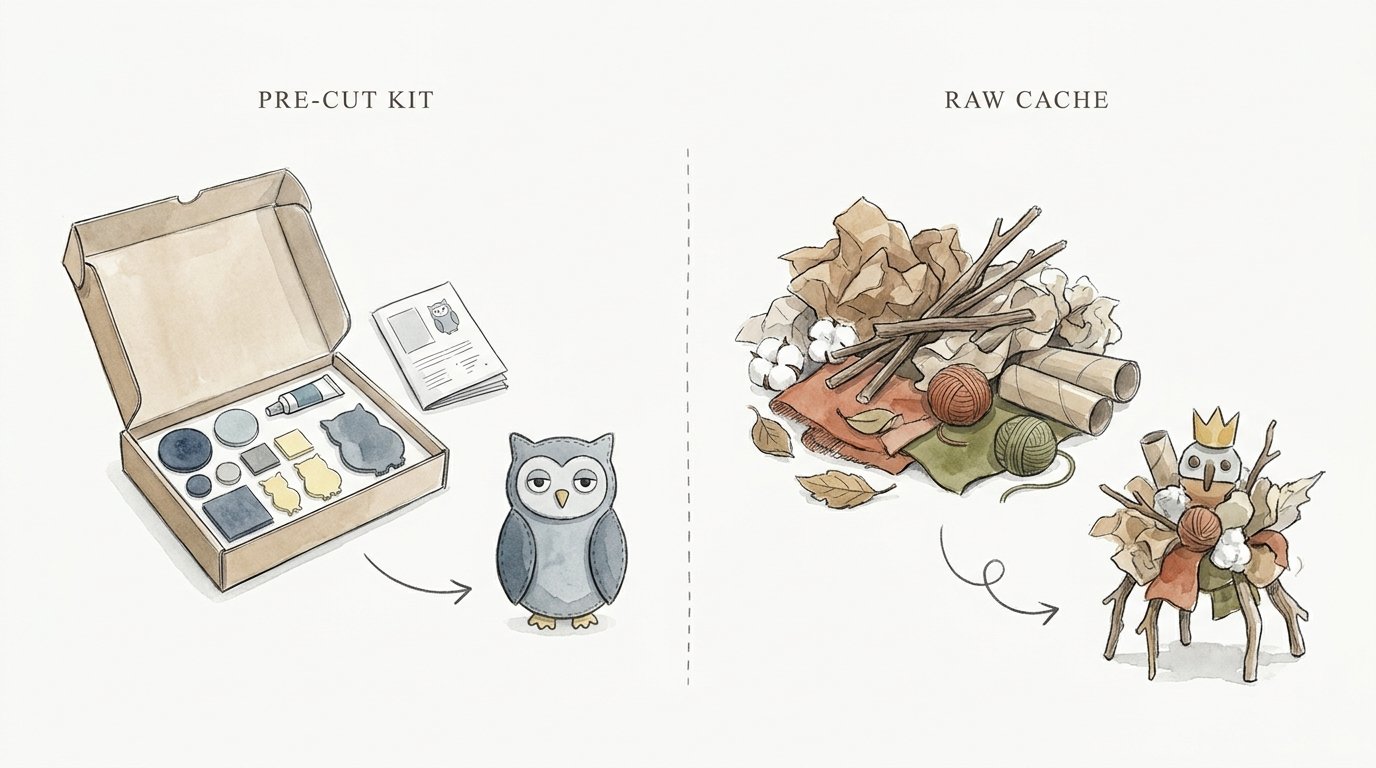
Why Craft Kits Stifle Child Creativity
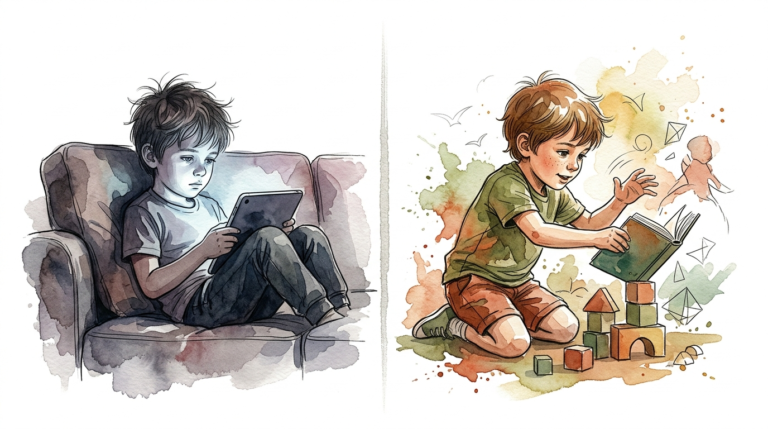
Is your child learning to follow an assembly line or are they learning to engineer from scratch? Craft kits turn children into consumers of someone else’s imagination. A ‘Raw Material Cache’—filled with wood, metal, and fiber—turns them into producers. One teaches them how to follow a manual; the other teaches them how to solve a problem. Choose the builder, not the assembler.

Parents often reach for the pre-packaged box because it is easy. It promises a “guaranteed outcome” and a tidy afternoon. But that convenience comes at a steep price. When the path is paved with numbered stickers and pre-cut slots, the brain goes on autopilot. True engineering happens in the mess.

The world needs problem solvers. It needs people who can look at a pile of discarded junk and see a solution. Creating a Raw Material Cache at home is the first step in cultivating that mindset. It shifts the goal from “finishing the kit” to “solving the challenge.”
Why Craft Kits Stifle Child Creativity
Craft kits are essentially three-dimensional coloring books. They provide every component, every measurement, and a final image on the box to replicate. This structure effectively eliminates “ill-defined problems.” In the real world, most problems are ill-defined. There is no manual for a leaking roof or a broken supply chain.
Following instructions trains the brain for compliance, not innovation. Research from experts in “Loose Parts Play” shows that fixed-outcome toys have a shelf life. Once the kit is assembled, the learning stops. The child has mastered the instruction manual, not the material itself.
Traditional kits create a fear of “doing it wrong.” If a child loses one specific plastic piece, the entire project is ruined. This fragility discourages experimentation. A child who is afraid of making a mistake will never take the creative risks necessary to become an engineer.
Copycat crafts lead to a classroom of identical squirrels. When every child produces the same result, they stop looking for their own voice. They start looking for the teacher’s approval or the box’s validation. This external validation kills the intrinsic drive to create.
The Anatomy of a Raw Material Cache
A Raw Material Cache is a curated collection of “loose parts.” These are materials that can be moved, combined, redesigned, and taken apart in endless ways. Unlike a kit, a cache does not have a “right” way to be used. It is a library of possibilities.
The Wood Cache
Wood is the foundation of structural engineering. It has grain, weight, and varying densities. Softwoods like pine and balsa are perfect for beginners. They are easy to saw, sand, and nail.
Stock your cache with offcuts from a local sawmill or hardware store. Include dowels of different diameters for axles and pivots. “Tree cookies”—thin slices of branches—make excellent wheels or platforms. Wood requires the child to understand friction and gravity.
The Metal Cache
Metal introduces conductivity, magnetism, and tensile strength. Soft copper wire is a powerhouse material. It can be bent by hand but holds its shape. Aluminum foil allows for quick prototyping and reflective surfaces.
Include hardware like nuts, bolts, and washers. These small metal parts teach fine motor skills and mechanical connections. Magnetic pieces add a layer of “invisible force” to their builds. Ensure all tin cans are de-burred and safe for handling.
The Fiber Cache
Fiber is about tension and flexibility. Twine, jute, and paracord are essential for lashing and binding. Fabric scraps from old clothes provide texture and skin for their structures.
Wool and yarn allow for weaving and soft connections. Fiber teaches children about knots and the strength found in braided materials. It is the “glue” that doesn’t need to dry. Using textiles also introduces the concept of sustainability and upcycling.
How to Build Your Cache: Step by Step
Setting up a cache is about curation, not just hoarding. You want a variety of materials that invite interaction. Start small and let the collection grow as your child’s skills evolve.
Step 1: Secure the Containers
Clear plastic bins are your best friend. Visibility is key to inspiration. If a child can’t see the copper wire, they won’t think to use it as a pulley cable. Label the bins clearly so cleanup becomes an exercise in organization.
Step 2: Source High-Quality “Junk”
Visit your local lumber yard and ask for “shorts” or scrap. Most shops will give these away for free. Raid the recycling bin for cardboard tubes and plastic lids. Buy a bulk pack of various-sized washers and nuts. These become the “connectors” of the cache.
Step 3: Introduce the Connectors
Materials need a way to stick together. Provide a range of tapes—masking, duct, and electrical. Add non-toxic wood glue and a low-temp glue gun for older children. Clamps and vices are vital; they act as a “third hand” during the building process.
Step 4: Provide the Right Tools
Real tools change the game. A small 7oz hammer is easier for a child to control than a plastic toy. A dovetail pull saw allows for precise cuts with minimal effort. Measuring tapes and levels introduce the language of geometry and physics.
Benefits of the Raw Material Approach
Open-ended play builds more than just birdhouses. It builds neural pathways. When a child works with raw materials, they are constantly performing “if-then” experiments. If I use this thin wire, will it hold the weight of the wood?
Cognitive Flexibility
Building from scratch requires a child to switch between concepts. They might start with a plan to build a boat, realize the wood is too heavy, and pivot to building a bridge. This ability to adapt is called cognitive flexibility. It is a primary indicator of future success in STEM fields.
Resilience and Perseverance
Failure is built into the cache. A structure will fall. A knot will slip. This is where the real learning happens. Instead of being “done,” the child is forced to troubleshoot. They develop the grit to try a second, third, or tenth time.
Spatial Awareness
Manipulating three-dimensional objects in space is the best way to learn math. Scaling a drawing to a physical piece of wood teaches proportions. Balancing a metal arm on a wooden base teaches center of gravity. These are lessons that a textbook cannot replicate.
Challenges and Common Mistakes
The biggest challenge is the mess. A Raw Material Cache is not a tidy hobby. It is an active workshop. Many parents abandon the approach because they cannot handle the sawdust and the half-finished projects.
Avoid the temptation to “fix” their work. When you step in to drive the nail or tie the knot, you steal the learning opportunity. Your role is that of a facilitator, not a lead engineer. Ask open-ended questions like, “How else could you attach those two pieces?”
Safety is a valid concern. Raw materials often have rough edges. Tools are sharp. Instead of banning these items, teach “tool respect.” Show them exactly how a saw works. Explain why we wear goggles. Controlled risk is a powerful teacher.
Don’t let the cache become a dump. If the bin is overflowing with useless scraps, it becomes overwhelming. Periodically go through the cache with your child. Decide what is worth keeping and what should be recycled. Curation keeps the inspiration fresh.
Limitations: When a Kit Might Be Useful
Kits are not entirely evil. They have a specific place in the learning ladder. When a child is first learning a highly technical skill, a kit provides the “scaffolding” they need to succeed.
Learning to solder or code a specific sensor can be daunting. A well-designed kit can introduce these specialized tools without the frustration of sourcing a dozen different components. It acts as a controlled environment for a new technique.
Time is another factor. Sometimes, you only have an hour. A kit provides a contained experience with a clear start and finish. However, the kit should always be viewed as a tutorial—a stepping stone toward using those same parts in the Raw Material Cache later.
Comparing the Builder and the Assembler
| Feature | The Assembler (Kit-Based) | The Builder (Cache-Based) |
|---|---|---|
| Goal | Replicate the image on the box. | Solve a specific functional problem. |
| Mental State | Following instructions (Compliance). | Design thinking (Innovation). |
| Skill Development | Fine motor and matching. | Physics, engineering, and grit. |
| Cost | High (One-time use). | Low (Sustainable and reusable). |
| Outcome | Predictable and uniform. | Unique and adaptable. |
Practical Tips for Managing the Cache
Organization is what separates a workshop from a closet. Use transparent bins of various sizes. Put the wood in the large floor bins. Put the metal nuts and bolts in small, divided organizers.
Display tools on a pegboard. This gives them a “home” and makes it obvious when something is missing. It also treats the tools with the respect they deserve. Seeing the tools hanging ready for action is a visual invitation to create.
Set “Design Challenges” to spark activity. If the child is staring at the cache and doesn’t know where to start, give them a prompt. “Build something that can carry an egg across the room without it breaking.” This provides the “why” while leaving the “how” entirely up to them.
Documentation is a powerful tool for reflection. Encourage your child to keep a “Maker Journal.” They can sketch their ideas before building and write down what worked or what didn’t. This bridges the gap between physical play and academic thinking.
Advanced Considerations: Scaling Up
As the child grows, the materials should become more complex. Move from balsa wood to pine or cedar. Introduce more advanced tools like a hand drill or a miter box. These tools require more physical strength and better coordination.
Integrate simple electronics into the metal cache. Batteries, LED bulbs, and small motors transform a static wooden sculpture into a kinetic machine. The logic of a circuit is the ultimate “if-then” problem.
Teach joinery beyond just glue and nails. Introduce the concept of a “mortise and tenon” or a “lap joint.” These are structural concepts used in everything from furniture to skyscrapers. Using these techniques in a small project builds a deep understanding of how the built world actually works.
Consider the “long game.” A child who grows up with a Raw Material Cache doesn’t just learn to build toys. They learn that they have agency over their environment. When something breaks in their house, their first instinct will be to fix it, not to call a professional.
Scenario: The Cardboard Catapult
Imagine a child who wants to launch a ping-pong ball across the living room. In a kit-based world, they would buy the “Medieval Siege Kit.” They would snap the plastic parts together and be done in ten minutes.
In the Raw Material Cache world, the child starts with a cardboard tube. They realize it needs a base, so they find a scrap piece of 1×4 pine. They try to tape the tube to the wood, but it wobbles. They pivot and decide to use two wood screws to secure a small hinge they found in the metal bin.
Next, they need tension. They raid the fiber bin and find a length of surgical tubing or a thick rubber band. They realize the arm needs to be light, so they choose a thin dowel. After three hours of testing, failing, and re-tightening, they have a working machine.
This child has learned about leverage, torque, fastener strength, and the properties of wood versus cardboard. They didn’t just build a catapult; they engineered a solution. They are the producer, not the consumer.
Final Thoughts
The shift from craft kits to raw materials is a shift from passive consumption to active creation. It requires more effort from the parent and more patience from the child. But the results are measurable in the way that child approaches the world.
Empower your children to be builders. Give them the wood, the metal, and the fiber. Let them make mistakes. Let them get sawdust on the floor. Every failed structure is a lesson in physics, and every successful build is a boost to their self-reliance.
Stop buying the box. Start building the cache. The future belongs to the engineers who know how to work with the raw materials of reality. Experiment, iterate, and watch as your child turns into a producer of their own imagination. Stronger brains are built from scratch.
Sources
1 youtube.com | 2 onehundredtoys.com | 3 youtube.com | 4 crayonary.com | 5 klium.com | 6 babbledabbledo.com | 7 craftingwithdonna.com | 8 creativekidsartlessons.com | 9 aussiechildcarenetwork.com.au | 10 hammersawdrill.com | 11 reddit.com | 12 themilleracres.com | 13 friellumber.com | 14 naeyc.org