Best Diy Playground Surfacing Guide
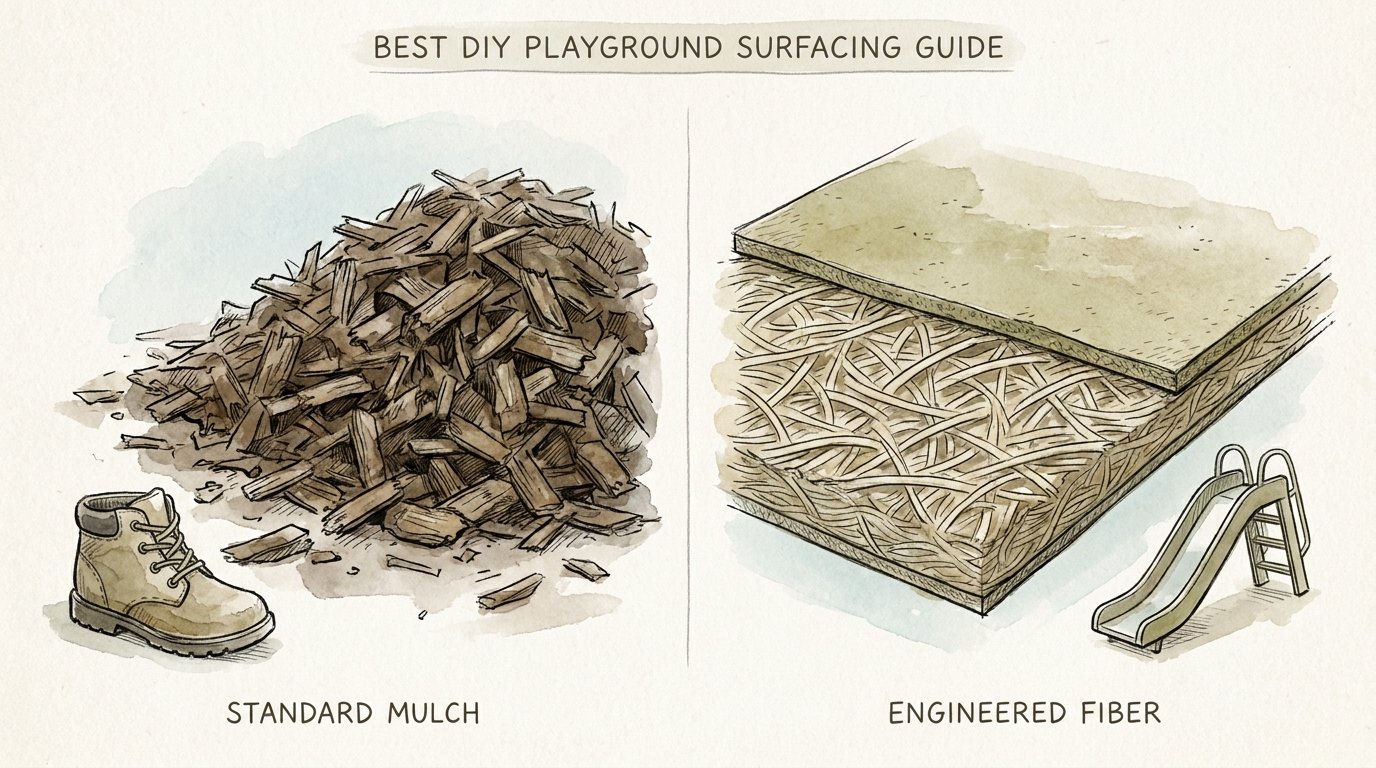
Is your current playground surface actually protecting their falls, or is it just hiding the hard ground? Most DIY parents grab a few bags of garden mulch and call it a day, but that’s a recipe for hard-packed ‘concrete’ dirt within a month. Pro-level playgrounds use Engineered Wood Fiber—a specific knit of fibers that creates an impact-absorbing mat. See why the right ‘carpet’ changes everything for your kids’ safety.
Best Diy Playground Surfacing Guide
Engineered Wood Fiber (EWF) represents the gold standard for budget-friendly, high-performance playground safety. Unlike the decorative mulch you find at a local nursery, EWF is a 100% virgin wood product. It consists of wood fibers that have been processed to a specific size and shape, ensuring they interlock when walked upon. This mechanical “knit” creates a stable yet springy surface that excels at absorbing energy from high falls.
Standard garden mulch contains bark, twigs, and often recycled wood from pallets that might carry old nails or chemical treatments. In contrast, EWF is clean, uniform, and specifically tested to meet ASTM safety standards. It exists to provide a “forgiving” landing zone that prevents life-threatening head injuries. You will find it everywhere from high-end municipal parks to serious backyard DIY builds because it strikes the perfect balance between cost and protection.
Visualize EWF as a thick, organic mattress for your yard. When a child falls, the individual fibers shift slightly to disperse the energy of the impact rather than sending that shock directly into the child’s body. This surfacing is used in real-world situations where safety is non-negotiable but budgets are a factor. It provides a natural, aesthetic look that blends into any landscape while outperforming grass, sand, or pea gravel in almost every safety metric.
How to Install Engineered Wood Fiber Step-by-Step
Successful installation starts long before the first bag of wood fiber arrives. Preparation is the secret to a playground that lasts ten years instead of two. Follow these technical steps to ensure your DIY project meets professional safety benchmarks.
Site Preparation and Excavation
Clear the designated play area of all grass, weeds, rocks, and roots. You must excavate the soil to a depth that accounts for both your drainage layer and the final compacted thickness of the wood fiber. A common standard is 12 inches of compacted EWF, which means you need to dig deep enough to house that material plus your base.
Establishing Proper Drainage
Water is the enemy of wood. If your playground holds water, the EWF will rot, grow fungus, and lose its ability to absorb impact. Grade the sub-soil to a 1% slope so water moves toward a designated exit point. For heavy clay soils, install a French drain or a 3-inch layer of clean gravel to ensure moisture escapes the “bowl” you have created.
Installing the Geotextile Fabric
Lay a high-quality, non-woven geotextile fabric over your prepared soil or gravel base. This fabric serves two critical purposes. First, it prevents the wood fibers from mixing with the dirt below, which would eventually turn your playground into a muddy mess. Second, it allows water to pass through while keeping weeds from pushing up through the surface.
Building the Containment Border
You need a sturdy perimeter to keep the EWF in place. Professional installers often use plastic playground borders or pressure-treated timbers. Ensure your border is high enough to contain the full depth of the material. If you use timbers, avoid those treated with older, toxic chemicals; look for modern, safe alternatives certified for residential use.
Layering and Compaction
Never dump the entire load and walk away. Spread the EWF in 6-inch layers. After each layer, use a rake to level the surface and then saturate it with water. Use a mechanical vibrating plate compactor to press the fibers together. This process “knits” the wood into a stable mat. A 6-inch loose layer typically compacts down to about 4 inches. Repeat this until you reach your target depth.
Benefits of Engineered Wood Fiber
Choosing EWF offers several practical and measurable advantages that make it the top choice for most backyard and community projects. Its primary benefit is high impact attenuation. When installed at the correct depth, it can protect children from falls of up to 12 feet, significantly outperforming traditional wood chips or sand.
Accessibility is another major win. While sand and pea gravel are impossible for wheelchairs or strollers to navigate, compacted EWF meets ADA accessibility standards under ASTM F1951. The interlocking fibers create a firm, stable surface that allows mobility devices to roll across the top rather than sinking into the material.
Cost-effectiveness remains a driving force for EWF. It is significantly cheaper than poured-in-place rubber or rubber tiles. For the price of a small rubberized section, you can often cover an entire large-scale playground with high-quality wood fiber. It also offers a natural aesthetic that fits beautifully into residential yards, unlike the bright, artificial colors of some synthetic options.
Challenges and Common Mistakes
The “Garden Mulch Trap” is the most frequent error DIYers make. Buying cheap landscape mulch saves money today but fails safety tests tomorrow. Landscape mulch decomposes rapidly, lacks the interlocking “knit” required for impact safety, and often contains sharp splinters that can cause injury.
Ignoring drainage is a fatal flaw for any EWF installation. If the material stays saturated, it becomes a breeding ground for mold and bacteria. In cold climates, waterlogged EWF can freeze into a solid, ice-like block. A playground surface that is frozen solid has zero impact absorption, making a fall onto it as dangerous as falling onto concrete.
Failing to account for compaction is another common pitfall. If you want a 9-inch safety depth, you cannot simply buy 9 inches of material. You must purchase enough to account for approximately 25% to 30% compaction. If you don’t compact it manually during installation, the surface will feel “squishy” and unstable for months until rain and foot traffic eventually settle it—often leaving you with a dangerously shallow layer.
Limitations and Constraints
EWF is an organic material, meaning it has a finite lifespan. Over time, the wood fibers break down and turn into soil. This decomposition process typically requires a “top-off” of fresh material every 2 to 5 years, depending on your climate and the amount of foot traffic the playground receives.
Environmental factors like high humidity or frequent rain can accelerate the breakdown of the fibers. In very dry climates, the material may last longer but can become dusty over time. Additionally, while EWF is ADA-compliant when freshly compacted, it requires regular raking and maintenance to keep that status. High-traffic areas like the base of a slide or under a swing set will see the material “kick out,” creating pits that are neither safe nor accessible.
Serious practitioners also recognize the “freezing factor.” While EWF is excellent in most conditions, its safety performance drops significantly when the moisture inside the fibers freezes. If your region experiences deep freezes, you must understand that the safety rating of your playground is compromised during those cold snaps.
Playground Surfacing Comparison
Choosing the right surface depends on your budget, safety needs, and maintenance capacity. Use this table to compare EWF against other common materials.
| Material | Initial Cost | Safety Rating | Maintenance | ADA Accessible |
|---|---|---|---|---|
| Engineered Wood Fiber | Low | High (if deep) | Moderate | Yes (compacted) |
| Rubber Mulch | Moderate | Very High | Low | No |
| Poured-in-Place Rubber | High | Very High | Very Low | Yes (Excellent) |
| Sand / Pea Gravel | Very Low | Low | High | No |
Practical Tips and Best Practices
Keep your playground in peak condition by implementing a few simple maintenance habits. The most effective trick is the “Post Marker” system. Use a permanent marker or a small notch on the support posts of your playground equipment to indicate the “Fill Line.” This allows you to see at a glance if the material has settled or been kicked away.
Focus your raking efforts on high-traffic zones. Areas under swings and at the bottom of slides are “displacement zones” where kids’ feet constantly push material away. Raking these areas weekly ensures that the critical fall zones maintain their required safety depth.
Consider using rubber wear mats in these high-traffic areas. Placing a heavy rubber mat on top of the EWF in the “kick zones” prevents the wood from being displaced. This simple addition can reduce your maintenance time by 80% and ensures that children are never landing on the bare geotextile fabric or sub-soil.
Advanced Considerations for Safety
Serious practitioners must look at the specific ASTM certifications of their material. ASTM F1292 is the standard for impact attenuation, measuring G-max and Head Injury Criterion (HIC) values. A G-max score over 200 or an HIC score over 1000 indicates a high risk of life-threatening head injury. High-quality EWF is tested to stay well below these thresholds at specific fall heights.
Another critical standard is ASTM F2075, which ensures the material is free from hazardous metals and tramp metal (like stray nails). It also mandates a sieve analysis to ensure the particle size is consistent enough to provide the “knit” required for stability. If your supplier cannot provide an IPEMA certification or proof of these ASTM tests, do not use the material for a playground.
Understanding the “Fall Zone” is also essential for safety. The surfacing should extend at least 6 feet in all directions from the equipment. For swings, the surfacing should extend twice the height of the pivot point both in front of and behind the swing set. This ensures that even a child who jumps or falls mid-swing is protected.
Example Scenario: Backyard Playground Build
Imagine a DIY project for a standard 20′ x 20′ backyard playground. The tallest piece of equipment is a swing set with a 7-foot fall height. Based on safety standards, you decide on a 9-inch compacted depth of EWF.
First, you calculate the volume needed. To get 9 inches of compacted material, you need to start with roughly 12 inches of loose-fill EWF. For a 400 square foot area (20×20), 12 inches of depth equals 400 cubic feet, or about 15 cubic yards.
After excavating and installing a 1% grade and geotextile fabric, you bring in the material. You spread the first 6 inches, soak it with a hose, and use a rented plate compactor. You then add the remaining material and repeat the process. By the end, you have a firm, stable surface that looks natural and provides safety for falls far exceeding your 7-foot equipment height. Total estimated cost for materials and rental: $1,200 to $1,800, compared to over $6,000 for a synthetic rubber alternative.
Final Thoughts
Building a safe playground is about more than just the equipment; it is about the “unseen” engineering underfoot. Engineered Wood Fiber offers the most accessible path for a DIY parent or a community manager to create a professional-grade safety zone. By following the rigorous steps of drainage, containment, and compaction, you ensure that your children are protected by a science-backed system rather than just a layer of mulch.
Success in playground surfacing comes down to consistency. Regular raking and periodic top-offs will keep your EWF performing like new for years. This system is not just a “set it and forget it” solution, but a living safety mat that adapts and protects through every season.
Take the time to verify your materials and measure your depths. The effort you put into the foundation today will pay off in years of worry-free play. Whether you are building a simple swing set area or a full-scale backyard park, the right surface is the ultimate insurance policy for your kids’ adventures.
Sources
1 fibar.com | 2 recreationsoutlet.com | 3 hellogravel.com | 4 ecowoodsolutions.com | 5 ecowoodsolutions.com | 6 americanpoleandtimber.com | 7 whitesulphurspringsmontana.com | 8 robertsonsurfaces.com | 9 getmulch.com | 10 tuvsud.com | 11 safetyfirstplayground.com | 12 playgroundprofessionals.com | 13 playgroundsafetyinspections.net | 14 fibar.com