Sustainable Birthday Rituals For Modern Families
When did our celebrations become a cleanup task instead of a lifelong memory? We’ve traded the weight of tradition for the convenience of plastic. A store-bought banner lasts 4 hours; an heirloom birthday ring lasts 4 generations. Watch how a shift from ‘stuff’ to ‘story’ changes the way your children view their special day.
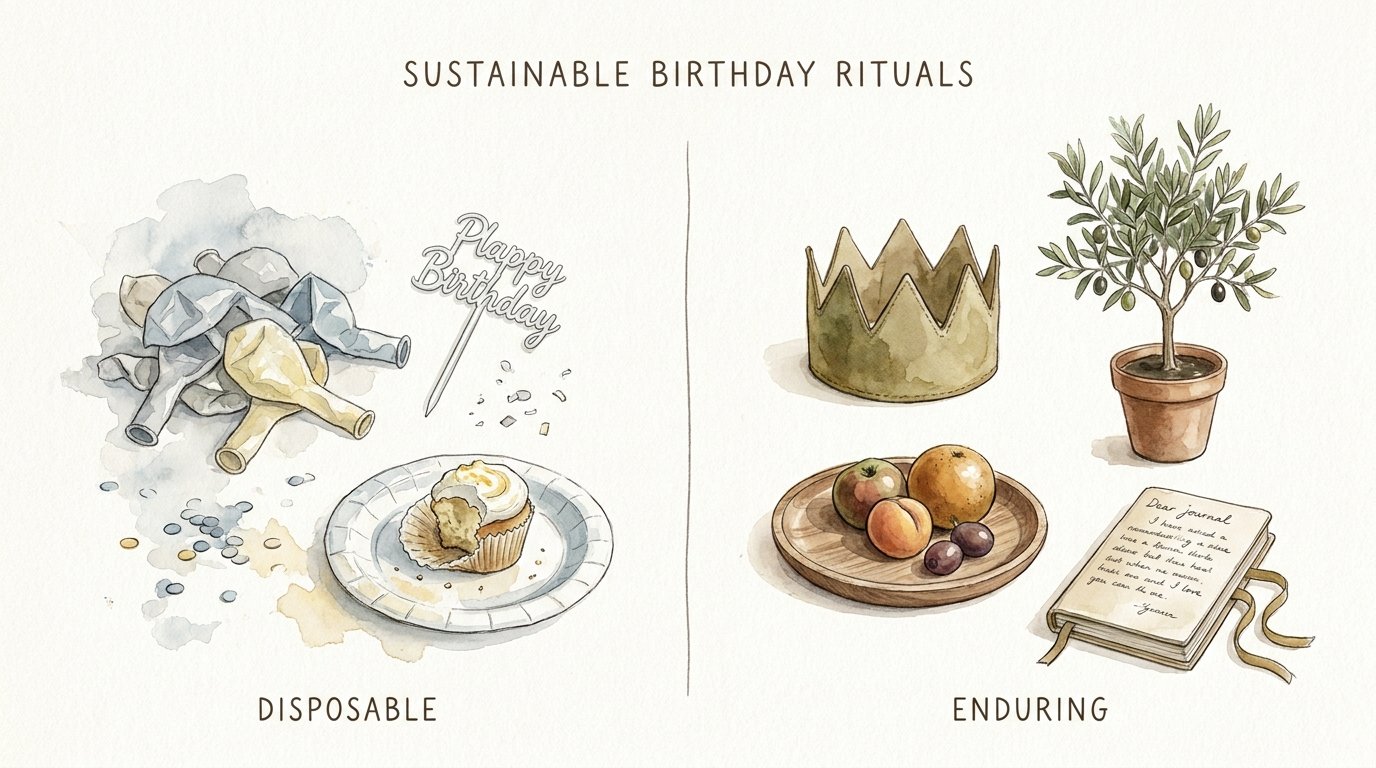
Every parent knows the post-party slump. You are standing in a living room littered with popped balloons, torn wrapping paper, and cheap plastic favors that will be forgotten by Tuesday. It feels hollow because the focus was on the consumption rather than the child.
There is a better way to mark the passing of time. Moving from disposable to enduring traditions creates a sense of “home” that children carry into adulthood. This guide explores how to build those lasting rituals starting today.
Sustainable Birthday Rituals For Modern Families
Sustainable birthday rituals are intentional practices designed to be repeated every year using high-quality, reusable materials. Instead of buying a new “theme” annually, families invest in a core set of heirloom items that come out of storage once a year. This creates a powerful visual and emotional signal that a special day has arrived.
These rituals exist to ground children in the rhythm of the year. In a world that moves at breakneck speed, a birthday ring or a hand-sewn silk banner provides a “temporal anchor.” It tells the child, “This is who we are, and this is how we celebrate you.”
In real-world terms, this looks like a “birthday kit” tucked away in a dedicated box. It might contain a wooden celebration ring, a set of hand-dipped beeswax candles, and a special birthday chair cover. These items aren’t just decorations; they are the stage for a family story that grows deeper every year.
Analogous to a holiday ornament or a family recipe, these rituals focus on the enduring over the disposable. Research shows that consistent family rituals lower stress hormones in children and foster a stronger sense of identity. When the same wooden ring appears on the table every year, it builds a bridge between the child’s past and their future.
The Anatomy of an Heirloom Birthday: How It Works
The transition to a sustainable birthday doesn’t happen overnight. It starts with selecting a few “touchstone” items that replace the usual plastic clutter. The most famous example is the Waldorf Birthday Ring, a German tradition that has gained global popularity for its simplicity and depth.
This wooden ring typically has 12 or 16 holes. On the child’s birthday, you place a candle for every year they have been alive. The remaining holes are filled with small wooden figures or “treasures” from nature like acorns, stones, or flowers. The ritual involves lighting one candle at a time while telling the story of that specific year in the child’s life.
Another process involves the “Birthday Story.” This is a narrative ritual where parents recount the child’s arrival and the major milestones of each year. As you light the candle for age one, you might talk about their first steps. For age two, perhaps you mention their first word or a favorite stuffed animal. This turns the birthday into a reflective journey rather than a sugar-fueled frenzy.
To implement this, follow these steps:
- Select your centerpiece: Choose a high-quality wooden ring or a ceramic “birthday train” that can be used for decades.
- Gather your natural elements: Use what is in season. Spring birthdays might feature daffodils, while autumn birthdays use colorful leaves and chestnuts.
- Establish the narrative: Write down one sentence for each year of the child’s life to read aloud during the candle-lighting.
- Invite participation: Allow the child to help set the “nature table” or choose which wooden figures represent their current interests.
Benefits of the Enduring Approach
The most immediate benefit is the reduction of environmental waste. Traditional parties often generate a staggering amount of trash, from 18,000 pieces of balloon waste found in waterways to the literal tons of unrecyclable gift wrap that hit landfills every January. Switching to reusables eliminates this cycle completely.
Financial savings are equally measurable. While the initial investment in a solid wood birthday ring or a GOTS-certified cotton birthday cape might be $50 to $100, these items replace the $40 annual “party pack” of plastic decor. Over a decade, the heirloom approach is significantly more cost-effective.
Psychologically, these rituals provide a “nervous system reset.” For children who get overwhelmed by loud, chaotic parties, the quiet lighting of candles and the focused storytelling provide a sense of safety. It transforms the birthday from a performance for others into a celebration of the self.
Family identity is the third major advantage. Rituals act as the “glue” for a family unit. When your child is 15 and “too cool” for many things, the familiar smell of the beeswax candles on their birthday morning provides a subtle, undeniable tether to their roots and their family’s love.
Challenges and Common Mistakes
A frequent error is falling into the “Pinterest Trap.” Parents often feel pressured to make the sustainable ritual look perfect, buying expensive eco-friendly disposables that are still, ultimately, waste. Sustainability isn’t about buying “green” versions of trash; it’s about not creating trash in the first place.
Another pitfall is overcomplicating the ritual. If a tradition takes three hours to set up and involves a 40-page script, it won’t last. The best rituals are those that can be executed even if the toddler is cranky or the parents are exhausted. Keep the “birthday kit” organized and accessible so the setup takes ten minutes, not two hours.
Consistency is often a struggle. Families might do a beautiful ritual for the first birthday and then forget it for the second. To avoid this, set a recurring calendar alert two weeks before the birthday to “unearth the birthday box.” Treat it with the same reverence you would a holiday trunk.
Lastly, some parents make the mistake of excluding the child from the planning. While surprises are fun, involving a child in setting the birthday table or polishing the wooden ring builds anticipation and gives them ownership over the tradition.
Limitations: When This Approach May Not Work
Heirloom traditions require physical storage space. If you live in a very small apartment or move frequently, a large collection of wooden decor may feel like a burden. In these cases, focus on “ephemeral rituals” like a special birthday song, a specific meal, or a “birthday hike” that leaves no physical footprint.
Initial costs can be a barrier for some families. Not everyone can drop $80 on a handmade celebration ring. It is important to remember that the “heirloom” isn’t defined by its price tag, but by its longevity. A simple colorful cloth banner you stitched yourself is more of an heirloom than an expensive wooden ring bought but never used.
Cultural expectations can also create friction. If extended family members are used to “big, loud, plastic” parties, they might find a quiet storytelling ritual “boring” or “too crunchy.” It takes confidence to set boundaries around how your family celebrates and to prioritize meaning over spectacle.
Comparison: Disposable vs. Enduring Celebrations
| Feature | Disposable Party | Enduring Ritual |
|---|---|---|
| Annual Cost | $50 – $200 (Recurring) | $0 (After initial investment) |
| Waste Produced | High (Plastic, paper, latex) | Near Zero |
| Preparation Time | High (Shopping, setup) | Low (Retrieve kit, light candles) |
| Emotional Resonance | Variable (Often chaotic) | High (Consistent, reflective) |
| Longevity | Hours | Generations |
Practical Tips for Starting Your Tradition
Start small. You do not need to replace every decoration at once. This year, buy or make one “birthday crown.” Next year, add a set of reusable cloth napkins. The following year, invest in the birthday ring. Building the collection slowly makes it more meaningful and less of a financial shock.
Focus on the senses. The smell of beeswax, the texture of a silk cape, and the sound of a specific “birthday bell” create stronger memories than visual stimuli alone. Children’s brains are wired to associate sensory input with emotional states. A specific scent can instantly transport them to a feeling of being loved and celebrated.
Use digital invitations. Platforms like Evite or simple text-based designs save paper and make managing RSVPs easier. If you want a “physical” feel, send a photo of the child holding a chalkboard with the date. It is personal, sweet, and doesn’t end up in the trash.
Think about “experience gifts.” Instead of plastic toys, encourage guests to contribute to a “nature camp” fund, museum memberships, or a special class the child wants to take. If guests insist on physical gifts, suggest “consumables” like art supplies, seeds for a garden, or books.
Advanced Considerations: Evolving with the Child
As children reach their teenage years, the birthday ring might feel “young.” This is the time to transition the ritual rather than abandon it. Perhaps the storytelling focuses less on “first steps” and more on “challenges overcome” and “character growth.” The candles remain a symbol of the light they bring into the world, even if the wooden figures are swapped for more sophisticated symbols.
Consider the “Passing of the Guard.” When a child turns 18, the birthday kit can be ceremoniously “retired” to their own future household box, or they can choose one specific piece—like their birthday crown—to keep as a memento. This reinforces the idea that the ritual is a legacy they can one day share with their own children.
Scaling for multiple children requires a bit of organization. Some families use one “family ring” and different colored candles or personalized figures for each child. Others give each child their own specific ring. The goal is to ensure each child feels their unique story is being honored without the parents feeling overwhelmed by “stuff.”
Example Scenario: The Three-Year-Old’s Birthday Morning
The sun is just starting to peek through the curtains. Instead of a room full of static-cling balloons, Sarah wakes up to find a “Rainbow Bridge” made of silk scarves draped over her bedroom door. This is a tradition she recognizes; it means the special day has arrived.
Downstairs, the kitchen table has been transformed. The wooden birthday ring is in the center, decorated with fresh pansies from the garden. Three beeswax candles are ready. Beside the ring sits a small glass jar containing a few smooth stones and a feather Sarah found on a walk last week.
The family sits down. No one is rushing to open boxes. Instead, Dad lights the first candle. “When Sarah was zero, she was a tiny seed in our hearts. Then she was born on a rainy Tuesday, and the whole world felt new.” He lights the second. “When Sarah was one, she discovered that blueberries were her favorite food and she learned to chase the cat.”
He lights the third candle. “When Sarah was two, she became a big sister and learned to sing her first song. Now she is three, and we can’t wait to see what this year brings.” Sarah beams. She isn’t looking at a pile of toys; she is looking at her life story, lit by fire and surrounded by family. The entire ritual took 12 minutes, used zero plastic, and cost nothing but the price of three candles.
Final Thoughts
Shifting from a disposable party culture to enduring birthday rituals is an act of rebellion against the “faster, cheaper, more” mindset of modern parenting. It is a choice to prioritize the child’s internal experience over the external display. By investing in a few high-quality items and a consistent narrative, you create a sanctuary of meaning in a busy world.
The beauty of these traditions lies in their simplicity and their ability to grow with your family. They remind us that the most precious things we give our children aren’t found in a toy aisle, but in the stories we tell them about who they are. Every year you light those candles, you are weaving a safety net of belonging that will support them for the rest of their lives.
Start today by choosing one thing. One fabric banner, one wooden candle holder, or one simple story. Watch as the “cleanup task” fades away, replaced by the weight and wonder of a real tradition. Your future self—and your children—will thank you for the memories that actually last.
Sources
1 prasadainhome.com | 2 madlywish.com | 3 todaysparent.com | 4 terrapass.com | 5 instituteofchildpsychology.com | 6 livieandluca.com | 7 playinspiredmum.com | 8 momsbeyond.com | 9 happiestbaby.com | 10 schoolhousebythesea.com | 11 greenlight.com | 12 honestlymodern.com | 13 indulgewithbibi.com | 14 ecotokbusiness.com